
あなたは強力な電子アセンブリを設計しました——おそらく高密度電源、5G基地局モジュール、あるいはAIアクセラレータカードでしょう。性能数値は紙の上では素晴らしく見えます。しかし最初の熱シミュレーションを実行すると、すぐに問題が見えてきます。重要部品のジャンクション温度が危険領域に近づいているのです。冷却ソリューションが必要で、しかも迅速に必要です。ここで アルミニウムヒートシンク加工 が登場します——それはコモディティサービスとしてではなく、製品の信頼性を左右する戦略的なエンジニアリング判断としてです。.
熱管理は、あらゆるエレクトロニクスの成功物語における縁の下の力持ちです。部品は熱を発生し、熱は性能を劣化させ、性能劣化は現場での故障につながります。このサイクルは予測可能であり、容赦がありません。パワーエレクトロニクス、通信、自動車、コンピューティング業界のエンジニアは、この現実に日々直面しています。問題はヒートシンクが必要かどうかではなく、機械的、熱的、予算的な制約の中で実際に機能するものを入手できるかどうかです。.
本ガイドでは、 アルミニウムヒートシンク加工, の現実世界の課題、効果的な冷却と無駄な努力を分ける製造上の判断、そしてその重要性を理解する精密加工パートナーとどのように連携するかを解説します。新製品の試作であれ量産へのスケールアップであれ、ここで紹介する知見は開発期間を数か月短縮し、手直しにかかる数千ドルを節約できる可能性があります。.
本当の問題:既製ヒートシンクがしばしば失敗する理由
エレクトロニクス業界には汚れた秘密があります。多くの熱管理の失敗は、仕様策定段階での思い込みに起因しているのです。エンジニアはカタログを見て、自分の消費電力要件に合いそうなヒートシンクを見つけ、サンプルを発注します。サンプルが届き、取り付けられ、初期テストは有望に見えます。そして生産が本格化し、公差がずれ、ラボで機能した熱性能が現場ではぎりぎりになります。.
何が問題だったのでしょうか?答えはしばしば、標準的な押出しまたはダイカストのヒートシンクが提供できるものと、あなたの特定のアプリケーションが実際に必要とするものとの間のギャップにあります。押出しは大量生産には経済的ですが、フィン密度とアスペクト比を制限する幾何学的制約を課します。ダイカストは複雑な形状を提供しますが、熱界面性能に影響するポロシティと表面仕上げの課題をもたらします。どちらの方法も、あなた独自の気流パターン、取り付け制約、部品レイアウトに合わせて最適化する設計の自由度を提供しません。.
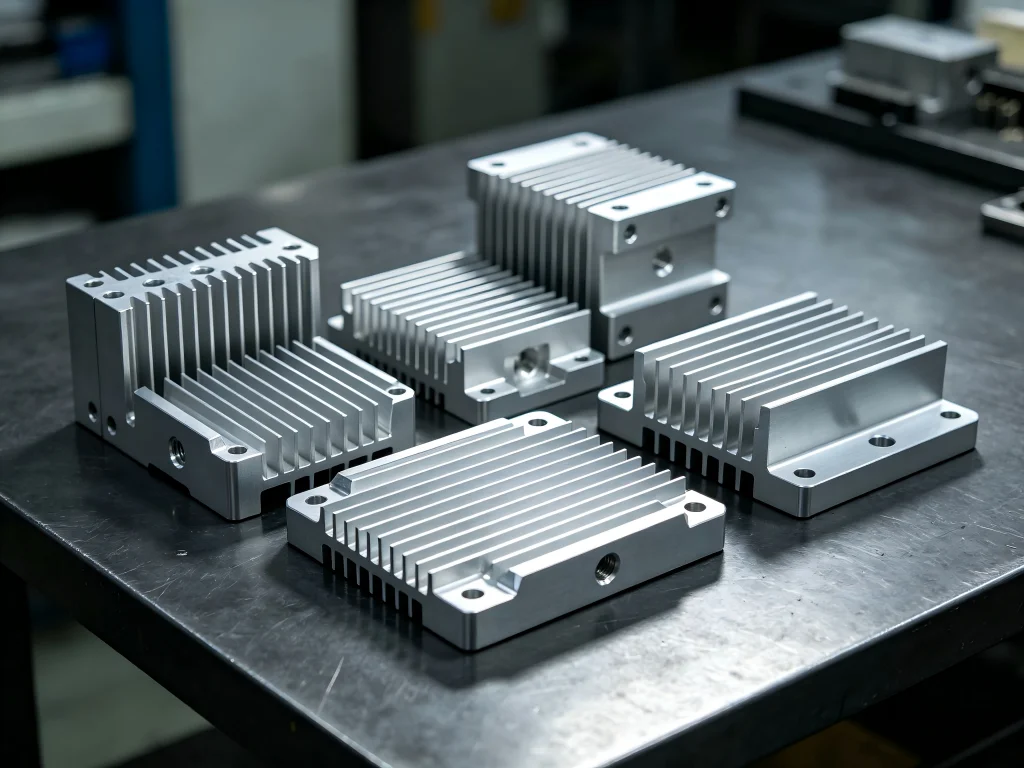
これが、精密 アルミニウムヒートシンク加工 が解決する問題です。アルミニウムのソリッドビレットから始め、不要な部分の材料を除去することで、CNC加工は押出しや鋳造では再現できない形状を実現します。トレードオフは?単価は高くなりますが、熱性能は大幅に向上し、公差は厳しくなり、設計を迅速に反復できます。.
アルミニウムヒートシンク加工を理解する:金属を切削するだけではない
その核心において、, アルミニウムヒートシンク加工 は減法加工プロセスです。アルミニウムの固体ブロック(通常は6061または6063合金)をCNC機械に固定し、回転する切削工具で材料を除去してフィン構造、ベースプレート、取り付け機能を作り出します。プロセス自体は単純に聞こえますが、その実行にはツールパス戦略、クーラント管理、ワークホールディングに関する深い専門知識が求められます。.
CADモデルから完成したヒートシンクに至るまでの過程には、いくつかの重要な段階があります。まず、CAMプログラマーが3D設計をGコード(機械にどこへ、どのくらいの速さで、どの工具で移動するかを指示する言語)に変換します。深く狭いフィンを持つヒートシンクの場合、プログラマーは工具のたわみやびびりを避けるために、工具の選択、切削速度、加工順序を決定しなければなりません。ここで経験が、信頼できるサプライヤーと不良品を生み出すサプライヤーを分けます。.
次にセットアップです。原材料ブロックを固定し、ワークゼロ点を設定し、工具を機械のツールチェンジャーに装填します。この段階での1ミリメートルの何分の一かの誤差が、その後のすべての工程に波及します。実際の切削段階は、粗取りパス、半仕上げ、仕上げ切削が注意深く組み立てられた一連の流れです。クーラントが切削領域に大量に供給され、温度を管理し、切りくずを工具から洗い流します。.
その結果、フィンがまっすぐで平行かつ寸法的に正確なヒートシンクが得られます。これらの特性は、一貫した熱性能に直結します。.
材料選定:アルミニウム対銅と合金の選択
ヒートシンクに選ぶ材料は、熱伝導率から被削性、コストに至るまですべてに影響します。アルミニウムが熱管理の分野で支配的なのは当然の理由があります。熱性能、重量、製造性の優れたバランスを提供するのです。.
アルミニウムの中でも、6061-T6と6063-T5が最も一般的な選択肢です。 アルミニウムヒートシンク加工. 6061はやや高い強度を提供し、加工中により寛容です。一方、6063はより優れた表面仕上げを提供し、二次加工を受ける押出プロファイルに好まれることがよくあります。どちらの合金も167~200 W/m·Kの範囲の熱伝導率を持ち、大多数の電子機器冷却用途に十分です。.
銅は約400 W/m·Kの熱伝導率を持ち、絶対的な熱伝達においてアルミニウムを上回ります。しかし、銅は著しく重く、高価で、加工がより困難です。工具への付着やバリの発生は、生産コストとサイクルタイムを増加させる一般的な問題です。重量が問題にならず、熱性能のあらゆる度合いが重要となる用途(ハイエンドRFアンプやレーザーダイオードパッケージなど)では、銅は割高に見合う価値があるかもしれません。ほとんどの商業・産業用途では、アルミニウムが実用的な選択肢であり続けます。.
以下の表は、ヒートシンク用途におけるアルミニウムと銅の主な違いをまとめたものです。
| 特性 | アルミニウム(6061/6063) | 銅(C101/C110) |
|---|---|---|
| 熱伝導率(W/m·K) | 167–200 | ~400 |
| 密度(g/cm³) | 2.7 | 8.9 |
| 相対コスト | 低 | 高い |
| 被削性 | 優れている | Moderate (tool adhesion, burring) |
| Minimum Fin Thickness | ≥ 0.8 mm | ≥ 1.0 mm |
| Minimum Fin Spacing | ≥ 1.5 mm | ≥ 1.8 mm |
| Maximum Aspect Ratio (H/D) | ≤ 6:1 | ≤ 4:1 |
Data source: RapidDirect DFM Guide
Design for Manufacturability: The Parameters That Matter
The most thermally efficient heat sink design is worthless if it cannot be manufactured reliably and cost-effectively. Design for manufacturability (DFM) is the discipline that bridges the gap between thermal simulation and production reality. For アルミニウムヒートシンク加工, several parameters deserve particular attention.
Fin Thickness and Spacing
Fins increase surface area, and surface area drives convective heat transfer. But fins that are too thin deflect under cutting forces, producing tapered or wavy surfaces that reduce effective contact area. Fins that are too closely spaced trap chips during machining and restrict airflow during operation. The industry consensus recommends a minimum fin thickness of 0.8 mm for aluminum and 1.0 mm for copper, with minimum spacing of 1.5 mm and 1.8 mm respectively.
These are not arbitrary numbers—they reflect the physical limits of cutting tool diameters, chip evacuation, and material behavior under load. Designs that push below these thresholds are possible but require specialized tooling, slower feed rates, and significantly higher costs.
The Aspect Ratio Constraint
The aspect ratio—fin height divided by fin thickness—is perhaps the single most important DFM parameter for アルミニウムヒートシンク加工. A fin that is 10 mm tall and 1 mm thick has an aspect ratio of 10:1. At this ratio, the fin acts like a tuning fork when the cutting tool engages. The tool deflects, the fin vibrates, and the resulting surface finish is rough or tapered.
For aluminum, the practical maximum aspect ratio is approximately 6:1. Exceeding this ratio does not make machining impossible—it makes it expensive, slow, and unpredictable. If your thermal analysis demands fins taller than this constraint allows, consider a hybrid design: start with an extruded or skived fin structure and finish critical surfaces with CNC machining.
Surface Flatness and Thermal Interface
The flatness of the heat sink base is often overlooked in early design phases, yet it directly affects thermal resistance at the component interface. A base that is not flat creates air gaps that act as thermal insulators. In high-power applications, these gaps can increase junction temperatures by 10°C or more—enough to reduce component lifespan by half.
CNC machining delivers base flatness that extrusions and castings cannot match. With proper workholding and toolpath strategy, surface flatness of 0.01 mm or better is achievable. This precision ensures that thermal interface materials—whether thermal paste, pads, or phase-change compounds—perform as specified.
Manufacturing Methods: Skived, Extruded, and Machined Heat Sinks Compared
The thermal management market offers several manufacturing approaches, each with distinct advantages and limitations. Understanding these differences helps you make informed decisions about which method suits your application.
Extruded heat sinks are the most economical option for high-volume production. Molten aluminum is forced through a die, creating a continuous profile that is cut to length. The process is fast and material-efficient, but it imposes geometric constraints: fin thickness, spacing, and aspect ratio are limited by the extrusion die design. Complex features like mounting holes or non-uniform fin patterns require secondary machining.
Skived heat sinks are produced by carving fins directly from a solid block using a specialized cutting tool. The fins remain integrally connected to the base, eliminating the thermal interface resistance that plagues bonded-fin assemblies. Skiving achieves higher fin densities and thinner fins than extrusion, with no expensive tooling costs. However, skiving is directionally sensitive and may not suit all geometries.
CNC-machined heat sinks offer the greatest design freedom. With 3-axis or 5-axis milling, you can create non-constant cross-sections, multi-directional fins, and integrated mounting features. The process supports rapid iteration and low-volume production without tooling investment. The trade-off is higher per-unit cost compared to extrusion—a premium that is justified when performance, precision, or customization outweighs cost sensitivity.
For many applications, a hybrid approach works best: start with an extruded or skived profile to establish the fin geometry, then finish critical surfaces and add mounting features with CNC machining. This strategy balances cost and performance while maintaining design flexibility.
Real-World Applications: Where Aluminum Heatsink Machining Makes the Difference
The demand for precision-machined heat sinks spans multiple industries, each with unique thermal challenges and performance requirements. Understanding these applications helps contextualize the value of アルミニウムヒートシンク加工.
Power Electronics and Industrial Drives
IGBT modules, MOSFETs, and power diodes generate significant heat during operation. In industrial drives and inverters, these components are often mounted on large baseplates that must maintain flatness across wide temperature ranges. CNC machining delivers the flatness and parallelism required for reliable thermal contact. Deep-fin designs, common in this sector, benefit from the precision that machining provides—extruded profiles often require secondary machining to achieve the necessary surface quality.
Telecommunications and 5G Infrastructure
5G base stations and remote radio units operate in outdoor environments where ambient temperatures can exceed 50°C. Thermal management is not optional—it is a survival requirement. CNC-machined heat sinks for telecom applications often feature complex fin patterns optimized for natural convection, with mounting features that accommodate sealed enclosures and weatherproofing.
High-Performance Computing and AI Accelerators
Data center GPUs and AI accelerators push the boundaries of power density. The heat sinks for these components must dissipate hundreds of watts from a compact footprint. CNC machining enables fin geometries that maximize surface area within the available volume, often with integrated heat pipes or vapor chambers for enhanced performance.
Automotive Electronics
Electric vehicle battery management systems, onboard chargers, and motor controllers all require robust thermal management. The automotive environment adds vibration, thermal cycling, and space constraints to the challenge. CNC-machined heat sinks for automotive applications must balance thermal performance with mechanical durability and weight considerations.
UAV and Aerospace
Unmanned aerial vehicles present a unique thermal challenge: high power density in a weight-sensitive platform. Every gram of heat sink mass reduces payload capacity or flight endurance. Precision machining allows engineers to optimize fin density and geometry for the specific airflow patterns encountered in flight, maximizing cooling per unit weight.
Common Challenges in Aluminum Heatsink Machining
Even with careful design and capable equipment, アルミニウムヒートシンク加工 presents challenges that can derail production schedules and inflate costs. Awareness of these issues helps you anticipate problems and work with your supplier to mitigate them.
Tool Deflection and Chatter
Long, slender tools are required to machine deep fin channels. These tools deflect under cutting forces, producing tapered fins or poor surface finish. The solution involves careful selection of tool geometry, conservative feed rates, and strategic toolpath planning that minimizes radial engagement. Some shops use specialized toolholders with vibration-damping features to extend tool life and improve surface quality.
Heat Generation and Chip Evacuation
Machining aluminum generates significant heat at the cutting zone. Without adequate coolant, this heat softens the material and promotes built-up edge on the cutting tool. Chips that are not evacuated from the cutting zone can become welded to the tool or recut, damaging the surface finish. High-pressure flood coolant, directed precisely at the cutting zone, is the standard solution for deep-slot machining of aluminum heat sinks.
Stress Relief and Dimensional Stability
Aluminum extrusions and rolled plates contain internal stresses from the forming process. When material is removed during machining, these stresses redistribute, causing the part to distort. For heat sinks with tight flatness requirements, this distortion can be catastrophic. Experienced machinists use techniques like roughing, stress-relieving, and finishing in sequence to manage dimensional stability.
Burr Formation and Edge Quality
Aluminum is ductile, and cutting tools can produce burrs at the edges of machined features. These burrs interfere with assembly, damage thermal interface materials, and affect cosmetic appearance. Deburring operations add cost and cycle time. The best approach is preventive: sharp tools, appropriate cutting parameters, and toolpaths that minimize burr formation at the design stage.
Selecting a Partner for Aluminum Heatsink Machining
Not all CNC shops are equipped to handle the demands of heatsink machining. The combination of tight tolerances, deep cavities, and challenging material behavior requires specialized knowledge and equipment. When evaluating potential partners, consider the following factors.
Equipment Capability
Machining deep fins requires machines with sufficient spindle speed, rigidity, and tool-changing capacity. Five-axis machining centers offer the flexibility to approach the workpiece from multiple angles, reducing setups and improving accuracy. Look for a shop with a fleet of modern CNC machines and a track record of producing thermal management components.
Programming Expertise
The CAM programmer’s skill directly influences part quality and cycle time. An experienced programmer knows how to optimize toolpaths for deep-slot machining, select appropriate cutting parameters, and anticipate stress-related distortion. Ask potential suppliers about their approach to heatsink programming and request examples of similar work.
Quality Systems and Inspection
Thermal performance depends on dimensional accuracy. A capable supplier maintains rigorous quality systems, including in-process inspection and final verification with coordinate measuring machines (CMMs). ISO 9001 certification is a baseline; IATF 16949 for automotive or AS9100 for aerospace indicates higher standards.
Material Sourcing and Traceability
Aluminum alloys vary in composition and temper, and these variations affect machinability and thermal performance. A reliable supplier sources material from established mills and maintains traceability from raw stock to finished part. This traceability is essential for regulated industries and for troubleshooting quality issues.
Why Jucheng Precision Stands Out in Aluminum Heatsink Machining
Jucheng Precision operates at the intersection of technical capability and customer focus. With an 8,000 sq. ft. facility in the Shenzhen precision manufacturing hub and a fleet of 25 high-precision 5-axis CNC machines, Jucheng brings industrial-scale capacity to projects of any complexity. But scale alone does not tell the full story.
What distinguishes Jucheng is the integration of manufacturing disciplines under one roof. From mold design and flow analysis for die casting to CNC post-machining and surface finishing, Jucheng manages the entire lifecycle of thermal management components. This vertical integration eliminates the coordination headaches and quality risks that arise when multiple suppliers handle different stages of production.
Jucheng’s engineering team brings deep expertise in アルミニウムヒートシンク加工, with particular strength in micro-milling, skiving, and 5-axis machining. The company’s quality systems include 100% inspection of critical dimensions with advanced CMMs, ensuring that every part meets specification. For customers in aerospace, automotive, and medical device sectors, Jucheng maintains the certifications and documentation required for regulatory compliance.
Perhaps most importantly, Jucheng approaches each project as a partnership. The engineering team provides design-for-manufacturability feedback early in the development cycle, identifying potential issues before they become costly problems. This proactive approach reduces development time, minimizes scrap, and ensures that the final product performs as intended.
Jucheng’s capabilities extend beyond pure CNC machining to include aluminum die casting with cold chamber machines from 200 to 2,500 tons. For high-volume production of heat sinks, this casting capability provides a cost-effective alternative to machining from solid billet, with CNC post-machining applied only where precision is required.
Frequently Asked Questions About Aluminum Heatsink Machining
What is the best aluminum alloy for CNC-machined heat sinks?
6061-T6 and 6063-T5 are the most widely used alloys for アルミニウムヒートシンク加工. 6061 offers good strength and machinability, while 6063 provides superior surface finish and is often preferred for extruded profiles that receive secondary machining. Both alloys deliver thermal conductivity in the 167-200 W/m·K range, suitable for most electronics cooling applications.
How thin can CNC-machined aluminum fins be?
The practical minimum fin thickness for CNC-machined aluminum is approximately 0.8 mm. Below this thickness, tool deflection and vibration become significant, leading to poor surface finish, tapered fins, or breakage. Achieving thinner fins is possible with specialized tooling and slower feed rates, but the cost increases substantially.
What is the maximum aspect ratio for CNC-machined aluminum fins?
The industry standard maximum aspect ratio—fin height divided by fin thickness—is 6:1 for aluminum. Exceeding this ratio requires longer, more flexible tools that are prone to deflection and chatter. If your thermal analysis demands higher aspect ratios, consider a hybrid design that combines extrusion or skiving with CNC finishing.
How does CNC machining compare to extrusion for heat sink production?
Extrusion is more economical for high volumes and simple geometries, but it imposes constraints on fin thickness, spacing, and aspect ratio. CNC machining offers greater design freedom, tighter tolerances, and the ability to produce complex geometries that cannot be extruded. The choice depends on your performance requirements, production volume, and budget.
What surface finishes are available for CNC-machined aluminum heat sinks?
Common surface finishes include anodizing (clear, black, or colored), which improves corrosion resistance and thermal radiation. Other options include powder coating, chromate conversion, and shot blasting. The choice depends on the operating environment, cosmetic requirements, and thermal performance needs.
How does flatness affect heat sink thermal performance?
Flatness directly impacts thermal contact resistance at the component interface. A non-flat base creates air gaps that act as thermal insulators, increasing junction temperature and reducing component lifespan. CNC machining achieves base flatness of 0.01 mm or better, ensuring optimal thermal interface performance.
Can CNC-machined heat sinks include integrated mounting features?
Yes. CNC machining allows for the integration of counterbores, tapped holes, recessed pockets for thermal interface materials, and alignment pins—all within a single setup. This integration reduces secondary operations, improves reliability, and lowers assembly costs.
What is the typical lead time for custom CNC-machined aluminum heat sinks?
Lead times vary based on complexity, quantity, and current shop loading. For prototypes, lead times of 1-2 weeks are common. For production quantities, allow 3-4 weeks for tooling, setup, and machining. Jucheng Precision offers expedited services for urgent projects.
Making the Right Decision for Your Thermal Management Needs
The path to effective thermal management begins with understanding your requirements and constraints. Start by defining the thermal load, operating environment, and physical envelope. Then evaluate whether standard extruded or die-cast heat sinks can meet your needs, or whether the performance advantages of アルミニウムヒートシンク加工 justify the additional cost.
For applications demanding high performance, tight tolerances, or complex geometries, CNC machining is not just an option—it is the only viable path forward. The key is to partner with a supplier that understands the nuances of heatsink machining and can provide design guidance that balances thermal performance with manufacturability.
Jucheng Precision brings the technical depth, manufacturing capacity, and quality systems to support projects from prototyping through production. With expertise in 5-axis machining, skiving, and die casting, Jucheng offers a comprehensive solution for thermal management components. The company’s commitment to design-for-manufacturability feedback and rigorous quality control ensures that your heat sinks perform as specified, on time and within budget.
Your thermal management challenge has a solution. The question is whether you are ready to pursue it with the precision and expertise that the application demands.