
Ha diseñado un conjunto electrónico potente—quizás una fuente de alimentación de alta densidad, un módulo de estación base 5G o una tarjeta aceleradora de IA. Los números de rendimiento se ven excelentes sobre el papel. Pero cuando ejecuta la primera simulación térmica, ve el problema de inmediato: la temperatura de unión de sus componentes críticos coquetea con la zona de peligro. Necesita una solución de enfriamiento, y la necesita rápido. Aquí es donde el mecanizado de disipadores de calor de aluminio entra en escena—no como un servicio básico, sino como una decisión de ingeniería estratégica que puede hacer o deshacer la fiabilidad de su producto.
La gestión térmica es el socio silencioso en toda historia de éxito electrónico. Los componentes generan calor; el calor degrada el rendimiento; la degradación del rendimiento conduce a fallos en campo. El ciclo es predecible e implacable. Los ingenieros de las industrias de electrónica de potencia, telecomunicaciones, automoción y computación enfrentan esta realidad a diario. La pregunta no es si necesita un disipador de calor—es si puede obtener uno que realmente funcione dentro de sus restricciones mecánicas, térmicas y presupuestarias.
Esta guía recorre los desafíos del mundo real de el mecanizado de disipadores de calor de aluminio, las decisiones de fabricación que separan un enfriamiento efectivo de un esfuerzo desperdiciado, y cómo asociarse con un proveedor de mecanizado de precisión que entienda lo que está en juego. Ya sea que esté prototipando un nuevo producto o escalando a producción, los conocimientos aquí podrían ahorrarle meses de tiempo de desarrollo y miles de dólares en retrabajo.
El problema real: Por qué los disipadores de calor estándar a menudo fallan
La industria electrónica tiene un secreto sucio: muchas fallas de gestión térmica se remontan a suposiciones hechas durante la fase de especificación. Los ingenieros miran un catálogo, encuentran un disipador de calor que parece coincidir con sus requisitos de disipación de potencia, y piden muestras. Las muestras llegan, se colocan, y las pruebas iniciales parecen prometedoras. Luego la producción se acelera, las tolerancias cambian, y el rendimiento térmico que funcionaba en el laboratorio se vuelve marginal en el campo.
¿Qué salió mal? La respuesta a menudo radica en la brecha entre lo que un disipador de calor extruido o fundido a presión estándar puede ofrecer y lo que su aplicación específica realmente requiere. Las extrusiones son económicas para grandes volúmenes, pero imponen restricciones geométricas que limitan la densidad de aletas y la relación de aspecto. La fundición a presión ofrece formas complejas pero introduce porosidad y desafíos de acabado superficial que afectan el rendimiento de la interfaz térmica. Ninguno de los dos métodos proporciona la libertad de diseño para optimizar sus patrones de flujo de aire únicos, restricciones de montaje o disposición de componentes.
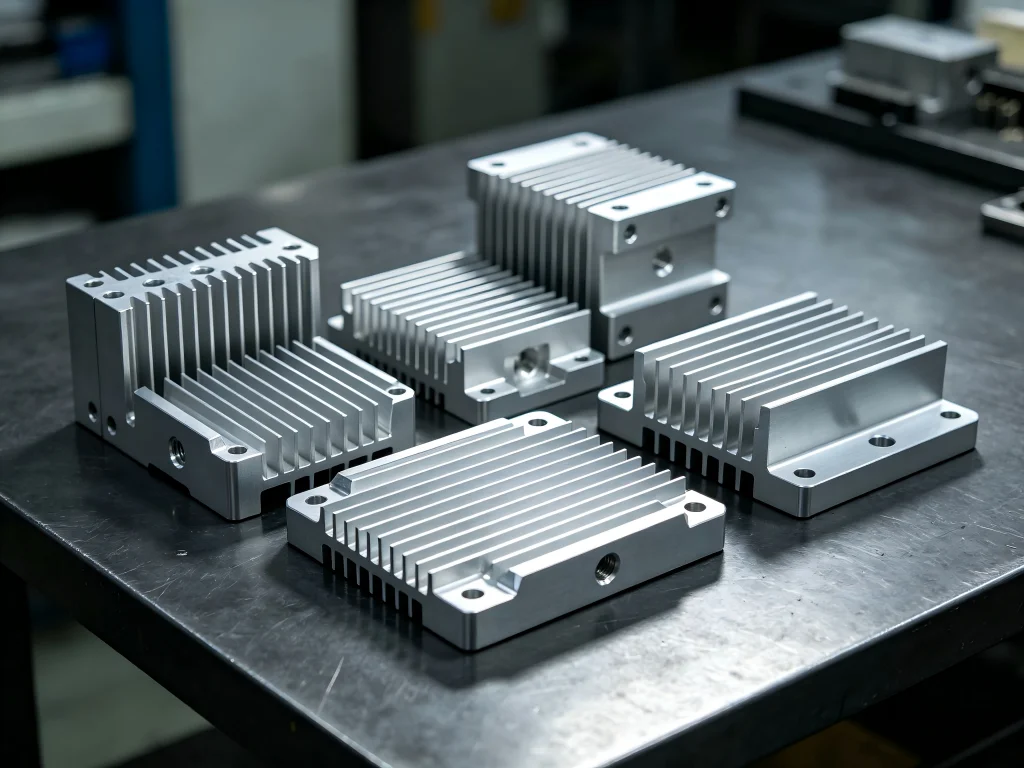
Este es el problema que la precisión el mecanizado de disipadores de calor de aluminio resuelve. Al comenzar con un bloque sólido de aluminio y eliminar material donde no se necesita, el mecanizado CNC ofrece geometrías que las extrusiones y fundiciones no pueden replicar. ¿La contrapartida? Mayor costo por unidad, pero un rendimiento térmico significativamente mejor, tolerancias más ajustadas y la capacidad de iterar diseños rápidamente.
Entendiendo el mecanizado de disipadores de calor de aluminio: Más que solo cortar metal
En esencia, el mecanizado de disipadores de calor de aluminio es un proceso de fabricación sustractivo. Un bloque sólido de aluminio—típicamente aleación 6061 o 6063—se asegura en una máquina CNC, y las herramientas de corte giratorias eliminan material para crear la estructura de aletas, la placa base y las características de montaje. El proceso suena sencillo, pero la ejecución requiere una profunda experiencia en estrategia de trayectorias de herramienta, gestión de refrigerante y sujeción de piezas.
El viaje desde el modelo CAD hasta el disipador de calor terminado involucra varias etapas críticas. Primero, un programador de CAM traduce su diseño 3D a código G—el lenguaje que le dice a la máquina dónde moverse, qué tan rápido y con qué herramienta. Para un disipador de calor con aletas profundas y estrechas, el programador debe decidir sobre la selección de herramientas, velocidades de corte y secuencia de mecanizado para evitar la deflexión de la herramienta y el chatter. Aquí es donde la experiencia separa a un proveedor confiable de uno que produce chatarra.
Next comes the setup: securing the raw block, establishing the work zero, and loading tools into the machine’s changer. A mistake of a fraction of a millimeter at this stage propagates through every subsequent operation. The actual cutting phase is a carefully orchestrated sequence of roughing passes, semi-finishing, and finishing cuts. Coolant floods the cutting zone to manage temperature and flush chips away from the tool.
The result is a heat sink with fins that are straight, parallel, and dimensionally accurate—features that directly translate to consistent thermal performance.
Material Selection: Aluminum vs. Copper and Alloy Choices
The material you choose for your heat sink influences everything from thermal conductivity to machinability to cost. Aluminum dominates the thermal management landscape for good reason: it offers an excellent balance of thermal performance, weight, and manufacturability.
Within the aluminum family, 6061-T6 and 6063-T5 are the most common choices for el mecanizado de disipadores de calor de aluminio. 6061 provides slightly higher strength and is more forgiving during machining, while 6063 offers better surface finish and is often preferred for extruded profiles that receive secondary machining. Both alloys deliver thermal conductivity in the range of 167-200 W/m·K—sufficient for the vast majority of electronics cooling applications.
Copper, with its thermal conductivity of approximately 400 W/m·K, outperforms aluminum in absolute heat transfer. However, copper is significantly heavier, more expensive, and more challenging to machine. Tool adhesion and burr formation are common issues that increase production costs and cycle times. For applications where weight is not a concern and every degree of thermal performance matters—such as high-end RF amplifiers or laser diode packages—copper may be worth the premium. For most commercial and industrial applications, aluminum remains the practical choice.
The table below summarizes the key differences between aluminum and copper for heatsink applications:
| Propiedad | Aluminum (6061/6063) | Copper (C101/C110) |
|---|---|---|
| Thermal Conductivity (W/m·K) | 167–200 | ~400 |
| Density (g/cm³) | 2.7 | 8.9 |
| Costo relativo | Bajo | Alta |
| Maquinabilidad | Excelente | Moderate (tool adhesion, burring) |
| Minimum Fin Thickness | ≥ 0.8 mm | ≥ 1.0 mm |
| Minimum Fin Spacing | ≥ 1.5 mm | ≥ 1.8 mm |
| Maximum Aspect Ratio (H/D) | ≤ 6:1 | ≤ 4:1 |
Data source: RapidDirect DFM Guide
Design for Manufacturability: The Parameters That Matter
The most thermally efficient heat sink design is worthless if it cannot be manufactured reliably and cost-effectively. Design for manufacturability (DFM) is the discipline that bridges the gap between thermal simulation and production reality. For el mecanizado de disipadores de calor de aluminio, several parameters deserve particular attention.
Fin Thickness and Spacing
Fins increase surface area, and surface area drives convective heat transfer. But fins that are too thin deflect under cutting forces, producing tapered or wavy surfaces that reduce effective contact area. Fins that are too closely spaced trap chips during machining and restrict airflow during operation. The industry consensus recommends a minimum fin thickness of 0.8 mm for aluminum and 1.0 mm for copper, with minimum spacing of 1.5 mm and 1.8 mm respectively.
These are not arbitrary numbers—they reflect the physical limits of cutting tool diameters, chip evacuation, and material behavior under load. Designs that push below these thresholds are possible but require specialized tooling, slower feed rates, and significantly higher costs.
The Aspect Ratio Constraint
The aspect ratio—fin height divided by fin thickness—is perhaps the single most important DFM parameter for el mecanizado de disipadores de calor de aluminio. A fin that is 10 mm tall and 1 mm thick has an aspect ratio of 10:1. At this ratio, the fin acts like a tuning fork when the cutting tool engages. The tool deflects, the fin vibrates, and the resulting surface finish is rough or tapered.
For aluminum, the practical maximum aspect ratio is approximately 6:1. Exceeding this ratio does not make machining impossible—it makes it expensive, slow, and unpredictable. If your thermal analysis demands fins taller than this constraint allows, consider a hybrid design: start with an extruded or skived fin structure and finish critical surfaces with CNC machining.
Surface Flatness and Thermal Interface
The flatness of the heat sink base is often overlooked in early design phases, yet it directly affects thermal resistance at the component interface. A base that is not flat creates air gaps that act as thermal insulators. In high-power applications, these gaps can increase junction temperatures by 10°C or more—enough to reduce component lifespan by half.
CNC machining delivers base flatness that extrusions and castings cannot match. With proper workholding and toolpath strategy, surface flatness of 0.01 mm or better is achievable. This precision ensures that thermal interface materials—whether thermal paste, pads, or phase-change compounds—perform as specified.
Manufacturing Methods: Skived, Extruded, and Machined Heat Sinks Compared
The thermal management market offers several manufacturing approaches, each with distinct advantages and limitations. Understanding these differences helps you make informed decisions about which method suits your application.
Extruded heat sinks are the most economical option for high-volume production. Molten aluminum is forced through a die, creating a continuous profile that is cut to length. The process is fast and material-efficient, but it imposes geometric constraints: fin thickness, spacing, and aspect ratio are limited by the extrusion die design. Complex features like mounting holes or non-uniform fin patterns require secondary machining.
Skived heat sinks are produced by carving fins directly from a solid block using a specialized cutting tool. The fins remain integrally connected to the base, eliminating the thermal interface resistance that plagues bonded-fin assemblies. Skiving achieves higher fin densities and thinner fins than extrusion, with no expensive tooling costs. However, skiving is directionally sensitive and may not suit all geometries.
CNC-machined heat sinks offer the greatest design freedom. With 3-axis or 5-axis milling, you can create non-constant cross-sections, multi-directional fins, and integrated mounting features. The process supports rapid iteration and low-volume production without tooling investment. The trade-off is higher per-unit cost compared to extrusion—a premium that is justified when performance, precision, or customization outweighs cost sensitivity.
For many applications, a hybrid approach works best: start with an extruded or skived profile to establish the fin geometry, then finish critical surfaces and add mounting features with CNC machining. This strategy balances cost and performance while maintaining design flexibility.
Real-World Applications: Where Aluminum Heatsink Machining Makes the Difference
The demand for precision-machined heat sinks spans multiple industries, each with unique thermal challenges and performance requirements. Understanding these applications helps contextualize the value of el mecanizado de disipadores de calor de aluminio.
Power Electronics and Industrial Drives
IGBT modules, MOSFETs, and power diodes generate significant heat during operation. In industrial drives and inverters, these components are often mounted on large baseplates that must maintain flatness across wide temperature ranges. CNC machining delivers the flatness and parallelism required for reliable thermal contact. Deep-fin designs, common in this sector, benefit from the precision that machining provides—extruded profiles often require secondary machining to achieve the necessary surface quality.
Telecommunications and 5G Infrastructure
5G base stations and remote radio units operate in outdoor environments where ambient temperatures can exceed 50°C. Thermal management is not optional—it is a survival requirement. CNC-machined heat sinks for telecom applications often feature complex fin patterns optimized for natural convection, with mounting features that accommodate sealed enclosures and weatherproofing.
High-Performance Computing and AI Accelerators
Data center GPUs and AI accelerators push the boundaries of power density. The heat sinks for these components must dissipate hundreds of watts from a compact footprint. CNC machining enables fin geometries that maximize surface area within the available volume, often with integrated heat pipes or vapor chambers for enhanced performance.
Electrónica automotriz
Electric vehicle battery management systems, onboard chargers, and motor controllers all require robust thermal management. The automotive environment adds vibration, thermal cycling, and space constraints to the challenge. CNC-machined heat sinks for automotive applications must balance thermal performance with mechanical durability and weight considerations.
UAV and Aerospace
Unmanned aerial vehicles present a unique thermal challenge: high power density in a weight-sensitive platform. Every gram of heat sink mass reduces payload capacity or flight endurance. Precision machining allows engineers to optimize fin density and geometry for the specific airflow patterns encountered in flight, maximizing cooling per unit weight.
Common Challenges in Aluminum Heatsink Machining
Even with careful design and capable equipment, el mecanizado de disipadores de calor de aluminio presents challenges that can derail production schedules and inflate costs. Awareness of these issues helps you anticipate problems and work with your supplier to mitigate them.
Tool Deflection and Chatter
Long, slender tools are required to machine deep fin channels. These tools deflect under cutting forces, producing tapered fins or poor surface finish. The solution involves careful selection of tool geometry, conservative feed rates, and strategic toolpath planning that minimizes radial engagement. Some shops use specialized toolholders with vibration-damping features to extend tool life and improve surface quality.
Heat Generation and Chip Evacuation
Machining aluminum generates significant heat at the cutting zone. Without adequate coolant, this heat softens the material and promotes built-up edge on the cutting tool. Chips that are not evacuated from the cutting zone can become welded to the tool or recut, damaging the surface finish. High-pressure flood coolant, directed precisely at the cutting zone, is the standard solution for deep-slot machining of aluminum heat sinks.
Stress Relief and Dimensional Stability
Aluminum extrusions and rolled plates contain internal stresses from the forming process. When material is removed during machining, these stresses redistribute, causing the part to distort. For heat sinks with tight flatness requirements, this distortion can be catastrophic. Experienced machinists use techniques like roughing, stress-relieving, and finishing in sequence to manage dimensional stability.
Burr Formation and Edge Quality
Aluminum is ductile, and cutting tools can produce burrs at the edges of machined features. These burrs interfere with assembly, damage thermal interface materials, and affect cosmetic appearance. Deburring operations add cost and cycle time. The best approach is preventive: sharp tools, appropriate cutting parameters, and toolpaths that minimize burr formation at the design stage.
Selecting a Partner for Aluminum Heatsink Machining
Not all CNC shops are equipped to handle the demands of heatsink machining. The combination of tight tolerances, deep cavities, and challenging material behavior requires specialized knowledge and equipment. When evaluating potential partners, consider the following factors.
Capacidad del Equipo
Machining deep fins requires machines with sufficient spindle speed, rigidity, and tool-changing capacity. Five-axis machining centers offer the flexibility to approach the workpiece from multiple angles, reducing setups and improving accuracy. Look for a shop with a fleet of modern CNC machines and a track record of producing thermal management components.
Programming Expertise
The CAM programmer’s skill directly influences part quality and cycle time. An experienced programmer knows how to optimize toolpaths for deep-slot machining, select appropriate cutting parameters, and anticipate stress-related distortion. Ask potential suppliers about their approach to heatsink programming and request examples of similar work.
Quality Systems and Inspection
Thermal performance depends on dimensional accuracy. A capable supplier maintains rigorous quality systems, including in-process inspection and final verification with coordinate measuring machines (CMMs). ISO 9001 certification is a baseline; IATF 16949 for automotive or AS9100 for aerospace indicates higher standards.
Material Sourcing and Traceability
Aluminum alloys vary in composition and temper, and these variations affect machinability and thermal performance. A reliable supplier sources material from established mills and maintains traceability from raw stock to finished part. This traceability is essential for regulated industries and for troubleshooting quality issues.
Why Jucheng Precision Stands Out in Aluminum Heatsink Machining
Jucheng Precision operates at the intersection of technical capability and customer focus. With an 8,000 sq. ft. facility in the Shenzhen precision manufacturing hub and a fleet of 25 high-precision 5-axis CNC machines, Jucheng brings industrial-scale capacity to projects of any complexity. But scale alone does not tell the full story.
What distinguishes Jucheng is the integration of manufacturing disciplines under one roof. From mold design and flow analysis for die casting to CNC post-machining and surface finishing, Jucheng manages the entire lifecycle of thermal management components. This vertical integration eliminates the coordination headaches and quality risks that arise when multiple suppliers handle different stages of production.
Jucheng’s engineering team brings deep expertise in el mecanizado de disipadores de calor de aluminio, with particular strength in micro-milling, skiving, and 5-axis machining. The company’s quality systems include 100% inspection of critical dimensions with advanced CMMs, ensuring that every part meets specification. For customers in aerospace, automotive, and medical device sectors, Jucheng maintains the certifications and documentation required for regulatory compliance.
Perhaps most importantly, Jucheng approaches each project as a partnership. The engineering team provides design-for-manufacturability feedback early in the development cycle, identifying potential issues before they become costly problems. This proactive approach reduces development time, minimizes scrap, and ensures that the final product performs as intended.
Jucheng’s capabilities extend beyond pure CNC machining to include aluminum die casting with cold chamber machines from 200 to 2,500 tons. For high-volume production of heat sinks, this casting capability provides a cost-effective alternative to machining from solid billet, with CNC post-machining applied only where precision is required.
Frequently Asked Questions About Aluminum Heatsink Machining
What is the best aluminum alloy for CNC-machined heat sinks?
6061-T6 and 6063-T5 are the most widely used alloys for el mecanizado de disipadores de calor de aluminio. 6061 offers good strength and machinability, while 6063 provides superior surface finish and is often preferred for extruded profiles that receive secondary machining. Both alloys deliver thermal conductivity in the 167-200 W/m·K range, suitable for most electronics cooling applications.
How thin can CNC-machined aluminum fins be?
The practical minimum fin thickness for CNC-machined aluminum is approximately 0.8 mm. Below this thickness, tool deflection and vibration become significant, leading to poor surface finish, tapered fins, or breakage. Achieving thinner fins is possible with specialized tooling and slower feed rates, but the cost increases substantially.
What is the maximum aspect ratio for CNC-machined aluminum fins?
The industry standard maximum aspect ratio—fin height divided by fin thickness—is 6:1 for aluminum. Exceeding this ratio requires longer, more flexible tools that are prone to deflection and chatter. If your thermal analysis demands higher aspect ratios, consider a hybrid design that combines extrusion or skiving with CNC finishing.
How does CNC machining compare to extrusion for heat sink production?
Extrusion is more economical for high volumes and simple geometries, but it imposes constraints on fin thickness, spacing, and aspect ratio. CNC machining offers greater design freedom, tighter tolerances, and the ability to produce complex geometries that cannot be extruded. The choice depends on your performance requirements, production volume, and budget.
What surface finishes are available for CNC-machined aluminum heat sinks?
Common surface finishes include anodizing (clear, black, or colored), which improves corrosion resistance and thermal radiation. Other options include powder coating, chromate conversion, and shot blasting. The choice depends on the operating environment, cosmetic requirements, and thermal performance needs.
How does flatness affect heat sink thermal performance?
Flatness directly impacts thermal contact resistance at the component interface. A non-flat base creates air gaps that act as thermal insulators, increasing junction temperature and reducing component lifespan. CNC machining achieves base flatness of 0.01 mm or better, ensuring optimal thermal interface performance.
Can CNC-machined heat sinks include integrated mounting features?
Yes. CNC machining allows for the integration of counterbores, tapped holes, recessed pockets for thermal interface materials, and alignment pins—all within a single setup. This integration reduces secondary operations, improves reliability, and lowers assembly costs.
What is the typical lead time for custom CNC-machined aluminum heat sinks?
Lead times vary based on complexity, quantity, and current shop loading. For prototypes, lead times of 1-2 weeks are common. For production quantities, allow 3-4 weeks for tooling, setup, and machining. Jucheng Precision offers expedited services for urgent projects.
Making the Right Decision for Your Thermal Management Needs
The path to effective thermal management begins with understanding your requirements and constraints. Start by defining the thermal load, operating environment, and physical envelope. Then evaluate whether standard extruded or die-cast heat sinks can meet your needs, or whether the performance advantages of el mecanizado de disipadores de calor de aluminio justify the additional cost.
For applications demanding high performance, tight tolerances, or complex geometries, CNC machining is not just an option—it is the only viable path forward. The key is to partner with a supplier that understands the nuances of heatsink machining and can provide design guidance that balances thermal performance with manufacturability.
Jucheng Precision brings the technical depth, manufacturing capacity, and quality systems to support projects from prototyping through production. With expertise in 5-axis machining, skiving, and die casting, Jucheng offers a comprehensive solution for thermal management components. The company’s commitment to design-for-manufacturability feedback and rigorous quality control ensures that your heat sinks perform as specified, on time and within budget.
Your thermal management challenge has a solution. The question is whether you are ready to pursue it with the precision and expertise that the application demands.