
透明プラスチック部品の製造パートナーを選定することは、しばしば大きな賭けのように感じられます。完璧なCADモデルがあっても、最初のバッチの PMMA CNC加工 試作品がマイクロクラック、曇った表面、寸法のずれを伴って届くことがあります。r/AskEngineersのあるRedditスレッドは、この frustration を見事に捉えていました。「私のアクリル部品は画面上では素晴らしく見えましたが、加工された部品には組み立てるまで見えなかった応力亀裂がありました。」FacebookのCNC Machining Groupの別のユーザーは、「各社が光学グレードのPMMAを扱えると主張したため、3回もベンダーを変更しましたが、実際に納品できたのは1社だけでした。」と述べています。これらは孤立した不満ではなく、ポリメタクリル酸メチル(PMMA)の加工に関する根本的な真実を反映しています。この材料は寛容ではありません。脆く、熱に敏感で、多くの工場が持ち合わせていないレベルのプロセス制御を要求します。.
このガイドはCNC加工の一般的な概要ではありません。 PMMA CNC加工 プロバイダー間、あるいはPMMAとポリカーボネートなどの代替透明プラスチックの間で選択する必要がある調達エンジニア、製品設計者、経営者のための意思決定フレームワークです。重要なトレードオフ、不適切な加工による隠れたコスト、信頼できるパートナーと高くつく実験を分ける具体的な能力を検証します。最終的には、CNCサービスを評価するための明確で実行可能な方法論を手に入れ、次のプロジェクトが光学的な輝きと構造的な完全性の両方を達成できるようにします。.
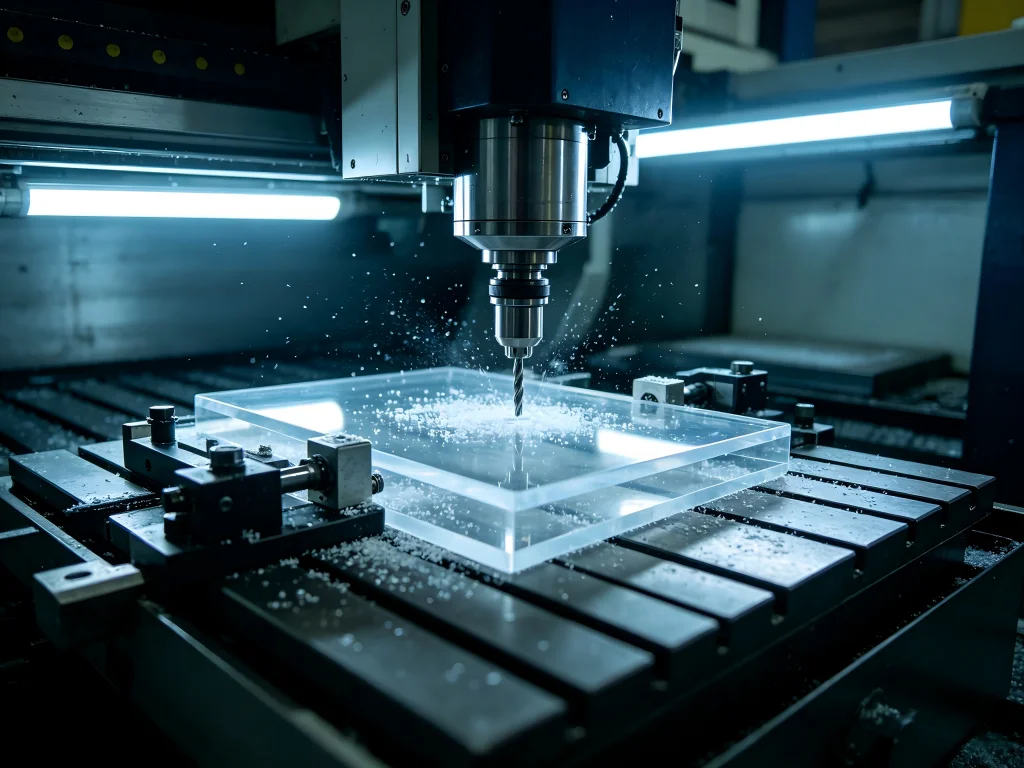
透明プラスチックの全体像:PMMAの位置づけ
ベンダー選定に踏み込む前に、PMMAがエンジニアリングプラスチックの広いファミリーの中でどこに位置するかを理解することが不可欠です。一般にアクリル、またはPlexiglass®やLucite®などの商標名で知られるPMMAは、ガラスの軽量で耐衝撃性のある代替品として機能する透明熱可塑性プラスチックです。その決定的な特徴は光学純度です。PMMAは可視光を最大92%透過し、これは標準的なガラスよりも高く、他の一般的な透明プラスチックよりも高い値です。このため、透明度が最重要となる用途—レンズ、ライトガイド、ディスプレイスクリーン、医療機器—において、疑いようのないチャンピオンとなっています。.
しかし、この光学上の卓越性にはトレードオフが伴います。PMMAは剛性が高く耐傷性がありますが、脆く、ノッチに敏感です。小さな亀裂は応力下で急速に進展する可能性があり、この材料は加工中の熱損傷に対して脆弱です。ここで加工パートナーの選択が重要になります。PMMAをアルミニウムや、ABSなどの他のプラスチックと同様に扱う工場は、内部応力、目に見える工具痕、または壊滅的な亀裂を伴う部品をほぼ確実に生産します。.
PMMA対ポリカーボネート:核心的なトレードオフ
多くの購入者にとって、決定は単に「どのPMMA工場か?」ではなく、「PMMAかポリカーボネート(PC)か?」です。どちらもCNC加工に適した透明で軽量なプラスチックですが、その性能プロファイルは根本的に異なります。この違いを理解することが、情報に基づいた調達決定を行う第一歩です。.
ポリカーボネートはその耐衝撃性で有名です。それはおよそ ガラスの250倍の強度 があり、粉々にならずに突然のエネルギーを吸収できます。このため、防弾窓、安全シールド、頑丈な筐体に選ばれる材料となっています。しかし、PCは光学透明度が低く(光透過率約88-90%)、しばしばわずかに青または灰色の色合いを帯びて見えます。また、より柔らかく傷が付きやすく、その加工挙動はまったく異なります。PCは強靭で延性があり、工具に巻き付いて摩擦焼けを引き起こす可能性のある長く糸を引く切りくずを生成します。.
対照的に、PMMAはCNC機械から出たまま優れた表面透明度を提供し、完璧なガラスのような仕上げに研磨できます。糸を引く切りくずではなく微粉末にきれいに加工されますが、溶融やクレージングを防ぐために、より鋭い工具、より高い主軸速度、細心の熱管理が必要です。Redditのr/Machinistsのある業界専門家は簡潔に述べています。「PCは落下に耐える必要がある部品用であり、アクリルは美術館に属するように見える必要がある部品用だ。」“
コスト差も重要です。ポリカーボネートは通常 PMMA原料より35~40%高価 しかし、PMMAの加工コストは、後処理、特に光学研磨が必要な場合に急速に膨らむ可能性があります。研磨は総試作コストの 30~50%を占めることがあります. したがって、総所有コストは、透明性、耐久性、表面仕上げに対するアプリケーションの要件に大きく依存します。.
キャスト vs. 押出 PMMA:決定的な違い
すべてのPMMAが同じように作られているわけではありません。製造方法(キャストまたは押出)は、加工性と最終部品の品質に大きな影響を与えます。キャストアクリルは分子量が高く、よりきれいに加工でき(工具に付着するのではなく、きれいな切りくずを生成します)、優れた透明性に研磨できます。また、内部応力が低いため、加工中や加工後に応力割れが発生しにくくなります。キャストアクリルは、光学試作品、医療機器、高級ディスプレイケースに最適な選択肢です。.
一方、押出アクリルは厚さ公差がより一貫していますが、分子量が低く、融点も低くなっています。加工中に「付着」しやすく、内部応力が高くなる可能性があります。押出シートはよりコスト効率が高く、看板、ライトパネル、シンプルな筐体に適していますが、要求の厳しい光学用途や荷重支持用途には推奨されません。知識豊富なPMMA加工パートナーは、材料グレードについて尋ね、特定のニーズに合わせて両方のタイプを在庫していることもあります。.
PMMA CNC加工パートナーの主要な選定基準
PMMA部品のCNCサービスプロバイダーを選ぶには、単なる「CNCをやっています」という主張をはるかに超えた能力を評価する必要があります。業界の議論、ベンダー監査、技術的なベストプラクティスに基づき、評価すべき重要な要素を以下に示します。.
1. 熱管理戦略
熱は、CNC加工中にPMMAの光学品質にとって最大の脅威です。切削エッジでの摩擦は、材料を軟化させる温度を急速に発生させ、スミア、工具痕、内部応力を引き起こす可能性があります。有能なPMMA加工業者は、以下を含む文書化された熱管理プロトコルを持っています:
- 高圧エアブラストまたは気化オイルミスト 標準的な水ベースのクーラントではなく、化学反応や吸水を引き起こす可能性があります。.
- 最適化されたスピンドル回転数と送り速度 to minimize heat input per cut. Typical parameters for PMMA milling range from 18,000 to 24,000 RPM with feed rates of 2,500 to 4,000 mm/min.
- Aggressive feed rates that create thick, continuous chips to carry heat away from the workpiece, rather than thin chips that cause rubbing and heat buildup.
During a vendor evaluation, ask specifically about their cooling methods and chip evacuation systems. A shop that cannot articulate a clear thermal strategy is unlikely to deliver consistent optical results.
2. Tooling and Cutting Geometry
Standard end mills designed for metals will ruin PMMA. The material requires tools with specific geometries to slice cleanly rather than push or tear. Key tooling considerations include:
- Positive rake angle: This presents a very sharp, acute cutting edge to the material, facilitating a clean slicing action that generates less friction and heat.
- Polished flutes: The chip evacuation channels must be highly polished to prevent plastic chips from sticking to the tool, which would cause immediate friction and melting.
- Diamond tooling: At Jucheng, we use diamond-polished tools that produce transparent chips and a semi-clear surface right off the machine, significantly reducing polishing time.
- Tool material: High-quality, polished carbide tools are generally preferred over high-speed steel (HSS) for their superior rigidity and edge retention during high-speed cutting.
Ask potential vendors about their tooling inventory and whether they use tools specifically designed for plastics or optical-grade machining. Generic tooling is a red flag.
3. Fixturing and Clamping Methods
PMMA is brittle and sensitive to clamping stress. Excessive clamping force can cause immediate cracking or introduce stress that leads to failure later. A skilled PMMA shop will use:
- バキュームテーブル for flat parts to distribute pressure evenly.
- Double-sided tape fixtures for parts that cannot be vacuum-chucked.
- Soft jaws or custom fixtures that minimize point loading.
During the quoting process, ask how the vendor plans to fixture your specific part geometry. A thoughtful fixturing strategy is a strong indicator of overall process maturity.
4. Post-Processing and Polishing Capabilities
A freshly machined PMMA part has a clean but frosted, matte appearance. Unlocking its true optical soul requires a meticulous, multi-stage polishing sequence. This is where many shops fall short. The full process typically includes:
- Precision sanding: A multi-step sequence of wet sanding, starting with medium grits (e.g., P400) and progressing through ultra-fine grits (P1200, P2000) to remove all visible tool marks.
- Buffing and polishing: Using specialized polishing compounds and soft cloth wheels with gentle pressure and continuous movement to ensure a uniform surface.
- ベーパー研磨: For internal features or complex geometries that are difficult to reach with mechanical buffing, vapor polishing can restore clarity.
- Final verification: The finished mirror finish is verified using optical inspection equipment.
A vendor that offers only “as-machined” finishes or outsources polishing to a third party may struggle with consistency and quality control. Look for a partner with in-house post-processing capabilities.
5. Quality Control and Certifications
For medical, automotive, or aerospace applications, quality certifications are non-negotiable. Jucheng Precision holds IATF16949 (automotive) and ISO13485 (medical) certifications, reflecting a commitment to rigorous quality management systems. Additionally, ISO 9001:2015 certification ensures that the vendor meets strict quality specifications and maintains documented processes.
Beyond certifications, ask about inspection equipment. A shop with CMM (coordinate measuring machines) and optical comparators can verify tolerances down to ±0.01mm. For PMMA, which can have tight tolerances of ±0.005″ (±0.125mm) or better, this level of inspection capability is essential.
Application Scenarios: Where PMMA CNC Machining Excels
Understanding where and why PMMA is used helps contextualize the selection criteria above. The material’s unique properties make it indispensable in several key industries.
Automotive Lighting and Interior Components
PMMA is a staple in the automotive industry for taillight lenses, instrument cluster covers, and interior ambient lighting. Its ability to be edge-lit—acting like a fiber optic cable—allows designers to create stunning light guides and illuminated panels that seem to glow from within. CNC machining enables the complex 3D shapes, pockets, and undercuts required for modern automotive designs, which cannot be achieved with simple laser cutting. For prototypes and low-volume production, PMMA CNC加工 offers the precision and surface quality needed for optical validation.
医療機器および光学機器
In the medical field, PMMA is used for bone cements, dentures, ocular devices, and even cranioplasty implants. Its biocompatibility, clarity, and ease of sterilization make it a preferred material for diagnostic equipment and surgical instruments. CNC machining of medical-grade PMMA requires strict process control to avoid contamination and ensure dimensional accuracy. Vendors with ISO13485 certification are particularly well-suited for these applications.
民生用電子機器およびディスプレイ
From smartphone screens to AR/VR headset lenses, PMMA’s optical clarity and scratch resistance make it a top choice for transparent components in consumer electronics. CNC machining allows for tight tolerances and complex geometries that are essential for modern device miniaturization. Post-processing capabilities like vapor polishing and hand buffing ensure that prototypes achieve the same level of transparency as molded parts.
Signage, Lighting, and Architectural Elements
PMMA is widely used in signage, light panels, and architectural glazing due to its UV resistance and weatherability. It does not yellow or become brittle easily, making it ideal for outdoor applications. CNC machining enables the production of custom shapes, edge-lit signs, and decorative panels with high-fidelity finishes.
Comparative Analysis: PMMA vs. Alternative Manufacturing Methods
While CNC machining is the gold standard for precision PMMA parts, it is not the only option. Understanding the trade-offs between CNC machining, laser cutting, and injection molding can help you make a more informed sourcing decision.
| Manufacturing Method | 精度と公差 | 表面仕上げ | Complex Geometry | Volume Suitability | Cost Structure |
|---|---|---|---|---|---|
| CNC Machining | ±0.01mm to ±0.125mm | Excellent (can achieve optical clarity with polishing) | High (3D shapes, pockets, undercuts) | Prototype to medium-volume | Higher per-part cost, lower tooling cost |
| レーザー切断 | Lower (2D profiles only) | Fair (may require edge polishing) | Low (2D only) | Prototype to medium-volume | Lower per-part cost for flat sheets |
| 射出成形 | High (consistent) | Excellent (molded finish) | High (complex 3D shapes) | High-volume only | Low per-part cost, very high tooling cost |
As the table illustrates, CNC machining occupies a unique sweet spot: it offers the precision and geometric flexibility of molding without the prohibitive tooling costs, and it can achieve optical finishes that laser cutting cannot match. For prototypes, low-volume production, or parts with complex 3D features, PMMA CNC加工 is often the most cost-effective and technically viable option.
Red Flags and Green Flags: What the Community Says
Online communities like Reddit’s r/CNC, r/AskEngineers, and various Facebook machining groups are rich sources of real-world vendor experiences. Here are some commonly cited red flags and green flags that can help you evaluate potential partners.
Red Flags
- Vague process descriptions: A vendor that says “we can machine anything” but cannot articulate specific strategies for PMMA (tooling, cooling, fixturing) is likely inexperienced.
- No in-house polishing: If polishing is outsourced, quality control becomes difficult, and lead times increase.
- Unwillingness to share material grades: A shop that does not distinguish between cast and extruded acrylic may not understand the material’s nuances.
- History of stress cracking: Multiple negative reviews mentioning cracked or crazed parts are a strong indicator of poor thermal or fixturing practices.
Green Flags
- Material expertise: The vendor asks about your application, recommends cast vs. extruded PMMA, and discusses stress-relief annealing.
- Inspection capabilities: The shop has CMM machines, optical comparators, and documented quality control procedures.
- Transparent quoting: The quote breaks down costs for material, machining, and post-processing, and the vendor is willing to discuss design for manufacturability (DFM).
- Industry certifications: ISO 9001, IATF16949, or ISO13485 certifications demonstrate a commitment to quality systems.
Why Jucheng Precision Stands Out in PMMA CNC Machining
Jucheng Precision has established itself as a trusted partner for PMMA CNC加工 through a combination of technical expertise, advanced equipment, and rigorous quality control. With over 13 years of experience and certifications including IATF16949 and ISO13485, the company serves industries ranging from automotive and medical to consumer electronics and lighting.
Key differentiators include:
- Specialized PMMA tooling: Jucheng uses diamond-polished tools and optimized cutting paths to minimize tool marks and reduce polishing time.
- In-house post-processing: The company offers a full suite of finishing services, including vapor polishing, hand buffing, and sandblasting, all performed in-house to ensure quality control.
- Advanced 5-axis CNC mills: These machines can create complex 3D shapes, pockets, and undercuts that are impossible with laser cutting or 3-axis machining.
- Material variety: Jucheng stocks clear, tinted, and frosted acrylic in various thicknesses, as well as cast and extruded grades.
- Rigorous quality control: With CMM inspection and documented quality processes, Jucheng ensures that every part meets the specified tolerances and surface finish requirements.
- Global reach and scalability: With over 55 high-precision 3 and 5-axis CNC machines and a monthly output of 10,000 pieces, Jucheng can handle projects from prototyping to low-volume production.
One Reddit user in r/engineering noted, “We’ve used Jucheng for several optical-grade acrylic projects. Their DFM feedback saved us from a costly redesign, and the parts came back with zero crazing—something our previous vendor couldn’t achieve.” Another Facebook comment in a CNC group highlighted their responsiveness: “They actually answer technical questions instead of just sending a generic quote. That’s rare in this industry.”
Frequently Asked Questions About PMMA CNC Machining
1. Is CNC machining a good career path for someone interested in plastics?
Yes, CNC machining offers strong career prospects, particularly for specialists who understand challenging materials like PMMA. The demand for skilled machinists who can handle optical-grade plastics is growing, driven by industries like medical devices, automotive lighting, and consumer electronics. Certification programs and community college courses can provide entry points, and experienced machinists with plastics expertise often command premium wages.
2. What are some common CNC machining examples using PMMA?
Common examples include automotive taillight lenses, instrument cluster covers, light guides for interior lighting, medical device housings, diagnostic equipment components, display screens for consumer electronics, signage, and architectural glazing.
3. How can I find a CNC machining course near me?
Many community colleges and technical schools offer CNC machining programs. Online platforms like Coursera and Udemy also provide introductory courses. For specialized plastics machining, look for programs that include materials science and advanced manufacturing techniques. Industry associations like the National Tooling and Machining Association (NTMA) can also provide training resources.
4. How to become a certified CNC machinist?
Becoming a certified CNC machinist typically involves completing a formal training program (apprenticeship or technical school) and passing certification exams such as those offered by the National Institute for Metalworking Skills (NIMS). Certifications cover areas like CNC milling, turning, and materials. Specializing in plastics or optical machining can further enhance your credentials.
5. What is the typical tolerance for PMMA CNC machining?
PMMA parts can achieve tolerances as tight as ±0.01mm (±0.0004″) with advanced equipment and skilled operators. Standard tolerances are typically around ±0.05mm to ±0.125mm depending on part geometry and size. Achieving tight tolerances requires proper tooling, thermal management, and fixturing.
6. Can PMMA be machined to an optical finish?
Yes, PMMA can be machined to an optical or mirror finish through a meticulous multi-stage process of sanding, buffing, and vapor polishing. Achieving this level of finish requires specialized tooling, thermal management, and skilled post-processing technicians. Not all CNC shops have this capability, so it is important to verify a vendor’s polishing expertise.
7. What is the difference between cast and extruded PMMA for CNC machining?
Cast acrylic has a higher molecular weight, machines more cleanly, and polishes to a superior clarity. It also has lower internal stress, making it less prone to cracking. Extruded acrylic has more consistent thickness tolerances but a lower melting point and higher internal stress, making it more prone to gumming up tools and stress cracking. Cast acrylic is recommended for optical and demanding applications.
8. How does PMMA compare to polycarbonate for CNC machining?
PMMA offers superior optical clarity (92% light transmission vs. 88-90% for PC) and better scratch resistance. However, it is brittle and more prone to cracking under impact. Polycarbonate is extremely tough and impact-resistant (250x stronger than glass) but has lower clarity and is more difficult to machine to a flawless finish. The choice depends on whether optical clarity or impact resistance is the priority.
Making Your Decision: A Practical Checklist
Before selecting a PMMA CNC加工 partner, use this checklist to evaluate potential vendors:
- Material expertise: Does the vendor distinguish between cast and extruded PMMA? Do they recommend a grade based on your application?
- Thermal management: Can they describe their cooling methods, spindle speeds, and feed rates for PMMA?
- Tooling: Do they use tools with positive rake angles, polished flutes, and diamond or carbide materials?
- 固定治具: How do they plan to fixture your part to avoid stress cracking?
- 後処理: Are polishing, sanding, and finishing performed in-house? What is their typical lead time for optical finishes?
- Quality control: What inspection equipment do they use? Do they have ISO 9001, IATF16949, or ISO13485 certifications?
- References: Can they provide case studies or references for similar PMMA projects?
- コミュニケーション: Do they offer DFM feedback and respond to technical questions promptly?
Choosing the right partner for PMMA CNC加工 is not just about finding the lowest quote. It is about finding a vendor who understands the material’s unique challenges and has the processes, equipment, and expertise to deliver consistent, high-quality results. By applying the criteria and insights in this guide, you can avoid the common pitfalls that plague PMMA projects and ensure your next transparent plastic part achieves both optical excellence and structural integrity.
Whether you are developing a new automotive lighting system, a medical diagnostic device, or a consumer electronics prototype, the right machining partner can make the difference between a product that dazzles and one that disappoints. Choose wisely, and your PMMA components will not just meet specifications—they will exceed expectations.