
투명 플라스틱 부품을 위한 제조 파트너를 선택하는 것은 종종 큰 위험이 따르는 도박처럼 느껴집니다. 완벽한 CAD 모델을 가지고 있을지라도, 첫 번째 PMMA CNC 가공 프로토타입 배치가 미세 균열, 흐릿한 표면 또는 치수 변형과 함께 도착할 수 있습니다. r/AskEngineers의 한 Reddit 스레드는 이러한 좌절감을 완벽하게 포착했습니다: “내 아크릴 부품은 화면에서는 훌륭해 보였지만, 가공된 조각들은 조립하기 전까지는 보이지 않는 응력 균열이 있었습니다.” Facebook의 CNC Machining Group의 또 다른 사용자는 “각 업체가 광학 등급 PMMA를 할 수 있다고 주장했지만 실제로 납품한 곳은 한 곳뿐이어서 우리는 세 번이나 업체를 바꿨습니다.”라고 언급했습니다. 이는 고립된 불만이 아니라 폴리메틸 메타크릴레이트(PMMA) 가공에 관한 근본적인 진실을 반영합니다. 이 소재는 관대하지 않습니다. 취성이 있고 열에 민감하며, 많은 업체가 단순히 갖추지 못한 수준의 공정 제어를 요구합니다.
이 가이드는 CNC 가공에 대한 일반적인 개요가 아닙니다. 이는 PMMA CNC 가공 공급업체—또는 심지어 PMMA와 폴리카보네이트 같은 대체 투명 플라스틱—중에서 선택해야 하는 조달 엔지니어, 제품 설계자 및 사업주를 위한 의사 결정 프레임워크입니다. 우리는 중요한 트레이드오프, 잘못된 가공의 숨겨진 비용, 그리고 신뢰할 수 있는 파트너와 값비싼 실험을 구분하는 특정 역량을 살펴볼 것입니다. 끝까지 읽으면 CNC 서비스를 평가하기 위한 명확하고 실행 가능한 방법론을 갖추게 되어, 다음 프로젝트가 광학적 우수성과 구조적 무결성을 모두 달성할 수 있도록 보장할 것입니다.
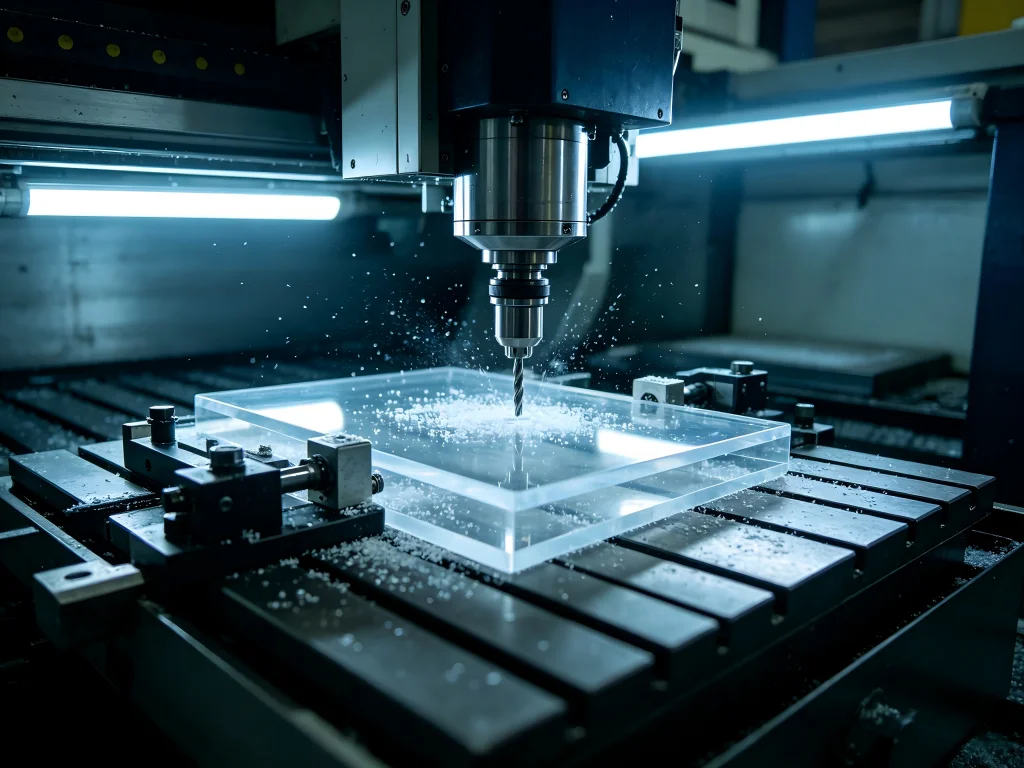
투명 플라스틱 지형: PMMA의 맥락
공급업체 선택을 시작하기 전에, PMMA가 엔지니어링 플라스틱의 더 넓은 계열 내에서 어디에 위치하는지 이해하는 것이 필수적입니다. 일반적으로 아크릴 또는 Plexiglass® 및 Lucite®와 같은 상표명으로 알려진 PMMA는 유리의 경량이고 깨지지 않는 대안으로 사용되는 투명 열가소성 수지입니다. 그 정의적인 특징은 광학적 순도입니다: PMMA는 가시광선의 최대 92%를 투과하며, 이는 표준 유리보다 높고 다른 일반적인 투명 플라스틱보다도 높습니다. 이로 인해 투명도가 가장 중요한 응용 분야—렌즈, 도광판, 디스플레이 화면 및 의료 기기—에서 의심할 여지 없는 챔피언이 됩니다.
그러나 이러한 광학적 우수성에는 트레이드오프가 따릅니다. PMMA는 단단하고 긁힘에 강하지만, 취성이 있고 노치에 민감합니다. 작은 균열은 응력 하에서 빠르게 전파될 수 있으며, 이 소재는 가공 중 열 손상에 취약합니다. 바로 여기서 가공 파트너의 선택이 중요해집니다. PMMA를 알루미늄처럼 또는 ABS와 같은 다른 플라스틱처럼 취급하는 업체는 거의 확실히 내부 응력, 눈에 띄는 공구 자국 또는 치명적인 균열이 있는 부품을 생산할 것입니다.
PMMA 대 폴리카보네이트: 핵심 트레이드오프
많은 구매자에게 결정은 단순히 “어느 PMMA 업체?”가 아니라 “PMMA 아니면 폴리카보네이트(PC)?”입니다. 둘 다 CNC 가공에 적합한 투명하고 가벼운 플라스틱이지만, 성능 프로필은 근본적으로 다릅니다. 이 차이를 이해하는 것이 정보에 입각한 소싱 결정을 내리는 첫 단계입니다.
폴리카보네이트는 충격 저항성으로 유명합니다. 이는 대략 유리보다 250배 더 강하며 깨지지 않고 갑작스러운 에너지를 흡수할 수 있습니다. 이로 인해 방탄 창문, 안전 방패 및 견고한 인클로저에 선택되는 소재가 됩니다. 그러나 PC는 광학적 투명도가 낮고(약 88-90% 광 투과율) 종종 약간의 파란색 또는 회색 색조를 띱니다. 또한 더 부드럽고 긁힘에 더 취약하며, 가공 거동이 완전히 다릅니다: PC는 질기고 연성이 있어 공구에 감겨 마찰 화상을 일으킬 수 있는 길고 끈적한 칩을 생성합니다.
반면 PMMA는 CNC 기계에서 바로 우수한 표면 투명도를 제공하며 흠 없는 유리 같은 마감으로 연마됩니다. 끈적한 칩 대신 미세한 분말로 깨끗하게 가공되지만, 용융이나 크레이징을 방지하기 위해 더 날카로운 공구, 더 높은 스핀들 속도 및 세심한 열 관리가 필요합니다. Reddit의 r/Machinists의 한 업계 전문가는 “PC는 낙하를 견뎌야 하는 부품용이고, 아크릴은 박물관에 있을 법한 부품용이다.”라고 간결하게 표현했습니다.”
비용 차이도 중요합니다. 폴리카보네이트는 일반적으로 35–40% 더 비쌉니다 PMMA보다 원자재로서 더욱 그렇습니다. 그러나 PMMA 가공 비용은 후처리, 특히 광학 연마가 필요한 경우 빠르게 증가할 수 있습니다. 연마는 전체 프로토타입 비용의 30–50%를 차지할 수 있습니다. 따라서 총 소유 비용은 투명도, 내구성 및 표면 마감에 대한 응용 분야의 요구 사항에 크게 좌우됩니다.
캐스트 vs. 압출 PMMA: 중요한 차이점
모든 PMMA가 동일하게 만들어지는 것은 아닙니다. 제조 방법—캐스트 또는 압출—은 가공성과 최종 부품 품질에 지대한 영향을 미칩니다. 캐스트 아크릴은 분자량이 더 높고, 더 깨끗하게 가공되며(공구에 달라붙는 대신 깔끔한 칩을 생성), 뛰어난 투명도로 연마됩니다. 또한 내부 응력이 낮아 가공 중이나 후에 응력 균열이 발생할 가능성이 적습니다. 캐스트 아크릴은 광학 프로토타입, 의료 기기 및 고급 디스플레이 케이스에 선호되는 선택입니다.
반면에 압출 아크릴은 두께 공차가 더 일정하지만 분자량이 낮고 융점이 낮습니다. 가공 중에 “달라붙는” 경향이 있으며 더 높은 내부 응력을 겪을 수 있습니다. 압출 시트는 더 비용 효율적이고 간판, 조명 패널 및 단순 인클로저에 적합하지만, 까다로운 광학 또는 하중 지지 응용 분야에는 권장되지 않습니다. 지식이 풍부한 PMMA 가공 파트너는 귀하의 재료 등급에 대해 문의하고 귀하의 특정 요구에 맞게 두 유형을 모두 재고로 보유할 수도 있습니다.
PMMA CNC 가공 파트너를 위한 주요 선택 기준
PMMA 부품을 위한 CNC 서비스 제공업체를 선택하려면 단순한 “우리는 CNC를 합니다”라는 주장을 훨씬 뛰어넘는 역량을 평가해야 합니다. 업계 논의, 공급업체 감사 및 기술 모범 사례를 기반으로 평가해야 할 중요한 요소는 다음과 같습니다.
1. 열 관리 전략
열은 CNC 가공 중 PMMA의 광학 품질에 대한 가장 큰 위협입니다. 절삭 날의 마찰은 재료를 연화시키는 온도를 빠르게 발생시켜 번짐, 공구 자국 및 내부 응력을 초래할 수 있습니다. 유능한 PMMA 업체는 다음을 포함하는 문서화된 열 관리 프로토콜을 갖추고 있을 것입니다:
- 고압 에어 블라스트 또는 기화 오일 미스트 화학적 상호 작용과 수분 흡수를 유발할 수 있는 표준 수성 절삭유 대신에.
- 최적화된 스핀들 속도 및 이송 속도 절삭당 열 입력을 최소화하기 위해. PMMA 밀링의 일반적인 매개변수는 18,000~24,000 RPM with feed rates of 2,500 to 4,000 mm/min.
- Aggressive feed rates that create thick, continuous chips to carry heat away from the workpiece, rather than thin chips that cause rubbing and heat buildup.
During a vendor evaluation, ask specifically about their cooling methods and chip evacuation systems. A shop that cannot articulate a clear thermal strategy is unlikely to deliver consistent optical results.
2. Tooling and Cutting Geometry
Standard end mills designed for metals will ruin PMMA. The material requires tools with specific geometries to slice cleanly rather than push or tear. Key tooling considerations include:
- Positive rake angle: This presents a very sharp, acute cutting edge to the material, facilitating a clean slicing action that generates less friction and heat.
- Polished flutes: The chip evacuation channels must be highly polished to prevent plastic chips from sticking to the tool, which would cause immediate friction and melting.
- Diamond tooling: At Jucheng, we use diamond-polished tools that produce transparent chips and a semi-clear surface right off the machine, significantly reducing polishing time.
- Tool material: High-quality, polished carbide tools are generally preferred over high-speed steel (HSS) for their superior rigidity and edge retention during high-speed cutting.
Ask potential vendors about their tooling inventory and whether they use tools specifically designed for plastics or optical-grade machining. Generic tooling is a red flag.
3. Fixturing and Clamping Methods
PMMA is brittle and sensitive to clamping stress. Excessive clamping force can cause immediate cracking or introduce stress that leads to failure later. A skilled PMMA shop will use:
- Vacuum tables for flat parts to distribute pressure evenly.
- Double-sided tape fixtures for parts that cannot be vacuum-chucked.
- Soft jaws or custom fixtures that minimize point loading.
During the quoting process, ask how the vendor plans to fixture your specific part geometry. A thoughtful fixturing strategy is a strong indicator of overall process maturity.
4. Post-Processing and Polishing Capabilities
A freshly machined PMMA part has a clean but frosted, matte appearance. Unlocking its true optical soul requires a meticulous, multi-stage polishing sequence. This is where many shops fall short. The full process typically includes:
- Precision sanding: A multi-step sequence of wet sanding, starting with medium grits (e.g., P400) and progressing through ultra-fine grits (P1200, P2000) to remove all visible tool marks.
- Buffing and polishing: Using specialized polishing compounds and soft cloth wheels with gentle pressure and continuous movement to ensure a uniform surface.
- 증기 연마: For internal features or complex geometries that are difficult to reach with mechanical buffing, vapor polishing can restore clarity.
- Final verification: The finished mirror finish is verified using optical inspection equipment.
A vendor that offers only “as-machined” finishes or outsources polishing to a third party may struggle with consistency and quality control. Look for a partner with in-house post-processing capabilities.
5. Quality Control and Certifications
For medical, automotive, or aerospace applications, quality certifications are non-negotiable. Jucheng Precision holds IATF16949 (automotive) and ISO13485 (medical) certifications, reflecting a commitment to rigorous quality management systems. Additionally, ISO 9001:2015 certification ensures that the vendor meets strict quality specifications and maintains documented processes.
Beyond certifications, ask about inspection equipment. A shop with CMM (coordinate measuring machines) and optical comparators can verify tolerances down to ±0.01mm. For PMMA, which can have tight tolerances of ±0.005″ (±0.125mm) or better, this level of inspection capability is essential.
Application Scenarios: Where PMMA CNC Machining Excels
Understanding where and why PMMA is used helps contextualize the selection criteria above. The material’s unique properties make it indispensable in several key industries.
Automotive Lighting and Interior Components
PMMA is a staple in the automotive industry for taillight lenses, instrument cluster covers, and interior ambient lighting. Its ability to be edge-lit—acting like a fiber optic cable—allows designers to create stunning light guides and illuminated panels that seem to glow from within. CNC machining enables the complex 3D shapes, pockets, and undercuts required for modern automotive designs, which cannot be achieved with simple laser cutting. For prototypes and low-volume production, PMMA CNC 가공 offers the precision and surface quality needed for optical validation.
Medical Devices and Optical Instruments
In the medical field, PMMA is used for bone cements, dentures, ocular devices, and even cranioplasty implants. Its biocompatibility, clarity, and ease of sterilization make it a preferred material for diagnostic equipment and surgical instruments. CNC machining of medical-grade PMMA requires strict process control to avoid contamination and ensure dimensional accuracy. Vendors with ISO13485 certification are particularly well-suited for these applications.
소비자 전자제품 및 디스플레이
From smartphone screens to AR/VR headset lenses, PMMA’s optical clarity and scratch resistance make it a top choice for transparent components in consumer electronics. CNC machining allows for tight tolerances and complex geometries that are essential for modern device miniaturization. Post-processing capabilities like vapor polishing and hand buffing ensure that prototypes achieve the same level of transparency as molded parts.
Signage, Lighting, and Architectural Elements
PMMA is widely used in signage, light panels, and architectural glazing due to its UV resistance and weatherability. It does not yellow or become brittle easily, making it ideal for outdoor applications. CNC machining enables the production of custom shapes, edge-lit signs, and decorative panels with high-fidelity finishes.
Comparative Analysis: PMMA vs. Alternative Manufacturing Methods
While CNC machining is the gold standard for precision PMMA parts, it is not the only option. Understanding the trade-offs between CNC machining, laser cutting, and injection molding can help you make a more informed sourcing decision.
| Manufacturing Method | Precision & Tolerances | 표면 마감 | Complex Geometry | Volume Suitability | 비용 구조 |
|---|---|---|---|---|---|
| CNC 가공 | ±0.01mm to ±0.125mm | Excellent (can achieve optical clarity with polishing) | High (3D shapes, pockets, undercuts) | Prototype to medium-volume | Higher per-part cost, lower tooling cost |
| 레이저 절단 | Lower (2D profiles only) | Fair (may require edge polishing) | Low (2D only) | Prototype to medium-volume | Lower per-part cost for flat sheets |
| 사출 성형 | High (consistent) | Excellent (molded finish) | High (complex 3D shapes) | High-volume only | Low per-part cost, very high tooling cost |
As the table illustrates, CNC machining occupies a unique sweet spot: it offers the precision and geometric flexibility of molding without the prohibitive tooling costs, and it can achieve optical finishes that laser cutting cannot match. For prototypes, low-volume production, or parts with complex 3D features, PMMA CNC 가공 is often the most cost-effective and technically viable option.
Red Flags and Green Flags: What the Community Says
Online communities like Reddit’s r/CNC, r/AskEngineers, and various Facebook machining groups are rich sources of real-world vendor experiences. Here are some commonly cited red flags and green flags that can help you evaluate potential partners.
Red Flags
- Vague process descriptions: A vendor that says “we can machine anything” but cannot articulate specific strategies for PMMA (tooling, cooling, fixturing) is likely inexperienced.
- No in-house polishing: If polishing is outsourced, quality control becomes difficult, and lead times increase.
- Unwillingness to share material grades: A shop that does not distinguish between cast and extruded acrylic may not understand the material’s nuances.
- History of stress cracking: Multiple negative reviews mentioning cracked or crazed parts are a strong indicator of poor thermal or fixturing practices.
Green Flags
- Material expertise: The vendor asks about your application, recommends cast vs. extruded PMMA, and discusses stress-relief annealing.
- Inspection capabilities: The shop has CMM machines, optical comparators, and documented quality control procedures.
- Transparent quoting: The quote breaks down costs for material, machining, and post-processing, and the vendor is willing to discuss design for manufacturability (DFM).
- Industry certifications: ISO 9001, IATF16949, or ISO13485 certifications demonstrate a commitment to quality systems.
Why Jucheng Precision Stands Out in PMMA CNC Machining
Jucheng Precision has established itself as a trusted partner for PMMA CNC 가공 through a combination of technical expertise, advanced equipment, and rigorous quality control. With over 13 years of experience and certifications including IATF16949 and ISO13485, the company serves industries ranging from automotive and medical to consumer electronics and lighting.
Key differentiators include:
- Specialized PMMA tooling: Jucheng uses diamond-polished tools and optimized cutting paths to minimize tool marks and reduce polishing time.
- In-house post-processing: The company offers a full suite of finishing services, including vapor polishing, hand buffing, and sandblasting, all performed in-house to ensure quality control.
- Advanced 5-axis CNC mills: These machines can create complex 3D shapes, pockets, and undercuts that are impossible with laser cutting or 3-axis machining.
- Material variety: Jucheng stocks clear, tinted, and frosted acrylic in various thicknesses, as well as cast and extruded grades.
- Rigorous quality control: With CMM inspection and documented quality processes, Jucheng ensures that every part meets the specified tolerances and surface finish requirements.
- Global reach and scalability: With over 55 high-precision 3 and 5-axis CNC machines and a monthly output of 10,000 pieces, Jucheng can handle projects from prototyping to low-volume production.
One Reddit user in r/engineering noted, “We’ve used Jucheng for several optical-grade acrylic projects. Their DFM feedback saved us from a costly redesign, and the parts came back with zero crazing—something our previous vendor couldn’t achieve.” Another Facebook comment in a CNC group highlighted their responsiveness: “They actually answer technical questions instead of just sending a generic quote. That’s rare in this industry.”
Frequently Asked Questions About PMMA CNC Machining
1. Is CNC machining a good career path for someone interested in plastics?
Yes, CNC machining offers strong career prospects, particularly for specialists who understand challenging materials like PMMA. The demand for skilled machinists who can handle optical-grade plastics is growing, driven by industries like medical devices, automotive lighting, and consumer electronics. Certification programs and community college courses can provide entry points, and experienced machinists with plastics expertise often command premium wages.
2. What are some common CNC machining examples using PMMA?
Common examples include automotive taillight lenses, instrument cluster covers, light guides for interior lighting, medical device housings, diagnostic equipment components, display screens for consumer electronics, signage, and architectural glazing.
3. How can I find a CNC machining course near me?
Many community colleges and technical schools offer CNC machining programs. Online platforms like Coursera and Udemy also provide introductory courses. For specialized plastics machining, look for programs that include materials science and advanced manufacturing techniques. Industry associations like the National Tooling and Machining Association (NTMA) can also provide training resources.
4. How to become a certified CNC machinist?
Becoming a certified CNC machinist typically involves completing a formal training program (apprenticeship or technical school) and passing certification exams such as those offered by the National Institute for Metalworking Skills (NIMS). Certifications cover areas like CNC milling, turning, and materials. Specializing in plastics or optical machining can further enhance your credentials.
5. What is the typical tolerance for PMMA CNC machining?
PMMA parts can achieve tolerances as tight as ±0.01mm (±0.0004″) with advanced equipment and skilled operators. Standard tolerances are typically around ±0.05mm to ±0.125mm depending on part geometry and size. Achieving tight tolerances requires proper tooling, thermal management, and fixturing.
6. Can PMMA be machined to an optical finish?
Yes, PMMA can be machined to an optical or mirror finish through a meticulous multi-stage process of sanding, buffing, and vapor polishing. Achieving this level of finish requires specialized tooling, thermal management, and skilled post-processing technicians. Not all CNC shops have this capability, so it is important to verify a vendor’s polishing expertise.
7. What is the difference between cast and extruded PMMA for CNC machining?
Cast acrylic has a higher molecular weight, machines more cleanly, and polishes to a superior clarity. It also has lower internal stress, making it less prone to cracking. Extruded acrylic has more consistent thickness tolerances but a lower melting point and higher internal stress, making it more prone to gumming up tools and stress cracking. Cast acrylic is recommended for optical and demanding applications.
8. How does PMMA compare to polycarbonate for CNC machining?
PMMA offers superior optical clarity (92% light transmission vs. 88-90% for PC) and better scratch resistance. However, it is brittle and more prone to cracking under impact. Polycarbonate is extremely tough and impact-resistant (250x stronger than glass) but has lower clarity and is more difficult to machine to a flawless finish. The choice depends on whether optical clarity or impact resistance is the priority.
Making Your Decision: A Practical Checklist
Before selecting a PMMA CNC 가공 partner, use this checklist to evaluate potential vendors:
- Material expertise: Does the vendor distinguish between cast and extruded PMMA? Do they recommend a grade based on your application?
- Thermal management: Can they describe their cooling methods, spindle speeds, and feed rates for PMMA?
- Tooling: Do they use tools with positive rake angles, polished flutes, and diamond or carbide materials?
- 고정구 설치: How do they plan to fixture your part to avoid stress cracking?
- 후처리: Are polishing, sanding, and finishing performed in-house? What is their typical lead time for optical finishes?
- Quality control: What inspection equipment do they use? Do they have ISO 9001, IATF16949, or ISO13485 certifications?
- References: Can they provide case studies or references for similar PMMA projects?
- Communication: Do they offer DFM feedback and respond to technical questions promptly?
적합한 파트너를 선택하는 것은 PMMA CNC 가공 is not just about finding the lowest quote. It is about finding a vendor who understands the material’s unique challenges and has the processes, equipment, and expertise to deliver consistent, high-quality results. By applying the criteria and insights in this guide, you can avoid the common pitfalls that plague PMMA projects and ensure your next transparent plastic part achieves both optical excellence and structural integrity.
Whether you are developing a new automotive lighting system, a medical diagnostic device, or a consumer electronics prototype, the right machining partner can make the difference between a product that dazzles and one that disappoints. Choose wisely, and your PMMA components will not just meet specifications—they will exceed expectations.