
Selezionare un partner produttivo per componenti in plastica trasparente spesso sembra una scommessa ad alto rischio. Si può avere un modello CAD perfetto, ma il primo lotto di lavorazione CNC del PMMA prototipi arriva con micro-crepe, superfici opache o derive dimensionali. Un thread su Reddit in r/AskEngineers ha catturato perfettamente la frustrazione: “I miei pezzi in acrilico sembravano perfetti sullo schermo, ma i pezzi lavorati presentavano fratture da stress che non riuscivo a vedere finché non sono stati assemblati.” Un altro utente sul gruppo Facebook CNC Machining Group ha osservato: “Abbiamo cambiato fornitore tre volte perché ognuno sosteneva di poter lavorare PMMA di qualità ottica, ma solo uno ha effettivamente mantenuto le promesse.” Non sono lamentele isolate; riflettono una verità fondamentale sulla lavorazione del polimetilmetacrilato (PMMA). Questo materiale non perdona. È fragile, sensibile al calore e richiede un livello di controllo di processo che molte officine semplicemente non possiedono.
Questa guida non è una panoramica generica della lavorazione CNC. È un quadro decisionale per ingegneri degli acquisti, progettisti di prodotto e titolari d'impresa che devono scegliere tra lavorazione CNC del PMMA fornitori—o persino tra PMMA e plastiche trasparenti alternative come il policarbonato. Esamineremo i compromessi critici, i costi nascosti di una lavorazione scadente e le capacità specifiche che distinguono un partner affidabile da un esperimento costoso. Alla fine, avrete una metodologia chiara e attuabile per valutare i servizi CNC, assicurando che il vostro prossimo progetto raggiunga sia la brillantezza ottica che l'integrità strutturale.
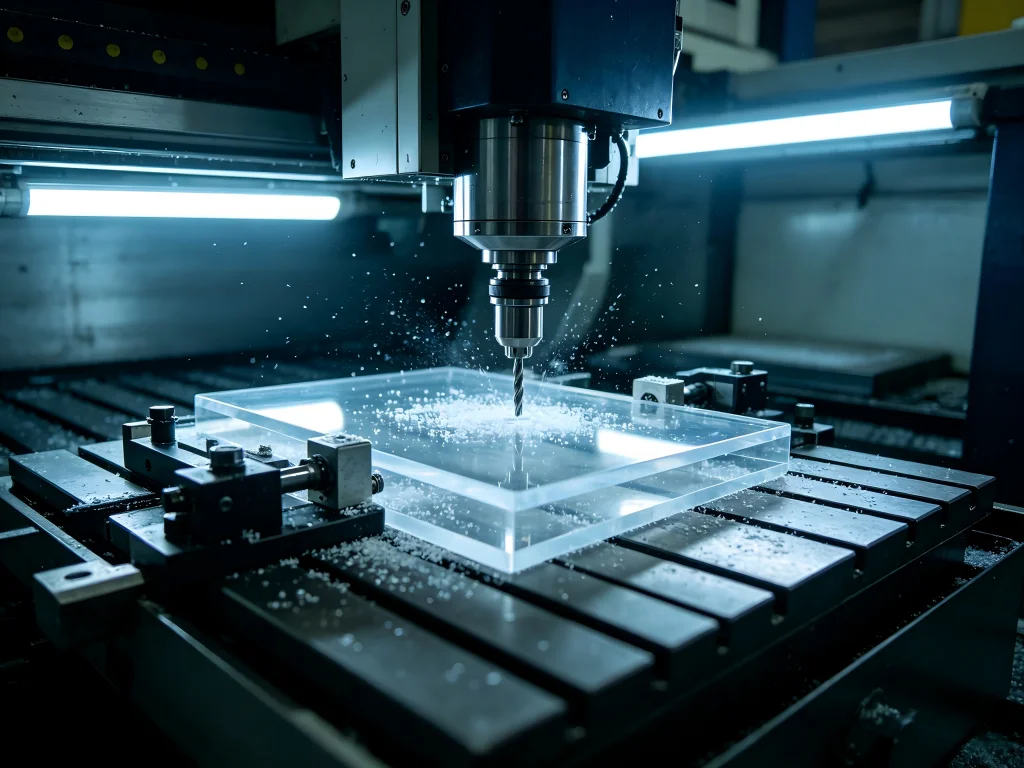
Il panorama delle plastiche trasparenti: il PMMA nel contesto
Prima di addentrarci nella selezione del fornitore, è essenziale capire dove si colloca il PMMA all'interno della più ampia famiglia delle plastiche ingegneristiche. Il PMMA, comunemente noto come acrilico o con nomi commerciali come Plexiglass® e Lucite®, è un termoplastico trasparente che funge da alternativa leggera e resistente alle scheggiature rispetto al vetro. La sua caratteristica distintiva è la purezza ottica: il PMMA trasmette fino al 92% della luce visibile, superiore al vetro standard e superiore a qualsiasi altra plastica trasparente comune. Questo lo rende il campione indiscusso per applicazioni in cui la chiarezza è fondamentale—lenti, guide di luce, schermi di visualizzazione e dispositivi medici.
Tuttavia, questa eccellenza ottica comporta un compromesso. Il PMMA è rigido e resistente ai graffi, ma è anche fragile e sensibile all'intaglio. Una piccola crepa può propagarsi rapidamente sotto stress, e il materiale è vulnerabile ai danni termici durante la lavorazione. È qui che la scelta del partner di lavorazione diventa critica. Un'officina che tratta il PMMA come l'alluminio o persino come altre plastiche quali l'ABS produrrà quasi certamente pezzi con stress interni, segni di utensile visibili o cricche catastrofiche.
PMMA vs. policarbonato: il compromesso fondamentale
Per molti acquirenti, la decisione non è semplicemente “quale officina PMMA?” ma “PMMA o policarbonato (PC)?” Entrambi sono plastiche trasparenti e leggere adatte alla lavorazione CNC, ma i loro profili prestazionali sono radicalmente diversi. Comprendere questa distinzione è il primo passo per prendere una decisione di approvvigionamento informata.
Il policarbonato è rinomato per la sua resistenza agli urti. È circa 250 volte più resistente del vetro e può assorbire energia improvvisa senza frantumarsi. Questo lo rende il materiale d'elezione per finestre antiproiettile, schermi di sicurezza e custodie robuste. Tuttavia, il PC ha una chiarezza ottica inferiore (circa 88-90% di trasmissione luminosa) e spesso appare con una leggera tinta blu o grigia. È anche più morbido e più soggetto ai graffi, e il suo comportamento in lavorazione è completamente diverso: il PC è tenace e duttile, producendo trucioli lunghi e filamentosi che possono avvolgersi attorno agli utensili e causare bruciature da attrito.
Il PMMA, al contrario, offre una chiarezza superficiale superiore direttamente dalla macchina CNC e si lucida fino a una finitura impeccabile, simile al vetro. Si lavora in modo pulito producendo polvere fine anziché trucioli filamentosi, ma richiede utensili più affilati, velocità del mandrino più elevate e una gestione termica meticolosa per prevenire fusione o fessurazioni. Un esperto del settore su r/Machinists di Reddit lo ha riassunto efficacemente: “Il PC è per pezzi che devono sopravvivere a una caduta; l'acrilico è per pezzi che devono sembrare appartenere a un museo.”
Anche il differenziale di costo conta. Il policarbonato è tipicamente 35–40% più costoso rispetto al PMMA come materiale grezzo. Tuttavia, i costi di lavorazione del PMMA possono aumentare rapidamente se è richiesta una post-lavorazione, in particolare la lucidatura ottica. La lucidatura può rappresentare 30–50% del costo totale del prototipo. Pertanto, il costo totale di proprietà dipende in larga misura dai requisiti dell'applicazione in termini di trasparenza, durabilità e finitura superficiale.
PMMA colato vs. estruso: una distinzione critica
Non tutto il PMMA è uguale. Il metodo di produzione—colato o estruso—influenza profondamente la lavorabilità e la qualità finale del pezzo. L'acrilico colato ha un peso molecolare più elevato, si lavora in modo più pulito (producendo trucioli netti anziché impastare gli utensili) e si lucida fino a una trasparenza superiore. Presenta inoltre tensioni interne inferiori, che lo rendono meno soggetto a fessurazione da stress durante o dopo la lavorazione. L'acrilico colato è la scelta preferita per prototipi ottici, dispositivi medici e vetrine di alta gamma.
L'acrilico estruso, d'altro canto, ha tolleranze di spessore più costanti ma un peso molecolare inferiore e un punto di fusione più basso. Tende a “impastare” durante la lavorazione e può presentare tensioni interne più elevate. Sebbene le lastre estrose siano più economiche e adatte per insegne, pannelli luminosi e contenitori semplici, non sono raccomandate per applicazioni ottiche o portanti impegnative. Un partner esperto nella lavorazione del PMMA chiederà informazioni sulla qualità del vostro materiale e potrebbe persino tenere a magazzino entrambi i tipi per soddisfare le vostre esigenze specifiche.
Criteri di selezione chiave per un partner di lavorazione CNC del PMMA
Scegliere un fornitore di servizi CNC per componenti in PMMA richiede la valutazione di capacità che vanno ben oltre la semplice affermazione “facciamo CNC”. Sulla base di discussioni di settore, audit dei fornitori e migliori pratiche tecniche, ecco i fattori critici da valutare.
1. Strategia di gestione termica
Il calore è la singola minaccia più grande alla qualità ottica del PMMA durante la lavorazione CNC. L'attrito sul tagliente può generare rapidamente temperature che ammorbidiscono il materiale, causando sbavature, segni di utensile e tensioni interne. Un'officina PMMA competente avrà un protocollo documentato di gestione termica che include:
- Soffio d'aria ad alta pressione o nebbia d'olio vaporizzato anziché refrigeranti standard a base d'acqua, che possono causare interazioni chimiche e assorbimento d'acqua.
- Velocità del mandrino e velocità di avanzamento ottimizzate per ridurre al minimo l'apporto di calore per taglio. I parametri tipici per la fresatura del PMMA vanno da 18.000 a 24.000 RPM with feed rates of 2,500 to 4,000 mm/min.
- Aggressive feed rates that create thick, continuous chips to carry heat away from the workpiece, rather than thin chips that cause rubbing and heat buildup.
During a vendor evaluation, ask specifically about their cooling methods and chip evacuation systems. A shop that cannot articulate a clear thermal strategy is unlikely to deliver consistent optical results.
2. Tooling and Cutting Geometry
Standard end mills designed for metals will ruin PMMA. The material requires tools with specific geometries to slice cleanly rather than push or tear. Key tooling considerations include:
- Positive rake angle: This presents a very sharp, acute cutting edge to the material, facilitating a clean slicing action that generates less friction and heat.
- Polished flutes: The chip evacuation channels must be highly polished to prevent plastic chips from sticking to the tool, which would cause immediate friction and melting.
- Diamond tooling: At Jucheng, we use diamond-polished tools that produce transparent chips and a semi-clear surface right off the machine, significantly reducing polishing time.
- Tool material: High-quality, polished carbide tools are generally preferred over high-speed steel (HSS) for their superior rigidity and edge retention during high-speed cutting.
Ask potential vendors about their tooling inventory and whether they use tools specifically designed for plastics or optical-grade machining. Generic tooling is a red flag.
3. Fixturing and Clamping Methods
PMMA is brittle and sensitive to clamping stress. Excessive clamping force can cause immediate cracking or introduce stress that leads to failure later. A skilled PMMA shop will use:
- Vacuum tables for flat parts to distribute pressure evenly.
- Double-sided tape fixtures for parts that cannot be vacuum-chucked.
- Soft jaws or custom fixtures that minimize point loading.
During the quoting process, ask how the vendor plans to fixture your specific part geometry. A thoughtful fixturing strategy is a strong indicator of overall process maturity.
4. Post-Processing and Polishing Capabilities
A freshly machined PMMA part has a clean but frosted, matte appearance. Unlocking its true optical soul requires a meticulous, multi-stage polishing sequence. This is where many shops fall short. The full process typically includes:
- Precision sanding: A multi-step sequence of wet sanding, starting with medium grits (e.g., P400) and progressing through ultra-fine grits (P1200, P2000) to remove all visible tool marks.
- Buffing and polishing: Using specialized polishing compounds and soft cloth wheels with gentle pressure and continuous movement to ensure a uniform surface.
- Lucidatura a vapore: For internal features or complex geometries that are difficult to reach with mechanical buffing, vapor polishing can restore clarity.
- Final verification: The finished mirror finish is verified using optical inspection equipment.
A vendor that offers only “as-machined” finishes or outsources polishing to a third party may struggle with consistency and quality control. Look for a partner with in-house post-processing capabilities.
5. Quality Control and Certifications
For medical, automotive, or aerospace applications, quality certifications are non-negotiable. Jucheng Precision holds IATF16949 (automotive) and ISO13485 (medical) certifications, reflecting a commitment to rigorous quality management systems. Additionally, ISO 9001:2015 certification ensures that the vendor meets strict quality specifications and maintains documented processes.
Beyond certifications, ask about inspection equipment. A shop with CMM (coordinate measuring machines) and optical comparators can verify tolerances down to ±0,01 mm. For PMMA, which can have tight tolerances of ±0.005″ (±0.125mm) or better, this level of inspection capability is essential.
Application Scenarios: Where PMMA CNC Machining Excels
Understanding where and why PMMA is used helps contextualize the selection criteria above. The material’s unique properties make it indispensable in several key industries.
Automotive Lighting and Interior Components
PMMA is a staple in the automotive industry for taillight lenses, instrument cluster covers, and interior ambient lighting. Its ability to be edge-lit—acting like a fiber optic cable—allows designers to create stunning light guides and illuminated panels that seem to glow from within. CNC machining enables the complex 3D shapes, pockets, and undercuts required for modern automotive designs, which cannot be achieved with simple laser cutting. For prototypes and low-volume production, lavorazione CNC del PMMA offers the precision and surface quality needed for optical validation.
Medical Devices and Optical Instruments
In the medical field, PMMA is used for bone cements, dentures, ocular devices, and even cranioplasty implants. Its biocompatibility, clarity, and ease of sterilization make it a preferred material for diagnostic equipment and surgical instruments. CNC machining of medical-grade PMMA requires strict process control to avoid contamination and ensure dimensional accuracy. Vendors with ISO13485 certification are particularly well-suited for these applications.
Consumer Electronics and Displays
From smartphone screens to AR/VR headset lenses, PMMA’s optical clarity and scratch resistance make it a top choice for transparent components in consumer electronics. CNC machining allows for tight tolerances and complex geometries that are essential for modern device miniaturization. Post-processing capabilities like vapor polishing and hand buffing ensure that prototypes achieve the same level of transparency as molded parts.
Signage, Lighting, and Architectural Elements
PMMA is widely used in signage, light panels, and architectural glazing due to its UV resistance and weatherability. It does not yellow or become brittle easily, making it ideal for outdoor applications. CNC machining enables the production of custom shapes, edge-lit signs, and decorative panels with high-fidelity finishes.
Comparative Analysis: PMMA vs. Alternative Manufacturing Methods
While CNC machining is the gold standard for precision PMMA parts, it is not the only option. Understanding the trade-offs between CNC machining, laser cutting, and injection molding can help you make a more informed sourcing decision.
| Manufacturing Method | Precision & Tolerances | Finitura superficiale | Complex Geometry | Volume Suitability | Cost Structure |
|---|---|---|---|---|---|
| Lavorazione meccanica CNC | ±0.01mm to ±0.125mm | Excellent (can achieve optical clarity with polishing) | High (3D shapes, pockets, undercuts) | Prototype to medium-volume | Higher per-part cost, lower tooling cost |
| Taglio laser | Lower (2D profiles only) | Fair (may require edge polishing) | Low (2D only) | Prototype to medium-volume | Lower per-part cost for flat sheets |
| Stampaggio a iniezione | High (consistent) | Excellent (molded finish) | High (complex 3D shapes) | High-volume only | Low per-part cost, very high tooling cost |
As the table illustrates, CNC machining occupies a unique sweet spot: it offers the precision and geometric flexibility of molding without the prohibitive tooling costs, and it can achieve optical finishes that laser cutting cannot match. For prototypes, low-volume production, or parts with complex 3D features, lavorazione CNC del PMMA is often the most cost-effective and technically viable option.
Red Flags and Green Flags: What the Community Says
Online communities like Reddit’s r/CNC, r/AskEngineers, and various Facebook machining groups are rich sources of real-world vendor experiences. Here are some commonly cited red flags and green flags that can help you evaluate potential partners.
Red Flags
- Vague process descriptions: A vendor that says “we can machine anything” but cannot articulate specific strategies for PMMA (tooling, cooling, fixturing) is likely inexperienced.
- No in-house polishing: If polishing is outsourced, quality control becomes difficult, and lead times increase.
- Unwillingness to share material grades: A shop that does not distinguish between cast and extruded acrylic may not understand the material’s nuances.
- History of stress cracking: Multiple negative reviews mentioning cracked or crazed parts are a strong indicator of poor thermal or fixturing practices.
Green Flags
- Competenza sui materiali: The vendor asks about your application, recommends cast vs. extruded PMMA, and discusses stress-relief annealing.
- Inspection capabilities: The shop has CMM machines, optical comparators, and documented quality control procedures.
- Transparent quoting: The quote breaks down costs for material, machining, and post-processing, and the vendor is willing to discuss design for manufacturability (DFM).
- Industry certifications: ISO 9001, IATF16949, or ISO13485 certifications demonstrate a commitment to quality systems.
Why Jucheng Precision Stands Out in PMMA CNC Machining
Jucheng Precision has established itself as a trusted partner for lavorazione CNC del PMMA through a combination of technical expertise, advanced equipment, and rigorous quality control. With over 13 years of experience and certifications including IATF16949 and ISO13485, the company serves industries ranging from automotive and medical to consumer electronics and lighting.
Key differentiators include:
- Specialized PMMA tooling: Jucheng uses diamond-polished tools and optimized cutting paths to minimize tool marks and reduce polishing time.
- In-house post-processing: The company offers a full suite of finishing services, including vapor polishing, hand buffing, and sandblasting, all performed in-house to ensure quality control.
- Advanced 5-axis CNC mills: These machines can create complex 3D shapes, pockets, and undercuts that are impossible with laser cutting or 3-axis machining.
- Material variety: Jucheng stocks clear, tinted, and frosted acrylic in various thicknesses, as well as cast and extruded grades.
- Rigorous quality control: With CMM inspection and documented quality processes, Jucheng ensures that every part meets the specified tolerances and surface finish requirements.
- Global reach and scalability: With over 55 high-precision 3 and 5-axis CNC machines and a monthly output of 10,000 pieces, Jucheng can handle projects from prototyping to low-volume production.
One Reddit user in r/engineering noted, “We’ve used Jucheng for several optical-grade acrylic projects. Their DFM feedback saved us from a costly redesign, and the parts came back with zero crazing—something our previous vendor couldn’t achieve.” Another Facebook comment in a CNC group highlighted their responsiveness: “They actually answer technical questions instead of just sending a generic quote. That’s rare in this industry.”
Frequently Asked Questions About PMMA CNC Machining
1. Is CNC machining a good career path for someone interested in plastics?
Yes, CNC machining offers strong career prospects, particularly for specialists who understand challenging materials like PMMA. The demand for skilled machinists who can handle optical-grade plastics is growing, driven by industries like medical devices, automotive lighting, and consumer electronics. Certification programs and community college courses can provide entry points, and experienced machinists with plastics expertise often command premium wages.
2. What are some common CNC machining examples using PMMA?
Common examples include automotive taillight lenses, instrument cluster covers, light guides for interior lighting, medical device housings, diagnostic equipment components, display screens for consumer electronics, signage, and architectural glazing.
3. How can I find a CNC machining course near me?
Many community colleges and technical schools offer CNC machining programs. Online platforms like Coursera and Udemy also provide introductory courses. For specialized plastics machining, look for programs that include materials science and advanced manufacturing techniques. Industry associations like the National Tooling and Machining Association (NTMA) can also provide training resources.
4. How to become a certified CNC machinist?
Becoming a certified CNC machinist typically involves completing a formal training program (apprenticeship or technical school) and passing certification exams such as those offered by the National Institute for Metalworking Skills (NIMS). Certifications cover areas like CNC milling, turning, and materials. Specializing in plastics or optical machining can further enhance your credentials.
5. What is the typical tolerance for PMMA CNC machining?
PMMA parts can achieve tolerances as tight as ±0.01mm (±0.0004″) with advanced equipment and skilled operators. Standard tolerances are typically around ±0.05mm to ±0.125mm depending on part geometry and size. Achieving tight tolerances requires proper tooling, thermal management, and fixturing.
6. Can PMMA be machined to an optical finish?
Yes, PMMA can be machined to an optical or mirror finish through a meticulous multi-stage process of sanding, buffing, and vapor polishing. Achieving this level of finish requires specialized tooling, thermal management, and skilled post-processing technicians. Not all CNC shops have this capability, so it is important to verify a vendor’s polishing expertise.
7. What is the difference between cast and extruded PMMA for CNC machining?
Cast acrylic has a higher molecular weight, machines more cleanly, and polishes to a superior clarity. It also has lower internal stress, making it less prone to cracking. Extruded acrylic has more consistent thickness tolerances but a lower melting point and higher internal stress, making it more prone to gumming up tools and stress cracking. Cast acrylic is recommended for optical and demanding applications.
8. How does PMMA compare to polycarbonate for CNC machining?
PMMA offers superior optical clarity (92% light transmission vs. 88-90% for PC) and better scratch resistance. However, it is brittle and more prone to cracking under impact. Polycarbonate is extremely tough and impact-resistant (250x stronger than glass) but has lower clarity and is more difficult to machine to a flawless finish. The choice depends on whether optical clarity or impact resistance is the priority.
Making Your Decision: A Practical Checklist
Before selecting a lavorazione CNC del PMMA partner, use this checklist to evaluate potential vendors:
- Competenza sui materiali: Does the vendor distinguish between cast and extruded PMMA? Do they recommend a grade based on your application?
- Thermal management: Can they describe their cooling methods, spindle speeds, and feed rates for PMMA?
- Tooling: Do they use tools with positive rake angles, polished flutes, and diamond or carbide materials?
- Attrezzaggio: How do they plan to fixture your part to avoid stress cracking?
- Post-lavorazione: Are polishing, sanding, and finishing performed in-house? What is their typical lead time for optical finishes?
- Quality control: What inspection equipment do they use? Do they have ISO 9001, IATF16949, or ISO13485 certifications?
- References: Can they provide case studies or references for similar PMMA projects?
- Comunicazione: Do they offer DFM feedback and respond to technical questions promptly?
Scegliere il partner giusto per lavorazione CNC del PMMA is not just about finding the lowest quote. It is about finding a vendor who understands the material’s unique challenges and has the processes, equipment, and expertise to deliver consistent, high-quality results. By applying the criteria and insights in this guide, you can avoid the common pitfalls that plague PMMA projects and ensure your next transparent plastic part achieves both optical excellence and structural integrity.
Whether you are developing a new automotive lighting system, a medical diagnostic device, or a consumer electronics prototype, the right machining partner can make the difference between a product that dazzles and one that disappoints. Choose wisely, and your PMMA components will not just meet specifications—they will exceed expectations.