
Selecionar um parceiro de fabricação para componentes de plástico transparente muitas vezes parece uma aposta de alto risco. Você pode ter um modelo CAD perfeito, mas o primeiro lote de usinagem CNC de PMMA protótipos chega com microfissuras, superfícies turvas ou variação dimensional. Um tópico no Reddit em r/AskEngineers capturou perfeitamente a frustração: “Minhas peças de acrílico pareciam ótimas na tela, mas as peças usinadas tinham fissuras por tensão que eu não conseguia ver até serem montadas.” Outro usuário no Grupo de Usinagem CNC do Facebook observou: “Trocamos de fornecedor três vezes porque cada um afirmava que podia fazer PMMA de grau óptico, mas apenas um realmente entregou.” Essas não são reclamações isoladas; elas refletem uma verdade fundamental sobre a usinagem de polimetilmetacrilato (PMMA). Esse material não perdoa. É quebradiço, sensível ao calor e exige um nível de controle de processo que muitas oficinas simplesmente não possuem.
Este guia não é uma visão geral genérica de usinagem CNC. É uma estrutura de tomada de decisão para engenheiros de compras, designers de produtos e proprietários de empresas que precisam escolher entre usinagem CNC de PMMA fornecedores — ou até mesmo entre PMMA e plásticos transparentes alternativos, como o policarbonato. Examinaremos as trocas críticas, os custos ocultos da usinagem deficiente e as capacidades específicas que separam um parceiro confiável de um experimento caro. Ao final, você terá uma metodologia clara e acionável para avaliar serviços de CNC, garantindo que seu próximo projeto alcance tanto brilho óptico quanto integridade estrutural.
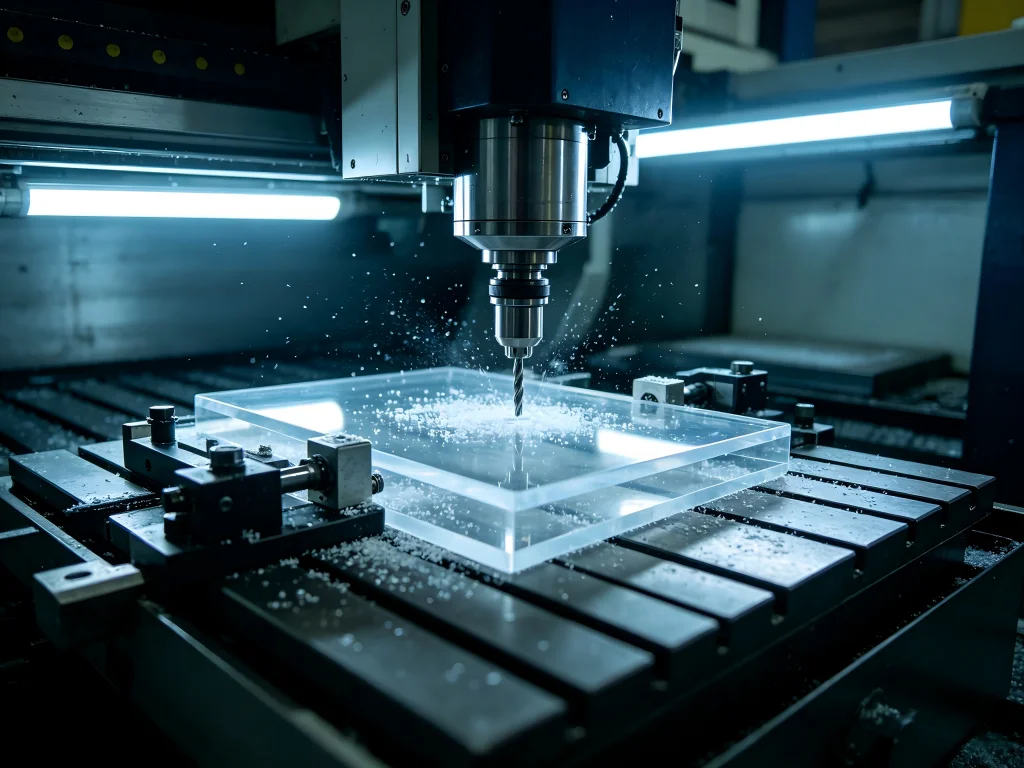
O Cenário dos Plásticos Transparentes: O PMMA em Contexto
Antes de mergulhar na seleção de fornecedores, é essencial entender onde o PMMA se encaixa na família mais ampla dos plásticos de engenharia. O PMMA, comumente conhecido como acrílico ou por nomes comerciais como Plexiglass® e Lucite®, é um termoplástico transparente que serve como alternativa leve e resistente a estilhaçamento ao vidro. Sua característica definidora é a pureza óptica: o PMMA transmite até 92% de luz visível, o que é superior ao vidro comum e superior a qualquer outro plástico transparente comum. Isso o torna o campeão indiscutível para aplicações em que a clareza é primordial — lentes, guias de luz, telas de exibição e dispositivos médicos.
No entanto, essa excelência óptica tem um custo. O PMMA é rígido e resistente a riscos, mas também é quebradiço e sensível a entalhes. Uma pequena trinca pode se propagar rapidamente sob tensão, e o material é vulnerável a danos térmicos durante a usinagem. É aqui que a escolha do parceiro de usinagem se torna crítica. Uma oficina que trata o PMMA como alumínio ou até como outros plásticos, como ABS, quase certamente produzirá peças com tensão interna, marcas de ferramenta visíveis ou trincas catastróficas.
PMMA vs. Policarbonato: A Troca Central
Para muitos compradores, a decisão não é simplesmente “qual oficina de PMMA?”, mas “PMMA ou policarbonato (PC)?”. Ambos são plásticos transparentes e leves adequados para usinagem CNC, mas seus perfis de desempenho são radicalmente diferentes. Entender essa distinção é o primeiro passo para tomar uma decisão de compra informada.
O policarbonato é renomado por sua resistência ao impacto. É aproximadamente 250 vezes mais forte que o vidro e pode absorver energia súbita sem se estilhaçar. Isso o torna o material de escolha para janelas à prova de balas, escudos de segurança e invólucros robustos. No entanto, o PC tem menor clareza óptica (cerca de 88-90% de transmissão de luz) e frequentemente apresenta um leve tom azul ou cinza. Também é mais macio e mais propenso a riscos, e seu comportamento de usinagem é totalmente diferente: o PC é tenaz e dúctil, produzindo cavacos longos e fibrosos que podem se enrolar nas ferramentas e causar queimaduras por atrito.
O PMMA, por outro lado, oferece clareza superficial superior diretamente da máquina CNC e polimento até um acabamento impecável, semelhante ao vidro. Ele é usinado de forma limpa em pó fino, em vez de cavacos fibrosos, mas exige ferramentas mais afiadas, velocidades de fuso mais altas e gerenciamento térmico meticuloso para evitar fusão ou fissuração. Um especialista do setor no r/Machinists do Reddit resumiu bem: “PC é para peças que precisam sobreviver a uma queda; acrílico é para peças que precisam parecer que pertencem a um museu.”
O diferencial de custo também importa. O policarbonato é tipicamente 35–40% mais caro do que o PMMA como matéria-prima. No entanto, os custos de usinagem do PMMA podem aumentar rapidamente se for necessário pós-processamento — particularmente polimento óptico. O polimento pode representar 30–50% do custo total do protótipo. Portanto, o custo total de propriedade depende fortemente dos requisitos da aplicação quanto a transparência, durabilidade e acabamento superficial.
PMMA Fundido vs. Extrudado: Uma Distinção Crítica
Nem todo PMMA é criado igual. O método de fabricação — fundido ou extrudado — afeta profundamente a usinabilidade e a qualidade final da peça. O acrílico fundido tem maior peso molecular, usina-se de forma mais limpa (produzindo cavacos agradáveis em vez de aderir às ferramentas) e polimenta-se com transparência superior. Também possui menor tensão interna, tornando-o menos propenso a fissuras por tensão durante ou após a usinagem. O acrílico fundido é a escolha preferida para protótipos ópticos, dispositivos médicos e vitrines de alto padrão.
O acrílico extrudado, por outro lado, tem tolerâncias de espessura mais consistentes, mas menor peso molecular e menor ponto de fusão. Ele tende a “aderir” durante a usinagem e pode sofrer de maior tensão interna. Embora as chapas extrudadas sejam mais econômicas e adequadas para sinalização, painéis de luz e invólucros simples, não são recomendadas para aplicações ópticas exigentes ou de suporte de carga. Um parceiro experiente em usinagem de PMMA perguntará sobre o grau do seu material e pode até manter ambos os tipos em estoque para atender às suas necessidades específicas.
Critérios-Chave de Seleção para um Parceiro de Usinagem CNC de PMMA
Escolher um prestador de serviços CNC para peças de PMMA exige avaliar capacidades que vão muito além de uma simples alegação de “fazemos CNC”. Com base em discussões do setor, auditorias de fornecedores e melhores práticas técnicas, aqui estão os fatores críticos a avaliar.
1. Estratégia de Gestão Térmica
O calor é a maior ameaça à qualidade óptica do PMMA durante a usinagem CNC. O atrito na aresta de corte pode gerar rapidamente temperaturas que amolecem o material, levando a borrões, marcas de ferramenta e tensão interna. Uma oficina competente em PMMA terá um protocolo documentado de gestão térmica que inclui:
- Jato de ar de alta pressão ou névoa de óleo vaporizado em vez de refrigerantes padrão à base de água, que podem causar interação química e absorção de água.
- Velocidades de rotação e avanços otimizados para minimizar a entrada de calor por corte. Parâmetros típicos para fresamento de PMMA variam de 18.000 a 24.000 RPM with feed rates of 2,500 to 4,000 mm/min.
- Aggressive feed rates that create thick, continuous chips to carry heat away from the workpiece, rather than thin chips that cause rubbing and heat buildup.
During a vendor evaluation, ask specifically about their cooling methods and chip evacuation systems. A shop that cannot articulate a clear thermal strategy is unlikely to deliver consistent optical results.
2. Tooling and Cutting Geometry
Standard end mills designed for metals will ruin PMMA. The material requires tools with specific geometries to slice cleanly rather than push or tear. Key tooling considerations include:
- Positive rake angle: This presents a very sharp, acute cutting edge to the material, facilitating a clean slicing action that generates less friction and heat.
- Polished flutes: The chip evacuation channels must be highly polished to prevent plastic chips from sticking to the tool, which would cause immediate friction and melting.
- Diamond tooling: At Jucheng, we use diamond-polished tools that produce transparent chips and a semi-clear surface right off the machine, significantly reducing polishing time.
- Tool material: High-quality, polished carbide tools are generally preferred over high-speed steel (HSS) for their superior rigidity and edge retention during high-speed cutting.
Ask potential vendors about their tooling inventory and whether they use tools specifically designed for plastics or optical-grade machining. Generic tooling is a red flag.
3. Fixturing and Clamping Methods
PMMA is brittle and sensitive to clamping stress. Excessive clamping force can cause immediate cracking or introduce stress that leads to failure later. A skilled PMMA shop will use:
- Mesas de vácuo for flat parts to distribute pressure evenly.
- Double-sided tape fixtures for parts that cannot be vacuum-chucked.
- Soft jaws or custom fixtures that minimize point loading.
During the quoting process, ask how the vendor plans to fixture your specific part geometry. A thoughtful fixturing strategy is a strong indicator of overall process maturity.
4. Post-Processing and Polishing Capabilities
A freshly machined PMMA part has a clean but frosted, matte appearance. Unlocking its true optical soul requires a meticulous, multi-stage polishing sequence. This is where many shops fall short. The full process typically includes:
- Precision sanding: A multi-step sequence of wet sanding, starting with medium grits (e.g., P400) and progressing through ultra-fine grits (P1200, P2000) to remove all visible tool marks.
- Buffing and polishing: Using specialized polishing compounds and soft cloth wheels with gentle pressure and continuous movement to ensure a uniform surface.
- Polimento a vapor: For internal features or complex geometries that are difficult to reach with mechanical buffing, vapor polishing can restore clarity.
- Final verification: The finished mirror finish is verified using optical inspection equipment.
A vendor that offers only “as-machined” finishes or outsources polishing to a third party may struggle with consistency and quality control. Look for a partner with in-house post-processing capabilities.
5. Quality Control and Certifications
For medical, automotive, or aerospace applications, quality certifications are non-negotiable. Jucheng Precision holds IATF16949 (automotive) and ISO13485 (medical) certifications, reflecting a commitment to rigorous quality management systems. Additionally, ISO 9001:2015 certification ensures that the vendor meets strict quality specifications and maintains documented processes.
Beyond certifications, ask about inspection equipment. A shop with CMM (coordinate measuring machines) and optical comparators can verify tolerances down to ±0,01 mm. For PMMA, which can have tight tolerances of ±0.005″ (±0.125mm) or better, this level of inspection capability is essential.
Application Scenarios: Where PMMA CNC Machining Excels
Understanding where and why PMMA is used helps contextualize the selection criteria above. The material’s unique properties make it indispensable in several key industries.
Automotive Lighting and Interior Components
PMMA is a staple in the automotive industry for taillight lenses, instrument cluster covers, and interior ambient lighting. Its ability to be edge-lit—acting like a fiber optic cable—allows designers to create stunning light guides and illuminated panels that seem to glow from within. CNC machining enables the complex 3D shapes, pockets, and undercuts required for modern automotive designs, which cannot be achieved with simple laser cutting. For prototypes and low-volume production, usinagem CNC de PMMA offers the precision and surface quality needed for optical validation.
Dispositivos Médicos e Instrumentos Ópticos
In the medical field, PMMA is used for bone cements, dentures, ocular devices, and even cranioplasty implants. Its biocompatibility, clarity, and ease of sterilization make it a preferred material for diagnostic equipment and surgical instruments. CNC machining of medical-grade PMMA requires strict process control to avoid contamination and ensure dimensional accuracy. Vendors with ISO13485 certification are particularly well-suited for these applications.
Eletrônicos de Consumo e Displays
From smartphone screens to AR/VR headset lenses, PMMA’s optical clarity and scratch resistance make it a top choice for transparent components in consumer electronics. CNC machining allows for tight tolerances and complex geometries that are essential for modern device miniaturization. Post-processing capabilities like vapor polishing and hand buffing ensure that prototypes achieve the same level of transparency as molded parts.
Signage, Lighting, and Architectural Elements
PMMA is widely used in signage, light panels, and architectural glazing due to its UV resistance and weatherability. It does not yellow or become brittle easily, making it ideal for outdoor applications. CNC machining enables the production of custom shapes, edge-lit signs, and decorative panels with high-fidelity finishes.
Comparative Analysis: PMMA vs. Alternative Manufacturing Methods
While CNC machining is the gold standard for precision PMMA parts, it is not the only option. Understanding the trade-offs between CNC machining, laser cutting, and injection molding can help you make a more informed sourcing decision.
| Manufacturing Method | Precisão e Tolerâncias | Acabamento Superficial | Complex Geometry | Volume Suitability | Cost Structure |
|---|---|---|---|---|---|
| Usinagem CNC | ±0.01mm to ±0.125mm | Excellent (can achieve optical clarity with polishing) | High (3D shapes, pockets, undercuts) | Prototype to medium-volume | Higher per-part cost, lower tooling cost |
| Corte a Laser | Lower (2D profiles only) | Fair (may require edge polishing) | Low (2D only) | Prototype to medium-volume | Lower per-part cost for flat sheets |
| Moldagem por Injeção | High (consistent) | Excellent (molded finish) | High (complex 3D shapes) | High-volume only | Low per-part cost, very high tooling cost |
As the table illustrates, CNC machining occupies a unique sweet spot: it offers the precision and geometric flexibility of molding without the prohibitive tooling costs, and it can achieve optical finishes that laser cutting cannot match. For prototypes, low-volume production, or parts with complex 3D features, usinagem CNC de PMMA is often the most cost-effective and technically viable option.
Red Flags and Green Flags: What the Community Says
Online communities like Reddit’s r/CNC, r/AskEngineers, and various Facebook machining groups are rich sources of real-world vendor experiences. Here are some commonly cited red flags and green flags that can help you evaluate potential partners.
Red Flags
- Vague process descriptions: A vendor that says “we can machine anything” but cannot articulate specific strategies for PMMA (tooling, cooling, fixturing) is likely inexperienced.
- No in-house polishing: If polishing is outsourced, quality control becomes difficult, and lead times increase.
- Unwillingness to share material grades: A shop that does not distinguish between cast and extruded acrylic may not understand the material’s nuances.
- History of stress cracking: Multiple negative reviews mentioning cracked or crazed parts are a strong indicator of poor thermal or fixturing practices.
Green Flags
- Especialização em materiais: The vendor asks about your application, recommends cast vs. extruded PMMA, and discusses stress-relief annealing.
- Inspection capabilities: The shop has CMM machines, optical comparators, and documented quality control procedures.
- Transparent quoting: The quote breaks down costs for material, machining, and post-processing, and the vendor is willing to discuss design for manufacturability (DFM).
- Industry certifications: ISO 9001, IATF16949, or ISO13485 certifications demonstrate a commitment to quality systems.
Why Jucheng Precision Stands Out in PMMA CNC Machining
Jucheng Precision has established itself as a trusted partner for usinagem CNC de PMMA through a combination of technical expertise, advanced equipment, and rigorous quality control. With over 13 years of experience and certifications including IATF16949 and ISO13485, the company serves industries ranging from automotive and medical to consumer electronics and lighting.
Key differentiators include:
- Specialized PMMA tooling: Jucheng uses diamond-polished tools and optimized cutting paths to minimize tool marks and reduce polishing time.
- In-house post-processing: The company offers a full suite of finishing services, including vapor polishing, hand buffing, and sandblasting, all performed in-house to ensure quality control.
- Advanced 5-axis CNC mills: These machines can create complex 3D shapes, pockets, and undercuts that are impossible with laser cutting or 3-axis machining.
- Material variety: Jucheng stocks clear, tinted, and frosted acrylic in various thicknesses, as well as cast and extruded grades.
- Rigorous quality control: With CMM inspection and documented quality processes, Jucheng ensures that every part meets the specified tolerances and surface finish requirements.
- Global reach and scalability: With over 55 high-precision 3 and 5-axis CNC machines and a monthly output of 10,000 pieces, Jucheng can handle projects from prototyping to low-volume production.
One Reddit user in r/engineering noted, “We’ve used Jucheng for several optical-grade acrylic projects. Their DFM feedback saved us from a costly redesign, and the parts came back with zero crazing—something our previous vendor couldn’t achieve.” Another Facebook comment in a CNC group highlighted their responsiveness: “They actually answer technical questions instead of just sending a generic quote. That’s rare in this industry.”
Frequently Asked Questions About PMMA CNC Machining
1. Is CNC machining a good career path for someone interested in plastics?
Yes, CNC machining offers strong career prospects, particularly for specialists who understand challenging materials like PMMA. The demand for skilled machinists who can handle optical-grade plastics is growing, driven by industries like medical devices, automotive lighting, and consumer electronics. Certification programs and community college courses can provide entry points, and experienced machinists with plastics expertise often command premium wages.
2. What are some common CNC machining examples using PMMA?
Common examples include automotive taillight lenses, instrument cluster covers, light guides for interior lighting, medical device housings, diagnostic equipment components, display screens for consumer electronics, signage, and architectural glazing.
3. How can I find a CNC machining course near me?
Many community colleges and technical schools offer CNC machining programs. Online platforms like Coursera and Udemy also provide introductory courses. For specialized plastics machining, look for programs that include materials science and advanced manufacturing techniques. Industry associations like the National Tooling and Machining Association (NTMA) can also provide training resources.
4. How to become a certified CNC machinist?
Becoming a certified CNC machinist typically involves completing a formal training program (apprenticeship or technical school) and passing certification exams such as those offered by the National Institute for Metalworking Skills (NIMS). Certifications cover areas like CNC milling, turning, and materials. Specializing in plastics or optical machining can further enhance your credentials.
5. What is the typical tolerance for PMMA CNC machining?
PMMA parts can achieve tolerances as tight as ±0.01mm (±0.0004″) with advanced equipment and skilled operators. Standard tolerances are typically around ±0.05mm to ±0.125mm depending on part geometry and size. Achieving tight tolerances requires proper tooling, thermal management, and fixturing.
6. Can PMMA be machined to an optical finish?
Yes, PMMA can be machined to an optical or mirror finish through a meticulous multi-stage process of sanding, buffing, and vapor polishing. Achieving this level of finish requires specialized tooling, thermal management, and skilled post-processing technicians. Not all CNC shops have this capability, so it is important to verify a vendor’s polishing expertise.
7. What is the difference between cast and extruded PMMA for CNC machining?
Cast acrylic has a higher molecular weight, machines more cleanly, and polishes to a superior clarity. It also has lower internal stress, making it less prone to cracking. Extruded acrylic has more consistent thickness tolerances but a lower melting point and higher internal stress, making it more prone to gumming up tools and stress cracking. Cast acrylic is recommended for optical and demanding applications.
8. How does PMMA compare to polycarbonate for CNC machining?
PMMA offers superior optical clarity (92% light transmission vs. 88-90% for PC) and better scratch resistance. However, it is brittle and more prone to cracking under impact. Polycarbonate is extremely tough and impact-resistant (250x stronger than glass) but has lower clarity and is more difficult to machine to a flawless finish. The choice depends on whether optical clarity or impact resistance is the priority.
Tomando Sua Decisão: Uma Lista de Verificação Prática
Before selecting a usinagem CNC de PMMA partner, use this checklist to evaluate potential vendors:
- Especialização em materiais: Does the vendor distinguish between cast and extruded PMMA? Do they recommend a grade based on your application?
- Thermal management: Can they describe their cooling methods, spindle speeds, and feed rates for PMMA?
- Tooling: Do they use tools with positive rake angles, polished flutes, and diamond or carbide materials?
- Fixação: How do they plan to fixture your part to avoid stress cracking?
- Pós-processamento: Are polishing, sanding, and finishing performed in-house? What is their typical lead time for optical finishes?
- Quality control: What inspection equipment do they use? Do they have ISO 9001, IATF16949, or ISO13485 certifications?
- References: Can they provide case studies or references for similar PMMA projects?
- Communication: Do they offer DFM feedback and respond to technical questions promptly?
Choosing the right partner for usinagem CNC de PMMA is not just about finding the lowest quote. It is about finding a vendor who understands the material’s unique challenges and has the processes, equipment, and expertise to deliver consistent, high-quality results. By applying the criteria and insights in this guide, you can avoid the common pitfalls that plague PMMA projects and ensure your next transparent plastic part achieves both optical excellence and structural integrity.
Whether you are developing a new automotive lighting system, a medical diagnostic device, or a consumer electronics prototype, the right machining partner can make the difference between a product that dazzles and one that disappoints. Choose wisely, and your PMMA components will not just meet specifications—they will exceed expectations.