
Sélectionner un partenaire de fabrication pour des composants en plastique transparent ressemble souvent à un pari à haut risque. Vous pouvez avoir un modèle CAO parfait, mais le premier lot de usinage CNC du PMMA prototypes arrive avec des microfissures, des surfaces voilées ou une dérive dimensionnelle. Un fil de discussion Reddit dans r/AskEngineers a parfaitement capturé cette frustration : “ Mes pièces en acrylique semblaient parfaites à l'écran, mais les pièces usinées présentaient des fractures de contrainte que je ne voyais pas avant l'assemblage. ” Un autre utilisateur du groupe CNC Machining sur Facebook a noté : “ Nous avons changé de fournisseur trois fois parce que chacun prétendait pouvoir travailler le PMMA de qualité optique, mais un seul a réellement livré. ” Ce ne sont pas des plaintes isolées ; elles reflètent une vérité fondamentale sur l'usinage du polyméthacrylate de méthyle (PMMA). Ce matériau ne pardonne pas. Il est cassant, sensible à la chaleur et exige un niveau de contrôle des procédés que de nombreux ateliers ne possèdent tout simplement pas.
Ce guide n'est pas un aperçu générique de l'usinage CNC. C'est un cadre de prise de décision pour les ingénieurs en approvisionnement, les concepteurs de produits et les chefs d'entreprise qui doivent choisir entre usinage CNC du PMMA fournisseurs—ou même entre le PMMA et des plastiques transparents alternatifs comme le polycarbonate. Nous examinerons les compromis critiques, les coûts cachés d'un usinage médiocre et les capacités spécifiques qui distinguent un partenaire fiable d'une expérience coûteuse. À la fin, vous disposerez d'une méthodologie claire et exploitable pour évaluer les services d'usinage CNC, garantissant que votre prochain projet atteigne à la fois l'éclat optique et l'intégrité structurelle.
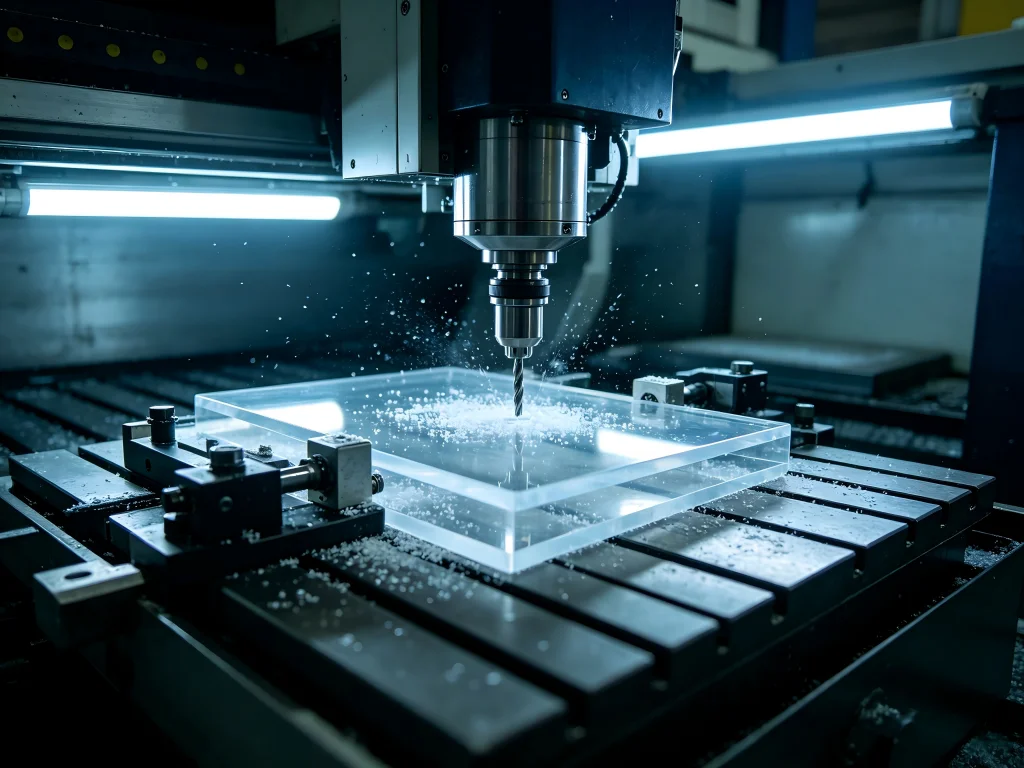
Le paysage des plastiques transparents : le PMMA en contexte
Avant de plonger dans la sélection des fournisseurs, il est essentiel de comprendre où se situe le PMMA au sein de la grande famille des plastiques techniques. Le PMMA, communément appelé acrylique ou connu sous des noms commerciaux comme Plexiglass® et Lucite®, est un thermoplastique transparent qui sert d'alternative légère et résistante aux chocs au verre. Sa caractéristique déterminante est la pureté optique : le PMMA transmet jusqu'à 92% de la lumière visible, ce qui est supérieur au verre standard et supérieur à tout autre plastique transparent courant. Cela en fait le champion incontesté pour les applications où la clarté est primordiale—lentilles, guides de lumière, écrans d'affichage et dispositifs médicaux.
Cependant, cette excellence optique a un compromis. Le PMMA est rigide et résistant aux rayures, mais il est aussi cassant et sensible aux entailles. Une petite fissure peut se propager rapidement sous contrainte, et le matériau est vulnérable aux dommages thermiques pendant l'usinage. C'est là que le choix du partenaire d'usinage devient critique. Un atelier qui traite le PMMA comme de l'aluminium ou même comme d'autres plastiques tels que l'ABS produira presque certainement des pièces avec des contraintes internes, des marques d'outil visibles ou des fissures catastrophiques.
PMMA vs polycarbonate : le compromis fondamental
Pour de nombreux acheteurs, la décision n'est pas simplement “ quel atelier de PMMA ? ” mais “ PMMA ou polycarbonate (PC) ? ” Les deux sont des plastiques transparents et légers adaptés à l'usinage CNC, mais leurs profils de performance sont radicalement différents. Comprendre cette distinction est la première étape pour prendre une décision d'approvisionnement éclairée.
Le polycarbonate est réputé pour sa résistance aux chocs. Il est environ 250 fois plus résistant que le verre et peut absorber une énergie soudaine sans se briser. Cela en fait le matériau de choix pour les vitres pare-balles, les écrans de protection et les boîtiers robustes. Cependant, le PC a une clarté optique inférieure (environ 88-90% de transmission lumineuse) et présente souvent une légère teinte bleue ou grise. Il est également plus tendre et plus sujet aux rayures, et son comportement à l'usinage est totalement différent : le PC est tenace et ductile, produisant de longs copeaux filandreux qui peuvent s'enrouler autour des outils et provoquer des brûlures par frottement.
Le PMMA, en revanche, offre une clarté de surface supérieure directement à la sortie de la machine CNC et se polit jusqu'à obtenir une finition impeccable, semblable à du verre. Il s'usine proprement en fine poudre plutôt qu'en copeaux filandreux, mais il nécessite des outils plus affûtés, des vitesses de broche plus élevées et une gestion thermique méticuleuse pour éviter la fusion ou le fendillement. Un expert de l'industrie sur r/Machinists de Reddit l'a résumé ainsi : “ Le PC est pour les pièces qui doivent survivre à une chute ; l'acrylique est pour les pièces qui doivent avoir l'air d'appartenir à un musée. ”
Le différentiel de coût compte aussi. Le polycarbonate est généralement 35 à 40 % plus cher que le PMMA en tant que matière première. Cependant, les coûts d'usinage du PMMA peuvent grimper rapidement si un post-traitement — en particulier le polissage optique — est requis. Le polissage peut représenter 30 à 50 % du coût total du prototype. Par conséquent, le coût total de possession dépend fortement des exigences de l'application en matière de clarté, de durabilité et de finition de surface.
PMMA coulé vs. extrudé : une distinction critique
Tous les PMMA ne se valent pas. La méthode de fabrication — coulé ou extrudé — affecte profondément l'usinabilité et la qualité finale de la pièce. L'acrylique coulé a un poids moléculaire plus élevé, s'usine plus proprement (produisant de beaux copeaux plutôt que d'encrasser les outils) et se polit avec une clarté supérieure. Il présente également des contraintes internes plus faibles, ce qui le rend moins sujet à la fissuration sous contrainte pendant ou après l'usinage. L'acrylique coulé est le choix privilégié pour les prototypes optiques, les dispositifs médicaux et les vitrines haut de gamme.
L'acrylique extrudé, en revanche, présente des tolérances d'épaisseur plus constantes mais un poids moléculaire plus faible et un point de fusion plus bas. Il a tendance à “ encrasser ” lors de l'usinage et peut souffrir de contraintes internes plus élevées. Bien que les plaques extrudées soient plus économiques et adaptées à la signalétique, aux panneaux lumineux et aux boîtiers simples, elles ne sont pas recommandées pour les applications optiques exigeantes ou porteuses. Un partenaire d'usinage PMMA compétent vous interrogera sur la nuance de votre matériau et pourra même stocker les deux types pour répondre à vos besoins spécifiques.
Critères de sélection clés pour un partenaire d'usinage CNC de PMMA
Choisir un prestataire de services CNC pour des pièces en PMMA exige d'évaluer des capacités qui vont bien au-delà d'une simple affirmation “ nous faisons du CNC ”. Sur la base de discussions sectorielles, d'audits de fournisseurs et des meilleures pratiques techniques, voici les facteurs critiques à évaluer.
1. Stratégie de gestion thermique
La chaleur est la plus grande menace pour la qualité optique du PMMA lors de l'usinage CNC. La friction au niveau de l'arête de coupe peut rapidement générer des températures qui ramollissent le matériau, entraînant des bavures, des marques d'outil et des contraintes internes. Un atelier PMMA compétent disposera d'un protocole documenté de gestion thermique comprenant :
- Un soufflage d'air à haute pression ou une brume d'huile vaporisée plutôt que des liquides de refroidissement aqueux standard, qui peuvent provoquer une interaction chimique et une absorption d'eau.
- Des vitesses de broche et des avances optimisées pour minimiser l'apport de chaleur par coupe. Les paramètres typiques pour le fraisage du PMMA vont de 18,000 to 24,000 RPM with feed rates of 2,500 to 4,000 mm/min.
- Aggressive feed rates that create thick, continuous chips to carry heat away from the workpiece, rather than thin chips that cause rubbing and heat buildup.
During a vendor evaluation, ask specifically about their cooling methods and chip evacuation systems. A shop that cannot articulate a clear thermal strategy is unlikely to deliver consistent optical results.
2. Tooling and Cutting Geometry
Standard end mills designed for metals will ruin PMMA. The material requires tools with specific geometries to slice cleanly rather than push or tear. Key tooling considerations include:
- Positive rake angle: This presents a very sharp, acute cutting edge to the material, facilitating a clean slicing action that generates less friction and heat.
- Polished flutes: The chip evacuation channels must be highly polished to prevent plastic chips from sticking to the tool, which would cause immediate friction and melting.
- Diamond tooling: At Jucheng, we use diamond-polished tools that produce transparent chips and a semi-clear surface right off the machine, significantly reducing polishing time.
- Tool material: High-quality, polished carbide tools are generally preferred over high-speed steel (HSS) for their superior rigidity and edge retention during high-speed cutting.
Ask potential vendors about their tooling inventory and whether they use tools specifically designed for plastics or optical-grade machining. Generic tooling is a red flag.
3. Fixturing and Clamping Methods
PMMA is brittle and sensitive to clamping stress. Excessive clamping force can cause immediate cracking or introduce stress that leads to failure later. A skilled PMMA shop will use:
- Vacuum tables for flat parts to distribute pressure evenly.
- Double-sided tape fixtures for parts that cannot be vacuum-chucked.
- Soft jaws or custom fixtures that minimize point loading.
During the quoting process, ask how the vendor plans to fixture your specific part geometry. A thoughtful fixturing strategy is a strong indicator of overall process maturity.
4. Post-Processing and Polishing Capabilities
A freshly machined PMMA part has a clean but frosted, matte appearance. Unlocking its true optical soul requires a meticulous, multi-stage polishing sequence. This is where many shops fall short. The full process typically includes:
- Precision sanding: A multi-step sequence of wet sanding, starting with medium grits (e.g., P400) and progressing through ultra-fine grits (P1200, P2000) to remove all visible tool marks.
- Buffing and polishing: Using specialized polishing compounds and soft cloth wheels with gentle pressure and continuous movement to ensure a uniform surface.
- Vapor polishing: For internal features or complex geometries that are difficult to reach with mechanical buffing, vapor polishing can restore clarity.
- Final verification: The finished mirror finish is verified using optical inspection equipment.
A vendor that offers only “as-machined” finishes or outsources polishing to a third party may struggle with consistency and quality control. Look for a partner with in-house post-processing capabilities.
5. Quality Control and Certifications
For medical, automotive, or aerospace applications, quality certifications are non-negotiable. Jucheng Precision holds IATF16949 (automotive) and ISO13485 (medical) certifications, reflecting a commitment to rigorous quality management systems. Additionally, ISO 9001:2015 certification ensures that the vendor meets strict quality specifications and maintains documented processes.
Beyond certifications, ask about inspection equipment. A shop with CMM (coordinate measuring machines) and optical comparators can verify tolerances down to ±0.01mm. For PMMA, which can have tight tolerances of ±0.005″ (±0.125mm) or better, this level of inspection capability is essential.
Application Scenarios: Where PMMA CNC Machining Excels
Understanding where and why PMMA is used helps contextualize the selection criteria above. The material’s unique properties make it indispensable in several key industries.
Automotive Lighting and Interior Components
PMMA is a staple in the automotive industry for taillight lenses, instrument cluster covers, and interior ambient lighting. Its ability to be edge-lit—acting like a fiber optic cable—allows designers to create stunning light guides and illuminated panels that seem to glow from within. CNC machining enables the complex 3D shapes, pockets, and undercuts required for modern automotive designs, which cannot be achieved with simple laser cutting. For prototypes and low-volume production, usinage CNC du PMMA offers the precision and surface quality needed for optical validation.
Medical Devices and Optical Instruments
In the medical field, PMMA is used for bone cements, dentures, ocular devices, and even cranioplasty implants. Its biocompatibility, clarity, and ease of sterilization make it a preferred material for diagnostic equipment and surgical instruments. CNC machining of medical-grade PMMA requires strict process control to avoid contamination and ensure dimensional accuracy. Vendors with ISO13485 certification are particularly well-suited for these applications.
Consumer Electronics and Displays
From smartphone screens to AR/VR headset lenses, PMMA’s optical clarity and scratch resistance make it a top choice for transparent components in consumer electronics. CNC machining allows for tight tolerances and complex geometries that are essential for modern device miniaturization. Post-processing capabilities like vapor polishing and hand buffing ensure that prototypes achieve the same level of transparency as molded parts.
Signage, Lighting, and Architectural Elements
PMMA is widely used in signage, light panels, and architectural glazing due to its UV resistance and weatherability. It does not yellow or become brittle easily, making it ideal for outdoor applications. CNC machining enables the production of custom shapes, edge-lit signs, and decorative panels with high-fidelity finishes.
Comparative Analysis: PMMA vs. Alternative Manufacturing Methods
While CNC machining is the gold standard for precision PMMA parts, it is not the only option. Understanding the trade-offs between CNC machining, laser cutting, and injection molding can help you make a more informed sourcing decision.
| Manufacturing Method | Precision & Tolerances | Finition de surface | Complex Geometry | Volume Suitability | Cost Structure |
|---|---|---|---|---|---|
| CNC Machining | ±0.01mm to ±0.125mm | Excellent (can achieve optical clarity with polishing) | High (3D shapes, pockets, undercuts) | Prototype to medium-volume | Higher per-part cost, lower tooling cost |
| Laser Cutting | Lower (2D profiles only) | Fair (may require edge polishing) | Low (2D only) | Prototype to medium-volume | Lower per-part cost for flat sheets |
| Injection Molding | High (consistent) | Excellent (molded finish) | High (complex 3D shapes) | High-volume only | Low per-part cost, very high tooling cost |
As the table illustrates, CNC machining occupies a unique sweet spot: it offers the precision and geometric flexibility of molding without the prohibitive tooling costs, and it can achieve optical finishes that laser cutting cannot match. For prototypes, low-volume production, or parts with complex 3D features, usinage CNC du PMMA is often the most cost-effective and technically viable option.
Red Flags and Green Flags: What the Community Says
Online communities like Reddit’s r/CNC, r/AskEngineers, and various Facebook machining groups are rich sources of real-world vendor experiences. Here are some commonly cited red flags and green flags that can help you evaluate potential partners.
Red Flags
- Vague process descriptions: A vendor that says “we can machine anything” but cannot articulate specific strategies for PMMA (tooling, cooling, fixturing) is likely inexperienced.
- No in-house polishing: If polishing is outsourced, quality control becomes difficult, and lead times increase.
- Unwillingness to share material grades: A shop that does not distinguish between cast and extruded acrylic may not understand the material’s nuances.
- History of stress cracking: Multiple negative reviews mentioning cracked or crazed parts are a strong indicator of poor thermal or fixturing practices.
Green Flags
- Material expertise: The vendor asks about your application, recommends cast vs. extruded PMMA, and discusses stress-relief annealing.
- Inspection capabilities: The shop has CMM machines, optical comparators, and documented quality control procedures.
- Transparent quoting: The quote breaks down costs for material, machining, and post-processing, and the vendor is willing to discuss design for manufacturability (DFM).
- Industry certifications: ISO 9001, IATF16949, or ISO13485 certifications demonstrate a commitment to quality systems.
Why Jucheng Precision Stands Out in PMMA CNC Machining
Jucheng Precision has established itself as a trusted partner for usinage CNC du PMMA through a combination of technical expertise, advanced equipment, and rigorous quality control. With over 13 years of experience and certifications including IATF16949 and ISO13485, the company serves industries ranging from automotive and medical to consumer electronics and lighting.
Key differentiators include:
- Specialized PMMA tooling: Jucheng uses diamond-polished tools and optimized cutting paths to minimize tool marks and reduce polishing time.
- In-house post-processing: The company offers a full suite of finishing services, including vapor polishing, hand buffing, and sandblasting, all performed in-house to ensure quality control.
- Advanced 5-axis CNC mills: These machines can create complex 3D shapes, pockets, and undercuts that are impossible with laser cutting or 3-axis machining.
- Material variety: Jucheng stocks clear, tinted, and frosted acrylic in various thicknesses, as well as cast and extruded grades.
- Rigorous quality control: With CMM inspection and documented quality processes, Jucheng ensures that every part meets the specified tolerances and surface finish requirements.
- Global reach and scalability: With over 55 high-precision 3 and 5-axis CNC machines and a monthly output of 10,000 pieces, Jucheng can handle projects from prototyping to low-volume production.
One Reddit user in r/engineering noted, “We’ve used Jucheng for several optical-grade acrylic projects. Their DFM feedback saved us from a costly redesign, and the parts came back with zero crazing—something our previous vendor couldn’t achieve.” Another Facebook comment in a CNC group highlighted their responsiveness: “They actually answer technical questions instead of just sending a generic quote. That’s rare in this industry.”
Frequently Asked Questions About PMMA CNC Machining
1. Is CNC machining a good career path for someone interested in plastics?
Yes, CNC machining offers strong career prospects, particularly for specialists who understand challenging materials like PMMA. The demand for skilled machinists who can handle optical-grade plastics is growing, driven by industries like medical devices, automotive lighting, and consumer electronics. Certification programs and community college courses can provide entry points, and experienced machinists with plastics expertise often command premium wages.
2. What are some common CNC machining examples using PMMA?
Common examples include automotive taillight lenses, instrument cluster covers, light guides for interior lighting, medical device housings, diagnostic equipment components, display screens for consumer electronics, signage, and architectural glazing.
3. How can I find a CNC machining course near me?
Many community colleges and technical schools offer CNC machining programs. Online platforms like Coursera and Udemy also provide introductory courses. For specialized plastics machining, look for programs that include materials science and advanced manufacturing techniques. Industry associations like the National Tooling and Machining Association (NTMA) can also provide training resources.
4. How to become a certified CNC machinist?
Becoming a certified CNC machinist typically involves completing a formal training program (apprenticeship or technical school) and passing certification exams such as those offered by the National Institute for Metalworking Skills (NIMS). Certifications cover areas like CNC milling, turning, and materials. Specializing in plastics or optical machining can further enhance your credentials.
5. What is the typical tolerance for PMMA CNC machining?
PMMA parts can achieve tolerances as tight as ±0.01mm (±0.0004″) with advanced equipment and skilled operators. Standard tolerances are typically around ±0.05mm to ±0.125mm depending on part geometry and size. Achieving tight tolerances requires proper tooling, thermal management, and fixturing.
6. Can PMMA be machined to an optical finish?
Yes, PMMA can be machined to an optical or mirror finish through a meticulous multi-stage process of sanding, buffing, and vapor polishing. Achieving this level of finish requires specialized tooling, thermal management, and skilled post-processing technicians. Not all CNC shops have this capability, so it is important to verify a vendor’s polishing expertise.
7. What is the difference between cast and extruded PMMA for CNC machining?
Cast acrylic has a higher molecular weight, machines more cleanly, and polishes to a superior clarity. It also has lower internal stress, making it less prone to cracking. Extruded acrylic has more consistent thickness tolerances but a lower melting point and higher internal stress, making it more prone to gumming up tools and stress cracking. Cast acrylic is recommended for optical and demanding applications.
8. How does PMMA compare to polycarbonate for CNC machining?
PMMA offers superior optical clarity (92% light transmission vs. 88-90% for PC) and better scratch resistance. However, it is brittle and more prone to cracking under impact. Polycarbonate is extremely tough and impact-resistant (250x stronger than glass) but has lower clarity and is more difficult to machine to a flawless finish. The choice depends on whether optical clarity or impact resistance is the priority.
Making Your Decision: A Practical Checklist
Before selecting a usinage CNC du PMMA partner, use this checklist to evaluate potential vendors:
- Material expertise: Does the vendor distinguish between cast and extruded PMMA? Do they recommend a grade based on your application?
- Thermal management: Can they describe their cooling methods, spindle speeds, and feed rates for PMMA?
- Tooling: Do they use tools with positive rake angles, polished flutes, and diamond or carbide materials?
- Maintien en position: How do they plan to fixture your part to avoid stress cracking?
- Post-traitement: Are polishing, sanding, and finishing performed in-house? What is their typical lead time for optical finishes?
- Quality control: What inspection equipment do they use? Do they have ISO 9001, IATF16949, or ISO13485 certifications?
- References: Can they provide case studies or references for similar PMMA projects?
- Communication: Do they offer DFM feedback and respond to technical questions promptly?
Choosing the right partner for usinage CNC du PMMA is not just about finding the lowest quote. It is about finding a vendor who understands the material’s unique challenges and has the processes, equipment, and expertise to deliver consistent, high-quality results. By applying the criteria and insights in this guide, you can avoid the common pitfalls that plague PMMA projects and ensure your next transparent plastic part achieves both optical excellence and structural integrity.
Whether you are developing a new automotive lighting system, a medical diagnostic device, or a consumer electronics prototype, the right machining partner can make the difference between a product that dazzles and one that disappoints. Choose wisely, and your PMMA components will not just meet specifications—they will exceed expectations.