
ビーズブラストは拡散したマットな質感を生み出し、ブラッシングは方向性のある筋目を生み出し、研磨は目に見える質感を明るいまたは鏡のような表面に向けて低減します。. 視覚的な違いは明らかですが、エンジニアリング上の違いは見落とされがちです。各プロセスは、エッジ、工具痕、粗さ、取り扱い感度、コーティング準備、検査、工数、ロットの一貫性をそれぞれ異なる形で変化させます。仕上げは、顧客がその部品をどのように見て、触れ、組み立て、清掃するかに基づいて選択すべきです。.
同じ機械加工パネル上の3つの仕上げ
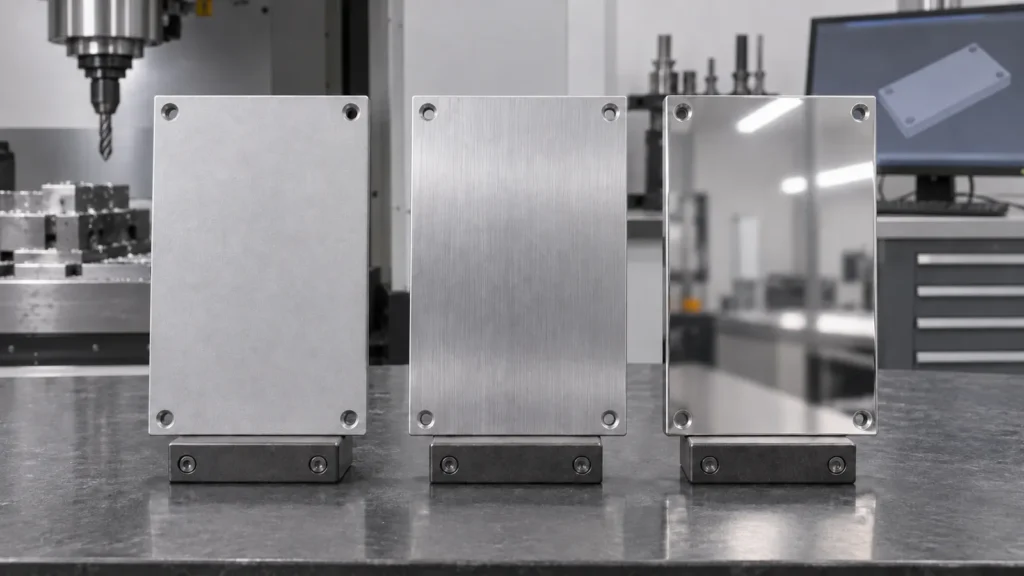
どれも自動的に「より高品質」というわけではありません。マットな計器ハウジング、ブラッシングされた家電トリム、研磨されたディスプレイ部品は、それぞれ異なるデザイン意図を伝えます。品質とは、選択された質感が再現可能で、材料と適合し、明確な視覚基準によって承認されることを意味します。.
これら3つの機械的処理を超える処理については、 CNC加工表面仕上げガイド を使用して、コーティング、化成処理、めっき、および機械加工ままの表面を比較してください。.
仕上げを製品の視覚言語に合わせる

各プロセスは異なる痕跡を残す
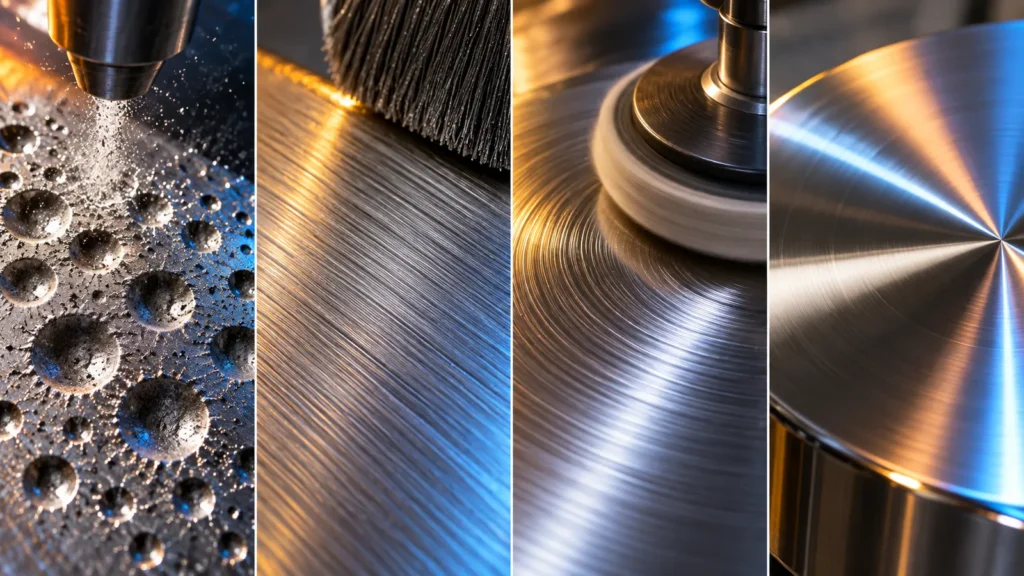
メディアが表面に衝突し、小さな衝撃の場を形成する。メディアの種類、サイズ、圧力、角度、距離、滞留時間、材料硬度、および作業者の経路が結果に影響する。ブラストは外観を統一できるが、鋭いエッジを鈍らせ、粗さを変化させ、汚染を埋め込み、または小さな穴やねじに影響を与える可能性がある。マスキングは機能的な管理であり、単なる外観上の好みではない。.
ヘアライン加工:方向性のあるテクスチャ
研磨ベルト、ホイール、パッド、またはその他の制御された接触により、直線状の目が生じる。目は製品の形状の一部となる。隣接するパネルは同じ方向に走らせる必要があり、コーナーには移行規則が必要であり、再加工は光の反射が異なる局所的なパッチを生じさせる可能性がある。.
研磨:反射に向けた除去
段階的に細かい研磨とバフ研磨により、傷を減らし、明るい表面を生み出すことができる。研磨は材料を除去し、エッジを丸め、低い箇所を露出させ、軟らかい金属をスミアさせ、または平坦度を変化させる可能性がある。鏡のような外観は、既存の波打ちや取り扱いに対して特に敏感である。.
これらの表面性状は触感にも影響します。ブラスト加工された表面は乾いた拡散的な感触を与え、ヘアライン加工された表面は指先で方向性を伝え、研磨された面は滑らかですが皮脂の跡が目立ちやすくなります。顧客が部品を繰り返し手に取る場合は、展示専用のサンプルで判断するのではなく、意図する仕上げで清掃性と指紋の目立ちやすさを試験してください。.
1つの部品に複数の仕上げを施す場合は、境界の管理が必要です。ヘアライン加工部と研磨部の間の鮮明な境界には、マスキングや機械加工による区切り線が必要になることがあります。意図的な境界を設けないと、行き過ぎやぼかしによって、個々の局所的なテクスチャが許容範囲であっても、部品が手直しされたように見えることがあります。.
化粧サンプルの前に形状監査を実施する
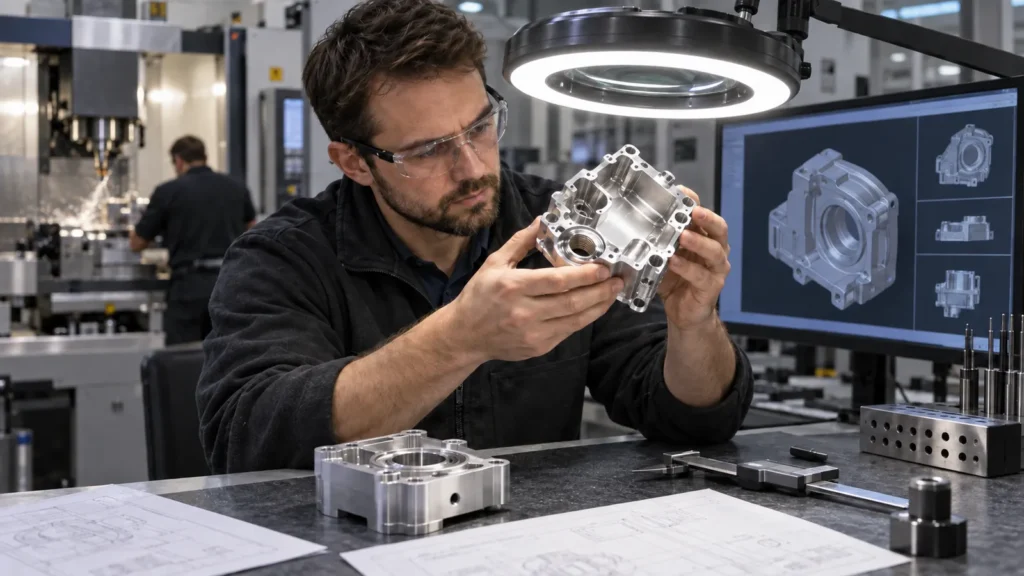
- 鋭いエッジ: ブラスト加工や研磨はエッジの性状を変化させる可能性があり、ヘアライン加工は移行部で目を乱すことがあります。.
- 深いポケット: メディアや工具が均一に届かない可能性があり、残留物の除去がより困難になることがあります。.
- ねじ山とボア: 嵌合、清浄度、ゲージ合格を保護してください。.
- 薄肉部: 研磨の圧力と熱により、柔軟な部分が変形する可能性があります。.
- 浮き出し文字と彫刻: 仕上げによって細部が鈍ったり、形状の周囲に影が生じたりすることがあります。.
- 大きな反射パネル: even minor waviness becomes visually amplified.
- Joined assemblies: parts finished separately may not align in grain, gloss, or reflection.
The dedicated pages for bead blasting services, brushed metal finishes, 、そして mirror polishing can help identify process-specific questions for this audit.
The Next Process May Choose the Finish for You
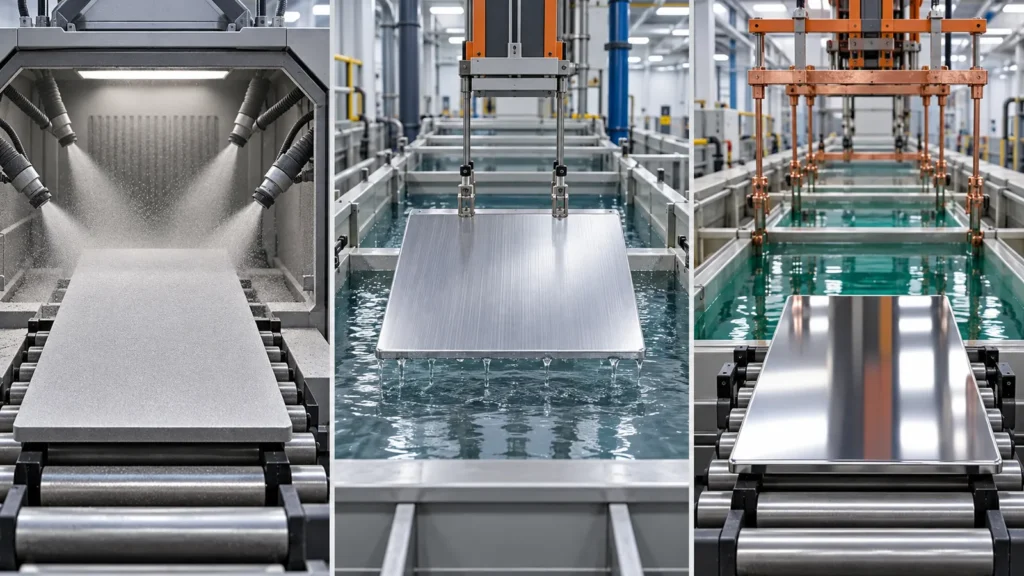
| Downstream need | Question for the mechanical finish |
|---|---|
| Anodizing | Will the preparation produce uniform texture across alloy lots and machined zones? |
| Powder or paint | Is the surface clean and appropriate for adhesion without damaging interfaces? |
| Plating | Will substrate scratches, pits, or waviness remain visible through the deposit? |
| Laser marking or printing | Does texture support contrast, focus, adhesion, and readability? |
| Adhesive bonding | Should the bond zone be prepared separately and protected from polish compounds? |
Sequence is critical. If blasting follows a fine engraving operation, the mark may lose contrast; if brushing follows machining, the grain may cross a datum edge or change the apparent straightness of a panel. Put the complete process order on the manufacturing plan and approve samples made in that order.
Cleaning between steps must also be compatible with the next process. Embedded media, abrasive residue, buffing compound, and fingerprints can create adhesion, staining, or color problems later. A cosmetic finish is therefore also a cleanliness-control operation.
Build an Acceptance Board, Not a String of Adjectives
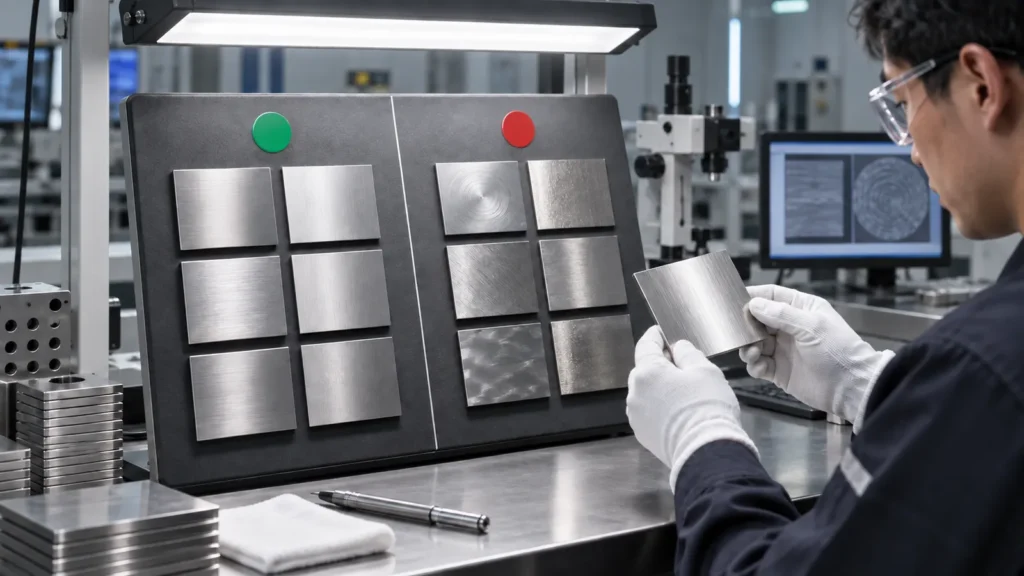
Record these visual controls
- Texture direction and orientation relative to the part
- Gloss, reflectivity, or matte target by approved sample
- Allowable scratches, dents, stains, rack marks, and edge variation
- Primary, secondary, and hidden cosmetic zones
- Part-to-part and lot-to-lot matching expectations
- Handling gloves, separators, film, and final packaging
A roughness value can supplement this standard when function requires it, but it cannot replace visual reference samples for directional grain or mirror quality.
Where the Cost Really Comes From
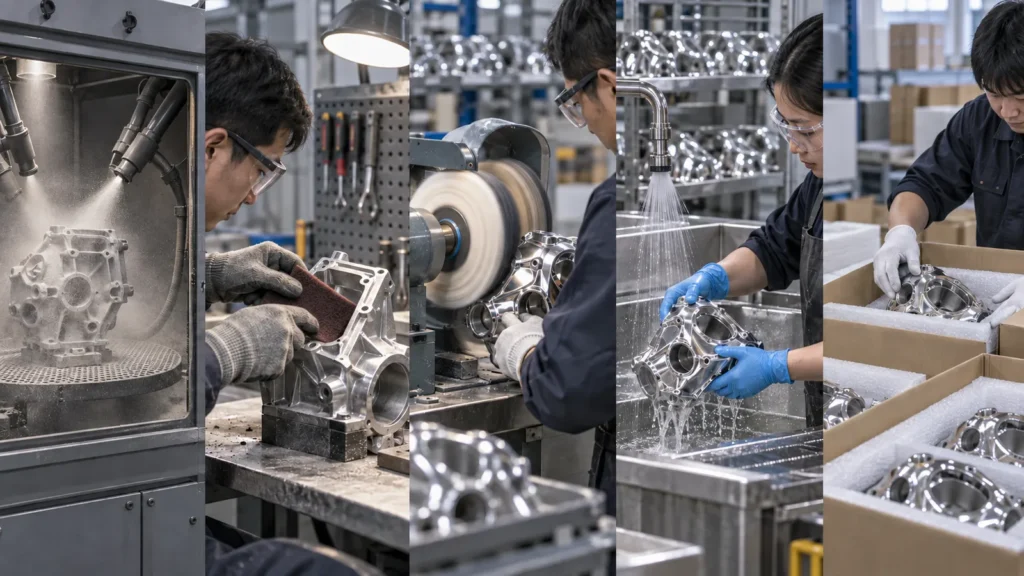
Cost can often be reduced by narrowing the cosmetic zone, choosing a texture that tolerates the real environment, avoiding finish on hidden faces, designing tool access, and approving a realistic sample early. The cheapest process is the one that meets the product’s visual language without creating recurring rework.
Automation changes the cost structure but does not remove the need for a standard. Robotic brushing or polishing can improve repeatability on accessible paths, while complex recesses and transitions may remain manual. Quote reviews should identify which surfaces are automated, manually blended, or excluded so scale-up does not silently change appearance.
Yield is another hidden driver. A demanding mirror zone can be rejected for a defect that would be invisible on matte texture. Include expected cosmetic yield and rework limits when comparing finishes for high-volume production.
A Designer’s Selection Sequence
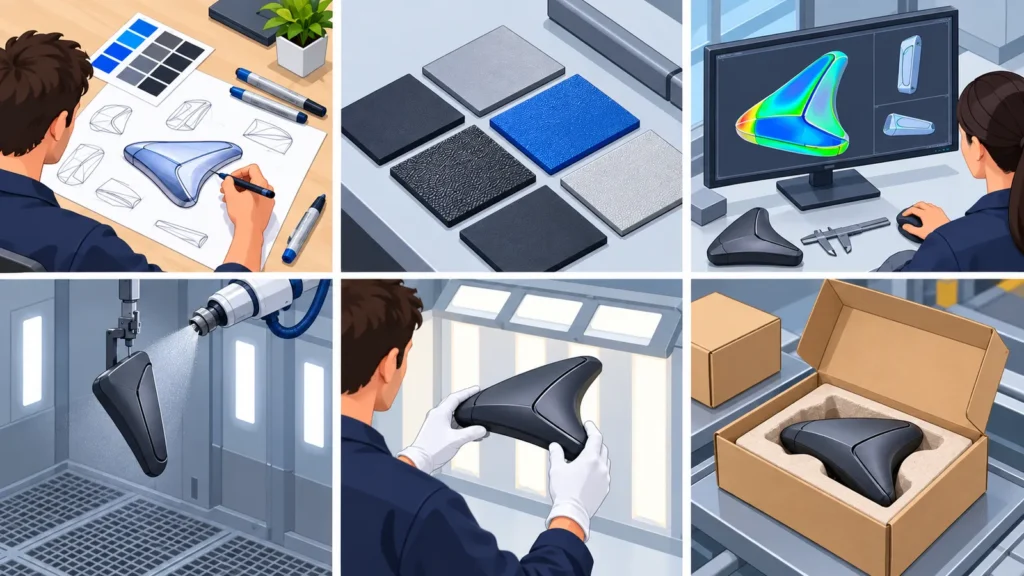
This sequence turns an aesthetic preference into an auditable manufacturing specification. It also gives the supplier room to recommend a process that reaches the intended look on the actual geometry.
Short Answers to Common Finish Questions
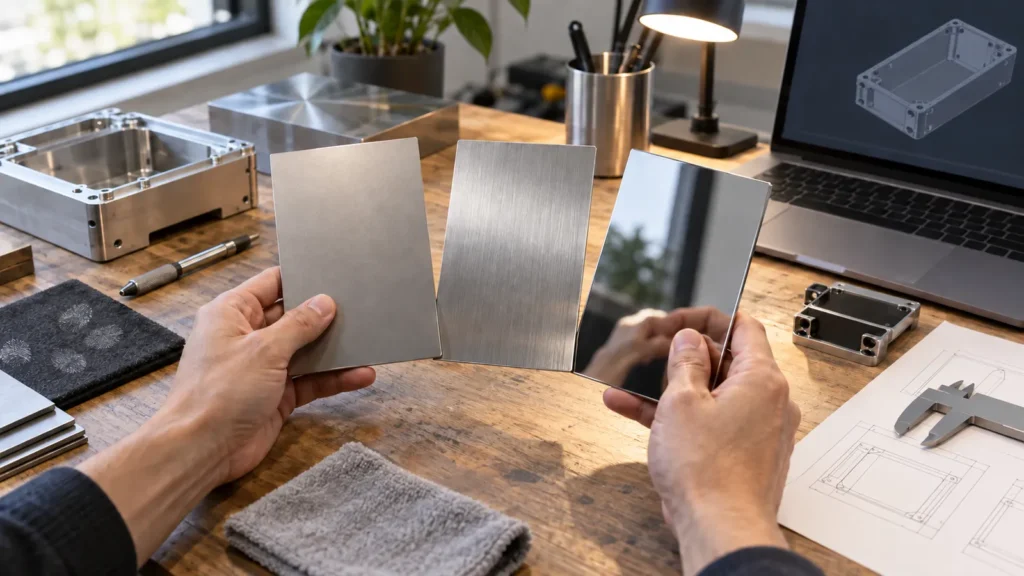
Bead blasting can reduce the visual dominance of consistent light tool marks, but it does not erase deep grooves, chatter, dents, or waviness. Brushing may incorporate marks into a directional texture. Polishing can remove marks but may reveal low spots and geometry variation.
Is a mirror finish the smoothest finish?
A mirror-like appearance suggests low visible texture, but visual reflectivity and measured functional roughness are not identical. Specify roughness separately when sealing, friction, flow, or cleanability is critical.
Can blasted and brushed parts match across production lots?
They can be controlled, but repeatability depends on material lot, starting surface, media or abrasive condition, machine settings, operator path, part orientation, downstream treatment, and inspection. Approved samples and recorded process conditions reduce ambiguity.
Should cosmetic finishes cover threads and sealing faces?
Usually they require separate review. Protect or specially control any surface whose fit, sealing, grounding, bonding, or cleanliness could be harmed by the cosmetic process.