
In der sich wandelnden Landschaft der modernen Fertigung war die Nachfrage nach komplexen Geometrien und mikroskopischen Toleranzen noch nie so hoch. Unter der vielfältigen Palette subtraktiver Fertigungstechnologien, Kegelschneiden mit Drahterodieren ragt als Höhepunkt der Präzision hervor. Dieses spezialisierte Verfahren ermöglicht es Ingenieuren, komplexe, winklige Formen in gehärteten Materialien zu erzeugen, die durch konventionelles Fräsen oder Drehen unmöglich zu erreichen wären. Ob Sie Luft- und Raumfahrtkomponenten oder hochpräzise medizinische Geräte entwickeln – das Verständnis der Nuancen von was ist EDM-Drahtschneiden und wie es komplexes Kegelschneiden ermöglicht, ist unerlässlich, um im heutigen Industriemarkt wettbewerbsfähig zu bleiben.
Während Branchen die Grenzen des Designs erweitern, jucheng hat sich als führend bei der Bereitstellung von High-End-CNC-Lösungen etabliert, die diese spezifischen Anforderungen erfüllen. Durch den Einsatz fortschrittlicher elektrischer Entladungstechnologie bietet der EDM-Drahtschneideprozess eine berührungslose Methode der Materialabtragung, die sicherstellt, dass selbst die empfindlichsten Werkstücke frei von mechanischer Belastung bleiben. In diesem umfassenden Leitfaden werden wir die mechanischen Prinzipien, Betriebsverfahren und strategischen Vorteile der Nutzung von Kegelschneiden mit Drahterodieren in Ihrer Produktionslinie untersuchen.
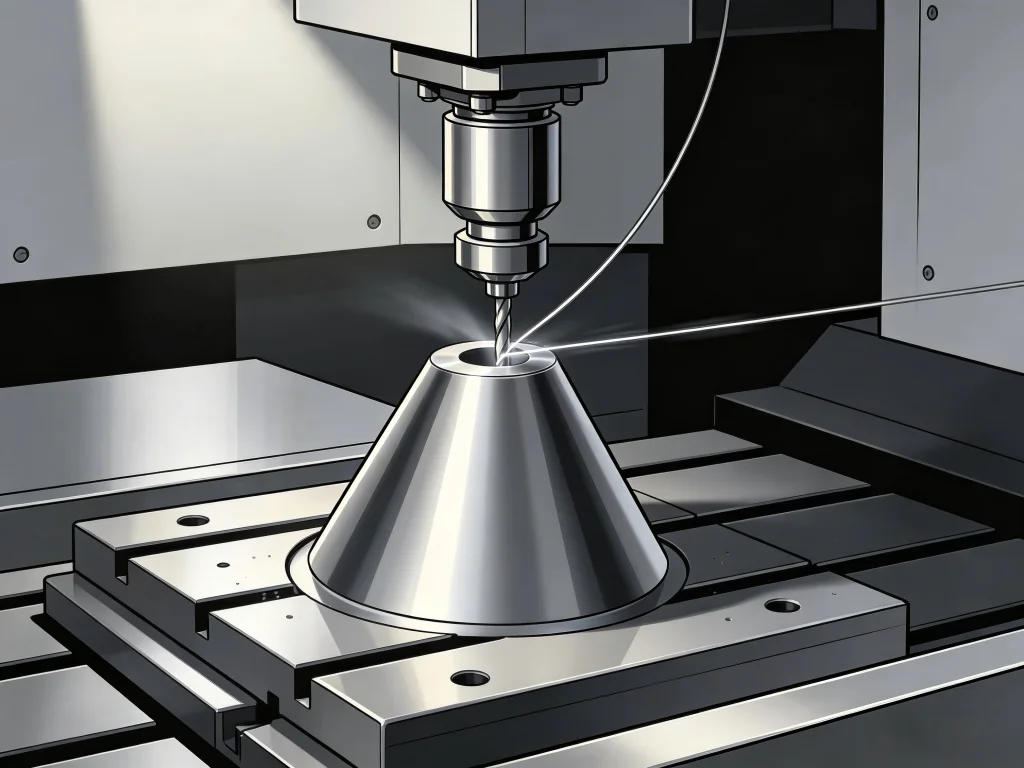
Die Grundlagen verstehen: Was ist EDM-Drahtschneiden?
Um die Komplexität des Kegelschneidens zu erfassen, muss man zunächst die Kerntechnologie definieren. Das EDM-Drahtschneideprozess, auch bekannt als Wire Electrical Discharge Machining (WEDM), beinhaltet die Verwendung eines dünnen, elektrisch geladenen Drahtes, um durch ein leitfähiges Material zu “schneiden”. Dieser Draht, oft als der EDM-Drahtschneidwerkzeug, berührt das Werkstück nicht tatsächlich. Stattdessen erzeugt er eine Reihe schneller elektrischer Funken zwischen dem Draht und dem Material, eingetaucht in ein dielektrisches Fluid – üblicherweise deionisiertes Wasser.
Die EDM-Drahtschneidverfahren wird durch kontrollierte Erosion gesteuert. Während die Funken auftreten, schmelzen und verdampfen sie kleine Mengen des Materials, die dann vom dielektrischen Fluid weggespült werden. Dies ermöglicht die Erzeugung extrem feiner Details und scharfer Innenkanten. In einer Standard-2-Achsen-Maschine bleibt der Draht vertikal. In Kegelschneiden mit Drahterodieren, nutzt die Maschine ein 4-Achsen- oder 5-Achsen-System, bei dem sich die oberen und unteren Drahtführungen unabhängig voneinander bewegen (U- und V-Achsen relativ zu X und Y), wodurch der Draht in präzisen Winkeln geneigt werden kann.
Die Rolle des EDM-Drahtschneiddrahts
Die Wahl des EDM-Drahtschneidedrahts ist entscheidend für den Erfolg der Operation. Am häufigsten wird Messingdraht verwendet, aufgrund seiner hervorragenden Leitfähigkeit und Zugfestigkeit. Für spezialisierte Konusanwendungen können jedoch zinkbeschichtete oder hochfeste Molybdändrähte eingesetzt werden. Der Durchmesser des Drahtes – typischerweise zwischen 0,1 mm und 0,3 mm – bestimmt die “Schnittfuge” bzw. die Breite des Schnitts. Beim Konusschneiden muss der Draht eine konstante Spannung aufrechterhalten, um “Drahtnachlauf” zu verhindern, der zu Ungenauigkeiten an der Ober- oder Unterseite des Werkstücks führen könnte.
Die technische Mechanik des Konusierens
Die Fähigkeit, den Draht zu neigen, erfordert eine hochentwickelte CNC-Steuerung. Während des EDM-Drahtschneidverfahren, berechnet die Software den Versatz für sowohl die obere als auch die untere Führung. Dies ist keine einfache lineare Bewegung; die Steuerung muss die Änderung der Drahtlänge und den variierenden Funkenabstand berücksichtigen, der durch den Winkel verursacht wird. Viele Anwender in Foren wie Reddit diskutieren häufig die Funktion “Konuskompensation”, die in High-End-Maschinen wie denen von jucheng, zu finden ist, welche automatisch Drahtflexion und geometrische Verzerrung ausgleicht.
Es gibt im Allgemeinen zwei Arten von Konen, die in diesem Prozess erzielt werden:
- Konstanter Konus: Bei dem der Winkel über das gesamte Profil des Schnitts gleich bleibt.
- Variable Taper: Where the angle changes as the wire moves along the path, allowing for complex transitional shapes from a square base to a circular top, for example.
Core Applications Across High-Tech Industries
The versatility of Kegelschneiden mit Drahterodieren makes it indispensable in several sectors. Because the process is unaffected by material hardness, it is the preferred choice for working with titanium, inconel, and hardened tool steels. jucheng has seen a significant uptick in clients from the following fields:
1. Tool and Die Making
This is the traditional home of the EDM-Drahtschneideprozess. Tapered holes are essential for extrusion dies and injection molds, where a “draft angle” is required to allow the finished part to be ejected easily. The precision of the EDM-Drahtschneidwerkzeug ensures that these angles are consistent within microns.
2. Aerospace Engineering
In aerospace, components often feature complex cooling holes or interlocking turbine blade roots. These geometries require the multi-axis movement that only Kegelschneiden mit Drahterodieren can provide. The lack of heat-affected zones (HAZ) compared to laser cutting is a major benefit for flight-critical parts.
3. Medical Device Manufacturing
Surgical instruments and orthopedic implants often require intricate, tapered slots. The EDM-Drahtschneidedrahts can navigate these tiny paths without burring, which is vital for components that will be used inside the human body.
Critical Factors When Choosing an EDM Solution
Selecting the right machinery and partner is a strategic decision. Users often debate the merits of various brands on platforms like Facebook industry groups, but several objective factors should guide your choice:
| Factor | Beschreibung | Impact on Quality |
|---|---|---|
| Positional Accuracy | The ability of the X, Y, U, and V axes to move to the exact coordinates. | Directly affects the dimensional tolerance of the taper. |
| Generator Technology | How the machine manages the electrical pulse. | Determines the surface finish (Ra value) and cutting speed. |
| Wire Tension Control | The system that keeps the EDM-Drahtschneidedrahts taut during angled moves. | Prevents “belly” or curvature in the tapered surface. |
| Dielectric System | Filtration and temperature control of the deionized water. | Ensures consistent spark conditions and prevents thermal expansion of parts. |
Installation and Maintenance: Ensuring Longevity
To maintain the high precision of Kegelschneiden mit Drahterodieren, a rigorous maintenance schedule is required. The environment plays a significant role; machines should ideally be placed in a temperature-controlled room to avoid the expansion and contraction of the machine casting. jucheng recommends the following routine checks:
- Power Feed Contact Cleaning: The points where electricity is transferred to the wire must be kept clean of debris to prevent “arcing” and wire breakage.
- Filter Replacement: The dielectric fluid must be pristine. Clogged filters lead to poor flushing, which causes unstable sparks and a rougher surface finish.
- Resin Monitoring: Deionized water needs a specific conductivity level. Ion exchange resins must be replaced when the water becomes too conductive.
- Guide Alignment: For taper cutting, the vertical alignment of the upper and lower guides (the “zero” position) must be calibrated frequently using a master square or laser alignment tool.
The Jucheng Advantage: Why We Lead in EDM Tech
Choosing jucheng means more than just buying a machine; it means investing in a partnership. Our Kegelschneiden mit Drahterodieren systems are engineered with the latest CNC controllers, capable of handling 45-degree tapers with ease. We understand that in the EDM-Drahtschneideprozess, reliability is paramount. That is why our machines feature high-rigidity castings and ultra-precise linear scales.
Our commitment to the EDM-Drahtschneidverfahren extends to our support. We provide extensive training for operators, ensuring they can maximize the potential of the EDM-Drahtschneidwerkzeug. From selecting the right EDM-Drahtschneidedrahts for a specific alloy to optimizing cutting parameters for speed vs. finish, jucheng is there to guide you through every micron of the process.
Häufig gestellte Fragen (FAQ)
1. What is the maximum angle possible in taper cutting wire edm?
While standard machines can handle 10-15 degrees, high-performance machines from jucheng can achieve tapers up to 45 degrees or more, depending on the height of the workpiece and the guide configuration. It is important to note that as the angle increases, the maximum thickness of the workpiece the machine can cut may decrease.
2. Does wire cutting produce heat that could damage the part?
Die EDM-Drahtschneideprozess is a thermal process, but it is extremely localized. The dielectric fluid acts as a coolant, immediately quenching the area. While a microscopic “recast layer” exists, it is significantly smaller than the heat-affected zone found in laser or plasma cutting, making it safe for most precision applications.
3. How do I choose the right edm wire cut wire?
For most general purposes, a standard brass wire is sufficient. However, if you are performing high-speed cutting or working with very thick materials, a zinc-coated wire might be better as it offers better flushing properties. For ultra-fine details, a tungsten or molybdenum wire might be used due to its high tensile strength at small diameters.
4. What is the typical surface finish of a wire-cut part?
With multiple “skim passes,” a Kegelschneiden mit Drahterodieren machine can achieve a mirror-like finish with an Ra value of less than 0.1 μm. The initial “rough cut” will be much coarser, but subsequent passes using lower energy levels refine the surface.
5. Can I cut non-conductive materials?
No, the EDM-Drahtschneidverfahren requires the material to be electrically conductive. This includes all metals, graphite, and some ceramics. If the material does not allow electricity to pass through it, the spark cannot be generated.
6. Is the edm wire cut tool reusable?
No, the wire used in EDM-Drahtschneideprozess is used only once. It is fed from a supply spool, passes through the workpiece, and is then collected in a scrap bin or chopped for recycling. This ensures that a fresh, perfectly round wire is always at the point of the cut, which is vital for maintaining precision.
7. Why is deionized water used instead of oil?
Most wire EDM machines use deionized water because it has a lower viscosity than oil, allowing it to flush the tiny kerf more effectively. However, some specialized “oil-based” wire machines exist for even finer surface finishes and smaller spark gaps.
8. How does Jucheng ensure machine accuracy over time?
jucheng utilizes hand-scraped surfaces on critical components and high-grade ball screws. Additionally, our software includes pitch error compensation and thermal growth compensation to ensure that the machine remains accurate even during long production runs in varying temperatures.
Solving Complex Geometries: A Problem/Solution Approach
Imagine a scenario where a manufacturer needs to produce a series of complex extrusion dies for a new automotive seal. These dies require a variable taper that changes continuously along a 3D path. Traditional machining would require a 5-axis mill, but the hardness of the D2 tool steel makes tool wear an expensive nightmare. Furthermore, the sharp internal corners are impossible for a physical cutting tool to reach.
Hier Kegelschneiden mit Drahterodieren acts as the ultimate solution. By using the EDM-Drahtschneidwerkzeug, the manufacturer can program the exact taper into the CNC. Because there is no physical force between the wire and the steel, there is no tool deflection. The EDM-Drahtschneideprozess carves through the hardened steel with the same ease as soft aluminum. The result is a perfect die with a surface finish that requires no manual polishing, significantly reducing lead times and costs.
Furthermore, by utilizing the high-speed capabilities of jucheng equipment, the EDM-Drahtschneidverfahren can be automated for overnight runs. This solves the “bottleneck” problem often found in tool rooms. By the time the technicians arrive in the morning, the complex tapered parts are finished, cleaned, and ready for assembly. This efficiency is why modern shops are increasingly moving toward advanced EDM solutions to solve their most difficult geometry puzzles.
Conclusion
In conclusion, Kegelschneiden mit Drahterodieren is a sophisticated and indispensable technology for any manufacturer dealing with high-precision, complex geometries. From the initial understanding of was ist EDM-Drahtschneiden to the selection of the correct EDM-Drahtschneidedrahts, every step of the process requires technical expertise and reliable equipment. Whether you are tackling a specific production problem or looking to upgrade your facility’s capabilities, jucheng offers the technology and support necessary to achieve excellence. By focusing on precision, maintenance, and the right application of the EDM-Drahtschneideprozess, you can ensure that your components meet the highest standards of the modern industrial world.
Ready to elevate your machining precision? Explore the full range of high-performance CNC and EDM solutions at jucheng. Our team of experts is ready to help you optimize your EDM-Drahtschneidverfahren for maximum efficiency and accuracy. Contact us today to discuss your next project!