
No cenário em evolução da manufatura moderna, a demanda por geometrias complexas e tolerâncias microscópicas nunca foi tão alta. Entre a diversificada gama de tecnologias de manufatura subtrativa, corte cônico em EDM a fio destaca-se como o ápice da precisão. Esse processo especializado permite que engenheiros criem formas complexas e anguladas em materiais endurecidos que seriam impossíveis de obter por meio de fresamento ou torneamento convencionais. Seja no desenvolvimento de componentes aeroespaciais ou dispositivos médicos de alta precisão, compreender as nuances do o que é corte a fio por EDM e como ele viabiliza a conicidade complexa é essencial para se manter competitivo no mercado industrial atual.
À medida que as indústrias ampliam os limites do design, jucheng emergiu como líder no fornecimento de soluções CNC de alto padrão que atendem a essas necessidades específicas. Ao aproveitar a tecnologia avançada de descarga elétrica, o processo de corte por fio de EDM fornece um método de remoção de material sem contato, garantindo que mesmo as peças mais delicadas permaneçam livres de tensões mecânicas. Neste guia abrangente, exploraremos os princípios mecânicos, os procedimentos operacionais e as vantagens estratégicas de utilizar corte cônico em EDM a fio na sua linha de produção.
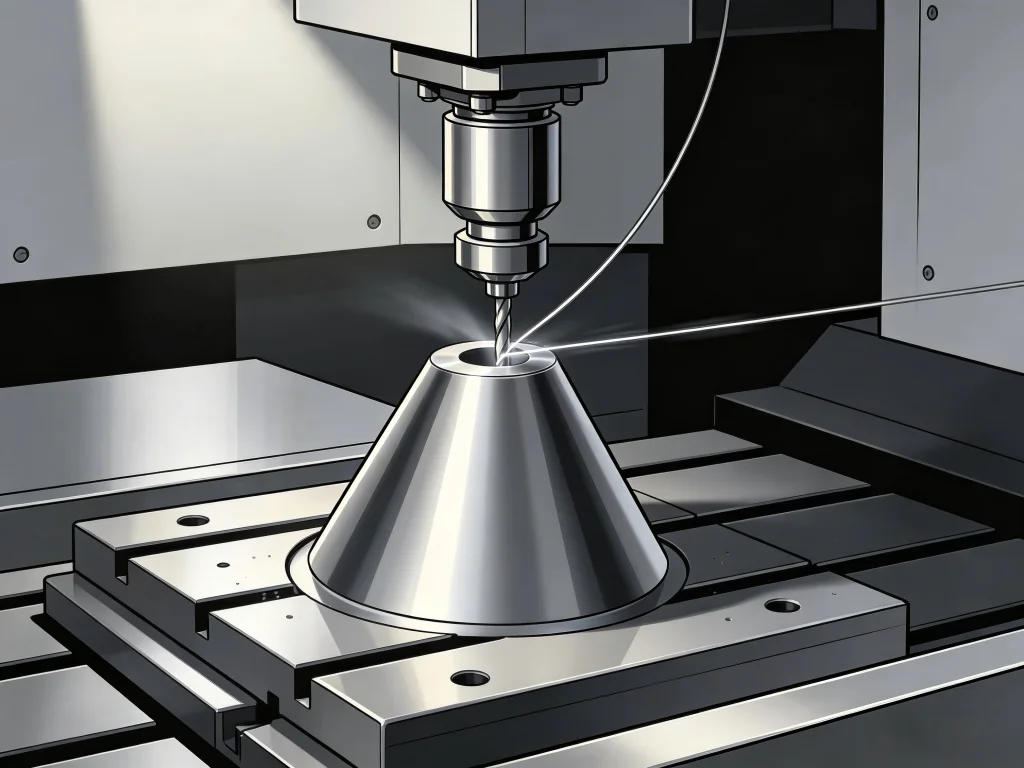
Compreendendo os Fundamentos: O que é Corte por Fio de EDM?
Para compreender a complexidade do corte cônico, é preciso primeiro definir a tecnologia central. O processo de corte por fio de EDM, também conhecido como Usinagem por Descarga Elétrica a Fio (WEDM), envolve o uso de um fio fino, eletricamente carregado, para “fatiar” um material condutor. Este fio, frequentemente referido como a ferramenta de corte por fio de EDM, na verdade não toca a peça de trabalho. Em vez disso, cria uma série de faíscas elétricas rápidas entre o fio e o material, submersos em um fluido dielétrico — geralmente água deionizada.
O procedimento de corte por fio de EDM é regido por erosão controlada. À medida que as faíscas ocorrem, elas derretem e vaporizam pequenas quantidades do material, que são então removidas pelo fluido dielétrico. Isso permite a criação de detalhes extremamente finos e cantos internos afiados. Em uma máquina padrão de 2 eixos, o fio permanece vertical. No entanto, em corte cônico em EDM a fio, a máquina utiliza um sistema de 4 eixos ou 5 eixos onde os guias de fio superior e inferior se movem independentemente (eixos U e V em relação a X e Y), permitindo que o fio se incline em ângulos precisos.
O Papel do Fio de Corte por Fio de EDM
A escolha do fio de corte por fio de EDM é fundamental para o sucesso da operação. Mais comumente, o fio de latão é utilizado devido à sua excelente condutividade e resistência à tração. No entanto, para aplicações especializadas de conicidade, fios de molibdênio revestidos de zinco ou de alta resistência podem ser empregados. O diâmetro do fio — tipicamente variando de 0,1 mm a 0,3 mm — determina o “kerf” ou a largura do corte. No corte cônico, o fio deve manter tensão constante para evitar o “wire lag” (atraso do fio), o que poderia resultar em imprecisões na parte superior ou inferior da peça de trabalho.
A Mecânica Técnica da Conicidade
A capacidade de inclinar o fio requer um controlador CNC sofisticado. Durante o procedimento de corte por fio de EDM, o software calcula o deslocamento tanto para as guias superior quanto inferior. Este não é um movimento linear simples; o controlador deve levar em conta a mudança no comprimento do fio e a variação do intervalo de centelha causada pelo ângulo. Muitos profissionais em fóruns como o Reddit frequentemente discutem o recurso de “compensação de conicidade” encontrado em máquinas de alto padrão como as oferecidas pela jucheng, que ajusta automaticamente a flexão do fio e a distorção geométrica.
Geralmente, dois tipos de conicidade são obtidos neste processo:
- Conicidade Constante: Onde o ângulo permanece o mesmo ao longo de todo o perfil do corte.
- Conicidade Variável: Onde o ângulo muda à medida que o fio se move ao longo do caminho, permitindo formas de transição complexas, por exemplo, de uma base quadrada para um topo circular.
Aplicações Principais em Indústrias de Alta Tecnologia
A versatilidade da corte cônico em EDM a fio a torna indispensável em vários setores. Como o processo não é afetado pela dureza do material, é a escolha preferida para trabalhar com titânio, inconel e aços-ferramenta endurecidos. jucheng tem observado um aumento significativo de clientes dos seguintes campos:
1. Fabricação de Ferramentas e Matrizes
This is the traditional home of the processo de corte por fio de EDM. Tapered holes are essential for extrusion dies and injection molds, where a “draft angle” is required to allow the finished part to be ejected easily. The precision of the ferramenta de corte por fio de EDM ensures that these angles are consistent within microns.
2. Aerospace Engineering
In aerospace, components often feature complex cooling holes or interlocking turbine blade roots. These geometries require the multi-axis movement that only corte cônico em EDM a fio can provide. The lack of heat-affected zones (HAZ) compared to laser cutting is a major benefit for flight-critical parts.
3. Medical Device Manufacturing
Surgical instruments and orthopedic implants often require intricate, tapered slots. The fio de corte por fio de EDM can navigate these tiny paths without burring, which is vital for components that will be used inside the human body.
Critical Factors When Choosing an EDM Solution
Selecting the right machinery and partner is a strategic decision. Users often debate the merits of various brands on platforms like Facebook industry groups, but several objective factors should guide your choice:
| Factor | Descrição | Impact on Quality |
|---|---|---|
| Positional Accuracy | The ability of the X, Y, U, and V axes to move to the exact coordinates. | Directly affects the dimensional tolerance of the taper. |
| Generator Technology | How the machine manages the electrical pulse. | Determines the surface finish (Ra value) and cutting speed. |
| Wire Tension Control | The system that keeps the fio de corte por fio de EDM taut during angled moves. | Prevents “belly” or curvature in the tapered surface. |
| Dielectric System | Filtration and temperature control of the deionized water. | Ensures consistent spark conditions and prevents thermal expansion of parts. |
Installation and Maintenance: Ensuring Longevity
To maintain the high precision of corte cônico em EDM a fio, a rigorous maintenance schedule is required. The environment plays a significant role; machines should ideally be placed in a temperature-controlled room to avoid the expansion and contraction of the machine casting. jucheng recommends the following routine checks:
- Power Feed Contact Cleaning: The points where electricity is transferred to the wire must be kept clean of debris to prevent “arcing” and wire breakage.
- Filter Replacement: The dielectric fluid must be pristine. Clogged filters lead to poor flushing, which causes unstable sparks and a rougher surface finish.
- Resin Monitoring: Deionized water needs a specific conductivity level. Ion exchange resins must be replaced when the water becomes too conductive.
- Guide Alignment: For taper cutting, the vertical alignment of the upper and lower guides (the “zero” position) must be calibrated frequently using a master square or laser alignment tool.
The Jucheng Advantage: Why We Lead in EDM Tech
Choosing jucheng means more than just buying a machine; it means investing in a partnership. Our corte cônico em EDM a fio systems are engineered with the latest CNC controllers, capable of handling 45-degree tapers with ease. We understand that in the processo de corte por fio de EDM, reliability is paramount. That is why our machines feature high-rigidity castings and ultra-precise linear scales.
Our commitment to the procedimento de corte por fio de EDM extends to our support. We provide extensive training for operators, ensuring they can maximize the potential of the ferramenta de corte por fio de EDM. From selecting the right fio de corte por fio de EDM for a specific alloy to optimizing cutting parameters for speed vs. finish, jucheng is there to guide you through every micron of the process.
Frequently Asked Questions (FAQ)
1. What is the maximum angle possible in taper cutting wire edm?
While standard machines can handle 10-15 degrees, high-performance machines from jucheng can achieve tapers up to 45 degrees or more, depending on the height of the workpiece and the guide configuration. It is important to note that as the angle increases, the maximum thickness of the workpiece the machine can cut may decrease.
2. Does wire cutting produce heat that could damage the part?
O processo de corte por fio de EDM is a thermal process, but it is extremely localized. The dielectric fluid acts as a coolant, immediately quenching the area. While a microscopic “recast layer” exists, it is significantly smaller than the heat-affected zone found in laser or plasma cutting, making it safe for most precision applications.
3. How do I choose the right edm wire cut wire?
For most general purposes, a standard brass wire is sufficient. However, if you are performing high-speed cutting or working with very thick materials, a zinc-coated wire might be better as it offers better flushing properties. For ultra-fine details, a tungsten or molybdenum wire might be used due to its high tensile strength at small diameters.
4. What is the typical surface finish of a wire-cut part?
With multiple “skim passes,” a corte cônico em EDM a fio machine can achieve a mirror-like finish with an Ra value of less than 0.1 μm. The initial “rough cut” will be much coarser, but subsequent passes using lower energy levels refine the surface.
5. Can I cut non-conductive materials?
No, the procedimento de corte por fio de EDM requires the material to be electrically conductive. This includes all metals, graphite, and some ceramics. If the material does not allow electricity to pass through it, the spark cannot be generated.
6. Is the edm wire cut tool reusable?
No, the wire used in processo de corte por fio de EDM is used only once. It is fed from a supply spool, passes through the workpiece, and is then collected in a scrap bin or chopped for recycling. This ensures that a fresh, perfectly round wire is always at the point of the cut, which is vital for maintaining precision.
7. Why is deionized water used instead of oil?
Most wire EDM machines use deionized water because it has a lower viscosity than oil, allowing it to flush the tiny kerf more effectively. However, some specialized “oil-based” wire machines exist for even finer surface finishes and smaller spark gaps.
8. How does Jucheng ensure machine accuracy over time?
jucheng utilizes hand-scraped surfaces on critical components and high-grade ball screws. Additionally, our software includes pitch error compensation and thermal growth compensation to ensure that the machine remains accurate even during long production runs in varying temperatures.
Solving Complex Geometries: A Problem/Solution Approach
Imagine a scenario where a manufacturer needs to produce a series of complex extrusion dies for a new automotive seal. These dies require a variable taper that changes continuously along a 3D path. Traditional machining would require a 5-axis mill, but the hardness of the D2 tool steel makes tool wear an expensive nightmare. Furthermore, the sharp internal corners are impossible for a physical cutting tool to reach.
This is where corte cônico em EDM a fio acts as the ultimate solution. By using the ferramenta de corte por fio de EDM, the manufacturer can program the exact taper into the CNC. Because there is no physical force between the wire and the steel, there is no tool deflection. The processo de corte por fio de EDM carves through the hardened steel with the same ease as soft aluminum. The result is a perfect die with a surface finish that requires no manual polishing, significantly reducing lead times and costs.
Furthermore, by utilizing the high-speed capabilities of jucheng equipment, the procedimento de corte por fio de EDM can be automated for overnight runs. This solves the “bottleneck” problem often found in tool rooms. By the time the technicians arrive in the morning, the complex tapered parts are finished, cleaned, and ready for assembly. This efficiency is why modern shops are increasingly moving toward advanced EDM solutions to solve their most difficult geometry puzzles.
Conclusion
In conclusion, corte cônico em EDM a fio is a sophisticated and indispensable technology for any manufacturer dealing with high-precision, complex geometries. From the initial understanding of o que é corte a fio por EDM to the selection of the correct fio de corte por fio de EDM, every step of the process requires technical expertise and reliable equipment. Whether you are tackling a specific production problem or looking to upgrade your facility’s capabilities, jucheng offers the technology and support necessary to achieve excellence. By focusing on precision, maintenance, and the right application of the processo de corte por fio de EDM, you can ensure that your components meet the highest standards of the modern industrial world.
Ready to elevate your machining precision? Explore the full range of high-performance CNC and EDM solutions at jucheng. Our team of experts is ready to help you optimize your procedimento de corte por fio de EDM for maximum efficiency and accuracy. Contact us today to discuss your next project!