
Nel panorama in evoluzione della produzione moderna, la domanda di geometrie intricate e tolleranze microscopiche non è mai stata così alta. Tra la vasta gamma di tecnologie di produzione sottrattiva, taglio conico con elettroerosione a filo si distingue come apice della precisione. Questo processo specializzato consente agli ingegneri di creare forme complesse e angolate in materiali induriti che sarebbe impossibile ottenere tramite fresatura o tornitura convenzionali. Che si stiano sviluppando componenti aerospaziali o dispositivi medici ad alta precisione, comprendere le sfumature di cos'è il taglio a filo EDM e come facilita la conicità complessa è essenziale per rimanere competitivi nel mercato industriale odierno.
Mentre le industrie spingono i confini del design, jucheng è emersa come leader nel fornire soluzioni CNC di fascia alta che soddisfano queste esigenze specifiche. Sfruttando la tecnologia avanzata di scarica elettrica, il processo di taglio a filo EDM fornisce un metodo di rimozione del materiale senza contatto, garantendo che anche i pezzi più delicati rimangano privi di sollecitazioni meccaniche. In questa guida completa, esploreremo i principi meccanici, le procedure operative e i vantaggi strategici dell'utilizzo di taglio conico con elettroerosione a filo nella vostra linea di produzione.
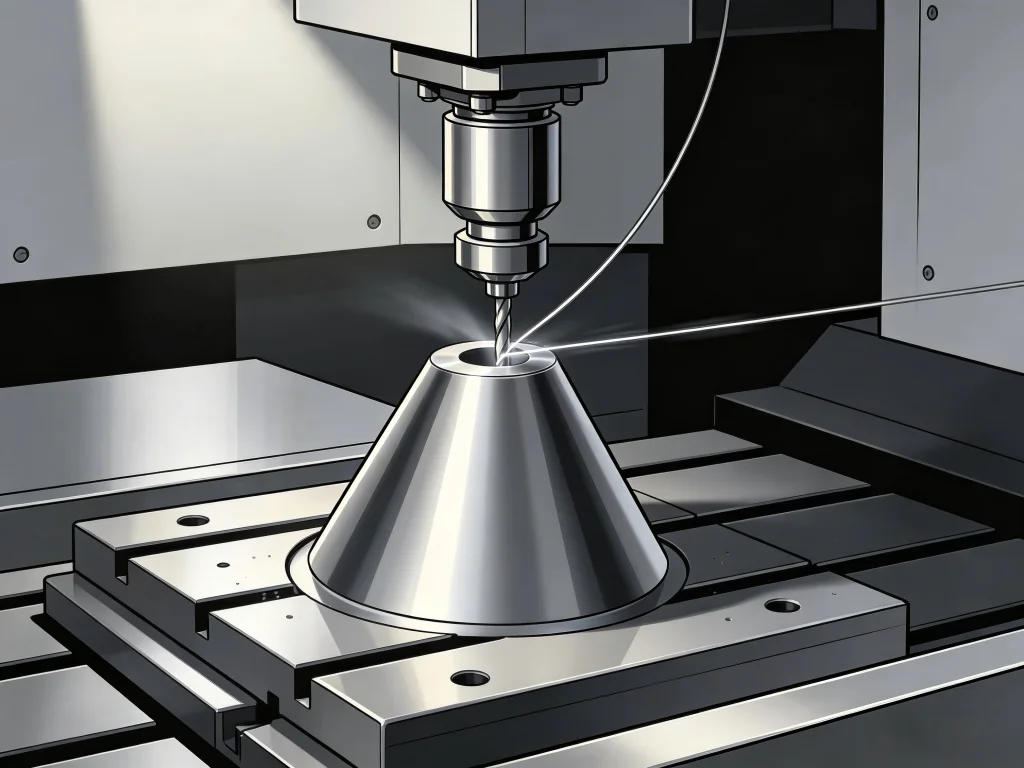
Comprendere i fondamenti: cos'è il taglio a filo EDM?
Per comprendere la complessità del taglio conico, bisogna prima definire la tecnologia di base. Il processo di taglio a filo EDM, noto anche come Wire Electrical Discharge Machining (WEDM), prevede l'uso di un sottile filo elettricamente carico per “tagliare” un materiale conduttivo. Questo filo, spesso indicato come strumento di taglio a filo EDM, non tocca effettivamente il pezzo. Invece, crea una serie di rapide scintille elettriche tra il filo e il materiale, immerso in un fluido dielettrico—di solito acqua deionizzata.
La procedura di taglio a filo EDM è governata da un'erosione controllata. Quando si verificano le scintille, fondono e vaporizzano piccole quantità del materiale, che vengono poi eliminate dal fluido dielettrico. Ciò consente la creazione di dettagli estremamente fini e spigoli interni netti. In una macchina standard a 2 assi, il filo rimane verticale. Tuttavia, in taglio conico con elettroerosione a filo, la macchina utilizza un sistema a 4 o 5 assi in cui le guide del filo superiore e inferiore si muovono indipendentemente (assi U e V rispetto a X e Y), consentendo al filo di inclinarsi ad angoli precisi.
Il ruolo del filo per taglio a filo EDM
La scelta del filo per taglio a filo EDM è critica per il successo dell'operazione. Più comunemente, si utilizza filo di ottone grazie alla sua eccellente conduttività e resistenza alla trazione. Tuttavia, per applicazioni specializzate di sformo, possono essere impiegati fili rivestiti di zinco o in molibdeno ad alta resistenza. Il diametro del filo—tipicamente compreso tra 0,1 mm e 0,3 mm—determina il “kerf” o la larghezza del taglio. Nel taglio conico, il filo deve mantenere una tensione costante per prevenire il “ritardo del filo”, che potrebbe causare imprecisioni nella parte superiore o inferiore del pezzo.
La meccanica tecnica dello sformo
La capacità di inclinare il filo richiede un sofisticato controllore CNC. Durante il procedura di taglio a filo EDM, il software calcola l'offset sia per la guida superiore che per quella inferiore. Questo non è un semplice movimento lineare; il controllore deve tenere conto della variazione della lunghezza del filo e della variazione del gap di scintilla causata dall'angolo. Molti operatori su forum come Reddit discutono spesso della funzione di “compensazione dello sformo” presente in macchine di fascia alta come quelle offerte da jucheng, che regola automaticamente la flessione del filo e la distorsione geometrica.
In questo processo si ottengono generalmente due tipi di conicità:
- Conicità costante: Dove l'angolo rimane lo stesso per tutto il profilo del taglio.
- Conicità variabile: Dove l'angolo cambia man mano che il filo si muove lungo il percorso, consentendo forme di transizione complesse, ad esempio da una base quadrata a una sommità circolare.
Applicazioni principali in tutti i settori high-tech
La versatilità di taglio conico con elettroerosione a filo lo rende indispensabile in diversi settori. Poiché il processo non è influenzato dalla durezza del materiale, è la scelta preferita per lavorare con titanio, inconel e acciai per utensili temprati. jucheng ha registrato un aumento significativo di clienti provenienti dai seguenti ambiti:
1. Costruzione di utensili e stampi
Questa è la sede tradizionale della processo di taglio a filo EDM. I fori conici sono essenziali per filiere di estrusione e stampi a iniezione, dove è richiesto un “angolo di sformo” per consentire l'espulsione agevole del pezzo finito. La precisione della strumento di taglio a filo EDM garantisce che questi angoli siano costanti entro i micron.
2. Ingegneria aerospaziale
In ambito aerospaziale, i componenti presentano spesso fori di raffreddamento complessi o radici di pale di turbina a incastro. Queste geometrie richiedono il movimento multiasse che solo taglio conico con elettroerosione a filo can provide. The lack of heat-affected zones (HAZ) compared to laser cutting is a major benefit for flight-critical parts.
3. Medical Device Manufacturing
Surgical instruments and orthopedic implants often require intricate, tapered slots. The filo per taglio a filo EDM can navigate these tiny paths without burring, which is vital for components that will be used inside the human body.
Critical Factors When Choosing an EDM Solution
Selecting the right machinery and partner is a strategic decision. Users often debate the merits of various brands on platforms like Facebook industry groups, but several objective factors should guide your choice:
| Factor | Description | Impact on Quality |
|---|---|---|
| Positional Accuracy | The ability of the X, Y, U, and V axes to move to the exact coordinates. | Directly affects the dimensional tolerance of the taper. |
| Generator Technology | How the machine manages the electrical pulse. | Determines the surface finish (Ra value) and cutting speed. |
| Wire Tension Control | The system that keeps the filo per taglio a filo EDM taut during angled moves. | Prevents “belly” or curvature in the tapered surface. |
| Dielectric System | Filtration and temperature control of the deionized water. | Ensures consistent spark conditions and prevents thermal expansion of parts. |
Installation and Maintenance: Ensuring Longevity
To maintain the high precision of taglio conico con elettroerosione a filo, a rigorous maintenance schedule is required. The environment plays a significant role; machines should ideally be placed in a temperature-controlled room to avoid the expansion and contraction of the machine casting. jucheng recommends the following routine checks:
- Power Feed Contact Cleaning: The points where electricity is transferred to the wire must be kept clean of debris to prevent “arcing” and wire breakage.
- Filter Replacement: The dielectric fluid must be pristine. Clogged filters lead to poor flushing, which causes unstable sparks and a rougher surface finish.
- Resin Monitoring: Deionized water needs a specific conductivity level. Ion exchange resins must be replaced when the water becomes too conductive.
- Guide Alignment: For taper cutting, the vertical alignment of the upper and lower guides (the “zero” position) must be calibrated frequently using a master square or laser alignment tool.
The Jucheng Advantage: Why We Lead in EDM Tech
Choosing jucheng means more than just buying a machine; it means investing in a partnership. Our taglio conico con elettroerosione a filo systems are engineered with the latest CNC controllers, capable of handling 45-degree tapers with ease. We understand that in the processo di taglio a filo EDM, reliability is paramount. That is why our machines feature high-rigidity castings and ultra-precise linear scales.
Our commitment to the procedura di taglio a filo EDM extends to our support. We provide extensive training for operators, ensuring they can maximize the potential of the strumento di taglio a filo EDM. From selecting the right filo per taglio a filo EDM for a specific alloy to optimizing cutting parameters for speed vs. finish, jucheng is there to guide you through every micron of the process.
Frequently Asked Questions (FAQ)
1. What is the maximum angle possible in taper cutting wire edm?
While standard machines can handle 10-15 degrees, high-performance machines from jucheng can achieve tapers up to 45 degrees or more, depending on the height of the workpiece and the guide configuration. It is important to note that as the angle increases, the maximum thickness of the workpiece the machine can cut may decrease.
2. Does wire cutting produce heat that could damage the part?
La processo di taglio a filo EDM is a thermal process, but it is extremely localized. The dielectric fluid acts as a coolant, immediately quenching the area. While a microscopic “recast layer” exists, it is significantly smaller than the heat-affected zone found in laser or plasma cutting, making it safe for most precision applications.
3. How do I choose the right edm wire cut wire?
For most general purposes, a standard brass wire is sufficient. However, if you are performing high-speed cutting or working with very thick materials, a zinc-coated wire might be better as it offers better flushing properties. For ultra-fine details, a tungsten or molybdenum wire might be used due to its high tensile strength at small diameters.
4. What is the typical surface finish of a wire-cut part?
With multiple “skim passes,” a taglio conico con elettroerosione a filo machine can achieve a mirror-like finish with an Ra value of less than 0.1 μm. The initial “rough cut” will be much coarser, but subsequent passes using lower energy levels refine the surface.
5. Can I cut non-conductive materials?
No, the procedura di taglio a filo EDM requires the material to be electrically conductive. This includes all metals, graphite, and some ceramics. If the material does not allow electricity to pass through it, the spark cannot be generated.
6. Is the edm wire cut tool reusable?
No, the wire used in processo di taglio a filo EDM is used only once. It is fed from a supply spool, passes through the workpiece, and is then collected in a scrap bin or chopped for recycling. This ensures that a fresh, perfectly round wire is always at the point of the cut, which is vital for maintaining precision.
7. Why is deionized water used instead of oil?
Most wire EDM machines use deionized water because it has a lower viscosity than oil, allowing it to flush the tiny kerf more effectively. However, some specialized “oil-based” wire machines exist for even finer surface finishes and smaller spark gaps.
8. How does Jucheng ensure machine accuracy over time?
jucheng utilizes hand-scraped surfaces on critical components and high-grade ball screws. Additionally, our software includes pitch error compensation and thermal growth compensation to ensure that the machine remains accurate even during long production runs in varying temperatures.
Solving Complex Geometries: A Problem/Solution Approach
Imagine a scenario where a manufacturer needs to produce a series of complex extrusion dies for a new automotive seal. These dies require a variable taper that changes continuously along a 3D path. Traditional machining would require a 5-axis mill, but the hardness of the D2 tool steel makes tool wear an expensive nightmare. Furthermore, the sharp internal corners are impossible for a physical cutting tool to reach.
This is where taglio conico con elettroerosione a filo acts as the ultimate solution. By using the strumento di taglio a filo EDM, the manufacturer can program the exact taper into the CNC. Because there is no physical force between the wire and the steel, there is no tool deflection. The processo di taglio a filo EDM carves through the hardened steel with the same ease as soft aluminum. The result is a perfect die with a surface finish that requires no manual polishing, significantly reducing lead times and costs.
Furthermore, by utilizing the high-speed capabilities of jucheng equipment, the procedura di taglio a filo EDM can be automated for overnight runs. This solves the “bottleneck” problem often found in tool rooms. By the time the technicians arrive in the morning, the complex tapered parts are finished, cleaned, and ready for assembly. This efficiency is why modern shops are increasingly moving toward advanced EDM solutions to solve their most difficult geometry puzzles.
Conclusion
In conclusion, taglio conico con elettroerosione a filo is a sophisticated and indispensable technology for any manufacturer dealing with high-precision, complex geometries. From the initial understanding of cos'è il taglio a filo EDM to the selection of the correct filo per taglio a filo EDM, every step of the process requires technical expertise and reliable equipment. Whether you are tackling a specific production problem or looking to upgrade your facility’s capabilities, jucheng offers the technology and support necessary to achieve excellence. By focusing on precision, maintenance, and the right application of the processo di taglio a filo EDM, you can ensure that your components meet the highest standards of the modern industrial world.
Ready to elevate your machining precision? Explore the full range of high-performance CNC and EDM solutions at jucheng. Our team of experts is ready to help you optimize your procedura di taglio a filo EDM for maximum efficiency and accuracy. Contact us today to discuss your next project!