
進化し続ける現代の製造業において、複雑な形状と微細な公差への要求はかつてないほど高まっています。多様な除去加工技術の中で、, テーパーカットワイヤ放電加工 は精度の頂点として際立っています。この専門的なプロセスにより、エンジニアは従来のフライス加工や旋削では実現不可能な、焼入れ材への複雑な角度形状の創成が可能になります。航空宇宙部品や高精度医療機器を開発する場合でも、 ワイヤ放電加工とは何か そしてそれが複雑なテーパー加工をどのように可能にするかを理解することは、今日の産業市場で競争力を維持するために不可欠です。.
業界が設計の限界を押し広げる中、, jucheng はこうした特定のニーズに応える高級CNCソリューションを提供するリーダーとして台頭してきました。高度な放電技術を活用することで、 ワイヤ放電加工プロセス は非接触の材料除去方法を提供し、最も繊細なワークピースであっても機械的応力から解放されることを保証します。この包括的なガイドでは、 テーパーカットワイヤ放電加工 を生産ラインに導入する際の機械的原理、操作手順、および戦略的優位性について探求します。.
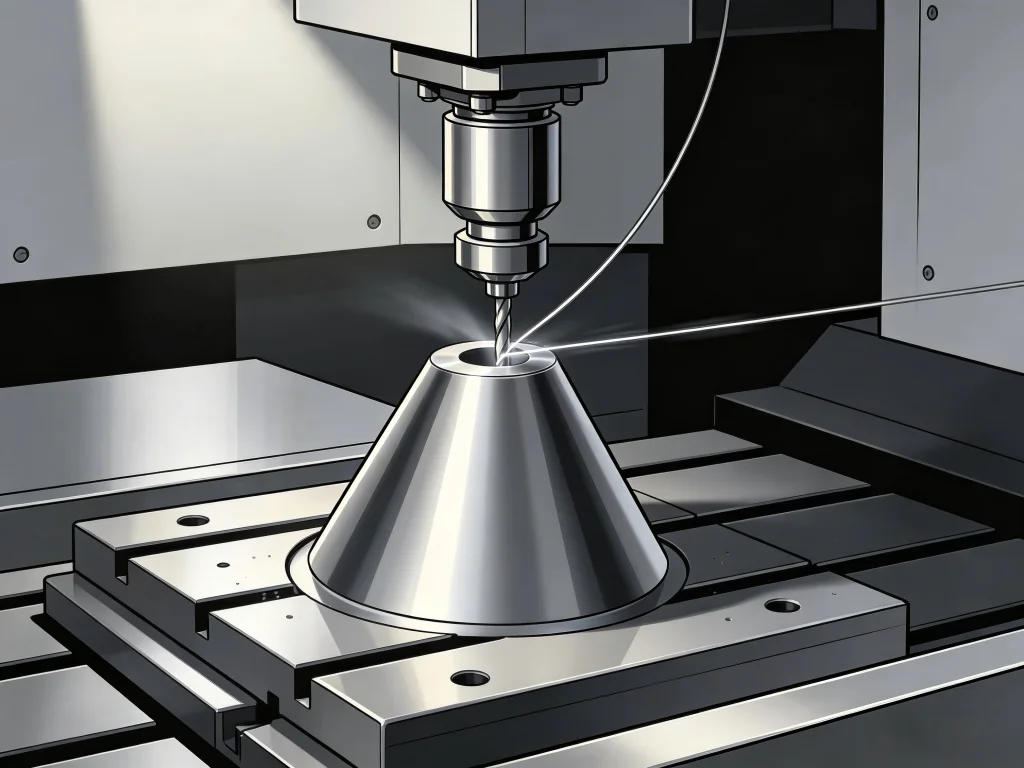
基礎の理解:ワイヤ放電加工とは何か?
テーパーカットの複雑さを把握するには、まずその中核技術を定義する必要があります。 ワイヤ放電加工プロセス, 、別名ワイヤ放電加工(WEDM)とも呼ばれ、細い帯電したワイヤを使用して導電性材料を「スライス」することを含みます。このワイヤは、しばしば EDMワイヤカットツール, と呼ばれ、実際にはワークピースに触れません。代わりに、通常は脱イオン水である誘電性流体に浸された状態で、ワイヤと材料の間に一連の急速な電気火花を発生させます。.
The EDMワイヤカット手順 は、制御された侵食によって支配されます。火花が発生すると、材料の少量が溶融および気化し、その後誘電性流体によって洗い流されます。これにより、非常に微細なディテールと鋭い内部コーナーの作成が可能になります。標準的な2軸機では、ワイヤは垂直に保たれます。しかし、 テーパーカットワイヤ放電加工, では、機械は4軸または5軸システムを利用し、上下のワイヤガイドが独立して移動し(XおよびYに対するUおよびV軸)、ワイヤを正確な角度で傾けることができます。.
EDMワイヤカットワイヤの役割
The choice of EDMワイヤカットワイヤ の選択は、作業の成功にとって重要です。最も一般的には、優れた導電性と引張強度のため、黄銅ワイヤが使用されます。ただし、特殊なテーパ用途では、亜鉛コーティングまたは高強度モリブデンワイヤが採用される場合があります。ワイヤの直径(通常0.1mmから0.3mmの範囲)は、「カーフ」または切断幅を決定します。テーパ切断では、ワイヤは「ワイヤ遅れ」を防ぐために一定の張力を維持する必要があり、これによりワークピースの上部または下部で不正確さが生じる可能性があります。.
テーパ加工の技術的メカニズム
ワイヤを傾ける能力には、高度なCNCコントローラが必要です。 EDMワイヤカット手順, の間、ソフトウェアは上下のガイドの両方のオフセットを計算します。これは単純な直線運動ではありません。コントローラは、ワイヤの長さの変化と角度によって生じる変動する火花ギャップを考慮する必要があります。Redditのようなフォーラムの多くの実務者は、 jucheng, が提供するようなハイエンド機に見られる「テーパ補正」機能についてよく議論しており、これはワイヤのたわみと幾何学的歪みを自動的に調整します。.
There are generally two types of tapers achieved in this process:
- Constant Taper: Where the angle remains the same throughout the profile of the cut.
- Variable Taper: Where the angle changes as the wire moves along the path, allowing for complex transitional shapes from a square base to a circular top, for example.
Core Applications Across High-Tech Industries
The versatility of テーパーカットワイヤ放電加工 makes it indispensable in several sectors. Because the process is unaffected by material hardness, it is the preferred choice for working with titanium, inconel, and hardened tool steels. jucheng has seen a significant uptick in clients from the following fields:
1. Tool and Die Making
This is the traditional home of the ワイヤ放電加工プロセス. Tapered holes are essential for extrusion dies and injection molds, where a “draft angle” is required to allow the finished part to be ejected easily. The precision of the EDMワイヤカットツール ensures that these angles are consistent within microns.
2. Aerospace Engineering
In aerospace, components often feature complex cooling holes or interlocking turbine blade roots. These geometries require the multi-axis movement that only テーパーカットワイヤ放電加工 can provide. The lack of heat-affected zones (HAZ) compared to laser cutting is a major benefit for flight-critical parts.
3. Medical Device Manufacturing
Surgical instruments and orthopedic implants often require intricate, tapered slots. The EDMワイヤカットワイヤ can navigate these tiny paths without burring, which is vital for components that will be used inside the human body.
Critical Factors When Choosing an EDM Solution
Selecting the right machinery and partner is a strategic decision. Users often debate the merits of various brands on platforms like Facebook industry groups, but several objective factors should guide your choice:
| Factor | Description | Impact on Quality |
|---|---|---|
| Positional Accuracy | The ability of the X, Y, U, and V axes to move to the exact coordinates. | Directly affects the dimensional tolerance of the taper. |
| Generator Technology | How the machine manages the electrical pulse. | Determines the surface finish (Ra value) and cutting speed. |
| Wire Tension Control | The system that keeps the EDMワイヤカットワイヤ taut during angled moves. | Prevents “belly” or curvature in the tapered surface. |
| Dielectric System | Filtration and temperature control of the deionized water. | Ensures consistent spark conditions and prevents thermal expansion of parts. |
Installation and Maintenance: Ensuring Longevity
To maintain the high precision of テーパーカットワイヤ放電加工, a rigorous maintenance schedule is required. The environment plays a significant role; machines should ideally be placed in a temperature-controlled room to avoid the expansion and contraction of the machine casting. jucheng recommends the following routine checks:
- Power Feed Contact Cleaning: The points where electricity is transferred to the wire must be kept clean of debris to prevent “arcing” and wire breakage.
- Filter Replacement: The dielectric fluid must be pristine. Clogged filters lead to poor flushing, which causes unstable sparks and a rougher surface finish.
- Resin Monitoring: Deionized water needs a specific conductivity level. Ion exchange resins must be replaced when the water becomes too conductive.
- Guide Alignment: For taper cutting, the vertical alignment of the upper and lower guides (the “zero” position) must be calibrated frequently using a master square or laser alignment tool.
The Jucheng Advantage: Why We Lead in EDM Tech
Choosing jucheng means more than just buying a machine; it means investing in a partnership. Our テーパーカットワイヤ放電加工 systems are engineered with the latest CNC controllers, capable of handling 45-degree tapers with ease. We understand that in the ワイヤ放電加工プロセス, reliability is paramount. That is why our machines feature high-rigidity castings and ultra-precise linear scales.
Our commitment to the EDMワイヤカット手順 extends to our support. We provide extensive training for operators, ensuring they can maximize the potential of the EDMワイヤカットツール. From selecting the right EDMワイヤカットワイヤ for a specific alloy to optimizing cutting parameters for speed vs. finish, jucheng is there to guide you through every micron of the process.
Frequently Asked Questions (FAQ)
1. What is the maximum angle possible in taper cutting wire edm?
While standard machines can handle 10-15 degrees, high-performance machines from jucheng can achieve tapers up to 45 degrees or more, depending on the height of the workpiece and the guide configuration. It is important to note that as the angle increases, the maximum thickness of the workpiece the machine can cut may decrease.
2. Does wire cutting produce heat that could damage the part?
The ワイヤ放電加工プロセス is a thermal process, but it is extremely localized. The dielectric fluid acts as a coolant, immediately quenching the area. While a microscopic “recast layer” exists, it is significantly smaller than the heat-affected zone found in laser or plasma cutting, making it safe for most precision applications.
3. How do I choose the right edm wire cut wire?
For most general purposes, a standard brass wire is sufficient. However, if you are performing high-speed cutting or working with very thick materials, a zinc-coated wire might be better as it offers better flushing properties. For ultra-fine details, a tungsten or molybdenum wire might be used due to its high tensile strength at small diameters.
4. What is the typical surface finish of a wire-cut part?
With multiple “skim passes,” a テーパーカットワイヤ放電加工 machine can achieve a mirror-like finish with an Ra value of less than 0.1 μm. The initial “rough cut” will be much coarser, but subsequent passes using lower energy levels refine the surface.
5. Can I cut non-conductive materials?
No, the EDMワイヤカット手順 requires the material to be electrically conductive. This includes all metals, graphite, and some ceramics. If the material does not allow electricity to pass through it, the spark cannot be generated.
6. Is the edm wire cut tool reusable?
No, the wire used in ワイヤ放電加工プロセス is used only once. It is fed from a supply spool, passes through the workpiece, and is then collected in a scrap bin or chopped for recycling. This ensures that a fresh, perfectly round wire is always at the point of the cut, which is vital for maintaining precision.
7. Why is deionized water used instead of oil?
Most wire EDM machines use deionized water because it has a lower viscosity than oil, allowing it to flush the tiny kerf more effectively. However, some specialized “oil-based” wire machines exist for even finer surface finishes and smaller spark gaps.
8. How does Jucheng ensure machine accuracy over time?
jucheng utilizes hand-scraped surfaces on critical components and high-grade ball screws. Additionally, our software includes pitch error compensation and thermal growth compensation to ensure that the machine remains accurate even during long production runs in varying temperatures.
Solving Complex Geometries: A Problem/Solution Approach
Imagine a scenario where a manufacturer needs to produce a series of complex extrusion dies for a new automotive seal. These dies require a variable taper that changes continuously along a 3D path. Traditional machining would require a 5-axis mill, but the hardness of the D2 tool steel makes tool wear an expensive nightmare. Furthermore, the sharp internal corners are impossible for a physical cutting tool to reach.
This is where テーパーカットワイヤ放電加工 acts as the ultimate solution. By using the EDMワイヤカットツール, the manufacturer can program the exact taper into the CNC. Because there is no physical force between the wire and the steel, there is no tool deflection. The ワイヤ放電加工プロセス carves through the hardened steel with the same ease as soft aluminum. The result is a perfect die with a surface finish that requires no manual polishing, significantly reducing lead times and costs.
Furthermore, by utilizing the high-speed capabilities of jucheng equipment, the EDMワイヤカット手順 can be automated for overnight runs. This solves the “bottleneck” problem often found in tool rooms. By the time the technicians arrive in the morning, the complex tapered parts are finished, cleaned, and ready for assembly. This efficiency is why modern shops are increasingly moving toward advanced EDM solutions to solve their most difficult geometry puzzles.
Conclusion
In conclusion, テーパーカットワイヤ放電加工 is a sophisticated and indispensable technology for any manufacturer dealing with high-precision, complex geometries. From the initial understanding of ワイヤ放電加工とは何か to the selection of the correct EDMワイヤカットワイヤ, every step of the process requires technical expertise and reliable equipment. Whether you are tackling a specific production problem or looking to upgrade your facility’s capabilities, jucheng offers the technology and support necessary to achieve excellence. By focusing on precision, maintenance, and the right application of the ワイヤ放電加工プロセス, you can ensure that your components meet the highest standards of the modern industrial world.
Ready to elevate your machining precision? Explore the full range of high-performance CNC and EDM solutions at jucheng. Our team of experts is ready to help you optimize your EDMワイヤカット手順 for maximum efficiency and accuracy. Contact us today to discuss your next project!