
항공우주 내장재, 의료용 멸균 트레이 또는 고주파 전자 인클로저용 정밀 부품을 소싱하고 있다면, 다음과 같은 요구사항을 접했을 가능성이 높습니다: Ultem 가공 이 핵심 역량 요구사항으로 등장합니다. SABIC이 ULTEM™이라는 브랜드명으로 개발한 이 비결정성 열가소성 수지는 열 안정성, 기계적 강도, 전기 절연성을 결합하여 다른 엔지니어링 플라스틱이 따라올 수 없는 수준을 제공합니다. 그러나 Ultem 가공 은 아세탈이나 알루미늄 절삭과는 다릅니다. 이 소재의 낮은 열전도율, 높은 강성, 응력 균열 취약성은 규율 있는 공정 제어, 특수 공구, 그리고 절삭력 하에서 각 등급이 어떻게 거동하는지에 대한 깊은 이해를 요구합니다. 이 가이드는 알아야 할 모든 것을 다룹니다: Ultem 플라스틱 이란 무엇인가, Ultem 1000 대비 Ultem 2300, 가공 방법, 성공과 폐기를 가르는 핵심 파라미터, 그리고 Jucheng Precision과 같은 경험 많은 CNC 업체와 협력하는 것이 성능을 발휘하는 부품과 실패하는 부품의 차이를 만드는 이유를 설명합니다.
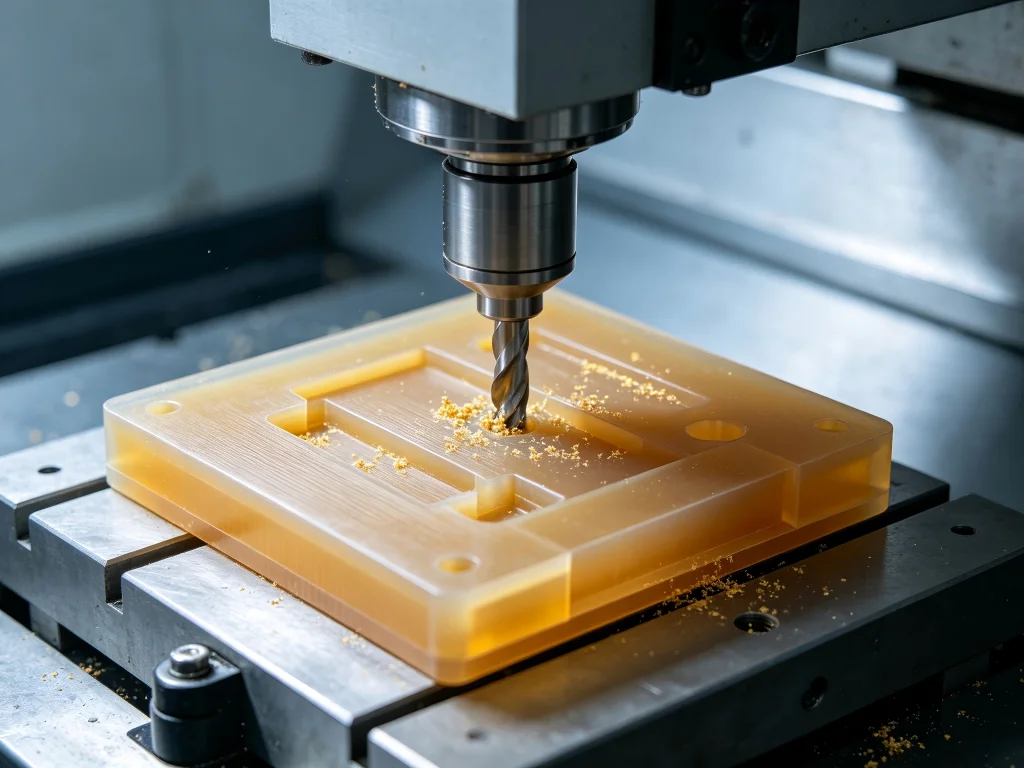
Ultem 플라스틱이란? 이름 뒤에 숨은 소재 이해하기
Ultem 플라스틱 는 폴리에테르이미드(PEI)의 브랜드명으로, 고성능 비결정성 엔지니어링 열가소성 수지입니다. 뚜렷한 융점을 가진 반결정성 폴리머와 달리, Ultem은 온도가 상승함에 따라 점진적으로 연화되어 열 분해 없이 효율적으로 재료 제거가 이루어지는 좁은 가공 윈도우를 형성합니다. 이러한 독특한 거동은 217°C의 유리 전이 온도(Tg) 및 170°C~180°C의 연속 사용 온도 등급과 결합되어, 나일론, 아세탈 또는 폴리카보네이트와 같은 기존 플라스틱이 실패할 응용 분야에 적합합니다.
이 소재의 분자 구조—유연성과 가공성을 위한 에테르 결합과 열적·기계적 저항성을 위한 이미드기가 결합된—는 엔지니어들이 흔히 경량의 전기 절연 패키지에서 금속과 같은 성능이라고 묘사하는 것을 제공합니다. 이 소재는 본질적으로 난연성을 가지며 화학 첨가제 없이 UL94 V-0 등급을 달성하고 최소한의 연기를 발생시키므로, 항공기 객실 내장재 및 기타 화재 안전이 중요한 환경에 사용됩니다.
Ultem의 성능을 정의하는 핵심 특성
왜 그런지 이해하려면 Ultem CNC 가공 이러한 세심한 주의가 필요하므로, 소재의 기본 특성을 살펴보는 것이 도움이 됩니다:
- 열 성능: 유리 전이 온도 217°C, 최대 170–180°C까지 연속 사용 가능. 대부분의 엔지니어링 플라스틱이 연화되는 온도에서도 강성을 유지합니다.
- 기계적 강도: Ultem 1000의 인장 강도는 약 105 MPa로 일부 주조 금속에 필적합니다. 뛰어난 크리프 저항성 덕분에 가공된 부품은 지속적인 응력 하에서도 정밀 공차를 유지합니다.
- 전기 절연성: 절연 파괴 강도가 약 33 kV/mm로, 마이크로파 방사선에 사실상 투명하여 고주파 RF 부품에 이상적입니다.
- 화학적 및 가수분해 안정성: 자동차용 유체, 알코올 및 수성 산에 강합니다. 뛰어난 가수분해 안정성으로 분자 열화 없이 반복적인 오토클레이브 멸균 사이클이 가능합니다.
- 치수 안정성: 낮은 열팽창 계수와 최소한의 수분 흡수로 부품이 온도 및 습도 변화 전반에 걸쳐 형상을 유지합니다.
이러한 특성은 Ultem PEI 가공 이 여러 산업 분야에서 필수적이 된 이유를 설명합니다. 그러나 이는 또한 이 소재가 현장에서 왜 까다로운지도 설명합니다. 높은 강성과 낮은 열전도율은 각별한 주의가 필요한 과제를 만들어냅니다.
가공 과제: Ultem이 다른 이유
숙련된 기계 가공 기술자들은 종종 Ultem 가공이 연성 금속보다는 취성 세라믹을 가공하는 것에 더 가깝다고 설명합니다. 이 소재는 매개변수가 올바를 때는 깨끗하게 부서지는 짧고 취성인 칩을 생성하지만, 최적 범위를 벗어나면 분말 형태의 먼지가 발생하거나 더 심하게는 표면 유리화 및 용융이 관찰됩니다.
열 관리: 최대의 적
Ultem의 열전도율은 약 0.22 W/m·K로 매우 낮습니다. 이는 절삭 중 발생하는 열이 벌크 소재나 칩으로 발산되지 않고 절삭 날에 집중된다는 것을 의미합니다. 그 결과는 심각할 수 있습니다:
- 표면 유리화 및 용융 치수 정밀도를 저해함
- 공구 날 끝의 부착물 표면 조도를 저하시킴
- 열 응력 균열 얇은 벽 부위에서 발생
- 변색 폴리머 매트릭스의 열적 열화를 나타냄
- 치수 왜곡 가공 후 잔류 응력이 이완되면서 발생
성공적인 가공의 핵심은 Ultem 가공 열 축적이 임계 수준에 도달하기 전에 소재를 제거하는 데 있습니다. 이를 위해서는 적극적인 칩 배출, 적절한 절삭 속도, 그리고 종종 표준 범람형 절삭유 공급을 넘어서는 추가 냉각 전략이 필요합니다.
공구 마모 및 선택
충전되지 않은 Ultem 1000은 유리 섬유 강화 복합재만큼 연마성이 높지는 않지만, 잘못 가공하면 여전히 공구 마모를 가속화합니다. 초경 공구는 필수입니다. 고속도강(HSS) 공구는 너무 빨리 무뎌집니다. Ultem 2300 가공, 30% 유리 섬유 강화로 인해 재료의 연마성이 현저히 높아지며, 많은 작업장에서는 급속한 공구 마모에 대응하기 위해 다결정 다이아몬드(PCD) 코팅 공구를 권장합니다.
공구 형상은 공구 재질만큼 중요합니다. 2날 또는 3날 엔드밀은 칩 배출을 효율적으로 하기 위한 더 큰 칩 포켓을 제공하여 칩 재절삭과 열 축적을 방지합니다. 약 45° 이상의 높은 헬릭스 각도가 선호되는데, 이는 절삭력을 감소시키는 전단 작용을 제공하기 때문입니다.
Ultem 1000 vs. Ultem 2300: 올바른 등급 선택
가장 흔한 결정 중 하나는 Ultem CNC 가공 프로젝트에서 Ultem 1000 또는 Ultem 2300. .를 지정할지 여부입니다. 이 선택은 가공 전략, 공구 비용 및 최종 부품 성능에 중대한 영향을 미칩니다.
| 속성 | Ultem 1000 (미충전) | Ultem 2300 (30% 유리 섬유 강화) |
|---|---|---|
| 밀도 | 1.27 g/cm³ | 1.51 g/cm³ |
| 인장 강도 | ~105 MPa | 17,000–20,000 psi (~117–138 MPa) |
| 굴곡 탄성률 | ~3,200 MPa | 850,000–950,000 psi (~5,860–6,550 MPa) |
| 가공성 | Easier; less tool wear; cleaner surface finish | More abrasive; requires specialized tooling; lower speeds |
| 표면 마감 | Typically smoother, more pristine | May be less smooth due to glass fibers |
| 일반적인 용도 | Insulators, housings, brackets,精密几何形状 | High-strength structural components, reusable medical devices |
Ultem 1000 is the unfilled base grade that offers the best balance of machinability and mechanical properties. It produces chips that are easier to control and generally delivers a cleaner surface finish. For parts that require tight dimensional tolerances, complex geometries, or optical-quality surfaces, Ultem 1000 is often the preferred choice.
Ultem 2300, by contrast, offers greater rigidity and improved dimensional stability at elevated temperatures, thanks to its 30% glass fiber reinforcement. However, the glass fibers make the material more abrasive and the chips more challenging to control. Tooling costs are higher, and surface finish may not reach the same level as unfilled grades.
The decision between these grades ultimately comes down to application requirements: if stiffness and strength at temperature are paramount, Ultem 2300 may be the better choice. If machinability, surface finish, and tool life are the primary concerns, Ultem 1000 is hard to beat.
Core Applications: Where Ultem Machining Delivers Value
Ultem 플라스틱 finds its way into some of the most demanding engineering applications across multiple industries. Understanding these use cases helps clarify why Ultem 가공 has become such a critical capability.
항공우주 및 항공
The aerospace industry is perhaps the largest consumer of machined Ultem components. The material’s inherent flame retardance (UL94 V-0), low smoke emissions, and high strength-to-weight ratio make it ideal for aircraft interior components. Specific applications include:
- Cabin interior components that must meet FAR 25.853 flame requirements
- Instrument housings and bracketry that require dimensional stability across temperature extremes
- Electrical connectors and insulators where dielectric performance is critical
- Radome assemblies that must be transparent to microwave radiation
의료 기기 및 헬스케어
Ultem’s biocompatibility and ability to withstand repeated autoclave sterilization cycles make it a material of choice for medical applications. The material maintains its properties through harsh sterilization methods that would destroy lesser plastics. Common medical applications include:
- Reusable surgical instruments and handles
- Medical device housings and probe enclosures
- Sterilization trays and containers
- Analytical instrument components
Electronics and Semiconductor
The electrical insulation properties of Ultem—high dielectric strength and stable dielectric loss factor across a broad frequency range—make it a standard material for high-frequency electronic applications. Semiconductor process components, electrical insulators, and connector bodies are typical applications.
자동차
Under-hood automotive applications benefit from Ultem’s heat resistance and dimensional stability. The material performs reliably in the high-temperature environments found in engine compartments and transmission systems.
Critical Selection Factors: What to Look For in an Ultem Machining Partner
Not every CNC shop is equipped to handle Ultem PEI 가공 successfully. The material’s sensitivity to heat, stress, and tool wear means that capability, experience, and process control matter enormously. Here are the key factors to evaluate when selecting a machining partner for your Ultem components.
Tooling Expertise and Inventory
Ultem 가공 requires specialized tooling—solid carbide end mills with specific geometries, and for glass-filled grades, PCD-coated tools. A shop that understands the difference between machining Ultem 1000 and Ultem 2300, and stocks the appropriate tooling for each, is already ahead of the curve. Ask potential partners about their tool selection protocols for high-performance plastics.
Thermal Management Capabilities
Because heat is the primary enemy in Ultem CNC 가공, a shop’s approach to thermal management is critical. This includes everything from cutting speed and feed rate selection to coolant strategy and chip evacuation. Shops that have experience with high-performance polymers will have established protocols for managing heat—aggressive chip evacuation, appropriate cutting speeds, and cooling strategies that go beyond standard flood coolant.
Stress Relief and Annealing Protocols
Ultem is susceptible to environmental stress cracking (ESC) when exposed to certain polar organic solvents, and internal stresses from machining can lead to warping or cracking over time. Experienced shops perform stress-relief annealing—heat treatment cycles both before and after machining—to relieve internal stresses and ensure long-term dimensional stability. For high-precision or large Ultem 1000 parts, stress relief before and after CNC machining may be necessary to reduce warping, cracking, or dimensional changes caused by internal stresses.
Quality Control and Metrology
Aerospace, medical, and semiconductor applications typically require tight tolerances—often in the ±0.01–0.02 mm range. A shop’s quality control capabilities, including CMM (coordinate measuring machine) inspection, optical comparators, and surface profilometers, directly impact whether your parts meet specifications.
Material Sourcing and Traceability
Ultem is available in sheet, rod, plate, block, and resin forms. The quality of the raw material matters, and shops that source from reputable suppliers and maintain full traceability provide an additional layer of assurance.
Best Practices for Successful Ultem CNC Machining
Whether you are machining Ultem in-house or outsourcing to a specialized shop, understanding the best practices helps you ask the right questions and set appropriate expectations.
Cutting Parameters: Starting Points
For machining Ultem 1000, recommended roughing parameters with carbide tooling are 500–900 SFM with a chip load of 0.004–0.007 inches per tooth for a 1/2-inch end mill. For finishing, 700–1200 SFM with a chip load of 0.002–0.003 inches per tooth. For Ultem 2300, reduce speeds to 350–700 SFM with a chip load of 0.003–0.005 inches per tooth.
These are first-pass starting points. Actual parameters depend on machine rigidity, tool geometry, coolant application, and part geometry. The goal is to remove material efficiently while preventing heat accumulation at the cutting edge.
Tool Geometry and Coatings
End mills with 2 or 3 flutes provide larger chip clearance than 4-flute designs. A helix angle of 45° or more produces a shearing action that reduces cutting forces and heat generation. For glass-filled grades, diamond coatings or PCD tools extend tool life significantly.
Workholding Considerations
Ultem’s relatively low modulus of elasticity compared to metal makes it more susceptible to deformation under clamping pressure. Excessive or poorly distributed clamping force can cause the material to bow or flex, resulting in out-of-tolerance dimensions once the clamps are released. For thin-walled or complex geometries, machining-induced stresses can cause the part to warp after it is cut free from the stock material.
Coolant and Chip Evacuation
Proper chip evacuation is essential to prevent chip re-welding onto the machined surface. While flood coolant is common, some shops use air blast or mist systems to avoid thermal shock that can occur when cold coolant hits a hot cutting zone. The right approach depends on the specific operation, tooling, and part geometry.
Avoiding Sharp Corners
Applying radii to internal corners relieves stress concentrations and reduces tool wear. Sharp internal corners can cause the brittle material to chip or break out, especially when exiting a cut.
Why Jucheng Precision for Ultem Machining
With over a decade of experience in precision manufacturing, Jucheng Precision has built a reputation for handling demanding engineering thermoplastics, including Ultem (PEI). Founded in Shenzhen in 2012, the company operates from an 8,000-square-meter facility with over 190 employees, including 30 highly skilled technical personnel.
The facility houses more than 150 CNC machines, including 25+ Haas and Mazak units covering 3-axis, 4-axis, turning, grinding, wire EDM, and sinker EDM. This extensive equipment base allows Jucheng to handle everything from prototyping through low-volume and high-volume production runs.
For Ultem CNC 가공 specifically, Jucheng has developed specialized protocols that address the material’s unique challenges:
- Specialized tooling: Razor-sharp carbide tools with specific ramp-in strategies for Ultem to ensure pristine surface finish
- Stress-relief annealing: Precise heat treatment cycles both before and after machining to relieve internal stresses and ensure long-term dimensional stability
- Quality certifications: ISO 9001:2015, ISO 14001, ISO 13485 (medical devices), and IATF 16949 (automotive)
- Advanced metrology: CMM, optical comparator, surface profilometer, and hardness tester supporting typical tolerances of ±0.005mm
- Rapid turnaround: Quotes within hours, parts as fast as 4 days
Jucheng’s testing has shown that for load-bearing brackets that do not see friction, Ultem is often the technically superior choice over alternatives like PEEK. The company’s experience across aerospace, medical, semiconductor, and automotive industries means they understand the specific requirements of each sector—from FAA flame ratings to USP Class VI biocompatibility.
Frequently Asked Questions About Ultem Machining
What is the difference between Ultem 1000 and Ultem 2300?
Ultem 1000 is the unfilled base grade offering the best balance of machinability and mechanical properties. Ultem 2300 contains 30% glass fiber reinforcement, providing greater stiffness and dimensional stability at elevated temperatures but with more abrasive machining characteristics and higher tooling costs.
Can Ultem be machined to tight tolerances?
Yes. With proper setup, tooling, and process control, Ultem CNC 가공 can achieve tolerances of ±0.01–0.02 mm. Jucheng Precision routinely holds tolerances of ±0.005mm with appropriate part geometry and process controls.
What tooling is recommended for machining Ultem?
Solid carbide tools are mandatory—HSS tools blunt too quickly. For Ultem 1000, sharp carbide end mills with 2 or 3 flutes and a 45°+ helix angle work well. For Ultem 2300, PCD-coated or diamond tools are recommended to combat the abrasive effects of glass fibers.
Why does Ultem require annealing?
Ultem is susceptible to stress cracking and warping from internal stresses generated during machining. Stress-relief annealing—heat treatment cycles before and after machining—relieves these internal stresses and ensures long-term dimensional stability. This is particularly important for high-precision or large parts.
What industries use machined Ultem components?
Aerospace (cabin interiors, instrument housings), medical devices (surgical instruments, sterilization trays), electronics and semiconductor (insulators, connectors), and automotive (under-hood components) are the primary industries.
Is Ultem difficult to machine?
Ultem is more challenging than standard engineering plastics like acetal or nylon. Its low thermal conductivity traps heat at the cutting edge, and its high rigidity makes it prone to brittle fracture if parameters are incorrect. However, with appropriate tooling, cooling, and process control, Ultem PEI 가공 can be performed reliably and repeatably.
What surface finish can be achieved with machined Ultem?
Typical machined finishes range from Ra 3.2 μm (125 μin) to finer values depending on machining requirements. Ultem 1000 generally produces a cleaner surface than Ultem 2300 due to the absence of glass fibers.
How does Ultem compare to PEEK for CNC machining?
Both are high-performance thermoplastics, but they have different strengths. PEEK offers higher continuous service temperature (260°C vs. 170–180°C for Ultem). However, Ultem is often the technically superior choice for load-bearing brackets that do not see friction, and it is generally easier to machine than PEEK. The choice depends on the specific application requirements.
Whether you are specifying Ultem 1000 for a精密 electronic housing or Ultem 2300 for a high-strength aerospace bracket, understanding the material’s properties, machining challenges, and best practices is essential for success. Partnering with an experienced shop like Jucheng Precision—with the right tooling, process controls, and quality systems in place—ensures your components meet specification the first time, every time.
Ready to discuss your next Ultem machining project? Contact Jucheng Precision for a quick quote and engineering consultation.