
Si vous recherchez des composants de précision pour des intérieurs aéronautiques, des bacs de stérilisation médicaux ou des boîtiers électroniques haute fréquence, vous avez probablement rencontré l'usinage de l'Ultem comme une exigence de capacité critique. Ce thermoplastique amorphe—développé par SABIC sous la marque ULTEM™—offre une combinaison de stabilité thermique, de résistance mécanique et d'isolation électrique que peu de plastiques techniques peuvent égaler. Mais l'usinage de l'Ultem ne ressemble pas à la découpe de l'acétal ou de l'aluminium. La faible conductivité thermique du matériau, sa rigidité élevée et sa sensibilité à la fissuration sous contrainte exigent un contrôle rigoureux du processus, un outillage spécialisé et une compréhension approfondie du comportement des différentes nuances sous les forces de coupe. Ce guide passe en revue tout ce que vous devez savoir : ce qu'est le plastique Ultem est, comment usiner Ultem 1000 par rapport à Ultem 2300, les paramètres critiques qui séparent le succès du rebut, et pourquoi s'associer à un atelier CNC expérimenté comme Jucheng Precision fait la différence entre une pièce qui performe et une qui échoue.
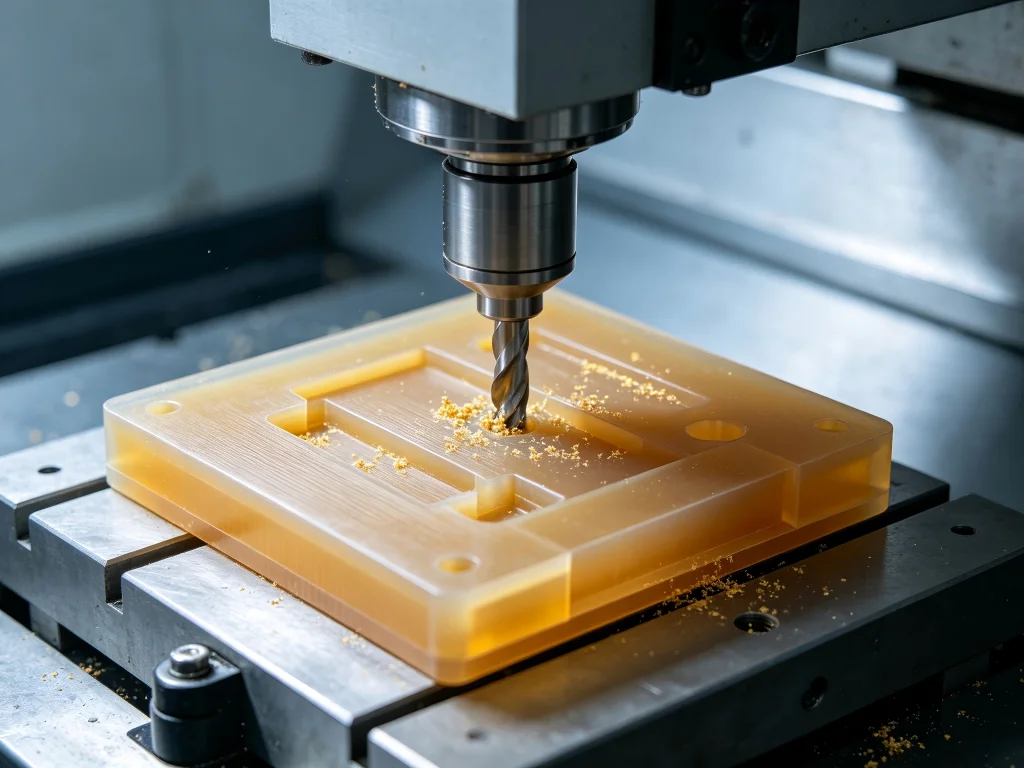
Qu'est-ce que le plastique Ultem ? Comprendre le matériau derrière le nom
le plastique Ultem est la marque du polyétherimide (PEI), un thermoplastique technique amorphe haute performance. Contrairement aux polymères semi-cristallins qui ont des points de fusion distincts, l'Ultem se ramollit progressivement à mesure que la température augmente, créant une fenêtre de traitement étroite où l'enlèvement de matière se produit efficacement sans dégradation thermique. Ce comportement unique, combiné à une température de transition vitreuse (Tg) de 217 °C et à une température de service continu de 170 °C à 180 °C, le rend adapté aux applications où les plastiques conventionnels comme le nylon, l'acétal ou le polycarbonate échoueraient.
La structure moléculaire du matériau—une liaison éther pour la flexibilité et l'aptitude au traitement combinée à un groupe imide pour la résistance thermique et mécanique—offre ce que les ingénieurs décrivent souvent comme une performance de type métallique dans un ensemble léger et électriquement isolant. Il est intrinsèquement ignifuge, atteignant une classification UL94 V-0 sans additifs chimiques, et génère une fumée minimale, ce qui explique sa présence dans les intérieurs de cabine d'aéronefs et autres environnements critiques en matière de sécurité incendie.
Propriétés clés qui définissent les performances de l'Ultem
Pour comprendre pourquoi l'usinage CNC de l'Ultem exige une attention aussi minutieuse, il est utile d'examiner les caractéristiques de base du matériau :
- Performances thermiques : Température de transition vitreuse de 217 °C, service continu jusqu'à 170–180 °C. Conserve sa rigidité à des températures où la plupart des plastiques techniques se ramollissent.
- Résistance mécanique : Résistance à la traction d'environ 105 MPa pour l'Ultem 1000, rivalisant avec certains métaux coulés. Une excellente résistance au fluage signifie que les composants usinés maintiennent des tolérances serrées sous contrainte continue.
- Isolation électrique : Rigidité diélectrique d'environ 33 kV/mm, ce qui le rend pratiquement transparent aux micro-ondes et idéal pour les composants RF haute fréquence.
- Stabilité chimique et hydrolytique : Résiste aux fluides automobiles, aux alcools et aux acides aqueux. Une stabilité hydrolytique exceptionnelle permet des cycles répétés de stérilisation en autoclave sans dégradation moléculaire.
- Stabilité dimensionnelle : Un faible coefficient de dilatation thermique et une absorption d'humidité minimale garantissent que les pièces conservent leur géométrie malgré les variations de température et d'humidité.
Ces propriétés expliquent pourquoi l'usinage de l'Ultem PEI est devenu essentiel dans de multiples industries. Mais ils expliquent aussi pourquoi le matériau est impitoyable en atelier—sa rigidité élevée et sa faible conductivité thermique créent des défis qui exigent du respect.
Le défi d'usinage : pourquoi l'Ultem est différent
Les machinistes expérimentés décrivent souvent le travail de l'Ultem comme plus proche de l'usinage d'une céramique fragile que d'un métal ductile. Le matériau produit des copeaux courts et cassants qui se fracturent proprement lorsque les paramètres sont corrects, mais lorsqu'ils dérivent hors des plages optimales, vous observerez une formation de poussière pulvérulente ou, pire, un glaçage et une fusion de la surface.
Gestion thermique : l'ennemi principal
La conductivité thermique de l'Ultem est remarquablement faible—environ 0,22 W/m·K. Cela signifie que la chaleur générée pendant la coupe se concentre au niveau de l'arête de coupe plutôt que de se dissiper dans la masse du matériau ou dans le copeau. Les conséquences peuvent être graves :
- Glaçage et fusion de la surface qui compromettent la précision dimensionnelle
- Accumulation sur l'arête de l'outil qui dégrade l'état de surface
- Fissuration par contrainte thermique dans les sections à paroi mince
- Décoloration indiquant une dégradation thermique de la matrice polymère
- Déformation dimensionnelle lorsque les contraintes résiduelles se relâchent après usinage
The key to successful l'usinage de l'Ultem lies in removing material before heat accumulation reaches critical levels. This requires aggressive chip evacuation, appropriate cutting speeds, and often supplemental cooling strategies that go beyond standard flood coolant application.
Tool Wear and Selection
While unfilled Ultem 1000 is not as abrasive as glass-filled composites, it will still accelerate tool wear when machined incorrectly. Solid carbide tools are mandatory—high-speed steel (HSS) tools blunt too quickly. For machining Ultem 2300, the 30% glass fiber reinforcement makes the material significantly more abrasive, and many shops recommend polycrystalline diamond (PCD)-coated tools to combat rapid tool ablation.
Tool geometry matters as much as tool material. Two- or three-flute end mills provide larger gullets for efficient chip evacuation, preventing chip re-cutting and heat buildup. A higher helix angle—around 45° or more—is preferred because it provides a shearing action that reduces cutting forces.
Ultem 1000 vs. Ultem 2300: Choosing the Right Grade
One of the most common decisions in l'usinage CNC de l'Ultem projects is whether to specify Ultem 1000 ou Ultem 2300. The choice has significant implications for machining strategy, tooling costs, and final part performance.
| Propriété | Ultem 1000 (Unfilled) | Ultem 2300 (30% Glass-Filled) |
|---|---|---|
| Densité | 1.27 g/cm³ | 1,51 g/cm³ |
| Résistance à la traction | ~105 MPa | 17,000–20,000 psi (~117–138 MPa) |
| Flexural Modulus | ~3,200 MPa | 850,000–950,000 psi (~5,860–6,550 MPa) |
| Usinabilité | Easier; less tool wear; cleaner surface finish | More abrasive; requires specialized tooling; lower speeds |
| Finition de surface | Typically smoother, more pristine | May be less smooth due to glass fibers |
| Applications typiques | Insulators, housings, brackets,精密几何形状 | High-strength structural components, reusable medical devices |
Ultem 1000 is the unfilled base grade that offers the best balance of machinability and mechanical properties. It produces chips that are easier to control and generally delivers a cleaner surface finish. For parts that require tight dimensional tolerances, complex geometries, or optical-quality surfaces, Ultem 1000 is often the preferred choice.
Ultem 2300, by contrast, offers greater rigidity and improved dimensional stability at elevated temperatures, thanks to its 30% glass fiber reinforcement. However, the glass fibers make the material more abrasive and the chips more challenging to control. Tooling costs are higher, and surface finish may not reach the same level as unfilled grades.
The decision between these grades ultimately comes down to application requirements: if stiffness and strength at temperature are paramount, Ultem 2300 may be the better choice. If machinability, surface finish, and tool life are the primary concerns, Ultem 1000 is hard to beat.
Core Applications: Where Ultem Machining Delivers Value
le plastique Ultem finds its way into some of the most demanding engineering applications across multiple industries. Understanding these use cases helps clarify why l'usinage de l'Ultem has become such a critical capability.
Aérospatiale et aviation
The aerospace industry is perhaps the largest consumer of machined Ultem components. The material’s inherent flame retardance (UL94 V-0), low smoke emissions, and high strength-to-weight ratio make it ideal for aircraft interior components. Specific applications include:
- Cabin interior components that must meet FAR 25.853 flame requirements
- Instrument housings and bracketry that require dimensional stability across temperature extremes
- Electrical connectors and insulators where dielectric performance is critical
- Radome assemblies that must be transparent to microwave radiation
Medical Devices and Healthcare
Ultem’s biocompatibility and ability to withstand repeated autoclave sterilization cycles make it a material of choice for medical applications. The material maintains its properties through harsh sterilization methods that would destroy lesser plastics. Common medical applications include:
- Reusable surgical instruments and handles
- Medical device housings and probe enclosures
- Sterilization trays and containers
- Analytical instrument components
Electronics and Semiconductor
The electrical insulation properties of Ultem—high dielectric strength and stable dielectric loss factor across a broad frequency range—make it a standard material for high-frequency electronic applications. Semiconductor process components, electrical insulators, and connector bodies are typical applications.
Automobile
Under-hood automotive applications benefit from Ultem’s heat resistance and dimensional stability. The material performs reliably in the high-temperature environments found in engine compartments and transmission systems.
Critical Selection Factors: What to Look For in an Ultem Machining Partner
Not every CNC shop is equipped to handle l'usinage de l'Ultem PEI successfully. The material’s sensitivity to heat, stress, and tool wear means that capability, experience, and process control matter enormously. Here are the key factors to evaluate when selecting a machining partner for your Ultem components.
Tooling Expertise and Inventory
l'usinage de l'Ultem requires specialized tooling—solid carbide end mills with specific geometries, and for glass-filled grades, PCD-coated tools. A shop that understands the difference between machining Ultem 1000 and Ultem 2300, and stocks the appropriate tooling for each, is already ahead of the curve. Ask potential partners about their tool selection protocols for high-performance plastics.
Thermal Management Capabilities
Because heat is the primary enemy in l'usinage CNC de l'Ultem, a shop’s approach to thermal management is critical. This includes everything from cutting speed and feed rate selection to coolant strategy and chip evacuation. Shops that have experience with high-performance polymers will have established protocols for managing heat—aggressive chip evacuation, appropriate cutting speeds, and cooling strategies that go beyond standard flood coolant.
Stress Relief and Annealing Protocols
Ultem is susceptible to environmental stress cracking (ESC) when exposed to certain polar organic solvents, and internal stresses from machining can lead to warping or cracking over time. Experienced shops perform stress-relief annealing—heat treatment cycles both before and after machining—to relieve internal stresses and ensure long-term dimensional stability. For high-precision or large Ultem 1000 parts, stress relief before and after CNC machining may be necessary to reduce warping, cracking, or dimensional changes caused by internal stresses.
Quality Control and Metrology
Aerospace, medical, and semiconductor applications typically require tight tolerances—often in the ±0.01–0.02 mm range. A shop’s quality control capabilities, including CMM (coordinate measuring machine) inspection, optical comparators, and surface profilometers, directly impact whether your parts meet specifications.
Approvisionnement en matériaux et traçabilité
Ultem is available in sheet, rod, plate, block, and resin forms. The quality of the raw material matters, and shops that source from reputable suppliers and maintain full traceability provide an additional layer of assurance.
Best Practices for Successful Ultem CNC Machining
Whether you are machining Ultem in-house or outsourcing to a specialized shop, understanding the best practices helps you ask the right questions and set appropriate expectations.
Cutting Parameters: Starting Points
Pour machining Ultem 1000, recommended roughing parameters with carbide tooling are 500–900 SFM with a chip load of 0.004–0.007 inches per tooth for a 1/2-inch end mill. For finishing, 700–1200 SFM with a chip load of 0.002–0.003 inches per tooth. For Ultem 2300, reduce speeds to 350–700 SFM with a chip load of 0.003–0.005 inches per tooth.
These are first-pass starting points. Actual parameters depend on machine rigidity, tool geometry, coolant application, and part geometry. The goal is to remove material efficiently while preventing heat accumulation at the cutting edge.
Tool Geometry and Coatings
End mills with 2 or 3 flutes provide larger chip clearance than 4-flute designs. A helix angle of 45° or more produces a shearing action that reduces cutting forces and heat generation. For glass-filled grades, diamond coatings or PCD tools extend tool life significantly.
Considérations sur le maintien d'œuvre
Ultem’s relatively low modulus of elasticity compared to metal makes it more susceptible to deformation under clamping pressure. Excessive or poorly distributed clamping force can cause the material to bow or flex, resulting in out-of-tolerance dimensions once the clamps are released. For thin-walled or complex geometries, machining-induced stresses can cause the part to warp after it is cut free from the stock material.
Coolant and Chip Evacuation
Proper chip evacuation is essential to prevent chip re-welding onto the machined surface. While flood coolant is common, some shops use air blast or mist systems to avoid thermal shock that can occur when cold coolant hits a hot cutting zone. The right approach depends on the specific operation, tooling, and part geometry.
Avoiding Sharp Corners
Applying radii to internal corners relieves stress concentrations and reduces tool wear. Sharp internal corners can cause the brittle material to chip or break out, especially when exiting a cut.
Why Jucheng Precision for Ultem Machining
With over a decade of experience in precision manufacturing, Jucheng Precision has built a reputation for handling demanding engineering thermoplastics, including Ultem (PEI). Founded in Shenzhen in 2012, the company operates from an 8,000-square-meter facility with over 190 employees, including 30 highly skilled technical personnel.
The facility houses more than 150 CNC machines, including 25+ Haas and Mazak units covering 3-axis, 4-axis, turning, grinding, wire EDM, and sinker EDM. This extensive equipment base allows Jucheng to handle everything from prototyping through low-volume and high-volume production runs.
Pour l'usinage CNC de l'Ultem specifically, Jucheng has developed specialized protocols that address the material’s unique challenges:
- Specialized tooling: Razor-sharp carbide tools with specific ramp-in strategies for Ultem to ensure pristine surface finish
- Stress-relief annealing: Precise heat treatment cycles both before and after machining to relieve internal stresses and ensure long-term dimensional stability
- Certifications qualité : ISO 9001:2015, ISO 14001, ISO 13485 (medical devices), and IATF 16949 (automotive)
- Advanced metrology: CMM, optical comparator, surface profilometer, and hardness tester supporting typical tolerances of ±0.005mm
- Rapid turnaround: Quotes within hours, parts as fast as 4 days
Jucheng’s testing has shown that for load-bearing brackets that do not see friction, Ultem is often the technically superior choice over alternatives like PEEK. The company’s experience across aerospace, medical, semiconductor, and automotive industries means they understand the specific requirements of each sector—from FAA flame ratings to USP Class VI biocompatibility.
Frequently Asked Questions About Ultem Machining
What is the difference between Ultem 1000 and Ultem 2300?
Ultem 1000 is the unfilled base grade offering the best balance of machinability and mechanical properties. Ultem 2300 contains 30% glass fiber reinforcement, providing greater stiffness and dimensional stability at elevated temperatures but with more abrasive machining characteristics and higher tooling costs.
Can Ultem be machined to tight tolerances?
Yes. With proper setup, tooling, and process control, l'usinage CNC de l'Ultem can achieve tolerances of ±0.01–0.02 mm. Jucheng Precision routinely holds tolerances of ±0.005mm with appropriate part geometry and process controls.
What tooling is recommended for machining Ultem?
Solid carbide tools are mandatory—HSS tools blunt too quickly. For Ultem 1000, sharp carbide end mills with 2 or 3 flutes and a 45°+ helix angle work well. For Ultem 2300, PCD-coated or diamond tools are recommended to combat the abrasive effects of glass fibers.
Why does Ultem require annealing?
Ultem is susceptible to stress cracking and warping from internal stresses generated during machining. Stress-relief annealing—heat treatment cycles before and after machining—relieves these internal stresses and ensures long-term dimensional stability. This is particularly important for high-precision or large parts.
What industries use machined Ultem components?
Aerospace (cabin interiors, instrument housings), medical devices (surgical instruments, sterilization trays), electronics and semiconductor (insulators, connectors), and automotive (under-hood components) are the primary industries.
Is Ultem difficult to machine?
Ultem is more challenging than standard engineering plastics like acetal or nylon. Its low thermal conductivity traps heat at the cutting edge, and its high rigidity makes it prone to brittle fracture if parameters are incorrect. However, with appropriate tooling, cooling, and process control, l'usinage de l'Ultem PEI can be performed reliably and repeatably.
What surface finish can be achieved with machined Ultem?
Typical machined finishes range from Ra 3.2 μm (125 μin) to finer values depending on machining requirements. Ultem 1000 generally produces a cleaner surface than Ultem 2300 due to the absence of glass fibers.
How does Ultem compare to PEEK for CNC machining?
Both are high-performance thermoplastics, but they have different strengths. PEEK offers higher continuous service temperature (260°C vs. 170–180°C for Ultem). However, Ultem is often the technically superior choice for load-bearing brackets that do not see friction, and it is generally easier to machine than PEEK. The choice depends on the specific application requirements.
Whether you are specifying Ultem 1000 for a精密 electronic housing or Ultem 2300 for a high-strength aerospace bracket, understanding the material’s properties, machining challenges, and best practices is essential for success. Partnering with an experienced shop like Jucheng Precision—with the right tooling, process controls, and quality systems in place—ensures your components meet specification the first time, every time.
Ready to discuss your next Ultem machining project? Contact Jucheng Precision for a quick quote and engineering consultation.