
ISO 16232 is a road-vehicle standard for determining and documenting particulate contamination on functionally relevant components and systems. For a machined part, the useful starting point is not “make it clean.” The drawing or purchase specification must define the cleanliness requirement, the extraction and analysis method, the reporting basis, and who is responsible for demonstrating conformity.
The current ISO listing identifies ISO 16232:2018 as published and states that it was confirmed in 2024, while also showing that a revision is in development. Check the standard’s live status and the customer’s required edition before releasing a drawing. The standard does not set one universal particle limit for every component.
What a cleanliness requirement must answer
A technical-cleanliness specification is about particulate that could interfere with a component’s function. It is different from appearance, oil-film control, or a general statement that a part should be “clean.” The system designer determines what contamination can affect the part and what limit is appropriate. A machining supplier should not invent that limit from the part’s size or industry label.
Specify the component or defined surface under evaluation, the relevant particle size or classification criteria, the acceptance limit and reporting basis, and the agreed test procedure. If results are normalized by area, mass, or component, say so explicitly and use the same basis for sampling and acceptance. Define the lot and sample selection as well; a result cannot represent production if the tested parts do not represent the released lot.
Separate process cleaning from cleanliness testing
Machining, deburring, washing, drying, handling, and packaging can each affect particle contamination. A cleaning operation is a process step; a cleanliness test is evidence about a defined specimen and method. Passing a visual check or wipe test does not automatically establish compliance with a quantitative extraction-and-analysis requirement. Conversely, a test result only describes the tested condition and method; it does not guarantee that later handling will preserve that state.
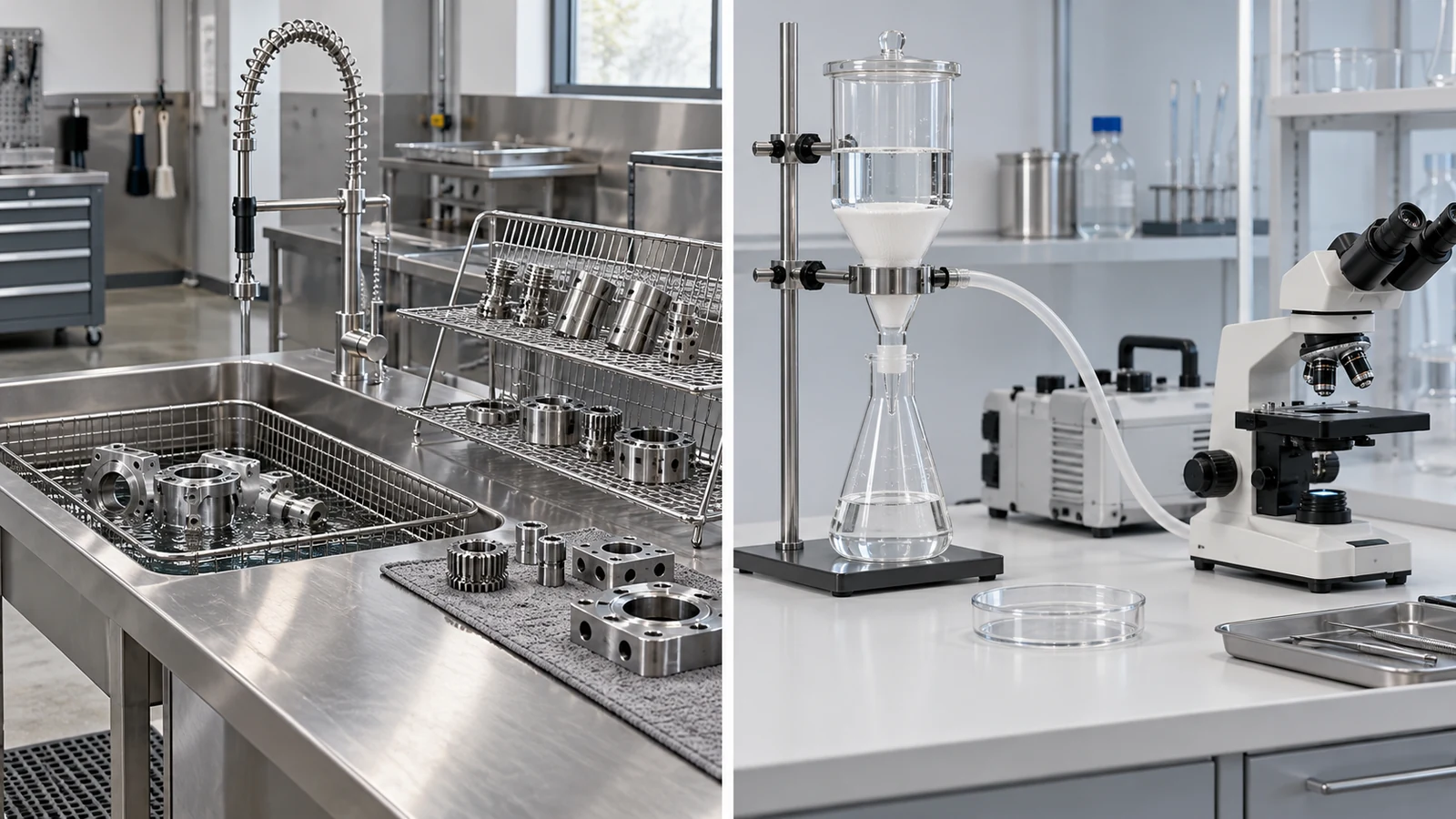
The procurement package should assign responsibility across the chain. The drawing owner defines the functional limit and acceptance rule. The machining supplier identifies the operations and handling points that can introduce particles. A qualified laboratory or agreed test provider performs the specified analysis where required. The receiving party verifies lot identity and records against the order. If those roles are unclear, a supplier may quote a wash step without knowing what evidence the customer expects.
Turn the requirement into a verifiable callout
- Define function. Explain what the particle limit protects—such as a fluid path, valve, bearing, or sensitive assembly—without substituting a generic “clean room” label for a measurable criterion.
- Name the governing document. State the standard edition, customer specification, and any approved procedure that controls extraction, analysis, and acceptance.
- Set the limit with the system owner. Use the component’s use conditions and system risk; ISO 16232 provides methods and reporting structure, not a universal limit table.
- Define sampling and records. Identify lot boundaries, sample quantity or selection method, result units, report fields, and the records that travel with the shipment.
- Protect the tested state. Specify handling and packaging after cleaning so that a passing result is not undermined before installation.
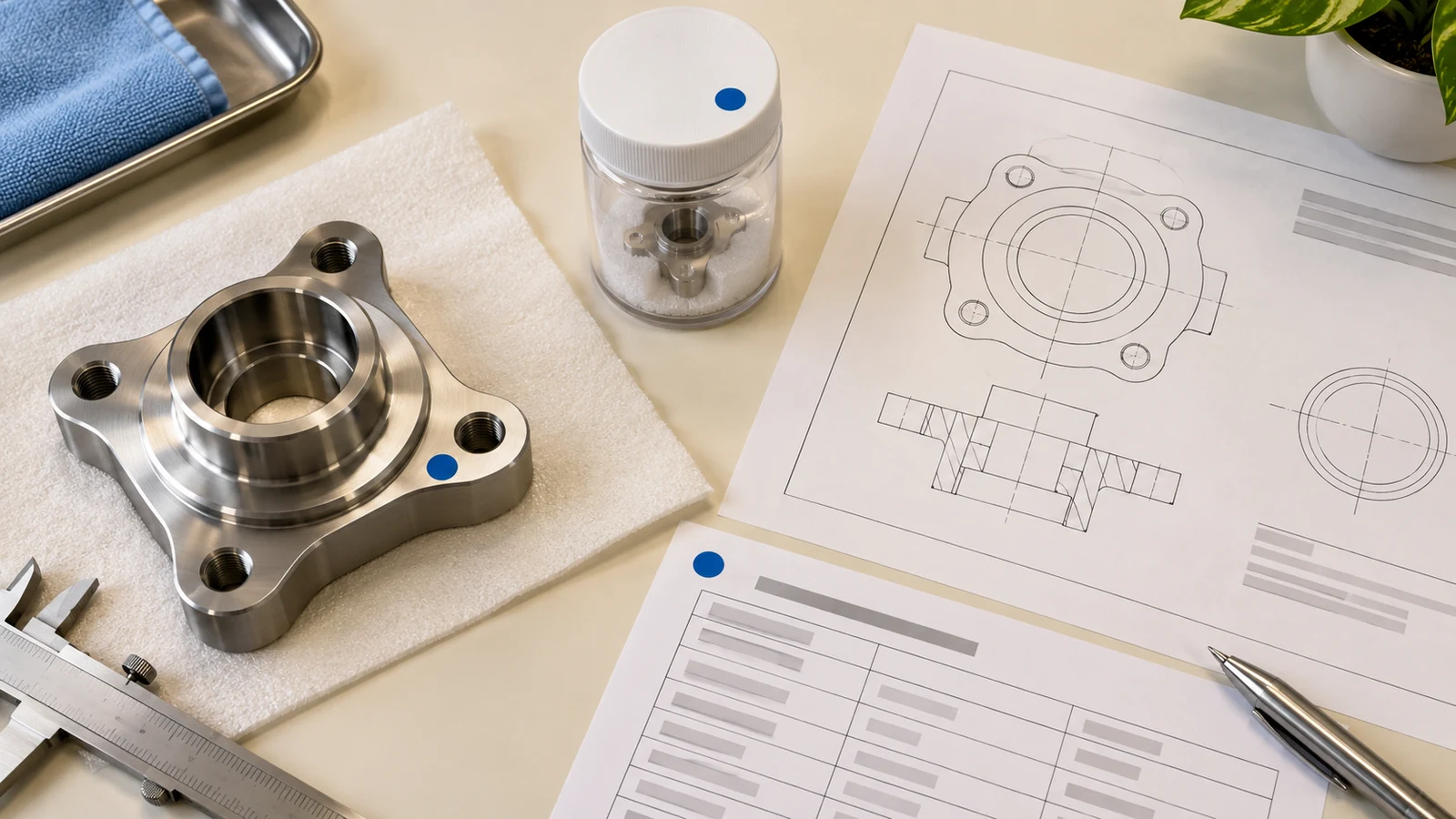
Do not confuse particulate cleanliness with films such as oil or grease. ISO’s stated scope excludes film contamination and non-quantifiable visual or wipe methods as substitutes for its defined cleanliness inspection. If film residue matters too, specify that requirement and its test separately.
Keep packaging and inspection requirements distinct
Cleanliness control continues after the test. Parts can acquire new particles through contact, abrasion, loose packaging, or poor handling. The CNC parts packaging guide covers protection and shipment handling; this standard-focused article addresses how to define and document particle cleanliness. A packaging instruction should preserve the required state, not replace the cleanliness acceptance plan.
For dimensional and material records, connect the cleanliness report to the same part number, drawing revision, lot, and shipment identity. The site’s traceability guide explains how records can stay linked to the delivered parts. Do not claim ISO 16232 conformity unless the specified method, criteria, and required evidence were actually followed.