
A2 and D2 are not interchangeable just because both are air-hardening cold-work tool steels. D2 is commonly selected when abrasive wear resistance is the leading requirement; A2 is often considered when a better balance of wear resistance and resistance to edge chipping is needed. The correct choice depends on the failure mode, section geometry, heat-treatment condition, finish, and the cost of an unplanned tool failure—not on hardness alone.
This comparison is most useful for punches, wear blocks, blades, and other machined tool components. It is not a substitute for a grade-specific heat-treatment specification. Commercial equivalents and branded grades can differ, so the purchase description should identify the governing standard, condition, and acceptance evidence.
Start with how the tool fails
Inspect a failed component before choosing a replacement. A polished or rounded working edge points toward wear; a chipped corner, crack from a notch, or sudden fracture points toward a different problem. If a tool is scrapped for wear but the process actually suffers from chipping, selecting a more wear-resistant steel can make the failure less predictable rather than solve it.
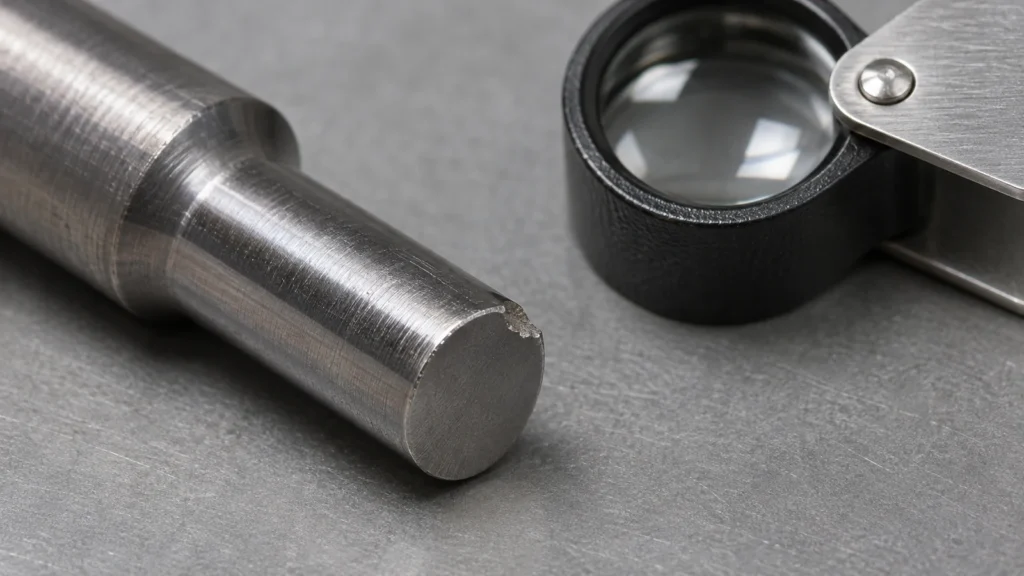
Record where the damage begins, whether it is localized, how the load is applied, and whether the failure follows a grinding burn, sharp transition, inclusion, or heat-treatment distortion. A2/D2 selection is meaningful only after abrasive, adhesive, impact, and gross-fracture risks are separated. Tooling guidance from steel producers likewise treats the dominant wear or fracture mechanism as the selection driver.
Wear resistance has a cost
D2’s high alloy and carbide structure make it attractive where abrasive wear is severe. In the same tool, however, a thin unsupported edge, abrupt section change, impact, or stress concentration can make chipping the controlling failure. A2 is often considered where the application needs a less extreme wear profile and more tolerance for edge damage, although the result depends on the exact steel, heat treatment, and geometry.
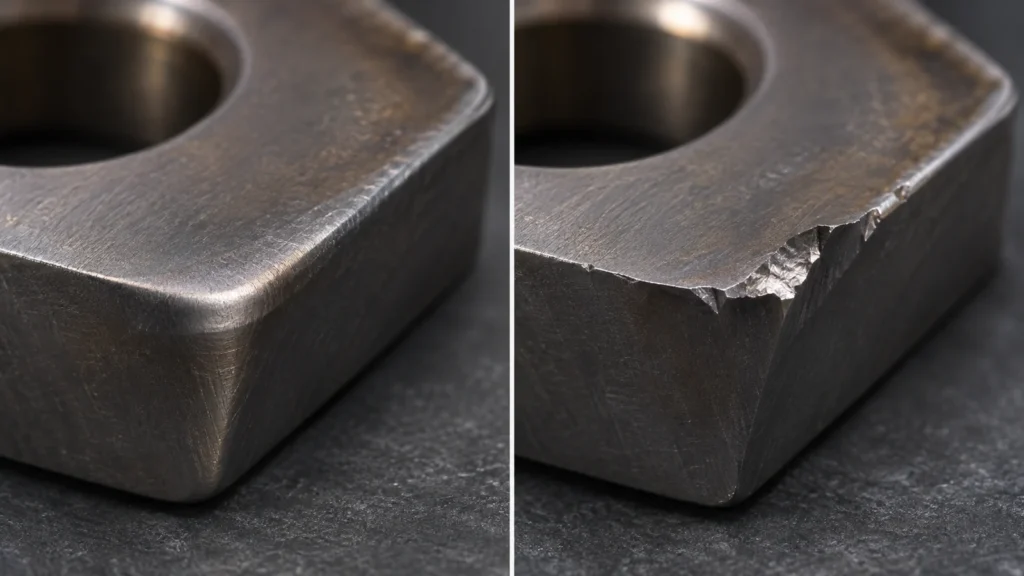
Do not translate a single manufacturer’s relative property chart into a universal ranking for every A2 and D2 product. The chart is a useful directional comparison within its stated material and test context. Carbide distribution, cleanliness, product route, heat treatment, and working hardness can all change performance. For a high-cost tool, a small controlled trial with documented failure criteria may be more valuable than a generic “upgrade” to D2.
Geometry can outweigh the grade label
Thin punches, small radii, narrow lands, and interrupted cuts concentrate stress. A nominally stronger or more wear-resistant steel cannot compensate for a fragile load path. Review edge support, clearance, alignment, backing, and the direction of the force. A radiused transition or a wider support may extend life without changing the material.
Surface condition also matters. Grinding damage, sharp internal corners, and rough transitions can initiate cracks. Specify the working surface, allowable edge condition, and any critical radii clearly. If the tool sees impact or misalignment, describe it in the application review; hardness data alone does not represent that duty cycle.
Plan machining around heat treatment
Tool-steel components are commonly roughed before hardening and finished afterward where the required geometry or surface calls for it. The exact sequence depends on stock condition, section size, expected movement, remaining stock, and the finishing process. Do not use a universal allowance copied from a different grade or shape. Agree on datum recovery and inspection stages so the critical edge can be located after treatment.
Machining cost can differ between A2 and D2 because of hardness, carbide content, stock condition, and the amount of grinding or EDM required. Identify which features must be machined before heat treatment, which can be finish-ground, and whether EDM recast or surface integrity requires additional work. The site’s A2 material page and D2 material page provide grade-specific context; they do not define the customer’s heat-treatment acceptance standard.
For the broader process sequence, compare heat-treatment planning with the part’s datum and finish requirements. If precision grinding is part of the route, put the finished profile, surface, and inspection references on the drawing.
A2 and D2 at the decision point
| Application evidence | Direction to evaluate | Question before release |
|---|---|---|
| Severe abrasive wear, edge well supported | Evaluate D2 | Will carbide-related chipping risk remain acceptable in this geometry? |
| Edge damage or impact dominates tool life | Evaluate A2 or a tougher alternative | Is wear rate acceptable if toughness improves? |
| Thin section or notch-sensitive feature | Review geometry and heat treatment first | Can support, radius, or load alignment reduce stress concentration? |
| High-cost or safety-critical tooling | Qualify exact supplier grade and condition | What inspection, hardness range, and failure evidence are required? |
The table is a decision aid, not a material guarantee. Confirm the exact grade and supplier data before substituting one steel for another.
Specify the condition, not just the name
A usable specification identifies A2 or D2 by the required standard or named product, the delivery condition, heat-treatment requirements, hardness acceptance range, critical surface and edge requirements, and traceability records. Add the dimensions that must be verified after heat treatment and the method or datum scheme when measurement ambiguity could affect acceptance.
In short: begin with the damage mechanism. D2 is a logical candidate when abrasive wear leads; A2 may be the better investigation when edge chipping and toughness lead. Then test the decision against geometry, treatment, finish, and actual tool-life evidence.