
Choose between brass and bronze by identifying the part’s job, not by treating either word as a single alloy. Brass generally describes copper-zinc alloys; bronze commonly refers to copper alloys with tin or other additions, and both families include grades with very different machinability, strength, corrosion behavior, and bearing performance. For a CNC component, the governing question may be a threaded fitting, a current-carrying contact, a low-friction bearing, or a structural load—not the family name on a quote.
Start with the exact grade and service environment. Free-machining brass such as C36000 is valued for machining behavior, while bearing bronzes such as C93200 are used for particular bearing duties. Those examples are not universal substitutes. The site’s brass overview is a family-level reference; the drawing should name the required alloy and acceptance conditions.
Why the family label is not enough
“Brass” can mean a free-machining leaded grade, a cartridge brass, or a naval brass family, among others. “Bronze” can refer to tin bronze, aluminum bronze, silicon bronze, and additional copper alloys. Their mechanical and environmental behavior is not interchangeable. Therefore, a comparison that says “brass is easier to machine” or “bronze is stronger” without naming alloys is too broad to guide a drawing or purchase order.
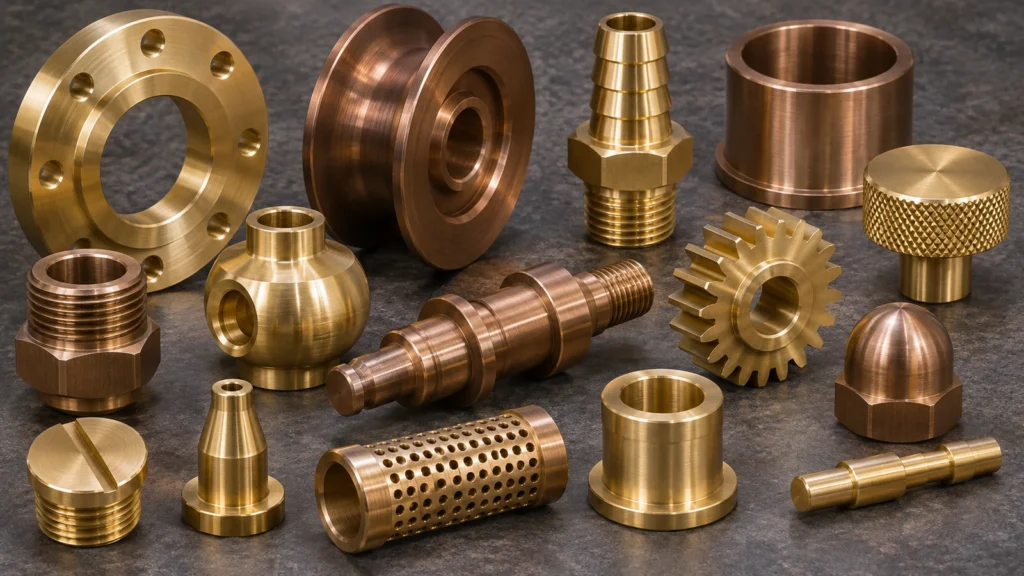
Use a grade-level comparison. For example, Copper Development Association data identify composition and typical applications for C36000 brass; other brass grades such as C46400 serve different roles. A bearing bronze such as C93200 has its own composition and application context. These references help screen an option, not certify the finished part.
When machinability leads
For turned connectors, small fittings, threaded parts, and high-feature-count components, machining behavior can influence cycle planning, burr control, chip handling, and surface finish. C36000 is a common free-machining brass example, but its lead content can make it unacceptable for some product, regulatory, or customer requirements. A “lead-free” request must be defined by the applicable specification and end use; it should not be inferred from the brass label.
Bronze machining varies widely by grade. A bearing alloy with a different chemistry and microstructure can require different tooling and cutting decisions than free-machining brass. The Copper Development Association’s comparative machinability material is tied to stated reference methods and alloys; it should not be converted into a guaranteed cycle-time ratio for an unknown part. Review the exact grade, stock, feature geometry, and finishing operations with the supplier.
When the part carries a sliding load
Bronze is often selected for bushings and bearing components because some bronze grades are designed for bearing service. Yet the bearing system includes shaft hardness and finish, lubrication, load direction, speed, dirt, and heat. A bearing alloy that is appropriate in one lubrication regime may be a poor choice in another. If the design depends on a specific bronze grade, state it explicitly instead of asking for “bronze equivalent.”
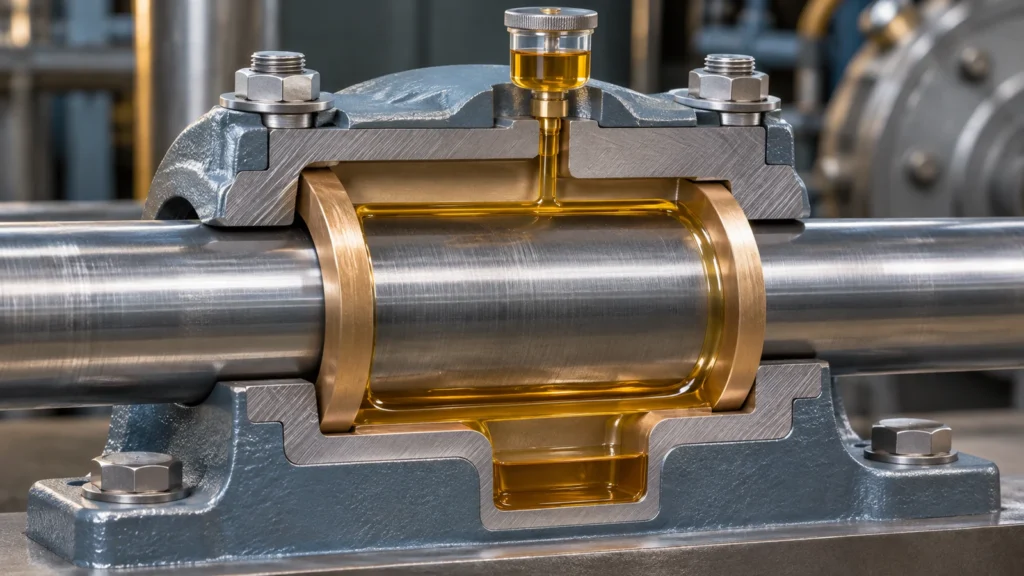
Brass can also appear in moving assemblies, but the application should be validated at the grade and contact-pair level. A part that merely guides a component is not automatically equivalent to a loaded bearing. Show whether the component supports a radial load, handles intermittent impact, or only maintains spacing. For a bearing, include the mating shaft and lubrication assumptions in the design review.
Corrosion and compliance change the answer
Corrosion depends on the medium, concentration, temperature, flow, crevices, and contact with other metals. Saltwater, cleaning agents, and stagnant trapped liquid pose different risks. Some copper alloys are chosen for marine or corrosive service, but the family name alone does not establish compatibility. If the part is exposed to a specified fluid, identify it and verify the exact alloy with authoritative material guidance.
Likewise, electrical conductivity, food-contact rules, drinking-water requirements, and restrictions on lead or other elements are grade- and jurisdiction-specific. A functional substitute can fail a compliance review even if its dimensions and machining appearance are acceptable. Material certificates and lot traceability should match the governing purchase requirement. See the site’s copper-alloy material context and its material and dimensional traceability guide when defining evidence.
A job-based comparison
| Part duty | First grades to investigate | Do not overlook |
|---|---|---|
| Small turned fitting with many threads | Free-machining brass when chemistry is permitted | Lead restrictions, thread form, burr limits, and fluid compatibility |
| Plain bearing or wear sleeve | Specified bearing bronze, such as an appropriate C93200 application | Shaft finish, lubrication, load, speed, and replacement access |
| Marine or corrosive assembly | Grade selected for the defined medium | Galvanic couple, crevice geometry, flow, and exposure concentration |
| Electrical contact or conductive part | Grade selected for conductivity and mechanical duty | Contact resistance, plating, spring behavior, and compliance limits |
| General machined spacer | Compare exact brass and bronze grades by drawing need | Strength, stock availability, finish, and traceability |
The examples are screening paths. Confirm data for the exact alloy, product form, and standard before releasing a substitute.
Make grade substitution reviewable
Put the alloy designation and any governing specification on the drawing or purchase order. State the product form, required certificates, restricted elements, service medium, contact conditions, and the dimensions that affect fit. If alternatives are allowed, define who approves them and what evidence is required—chemistry, mechanical properties, corrosion review, or a prototype test.
Brass is often an efficient place to start for machinability-led components; bronze may be more appropriate for a defined bearing or wear duty. The defensible choice is the exact grade that meets the load, environment, machining, and compliance requirements together.