
+86-188-7042-1176
project@jcproto.com
Mon-Fri: 8am-6pm (GMT+8)
EN
ISO 9001:2015 Certified
Heat Treatment
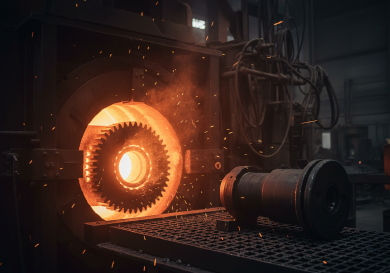
Heat Treatment is a controlled heating and cooling process used to alter the physical and mechanical properties of a metal without changing its shape. It is essential for increasing strength, hardness, toughness, or ductility. At Jucheng Precision, we manage a comprehensive range of heat treatment processes through our certified partners to ensure your CNC machined parts meet strict metallurgical requirements.
From Annealing to improve machinability before cutting, to Vacuum Hardening for finishing high-precision mold components, we oversee the entire lifecycle. We verify all treated parts with HRC (Rockwell) hardness testing to ensure they meet your specifications (e.g., 58-60 HRC for tool steels) before final precision grinding.
Key Specifications
| Specification | Technical Range | Note |
|---|---|---|
| Max Part Size | 1000 mm x 800 mm x 800 mm | Depends on furnace capacity |
| Hardness Range | 20 HRC – 65 HRC | Material dependent |
| Case Depth | 0.1 mm – 2.0 mm | For Case Hardening / Nitriding |
| Compatible Materials | Carbon Steel, Alloy Steel, Tool Steel, Stainless (17-4PH), Aluminum | Al uses Precipitation Hardening (T6) |
| Standard Lead Time | 3 – 5 Days | Includes batching and testing |
| Validation | Rockwell C (HRC), Brinell (HB) | Hardness report provided |
Heat Treatment Processes
| Process | Description | Key Benefits & Applications |
|---|---|---|
| Hardening & Quenching | Heating metal to a critical temperature and rapidly cooling (quenching) in oil, water, or air to “freeze” the microstructure. | Benefit: Maximum hardness and strength. App: Tool steel dies, structural steel parts. |
| Case Hardening (Carburizing) | Diffusing carbon into the surface of low-carbon steel. Creates a hard outer “case” while keeping the core soft and tough. | Benefit: Wear resistant surface + shock resistant core. App: Gears, shafts, pins, sprockets. |
| Vacuum Hardening | Performed in a vacuum environment to prevent oxidation and scaling. Provides a bright, clean finish. | Benefit: Minimal distortion and no surface scale. App: High-precision medical parts, aerospace components. |
| Annealing / Normalizing | Heating and slow cooling to soften the metal, relieve internal stresses, and improve grain structure. | Benefit: Makes material easier to machine and prevents warping. App: Pre-machining stock, welded parts. |
| Nitriding | Diffusing nitrogen into the surface to create a hard, wear-resistant layer without quenching. Low distortion. | Benefit: High surface hardness (up to 70 HRC equivalent) and corrosion resistance. App: Mold cavities, precision screws. |
Design Guidelines for Heat Treatment
Leave Grinding Stock:
Heat treatment causes internal stress release, leading to dimensional distortion (warping) and slight size changes. Tip: Always leave 0.2mm – 0.5mm of extra material (“grinding stock”) on critical features to be ground to final size after hardening.
Sharp Corners:
Avoid sharp internal corners. They act as stress concentrators during the rapid cooling of quenching and can cause the part to crack. Use radiused corners whenever possible.
Uniform Cross-Sections:
Parts with drastic changes in thickness (e.g., a thick block connected to a thin fin) cool at different rates, leading to cracking. Design for uniform wall thickness or gradual transitions.
Thread Protection:
Fine threads can become brittle or distorted during hardening. It is often best to mask threads (if nitriding) or machine them after heat treat if the material isn’t too hard.
Industry Applications
Automotive Powertrain
Transmission gears and crankshafts are Case Hardened to withstand constant friction wear while absorbing high torque loads without snapping.
Tool & Die Making
Injection molds made from H13 or P20 steel are Vacuum Hardened to withstand millions of cycles of high-pressure plastic injection without deforming.
Aerospace
17-4PH Stainless Steel parts are Precipitation Hardened (H900 condition) to achieve the maximum strength-to-weight ratio for flight control components.
Heavy Machinery
Axles and drive shafts undergo Induction Hardening (local heating) to harden just the bearing surfaces while leaving the rest of the shaft tough.