
+86-188-7042-1176
project@jcproto.com
Mon-Fri: 8am-6pm (GMT+8)
EN
ISO 9001:2015 Certified
Tool Steel D2
AISI D2 is a high-carbon, high-chromium, air-hardening tool steel that serves as the industry standard for extreme wear resistance. Containing 12% chromium, it is often referred to as a "semi-stainless" tool steel. It is designed to achieve high hardness (typically 60-62 HRC) and maintain a keen cutting edge under severe abrasive conditions. At Jucheng Precision, we specialize in the complex machining and precision grinding of D2 for high-volume stamping dies, thread rollers, and industrial blades. While it is challenging to machine due to its abrasive nature, our specialized cutting strategies and EDM capabilities ensure we deliver robust, high-performance tooling that maximizes your production uptime.
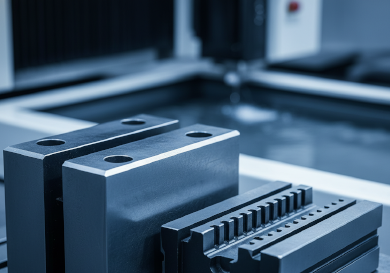
Tool Steel D2 Machining Capabilities
| Capability | Technical Description | Jucheng Advantage |
|---|---|---|
| Abrasive-Resistant Milling | D2 is highly abrasive due to large chromium carbides. We use specialized coated carbide tools to rough-machine complex shapes in the annealed state. | Our high-torque CNC centers maintain consistent feed rates to prevent tool glazing and work hardening, ensuring efficient material removal. |
| Hard Milling (Up to 62 HRC) | Finish-machining D2 after it has been fully hardened. This process requires ultra-rigid setups and CBN or ceramic tooling. | Allows us to achieve tight tolerances and superior surface finishes on hardened dies, reducing the need for manual stoning. |
| Precision Profile Grinding | Achieving micron-level accuracy on D2 cutting edges and forming profiles using CNC grinding wheels. | Jucheng guarantees edges that are sharp and durable, essential for high-volume stamping and blanking operations. |
| EDM & Wire Cutting | Using electrical discharge machining to create intricate internal features and sharp corners in hardened D2 blocks. | We specialize in Wire EDM for D2 thread rolling dies and complex punch profiles where traditional milling cannot reach. |
Fabrication Guidelines for Tool Steel D2
Machinability Challenge:
D2 is one of the more difficult tool steels to machine (approx. 45% machinability compared to A2). Tip: It is highly abrasive; expect higher tooling costs and slower cycle times during the roughing stage.
Heat Treatment Strategy:
D2 is an air-hardening steel with very high chromium content. Tip: To reach its peak hardness of 60-62 HRC, we recommend vacuum hardening followed by double tempering to ensure dimensional stability and maximum toughness.
Grinding Sensitivity:
Due to its high carbide content, D2 is susceptible to “grinding cracks” if the wheel is too hard or feed is too aggressive. Tip: We use soft-bond wheels and abundant coolant to protect the surface integrity of your dies.
Semi-Stainless Property:
With 12% Chromium, D2 offers better corrosion resistance than most other tool steels, but it is not a true stainless steel. Tip: It still requires oiling or protective coatings in humid environments to prevent pitting.
Primary Applications
Blanking & Stamping Dies
The standard choice for long-run dies that must cut hard materials while maintaining a sharp edge over millions of cycles.
Thread Rolling Dies
Used to form threads on bolts and screws. D2’s extreme hardness and compressive strength prevent the die profiles from collapsing.
Industrial Knives & Slitters
Paper cutters, wood chippers, and plastic granulator blades that require the ultimate in abrasion resistance.
Master Gauges
Checking fixtures and gauges that must resist wear from constant contact with production parts.
Properties
| Density | 7.70 g/cm³ |
| Tensile Strength | 2100+ MPa |
| Yield Strength | 1600+ MPa |
| Hardness | 60 - 62 HRC |
| Impact Strength | 22 J (Charpy V-notch) |
| Thermal Conductivity | 20.0 W/m-K |
| Machinability Rating | 45% (Annealed) |
| Weldability | Very Poor |
| Wear Resistance | Superior |
| Chromium Content | 11.0% - 13.0% |
| Max Part Size | 2000 x 800 x 600 mm |