
Introduction : les éléments constitutifs de la livraison autonome
Le bourdonnement discret d'un petit véhicule à roues naviguant sur un trottoir devient un paysage sonore urbain de plus en plus courant. Ces coursiers autonomes représentent un bond significatif dans la logistique, promettant une livraison du dernier kilomètre plus rapide, moins chère et plus efficace. Mais qu'est-ce qui transforme une simple boîte sur roues en un agent de livraison autonome fiable ? La réponse réside dans une intégration sophistiquée de matériel et de logiciels spécialisés. Comprendre les pièces de robots de livraison est essentiel pour apprécier comment ces machines fonctionnent en toute sécurité et efficacement dans des environnements complexes et dynamiques. Des capteurs qui leur servent d'yeux aux moteurs qui propulsent leur trajet, chaque composant joue un rôle critique. Cet article décortiquera l'anatomie d'un robot de livraison, en explorant le matériel essentiel qui constitue la fondation physique de cette révolution autonome.
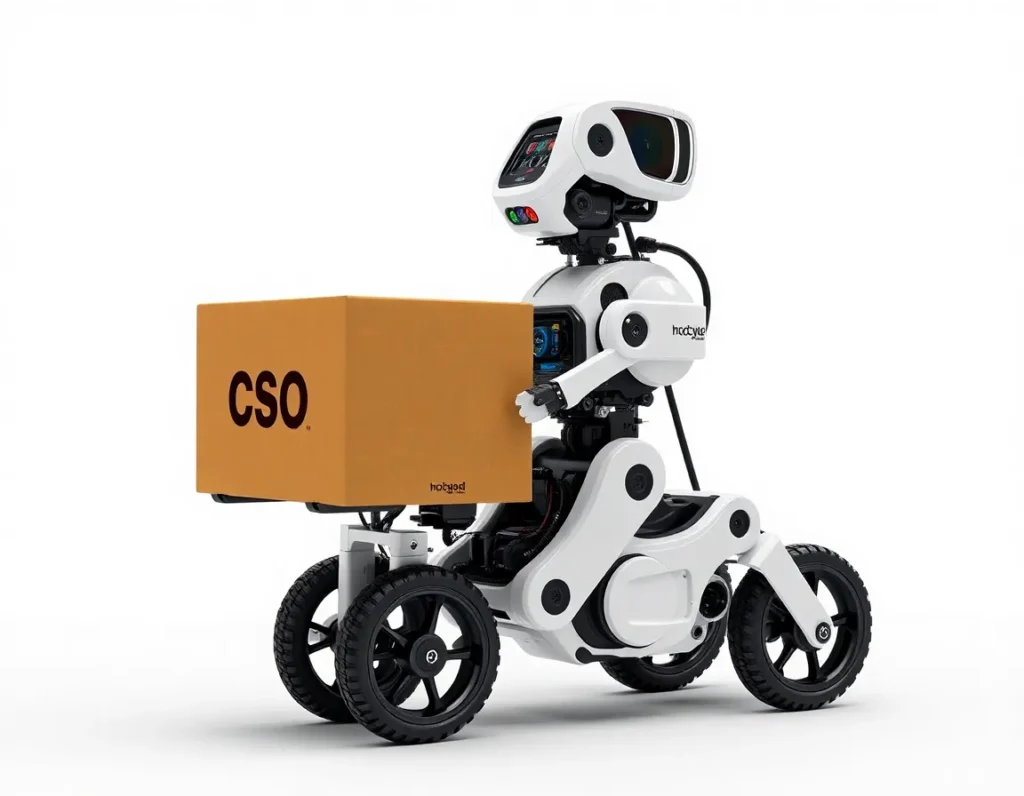
Composants principaux : le matériel essentiel d'un robot de livraison
À la base, un robot de livraison est un conteneur mobile et sécurisé doté d'un cerveau. Le matériel principal peut être classé en plusieurs systèmes interdépendants, chacun avec des pièces distinctes travaillant de concert. Le châssis forme le squelette du robot, une structure rigide généralement fabriquée à partir de matériaux légers mais durables comme l'aluminium ou des composites avancés. Cette structure doit résister aux chocs quotidiens, aux vibrations et aux intempéries tout en fournissant des points de fixation pour tous les autres systèmes. Fixé à ce châssis se trouve le système d'entraînement, composé de roues, de moteurs et de suspension. La plupart des robots de trottoir utilisent une combinaison de roues motorisées et de roues folles pour la stabilité et la maniabilité, souvent avec une configuration à entraînement différentiel qui permet des virages serrés et même une rotation sur place.
Le cœur computationnel est l'ordinateur principal embarqué, un processeur renforcé qui exécute le système d'exploitation et les logiciels d'IA du robot. Cet ordinateur fusionne les données de tous les capteurs pour prendre des décisions de navigation en temps réel. Alimentant l'ensemble, la batterie et le système de gestion de l'énergie, un pack lithium-ion à haute capacité conçu pour un fonctionnement toute la journée. Le composant principal peut-être le plus visible extérieurement est le compartiment ou la baie de chargement. Ce n'est pas une simple boîte ; c'est un casier sécurisé, souvent à température contrôlée, avec des serrures électroniques qui ne peuvent être ouvertes que par le destinataire prévu via un code sécurisé ou une application. Ces pièces fondamentales — le cadre, la transmission, l'ordinateur, la batterie et le compartiment de chargement — créent la plateforme physique sur laquelle l'intelligence du robot est construite.
Systèmes de navigation et de perception : comment les robots de livraison voient et se déplacent
Pour qu'un robot navigue dans un monde conçu pour les humains, il a besoin d'un ensemble d'outils de perception bien au-delà des sens humains. Ce système est un ensemble complexe de capteurs et de logiciels qui crée une compréhension 3D en temps réel de l'environnement. Les capteurs principaux sont les unités LiDAR (détection et télémétrie par la lumière), qui émettent des impulsions laser pour mesurer les distances aux objets environnants avec une extrême précision, créant une carte détaillée en nuage de points des environs du robot. Ceci est souvent complété par des caméras de vision stéréo, qui fournissent des données riches en couleurs et en textures, aidant le robot à interpréter les feux de circulation, lire les panneaux de signalisation et identifier des objets spécifiques comme les piétons ou les animaux domestiques.
Pour un positionnement et une orientation précis, les robots s'appuient sur une combinaison de GPS (pour la localisation grossière), d'unités de mesure inertielle (IMU avec accéléromètres et gyroscopes) et d'odométrie des roues. L'IMU suit l'accélération et la rotation du robot, comblant les lacunes lorsque les signaux GPS sont faibles, comme dans les canyons urbains ou sous la couverture arborée. Les capteurs à ultrasons agissent comme un filet de sécurité à courte portée, détectant les obstacles immédiats au niveau du sol, comme les bordures ou les objets inattendus qui pourraient tomber sous le champ de vision du LiDAR. Toutes ces données brutes de capteurs sont traitées simultanément par l'ordinateur embarqué à l'aide d'une technique appelée fusion de capteurs. Des algorithmes avancés, notamment la localisation et cartographie simultanées (SLAM), permettent au robot de construire une carte d'une zone inconnue tout en suivant simultanément sa propre position à l'intérieur de celle-ci. Cette perception traitée permet la planification de trajectoire, où le robot calcule l'itinéraire le plus sûr et le plus efficace vers sa destination, en s'ajustant dynamiquement aux obstacles statiques comme les boîtes aux lettres et dynamiques comme les personnes en mouvement.
Fusion de capteurs et prise de décision en temps réel
La véritable magie ne réside pas dans un capteur unique, mais dans leur intégration. Une caméra peut voir une forme rouge, mais fusionnée avec les données LiDAR confirmant sa position au-dessus d'une voie, le système l'interprète comme un feu stop. L'IMU détecte une légère inclinaison, confirmant que le robot est à une bordure. Cette analyse continue, milliseconde par milliseconde, permet des comportements nuancés : ralentir lorsque des enfants sont à proximité, laisser un large espace à une personne avec un chien en laisse, ou s'arrêter complètement et de manière prévisible à un passage piéton. Le système de navigation est une boucle constante de perception, de planification et d'action, faisant du robot non pas un simple suiveur aveugle d'un chemin préprogrammé, mais un participant conscient de l'espace partagé du trottoir.
Alimentation et propulsion : batteries, moteurs et endurance
The autonomy of a delivery robot is directly tied to its energy independence. Propulsion and power systems are engineered for endurance, reliability, and quiet operation. The cornerstone is a high-density lithium-ion or lithium-polymer battery pack, similar to those in electric vehicles but scaled down. These batteries are selected for their ability to deliver sustained power over a full shift—typically 8 to 12 hours—on a single charge, while also powering the computationally intensive sensors and computer. Sophisticated battery management systems (BMS) monitor cell health, temperature, and charge cycles to maximize lifespan and safety.
This stored electrical energy drives brushless DC electric motors, prized for their efficiency, low maintenance, and precise torque control. The motors are connected to the wheels through gearboxes or direct drives, providing the necessary force to climb mild inclines, navigate uneven pavement, and start from a stop while carrying a loaded cargo compartment. Regenerative braking, where the motors act as generators to recapture some energy during deceleration, is often employed to extend range. The entire system is designed for efficiency; low-rolling-resistance tires, aerodynamic (where applicable) body shapes, and power-saving sleep modes for idle periods all contribute to maximizing the distance a robot can travel between charges, which can range from 15 to over 30 miles depending on the model and load.
The Cargo Compartment: Securing and Protecting Deliveries
The entire purpose of the robot culminates in the cargo compartment. This is far more than a trunk; it is a secure, customer-facing interface designed for convenience and reliability. Compartments are modular and come in various sizes to accommodate anything from a pizza box to several grocery bags. Critical design considerations include weatherproofing—seals and gaskets to keep rain, snow, and dust out—and thermal insulation. For food delivery, active temperature control systems using Peltier elements or small compressors can maintain hot or cold temperatures throughout the journey.
Security is paramount. Compartments feature robust, electronically controlled locking mechanisms that engage automatically upon closure. Access is granted exclusively through a one-time PIN code or a digital key sent to the recipient’s smartphone app, ensuring the delivery is only retrieved by the intended person. Internally, compartments may include adjustable dividers, non-slip surfaces, and even suspension systems to cushion fragile items. The design prioritizes easy loading for operators and easy, intuitive retrieval for customers, often with compartments at a comfortable height to avoid bending. This focus on the cargo experience ensures that the goods arrive in the same condition they were loaded, completing the promise of autonomous delivery.
Communication and Control: The Robot’s Link to the World
The autonomous journey of a delivery robot is not a solitary one. It is a continuous, data-rich conversation with a wider network, enabled by a sophisticated suite of communication and control systems. These systems are the robot’s lifeline, allowing it to receive orders, navigate dynamically, and signal its status, all while remaining under the watchful eye of remote operators.
At the heart of this connectivity is a combination of cellular networks (4G/5G), Wi-Fi, and sometimes dedicated short-range communications (DSRC). Cellular provides the wide-area link for most operations, transmitting real-time location, sensor data, and system health back to a central fleet management platform. This platform is the mission control, where dispatchers can monitor dozens of robots simultaneously, assign new delivery tasks, and view live camera feeds. The control link is bidirectional; the platform can send route updates, such as redirecting a robot around a newly reported obstacle or traffic incident, or command it to return to base.
For immediate, low-latency interactions, many robots incorporate local communication modules. Bluetooth Low Energy (BLE) is often used for the final handshake, allowing a customer’s smartphone to securely unlock the cargo compartment upon arrival. Similarly, transceivers for Vehicle-to-Everything (V2X) communication allow robots to interact with smart city infrastructure, like traffic lights that can grant them a safe crossing window, enhancing both efficiency and safety.
The “control” aspect is a layered hierarchy. Primary navigation and obstacle avoidance are handled entirely onboard by the robot’s AI, making thousands of micro-decisions per second. However, a human-in-the-loop system is critical for edge cases. If a robot encounters a situation its programming cannot resolve—like a complex construction site or an overly curious pet—it will stop and request remote assistance. An operator can then assess the scene via the robot’s cameras and manually pilot it through the challenge using a virtual joystick interface before returning it to autonomous mode. This hybrid approach balances full automation with necessary human oversight.
Durability and Safety Features: Built for All Conditions
Delivery robots are designed for the real world, which is unpredictable and often unforgiving. Their operational mandate requires them to function reliably in pouring rain, summer heat, light snow, and across uneven urban terrain. This demands a foundational focus on durability and integrated safety features that protect the robot, its cargo, and the public.
The robot’s chassis and external shell are its first line of defense. Constructed from lightweight yet impact-resistant materials like polycarbonate composites or aerospace-grade aluminum, the body is built to withstand minor collisions, vandalism attempts, and the general wear and tear of daily use. Critical seams are sealed with IP-rated (Ingress Protection) gaskets, typically reaching IP65 or higher, making the internal electronics dust-tight and protected against powerful water jets. This weatherproofing ensures that a sudden downpour or a drive through a puddle won’t cause a system failure.
Safety is engineered into every movement. A combination of software and hardware creates multiple redundant layers. The primary perception sensors (LiDAR, cameras, ultrasonics) constantly scan for obstacles. If an object or person is detected in the path, the robot’s first response is to slow down, then stop completely if the obstacle remains. Physical bumper sensors around the base provide a final, tactile fail-safe; a light touch will trigger an immediate halt. Audible signals and expressive LED lights communicate the robot’s intentions to pedestrians, signaling “wait,” “moving,” or “yielding.”
For extreme scenarios, an integrated e-stop (emergency stop) button is always accessible on the robot’s exterior, allowing anyone to halt it instantly. Internally, thermal management systems prevent battery and computer overheating, while low-temperature packages allow operation in colder climates. The design also considers stability, with a low center of gravity and wheel configurations that prevent tipping on slopes or curbs. These features collectively ensure that the robot is not just a functional machine, but a responsible and resilient participant in shared public spaces.
Maintenance, Repair, and the Parts Ecosystem
To ensure a fleet of delivery robots remains operational and cost-effective, a robust strategy for maintenance, repair, and parts management is essential. Unlike consumer electronics, these robots are commercial assets where uptime is directly tied to revenue, necessitating a proactive and efficient support system.
Maintenance is heavily predictive and data-driven. The fleet management software continuously monitors the health of each robot, tracking metrics like battery cycle count, motor current draw, and sensor calibration. Algorithms can predict when a component is likely to fail based on usage patterns, triggering a maintenance alert before a roadside breakdown occurs. This allows for scheduled servicing during off-peak hours, where robots can be rotated out of service for inspection, software updates, and component replacements.
The modular design of most delivery robots is a key enabler for rapid repair. Core pièces de robots de livraison—such as wheel modules, sensor clusters, battery packs, and compute units—are designed as swappable units. A technician can quickly diagnose a faulty LiDAR sensor via a diagnostic port, unplug and unmount it, and install a pre-calibrated replacement in minutes, getting the robot back on its route with minimal downtime. This modularity extends the robot’s lifespan and simplifies the supply chain.
This practice gives rise to a specialized parts ecosystem. Original Equipment Manufacturers (OEMs) produce and warehouse critical proprietary components, while third-party suppliers may offer compatible wear items like tires, bumper skins, or standard fasteners. The aftermarket for refurbished or remanufactured major components is also growing, providing cost-effective alternatives for fleet operators. Effective management of this ecosystem—ensuring the right parts are available at the right depot at the right time—is as crucial to logistics success as the robots’ own navigation software. It transforms the robot from a static product into a sustainably maintained service platform.
Résumé des points clés
Autonomous delivery robots are sophisticated machines composed of integrated systems working in concert. Their hardware foundation includes a durable chassis, precise motor and steering controls, and efficient battery systems for all-day endurance. They perceive the world through a sensor fusion of LiDAR, cameras, and ultrasonics, processed by an onboard computer to navigate complex environments safely.
The cargo compartment is a secure, often climate-controlled space with electronic locks, designed to protect goods from the elements and ensure secure customer retrieval. Continuous communication via cellular and local networks keeps the robot connected to fleet management and remote human assistance. Durability features like weatherproofing and impact-resistant materials allow operation in diverse conditions, while multi-layered safety systems protect pedestrians and the robot itself.
Finally, the operational viability of a robot fleet depends on a structured approach to maintenance and repair, supported by a growing ecosystem of modular, swappable parts. From navigation to the final delivery handoff, each component plays a critical role in fulfilling the promise of reliable, contactless autonomous logistics.
Frequently Asked Questions (FAQ)
What are the most critical parts of a delivery robot?
The most critical parts form the core functional triad: the perception system (LiDAR, cameras), the navigation and control computer, and the propulsion system (motors, wheels, battery). If any one of these fails, the robot cannot operate autonomously. The sensors are its eyes, the computer is its brain, and the propulsion system is its legs.
How do delivery robots not bump into people or objects?
They use a combination of sensor technologies to create a 360-degree awareness field. LiDAR measures precise distances to objects, cameras identify and classify those objects (e.g., a person vs. a trash can), and ultrasonic sensors cover blind spots at ground level. The AI software interprets this data in real-time to plot a safe path and will stop completely if an obstacle enters its immediate safety zone.
What happens if a delivery robot breaks down or gets stuck?
First, it will attempt to self-diagnose and, if possible, move itself to a safe location out of foot traffic. It will simultaneously send an alert to the fleet operations center. A remote operator can then view its cameras and sensors to assess the situation. Often, the operator can guide it out of trouble remotely. If not, a human technician is dispatched to retrieve or repair the robot on-site.
Can delivery robots operate in bad weather like rain or snow?
Yes, within design limits. Most commercial delivery robots are rated for rain and light snow, with sealed bodies and components. However, heavy snow, ice storms, or severe flooding may ground a fleet. Sensors like LiDAR can be impaired by heavy precipitation, so operators may reduce service areas or pause operations during extreme weather for safety.
How long does a delivery robot’s battery last, and how is it recharged?
A typical delivery robot battery lasts for a full shift of 8-12 hours on a single charge, depending on load and terrain. Robots autonomously return to a docking station when battery levels are low. These stations provide automatic conductive (plug-based) or inductive (wireless) charging. Battery swaps are also common in some fleets for even faster turnaround.
How secure is the delivery compartment? Can someone steal from it?
Compartments have electronically controlled locks that engage automatically. They only open via a unique, time-sensitive access code or a digital key sent to the recipient’s smartphone app at the time of delivery. This makes casual theft very difficult. The compartments are also typically made of sturdy, tamper-resistant materials and may be equipped with tamper alerts.
Where can I find parts or learn more about specific delivery robot components?
Detailed technical information on pièces de robots de livraison can be found through manufacturer technical publications, industry whitepapers, and educational technology resources. For comprehensive overviews and diagrams, reputable sources like Encyclopedia Britannica, HowStuffWorks, and Wikipedia offer valuable introductory material on the subject.