
مقدمة: اللبنات الأساسية للتوصيل الذاتي
أصبح الطنين الهادئ لمركبة صغيرة ذات عجلات تتنقل على الرصيف مشهدًا صوتيًا حضريًا شائعًا بشكل متزايد. يمثل هؤلاء المندوبون المستقلون قفزة كبيرة في مجال الخدمات اللوجستية، إذ يعدون بتوصيل أسرع وأرخص وأكثر كفاءة للميل الأخير. لكن ما الذي يحوّل صندوقًا بسيطًا على عجلات إلى وكيل توصيل ذاتي موثوق؟ تكمن الإجابة في تكامل متطور بين أجهزة وبرمجيات متخصصة. إن فهم أجزاء روبوت التوصيل الأساسية هو مفتاح تقدير كيفية عمل هذه الآلات بأمان وفعالية في بيئات معقدة وديناميكية. من المستشعرات التي تعمل كعيون لها إلى المحركات التي تدفع رحلتها، يؤدي كل مكوّن دورًا حاسمًا. ستشرّح هذه المقالة تشريح روبوت التوصيل، مستكشفةً الأجهزة الأساسية التي تشكّل الأساس المادي لهذه الثورة الذاتية.
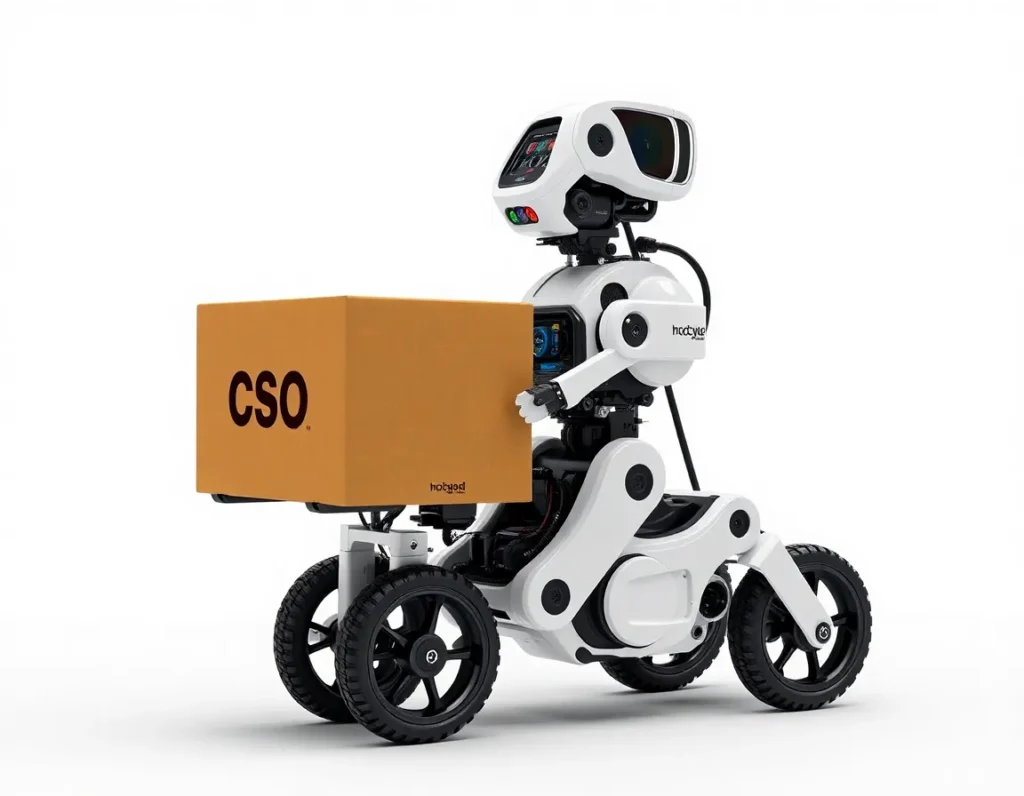
المكونات الأساسية: الأجهزة الضرورية لروبوت التوصيل
في أبسط صوره، روبوت التوصيل هو حاوية متنقلة وآمنة مزودة بعقل. يمكن تصنيف الأجهزة الأساسية إلى عدة أنظمة مترابطة، لكل منها أجزاء مميزة تعمل بتناغم. يشكّل الهيكل عظام الروبوت، وهو إطار صلب يُصنع عادةً من مواد خفيفة الوزن لكن متينة مثل الألومنيوم أو المواد المركبة المتقدمة. يجب أن يتحمل هذا الإطار الصدمات اليومية والاهتزازات والطقس مع توفير نقاط تثبيت لجميع الأنظمة الأخرى. ويتصل بهذا الهيكل نظام الدفع، الذي يتكون من العجلات والمحركات ونظام التعليق. تستخدم معظم روبوتات الأرصفة مزيجًا من العجلات المُدارة وعجلات التوجيه لتحقيق الاستقرار والقدرة على المناورة، غالبًا بإعداد دفع تفاضلي يسمح بالانعطافات الحادة وحتى الدوران في مكانه.
القلب الحسابي هو الحاسوب الرئيسي المدمج، وهو معالج مُقوّى يشغّل نظام تشغيل الروبوت وبرمجيات الذكاء الاصطناعي. يدمج هذا الحاسوب البيانات من جميع المستشعرات لاتخاذ قرارات ملاحية في الوقت الفعلي. ويغذّي كل شيء البطارية ونظام إدارة الطاقة، وهي حزمة ليثيوم-أيون عالية السعة مصممة للعمل طوال اليوم. وربما يكون المكوّن الأساسي الأكثر ظهورًا خارجيًا هو حجرة أو مقصورة الشحن. هذه ليست صندوقًا بسيطًا؛ بل خزانة آمنة، غالبًا ما تكون مُتحكَّمًا في مناخها، بأقفال إلكترونية لا يمكن فتحها إلا من قبل المستلم المقصود عبر رمز آمن أو تطبيق. تشكّل هذه الأجزاء الأساسية — الإطار ونظام الدفع والحاسوب والبطارية وحجرة الشحن — المنصة المادية التي تُبنى عليها ذكاء الروبوت.
أنظمة الملاحة والإدراك: كيف ترى روبوتات التوصيل وتتحرك
لكي يتنقل الروبوت في عالم مبني للبشر، يحتاج إلى مجموعة من أدوات الإدراك تتجاوز بكثير الحواس البشرية. هذا النظام عبارة عن مصفوفة معقدة من المستشعرات والبرمجيات التي تخلق فهمًا ثلاثي الأبعاد في الوقت الفعلي للبيئة. المستشعرات الأساسية هي وحدات LiDAR (الكشف عن الضوء وتحديد المدى)، التي تصدر نبضات ليزر لقياس المسافات إلى الأجسام المحيطة بدقة فائقة، مما ينشئ خريطة سحابية نقطية مفصلة لمحيط الروبوت. غالبًا ما يُستكمل ذلك بكاميرات رؤية مجسّمة، توفر بيانات غنية بالألوان والملمس، مما يساعد الروبوت على تفسير إشارات المرور وقراءة لافتات الشوارع وتحديد أجسام معينة مثل المشاة أو الحيوانات الأليفة.
لتحديد الموضع والتوجيه بدقة، تعتمد الروبوتات على مزيج من GPS (للموقع التقريبي)، ووحدات القياس بالقصور الذاتي (IMU مع مقاييس التسارع والجيروسكوبات)، وقياس مسافة العجلات. تتبع وحدة IMU تسارع الروبوت ودورانه، وتسد الفجوات عندما تكون إشارات GPS ضعيفة، كما في الممرات الحضرية أو تحت غطاء الأشجار. تعمل المستشعرات فوق الصوتية كشبكة أمان قريبة المدى، إذ تكتشف العوائق المباشرة على مستوى الأرض، مثل الأرصفة أو الأجسام غير المتوقعة التي قد تسقط خارج مجال رؤية LiDAR. تُعالَج كل هذه البيانات الخام من المستشعرات في وقت واحد بواسطة الحاسوب المدمج باستخدام تقنية تُسمى دمج المستشعرات. تسمح الخوارزميات المتقدمة، بما في ذلك التحديد والتخطيط المتزامن (SLAM)، للروبوت ببناء خريطة لمنطقة غير معروفة مع تتبع موقعه الخاص فيها في الوقت نفسه. يتيح هذا الإدراك المُعالَج تخطيط المسار، حيث يحسب الروبوت المسار الأكثر أمانًا وكفاءة إلى وجهته، مع التعديل الديناميكي للعوائق الثابتة مثل صناديق البريد والديناميكية مثل الأشخاص المتحركين.
دمج المستشعرات واتخاذ القرارات في الوقت الفعلي
السحر الحقيقي لا يحدث في أي مستشعر منفرد، بل في تكاملها. قد ترى الكاميرا شكلًا أحمر، لكن عند دمجها مع بيانات LiDAR التي تؤكد موقعه فوق مسار، يفسّره النظام على أنه إشارة توقف. تكتشف وحدة IMU ميلًا طفيفًا، مؤكدةً أن الروبوت عند رصيف. يتيح هذا التحليل المستمر، ميلي ثانية بعد ميلي ثانية، سلوكيات دقيقة: التباطؤ عند وجود أطفال قريبين، وإعطاء مسافة واسعة لشخص مع كلب مقيد بحبل، أو التوقف التام والمتوقع عند معبر المشاة. نظام الملاحة هو حلقة مستمرة من الإدراك والتخطيط والفعل، مما يجعل الروبوت ليس مجرد متابع أعمى لمسار مبرمج مسبقًا، بل مشاركًا واعيًا في المساحة المشتركة للرصيف.
الطاقة والدفع: البطاريات والمحركات والتحمل
The autonomy of a delivery robot is directly tied to its energy independence. Propulsion and power systems are engineered for endurance, reliability, and quiet operation. The cornerstone is a high-density lithium-ion or lithium-polymer battery pack, similar to those in electric vehicles but scaled down. These batteries are selected for their ability to deliver sustained power over a full shift—typically 8 to 12 hours—on a single charge, while also powering the computationally intensive sensors and computer. Sophisticated battery management systems (BMS) monitor cell health, temperature, and charge cycles to maximize lifespan and safety.
This stored electrical energy drives brushless DC electric motors, prized for their efficiency, low maintenance, and precise torque control. The motors are connected to the wheels through gearboxes or direct drives, providing the necessary force to climb mild inclines, navigate uneven pavement, and start from a stop while carrying a loaded cargo compartment. Regenerative braking, where the motors act as generators to recapture some energy during deceleration, is often employed to extend range. The entire system is designed for efficiency; low-rolling-resistance tires, aerodynamic (where applicable) body shapes, and power-saving sleep modes for idle periods all contribute to maximizing the distance a robot can travel between charges, which can range from 15 to over 30 miles depending on the model and load.
The Cargo Compartment: Securing and Protecting Deliveries
The entire purpose of the robot culminates in the cargo compartment. This is far more than a trunk; it is a secure, customer-facing interface designed for convenience and reliability. Compartments are modular and come in various sizes to accommodate anything from a pizza box to several grocery bags. Critical design considerations include weatherproofing—seals and gaskets to keep rain, snow, and dust out—and thermal insulation. For food delivery, active temperature control systems using Peltier elements or small compressors can maintain hot or cold temperatures throughout the journey.
Security is paramount. Compartments feature robust, electronically controlled locking mechanisms that engage automatically upon closure. Access is granted exclusively through a one-time PIN code or a digital key sent to the recipient’s smartphone app, ensuring the delivery is only retrieved by the intended person. Internally, compartments may include adjustable dividers, non-slip surfaces, and even suspension systems to cushion fragile items. The design prioritizes easy loading for operators and easy, intuitive retrieval for customers, often with compartments at a comfortable height to avoid bending. This focus on the cargo experience ensures that the goods arrive in the same condition they were loaded, completing the promise of autonomous delivery.
Communication and Control: The Robot’s Link to the World
The autonomous journey of a delivery robot is not a solitary one. It is a continuous, data-rich conversation with a wider network, enabled by a sophisticated suite of communication and control systems. These systems are the robot’s lifeline, allowing it to receive orders, navigate dynamically, and signal its status, all while remaining under the watchful eye of remote operators.
At the heart of this connectivity is a combination of cellular networks (4G/5G), Wi-Fi, and sometimes dedicated short-range communications (DSRC). Cellular provides the wide-area link for most operations, transmitting real-time location, sensor data, and system health back to a central fleet management platform. This platform is the mission control, where dispatchers can monitor dozens of robots simultaneously, assign new delivery tasks, and view live camera feeds. The control link is bidirectional; the platform can send route updates, such as redirecting a robot around a newly reported obstacle or traffic incident, or command it to return to base.
For immediate, low-latency interactions, many robots incorporate local communication modules. Bluetooth Low Energy (BLE) is often used for the final handshake, allowing a customer’s smartphone to securely unlock the cargo compartment upon arrival. Similarly, transceivers for Vehicle-to-Everything (V2X) communication allow robots to interact with smart city infrastructure, like traffic lights that can grant them a safe crossing window, enhancing both efficiency and safety.
The “control” aspect is a layered hierarchy. Primary navigation and obstacle avoidance are handled entirely onboard by the robot’s AI, making thousands of micro-decisions per second. However, a human-in-the-loop system is critical for edge cases. If a robot encounters a situation its programming cannot resolve—like a complex construction site or an overly curious pet—it will stop and request remote assistance. An operator can then assess the scene via the robot’s cameras and manually pilot it through the challenge using a virtual joystick interface before returning it to autonomous mode. This hybrid approach balances full automation with necessary human oversight.
Durability and Safety Features: Built for All Conditions
Delivery robots are designed for the real world, which is unpredictable and often unforgiving. Their operational mandate requires them to function reliably in pouring rain, summer heat, light snow, and across uneven urban terrain. This demands a foundational focus on durability and integrated safety features that protect the robot, its cargo, and the public.
The robot’s chassis and external shell are its first line of defense. Constructed from lightweight yet impact-resistant materials like polycarbonate composites or aerospace-grade aluminum, the body is built to withstand minor collisions, vandalism attempts, and the general wear and tear of daily use. Critical seams are sealed with IP-rated (Ingress Protection) gaskets, typically reaching IP65 or higher, making the internal electronics dust-tight and protected against powerful water jets. This weatherproofing ensures that a sudden downpour or a drive through a puddle won’t cause a system failure.
Safety is engineered into every movement. A combination of software and hardware creates multiple redundant layers. The primary perception sensors (LiDAR, cameras, ultrasonics) constantly scan for obstacles. If an object or person is detected in the path, the robot’s first response is to slow down, then stop completely if the obstacle remains. Physical bumper sensors around the base provide a final, tactile fail-safe; a light touch will trigger an immediate halt. Audible signals and expressive LED lights communicate the robot’s intentions to pedestrians, signaling “wait,” “moving,” or “yielding.”
For extreme scenarios, an integrated e-stop (emergency stop) button is always accessible on the robot’s exterior, allowing anyone to halt it instantly. Internally, thermal management systems prevent battery and computer overheating, while low-temperature packages allow operation in colder climates. The design also considers stability, with a low center of gravity and wheel configurations that prevent tipping on slopes or curbs. These features collectively ensure that the robot is not just a functional machine, but a responsible and resilient participant in shared public spaces.
Maintenance, Repair, and the Parts Ecosystem
To ensure a fleet of delivery robots remains operational and cost-effective, a robust strategy for maintenance, repair, and parts management is essential. Unlike consumer electronics, these robots are commercial assets where uptime is directly tied to revenue, necessitating a proactive and efficient support system.
Maintenance is heavily predictive and data-driven. The fleet management software continuously monitors the health of each robot, tracking metrics like battery cycle count, motor current draw, and sensor calibration. Algorithms can predict when a component is likely to fail based on usage patterns, triggering a maintenance alert before a roadside breakdown occurs. This allows for scheduled servicing during off-peak hours, where robots can be rotated out of service for inspection, software updates, and component replacements.
The modular design of most delivery robots is a key enabler for rapid repair. Core أجزاء روبوت التوصيل—such as wheel modules, sensor clusters, battery packs, and compute units—are designed as swappable units. A technician can quickly diagnose a faulty LiDAR sensor via a diagnostic port, unplug and unmount it, and install a pre-calibrated replacement in minutes, getting the robot back on its route with minimal downtime. This modularity extends the robot’s lifespan and simplifies the supply chain.
This practice gives rise to a specialized parts ecosystem. Original Equipment Manufacturers (OEMs) produce and warehouse critical proprietary components, while third-party suppliers may offer compatible wear items like tires, bumper skins, or standard fasteners. The aftermarket for refurbished or remanufactured major components is also growing, providing cost-effective alternatives for fleet operators. Effective management of this ecosystem—ensuring the right parts are available at the right depot at the right time—is as crucial to logistics success as the robots’ own navigation software. It transforms the robot from a static product into a sustainably maintained service platform.
ملخص النقاط الرئيسية
Autonomous delivery robots are sophisticated machines composed of integrated systems working in concert. Their hardware foundation includes a durable chassis, precise motor and steering controls, and efficient battery systems for all-day endurance. They perceive the world through a sensor fusion of LiDAR, cameras, and ultrasonics, processed by an onboard computer to navigate complex environments safely.
The cargo compartment is a secure, often climate-controlled space with electronic locks, designed to protect goods from the elements and ensure secure customer retrieval. Continuous communication via cellular and local networks keeps the robot connected to fleet management and remote human assistance. Durability features like weatherproofing and impact-resistant materials allow operation in diverse conditions, while multi-layered safety systems protect pedestrians and the robot itself.
Finally, the operational viability of a robot fleet depends on a structured approach to maintenance and repair, supported by a growing ecosystem of modular, swappable parts. From navigation to the final delivery handoff, each component plays a critical role in fulfilling the promise of reliable, contactless autonomous logistics.
الأسئلة الشائعة (FAQ)
What are the most critical parts of a delivery robot?
The most critical parts form the core functional triad: the perception system (LiDAR, cameras), the navigation and control computer, and the propulsion system (motors, wheels, battery). If any one of these fails, the robot cannot operate autonomously. The sensors are its eyes, the computer is its brain, and the propulsion system is its legs.
How do delivery robots not bump into people or objects?
They use a combination of sensor technologies to create a 360-degree awareness field. LiDAR measures precise distances to objects, cameras identify and classify those objects (e.g., a person vs. a trash can), and ultrasonic sensors cover blind spots at ground level. The AI software interprets this data in real-time to plot a safe path and will stop completely if an obstacle enters its immediate safety zone.
What happens if a delivery robot breaks down or gets stuck?
First, it will attempt to self-diagnose and, if possible, move itself to a safe location out of foot traffic. It will simultaneously send an alert to the fleet operations center. A remote operator can then view its cameras and sensors to assess the situation. Often, the operator can guide it out of trouble remotely. If not, a human technician is dispatched to retrieve or repair the robot on-site.
Can delivery robots operate in bad weather like rain or snow?
Yes, within design limits. Most commercial delivery robots are rated for rain and light snow, with sealed bodies and components. However, heavy snow, ice storms, or severe flooding may ground a fleet. Sensors like LiDAR can be impaired by heavy precipitation, so operators may reduce service areas or pause operations during extreme weather for safety.
How long does a delivery robot’s battery last, and how is it recharged?
A typical delivery robot battery lasts for a full shift of 8-12 hours on a single charge, depending on load and terrain. Robots autonomously return to a docking station when battery levels are low. These stations provide automatic conductive (plug-based) or inductive (wireless) charging. Battery swaps are also common in some fleets for even faster turnaround.
How secure is the delivery compartment? Can someone steal from it?
Compartments have electronically controlled locks that engage automatically. They only open via a unique, time-sensitive access code or a digital key sent to the recipient’s smartphone app at the time of delivery. This makes casual theft very difficult. The compartments are also typically made of sturdy, tamper-resistant materials and may be equipped with tamper alerts.
Where can I find parts or learn more about specific delivery robot components?
Detailed technical information on أجزاء روبوت التوصيل can be found through manufacturer technical publications, industry whitepapers, and educational technology resources. For comprehensive overviews and diagrams, reputable sources like Encyclopedia Britannica, HowStuffWorks, and Wikipedia offer valuable introductory material on the subject.