
Warum kann dasselbe CNC-Teil sehr unterschiedliche Angebote erhalten? Die Antwort ist normalerweise kein mysteriöser Aufschlagsunterschied. Jeder Lieferant kalkuliert einen Fertigungsweg: Material und Ausgangsform, Programmierung, Rüstvorgänge, Werkstückaufnahme, Schnittzeit, Werkzeuge, Oberflächenbearbeitung, Prüfung, Dokumentation, Verpackung und das technische Risiko, das durch die Zeichnung entsteht. Das Verständnis dieser Treiber hilft Ingenieuren, vermeidbare Kosten zu senken, und hilft Einkäufern, Angebote mit demselben Leistungsumfang zu vergleichen.
Ein CNC-Angebot ist ein Fertigungsplan

Zwei Angebote können daher beide technisch vertretbar sein und dennoch unterschiedliche Leistungsumfänge abdecken. Das eine kann Materialzeugnisse, vollständige Maßberichte, Oberflächenbearbeitung, Schutzverpackung und einen konservativen Prozessweg enthalten. Ein anderes kalkuliert möglicherweise nur die Bearbeitung und lässt diese Punkte offen. Die erste Frage, wenn ein Angebot hoch erscheint, ist nicht “Können Sie einen Rabatt geben?”, sondern “Welche Anforderung oder Annahme bestimmt den Prozessweg?”
Hintergrundinformationen dazu, wie CAD-Anforderungen zu Aufspannungen, Werkzeugwegen, Oberflächenbearbeitung und Prüfung werden, finden Sie auf der Website unter Leitfaden zum CNC-Bearbeitungsprozess.
Die Kostentreiber hinter einem bearbeiteten Teil

| Kostenkategorie | Was die Kosten verursacht | Frage des Käufers |
|---|---|---|
| Konstruktion und Rüstung | DFM-Prüfung, Programmierung, Werkstückaufnahme, Werkzeugeinrichtung, Bezugsausrichtung und Erstmusterprüfung | Welche einmaligen Kosten sind enthalten oder werden amortisiert? |
| Material und Ausbeute | Sorte, Wärmebehandlungszustand, Halbzeuggröße, Zerspanungszugabe, Verschnitt und Zertifizierung | Bieten alle Lieferanten denselben Materialzustand und dieselbe Halbzeugannahme an? |
| Bearbeitungszeit | Materialabtrag, Werkzeugwechsel, Werkstückdrehungen, Werkzeugreichweite und Schlichtdurchgänge | Welche Geometrie oder welcher Prozessschritt verbraucht die meiste Zeit? |
| Nachbearbeitung | Wärmebehandlung, Eloxieren, Galvanisieren, Passivieren, Polieren, Markieren und Reinigen | Sind externe Prozesse spezifiziert und auf derselben Basis einbezogen? |
| Qualität und Logistik | Prüfumfang, Berichte, Rückverfolgbarkeit, Verpackung, Zeitplan und Lieferbedingungen | Lässt das niedrige Angebot Nachweise oder den vom Projekt benötigten Lieferumfang weg? |
Geometrie: Wo Minuten zu Geld werden
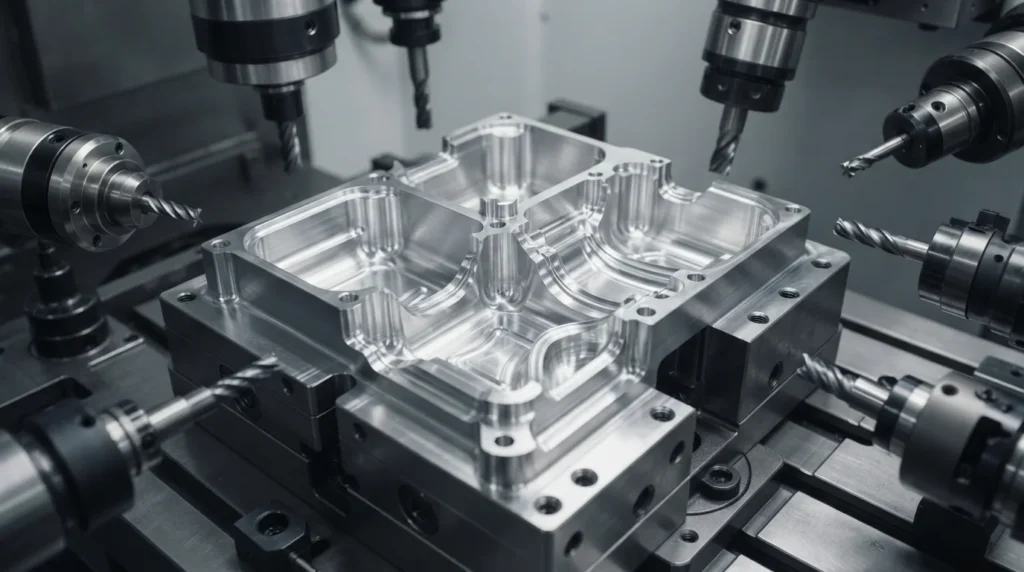
Merkmale, die häufig die Prozesszeit erhöhen
- Tiefe Taschen oder enge Kavitäten, die lang auskragende Werkzeuge und langsameres Schneiden erfordern.
- Sehr kleine Innenradien, die kleine Werkzeuge und zusätzliche Durchgänge erfordern.
- Dünne Wände, hohe Rippen oder flexible Bereiche, die Abstützung und konservative Schnittführung benötigen.
- Komplexe dreidimensionale Oberflächen, die mehr Werkzeugwegkontrolle und Nachbearbeitung erfordern.
- Merkmale, die auf vielen Flächen liegen und das Umpositionieren, Antasten und die Bezugsübertragung erhöhen.
- Große Unterschiede zwischen Rohteil- und Teilevolumen, die die Schruppzeit und den Materialabfall erhöhen.
Ein Teil wird nicht allein deshalb kostengünstig, weil sein Fertigvolumen klein ist. Ein kleines Teil mit schwierigem Zugang kann länger dauern als ein größeres Teil mit einfacher, offener Geometrie. Bitten Sie den Lieferanten zu benennen, welches Merkmal oder welche Aufspannung die Kalkulation treibt.
Material und Ausgangsform
Das Material beeinflusst sowohl die direkten Kosten als auch das Prozessrisiko. Sorte, Wärmebehandlungszustand, Härte, Verfügbarkeit, Halbzeugform und Zertifizierungsanforderung können Werkzeuge, Schnittstrategie, Zykluszeit, Nachbearbeitung und Prüfung verändern.
Vergleichen Sie nicht nur den Namen des Rohmaterials
“Aluminum,” “stainless steel,” or “plastic” is not always a complete commercial specification. Different grades and conditions can have different machinability, strength, surface behavior, and availability. A certified plate, a bar, a billet, or a customer-supplied blank may lead to different yield and documentation assumptions.
Verwenden Sie den CNC-Materialbibliothek as a starting point for material-family discussions, then put the exact grade, condition, and documentation requirement in the RFQ.
Toleranz, Oberfläche und Prüfrisiko
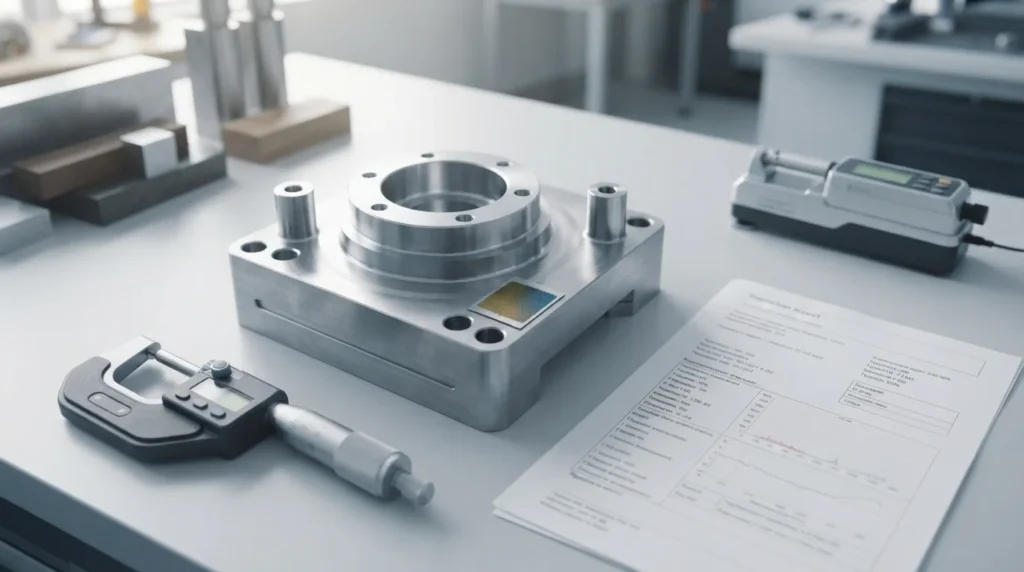
Pay for function, not habit
A useful cost review marks which features control fit, sealing, motion, alignment, load, or appearance. General features can often use a sensible general tolerance, while functional interfaces receive individual controls and an agreed inspection method. The site’s CNC-Toleranzleitfaden explains how to make that distinction before tightening every dimension.
Inspection is part of the product scope
A quote for routine checks is not necessarily equivalent to one that includes a full dimensional report, material evidence, traceability, functional assembly, or special measurement conditions. State the inspection deliverables so suppliers are pricing the same acceptance burden.
Warum sich das Kostenmodell mit der Stückzahl ändert
Setup, programming, fixturing, inspection planning, and material preparation are often distributed across the quantity. A one-piece prototype carries those non-recurring tasks on a single part. A repeat run can spread them across a batch, while higher volume may justify a more efficient fixture, tool strategy, inspection sampling plan, or process route.
| Project stage | Main cost concern | Useful commercial question |
|---|---|---|
| Prototype or first article | Engineering time, setup, learning, and one-time risk | Which setup or tooling costs are non-recurring? |
| Small batch | Setup allocation and material yield per part | What is the unit price at the actual quantity break? |
| Wiederholte Produktion | Process repeatability, replenishment, inspection sampling, and schedule | What remains fixed, and what changes with volume or revision? |
Wie man CNC-Angebote fair vergleicht

- Confirm that the same drawing revision, CAD model, units, quantity, and delivery destination were quoted.
- Compare exact material grade, condition, stock form, certification, and traceability assumptions.
- Check whether tolerances, GD&T, surface roughness, finishing, deburring, cleaning, and packaging are included.
- Ask whether programming, setup, fixtures, tooling, first-article inspection, and reports are separate charges.
- Check the process route, lead-time basis, shipping terms, payment assumptions, and validity period.
- Ask what exclusions, substitutions, deviations, or engineering assumptions could change the final price.
The lowest unit price may simply represent a narrower scope. The best quote is the one whose price, quality evidence, schedule, and technical assumptions match the project’s real needs.
Ein DFM-Weg zu niedrigeren Kosten
Cost reduction should begin with the drawing and function, not with an arbitrary request to cut the supplier’s margin. A focused DFM review can ask:
- Can non-critical tight tolerances be relaxed without changing fit or performance?
- Can internal radii, pocket depths, wall thicknesses, or tool access be made easier to machine?
- Can several features share a datum or setup without weakening the functional design?
- Can the material grade, stock size, or finish be selected for the actual environment and appearance?
- Can inspection focus on critical characteristics instead of measuring every feature with the same burden?
- Can the quantity, batch size, or release schedule distribute setup and fixture cost more effectively?
Cost and precision are not opposites. Clearer functional priorities often allow a supplier to protect the important features while simplifying the rest of the process.
Was in eine Anfrage (RFQ) gehört
A complete RFQ reduces uncertainty and makes quotes comparable. Include the current 2D drawing and 3D model, revision, quantity, delivery requirement, material and condition, finish, critical tolerances, GD&T, threads, inspection documents, packaging, and any regulatory or traceability requirement.
Explain the function of unusual features, the assembly interfaces, and the dimensions that cannot be changed. When the package is ready, submit it through the CNC machining quote workflow and ask the supplier to state major assumptions in the response.
FAQs zu CNC-Bearbeitungskosten
What is the biggest factor in CNC machining cost?
There is no universal single factor. Geometry, setup count, machining time, material, tolerance, finishing, inspection, quantity, and schedule risk interact. For many parts, the most useful question is which feature or requirement creates the longest or riskiest process step.
Why do two CNC suppliers quote different prices?
They may be assuming different material, setups, machines, tooling, finishing, inspection scope, lead time, packaging, or risk. A lower quote may exclude work that another supplier has included. Compare scope and assumptions before comparing totals.
Does quantity reduce CNC part price?
Often it can, because setup, programming, fixture, and first-part costs may be distributed across more parts. The actual effect depends on geometry, process stability, material yield, inspection plan, batch size, and whether the design changes between releases.
Do tight tolerances increase price?
They can increase finishing, process-control, measurement, and scrap risk. The best cost strategy is to apply tight controls only to features that need them and to define the datum and inspection method clearly.
How can I reduce CNC machining cost without reducing quality?
Use DFM to simplify tool access, internal radii, setups, stock, material, tolerances, finishing, and inspection while protecting function. Ask the supplier to identify the actual cost driver and propose a controlled alternative rather than removing requirements blindly.