
Choose 303 when frequent cutting, turning, drilling, and threading dominate a part’s production; choose 304 when welding, forming, broader corrosion exposure, or a more dependable general-purpose stainless specification matters more. That is a starting decision, not a blanket grade substitution. Confirm the exact product form, governing standard, service environment, and finish requirements before releasing a drawing or purchase order.
The practical difference is that 303 is a free-machining modification of the 300-series austenitic stainless family. Its sulfur additions improve chip breaking and machining behavior, while also narrowing the conditions in which the grade is a good choice. 304 accepts more fabrication and corrosion-resistance demands, but its work hardening, toughness, and chip behavior can make cutting less forgiving.
The trade-off behind the two grades
303 and 304 can appear interchangeable when a part is described only as “stainless steel.” They are not identical choices. In 303, sulfur-bearing inclusions help a cutting edge form shorter, more manageable chips. This is valuable on parts with many turned diameters, cross holes, grooves, and threads, where long chips can wrap around the work or tool and interrupt a cycle. The same modification affects corrosion behavior, welding, and forming, so the machinability gain has to be weighed against the part’s later life.
304 is a widely used austenitic grade for components that need a balance of corrosion resistance and fabrication flexibility. Its material behavior can include substantial work hardening. A tool that rubs, dwells, or repeatedly cuts a hardened surface can see rising forces and unstable edge life. The exact response depends on the product condition, stock, tool geometry, cutting strategy, and the component. Do not convert a grade comparison into a universal speed or cycle-time promise.
| Decision factor | 303 is worth evaluating when | 304 is worth evaluating when |
|---|---|---|
| Feature density | Many turned, drilled, grooved, or threaded features make chip control important. | The part has broader fabrication requirements or the process route includes forming. |
| Joining | The design is machined as a single component or mechanically assembled. | A qualified welding route is part of the design. |
| Environment | Exposure is mild and the specified corrosion limit is compatible with the grade. | General corrosion resistance is more important, subject to the actual medium. |
| Finish and acceptance | The drawing allows a finish and surface condition compatible with free-machining stainless. | Surface restoration or fabrication requirements favor the general-purpose grade. |
What changes at the machine
On 303, chip breaking can simplify automatic turning and reduce the tendency for stringy chips to interfere with small features. This can be useful where a component repeats the same groove, shoulder, or thread across a production lot. It does not remove the need for a rigid setup, a sharp edge, suitable tool engagement, and coolant or lubrication appropriate to the operation. If the part is thin, slender, or tightly toleranced, deflection and heat still need to be managed.
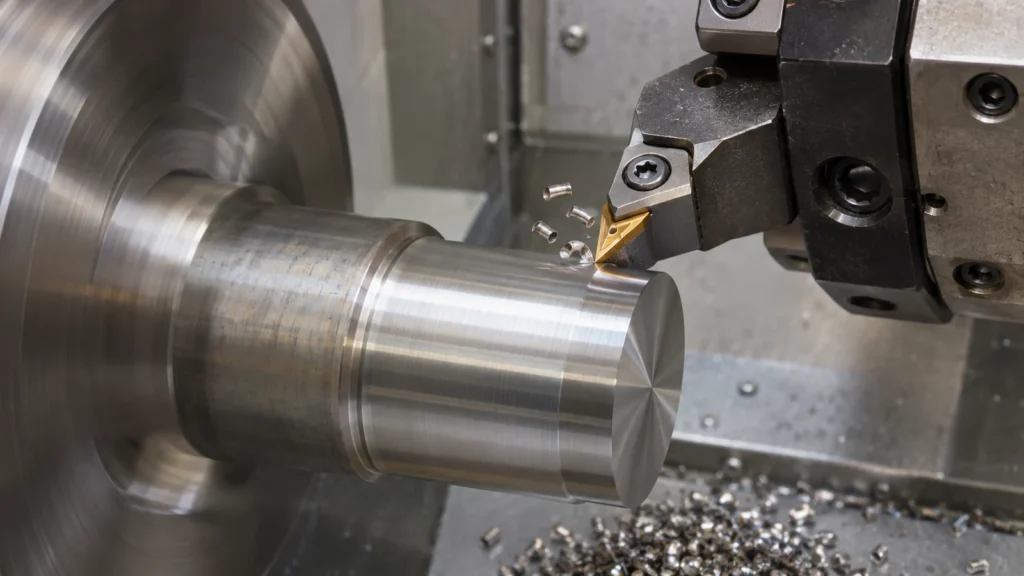
304 often asks for more deliberate cutting discipline. Avoid rubbing at the surface, stabilize the workpiece, and maintain an engagement that produces a real chip instead of polishing or burnishing the material. A pause at the wall or a light finishing pass can change the surface layer that the next tool encounters. Drilling, tapping, milling, and turning can therefore respond differently even on the same part. For threaded fittings or turned components, compare tool access, chip evacuation, and inspection—not only the alloy name. The site’s CNC turning capability and CNC milling capability pages describe relevant process families.
Do not assume a change to 303 automatically lowers total cost. Evaluate stock availability, cutting time, tool changes, burr removal, surface treatment, and the consequences of a rejected part. A free-machining grade may make the cutting stage easier while creating a problem at welding, passivation, or final service. The useful comparison follows the full route from raw stock through acceptance.
Where 304 has the safer design margin
When a component must be welded, formed, or exposed to a more demanding environment, 304 may fit the design better. A free-machining modification should not be selected simply because the shop can cut it faster. If a fitting will be welded into an assembly, a machined enclosure will be bent after cutting, or a wetted feature will see cleaning chemicals, the designer must evaluate the relevant fabrication procedure and exposure. Chlorides, crevices, temperature, concentration, and stagnant liquid can change corrosion risk; “stainless” alone does not establish suitability.
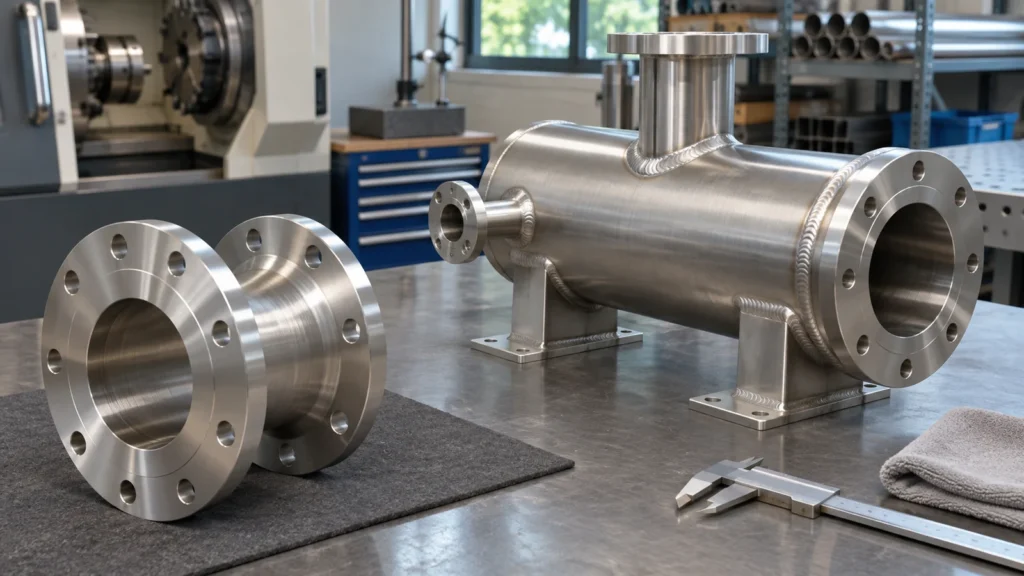
Surface treatment also deserves an explicit review. Machining can leave embedded particles, smeared material, burrs, and local surface differences. Cleaning and passivation requirements should follow the drawing, customer specification, and service conditions. A finish note written for 304 should not be carried over to 303 without confirming the applicable procedure and acceptance criteria. The site’s 303 material page and 304/304L material page are starting references; they do not replace the grade and condition on the controlled drawing.
Specify the material the part actually needs
Use 303 when the component’s function is compatible with its corrosion and fabrication limits and the production route benefits from short-chip machining. Use 304 when joining, forming, or broader corrosion performance leads the decision. If neither grade covers the service requirement, the answer may be another stainless family rather than a compromise between these two.
Keep the selection tied to measurable requirements. Identify the standard and revision, product form, delivery condition, required finish, and any additional chemistry or certification controls. Where a sealing, bearing, or electrical contact surface matters, call it out separately from the general material designation. A material certificate can identify the supplied heat and reported chemistry; it does not by itself prove that a machined feature, weld, or finished surface meets the component drawing.
A practical drawing and purchasing review
- List the part’s environment, including fluid, concentration, temperature, cleaning chemistry, and crevice exposure.
- Mark whether the route includes welding, bending, cold forming, passivation, or cosmetic finishing.
- Identify the features that drive machining time: repeated threads, cross holes, grooves, narrow slots, or difficult chip paths.
- Define the material standard, product form, condition, certificate, and any customer-specific restrictions.
- Set acceptance for burrs, surface condition, corrosion performance, and post-process dimensions before comparing quotes.
- Approve a grade change through the drawing or documented engineering process; do not infer equivalence from a machinability label.
For a simple turned component in mild service, 303 may be a practical production choice. For a fabricated or more broadly exposed component, 304 may reduce downstream risk. The correct decision comes from the part’s function and full manufacturing route, with the exact grade and acceptance requirements recorded before production.