
Matériaux d'usinage CNC doivent être sélectionnés en fonction de la fonction de la pièce, de l'environnement, de la géométrie, du plan d'inspection et de la quantité de production—et non à partir d'une liste générique des matériaux “ les plus résistants ” ou “ les moins chers ”. L'aluminium peut être le bon choix pour un boîtier léger, tandis que l'acier inoxydable, le titane, le laiton, le PEEK, le POM ou un autre plastique technique peuvent être préférables pour la corrosion, l'usure, la chaleur, l'isolation ou la stabilité dimensionnelle. Ce guide donne aux ingénieurs et aux acheteurs un cadre pratique pour réduire les options de matériaux avant la programmation et le devis dans un centre de fabrication de précision à Shenzhen.
Qu'est-ce qui rend un matériau CNC adapté à une pièce ?

Comment l'environnement d'exploitation doit-il guider le premier choix ?
Commencez par ce que le composant doit supporter. Listez les charges statiques et dynamiques, le contact avec l'eau ou les produits chimiques, l'exposition à la température, l'usure, les exigences électriques, la stérilisation, l'exposition en extérieur et l'apparence. Un boîtier, un arbre, un collecteur, un support, un montage de fixation et une entretoise isolante peuvent tous être usinés par CNC, mais ils n'ont pas besoin du même comportement de matériau.
- Charge et rigidité : tenez compte de la résistance, du module, de la fatigue, de l'impact et de la manière dont la pièce est supportée.
- Poids : évaluez la densité conjointement avec la rigidité et la quantité de matière que la géométrie exige.
- Chaleur : examinez la température de service, la dilatation thermique, le transfert de chaleur et le risque de perte d'ajustement après des variations de température.
- Environnement : vérifiez la corrosion, les produits chimiques, l'humidité, l'exposition aux UV, l'usure et les conditions de nettoyage ou de stérilisation.
- Comportement électrique : déterminez si la pièce doit conduire, isoler, dissiper la chaleur ou résister à l'accumulation de charges statiques.
- Apparence et finition : confirmez si la surface sera anodisée, passivée, plaquée, polie, peinte ou laissée brute d'usinage.
Utilisez la aperçu de l'usinage CNC comme contexte de service racine, puis passez au bibliothèque de matériaux CNC lorsqu'une famille ou une nuance spécifique doit être comparée.
Matrice de sélection des matériaux : faire correspondre les exigences avant la nuance

| Primary requirement | Families to evaluate | Questions before release |
|---|---|---|
| Low weight and general machinability | Aluminum alloys | Will strength, wear, threads, and finish performance be sufficient? |
| Corrosion resistance or hygiene | Stainless steels, selected plastics | What media, cleaning method, and surface condition will the part see? |
| High strength or wear | Alloy steel, tool steel, titanium | Is heat treatment required, and can it change size or create distortion? |
| Electrical or thermal function | Copper, aluminum, brass, technical plastics | Do conductivity, heat paths, burr control, and surface treatment align? |
| Insulation, low friction, or chemical resistance | POM, PEEK, PTFE, nylon, ABS, PC | Will moisture, creep, heat, clamping, and post-machining movement be controlled? |
Why is “machinability” not enough to choose a grade?
Machinability describes how readily a material can be cut under a given process, but it does not describe service life. A free-cutting material can machine efficiently and still fail a load, wear, temperature, or corrosion requirement. Conversely, a difficult material may be justified when its performance prevents a larger failure in the field. Selection should balance material behavior, cycle time, tooling, inspection, finishing, and total part risk.
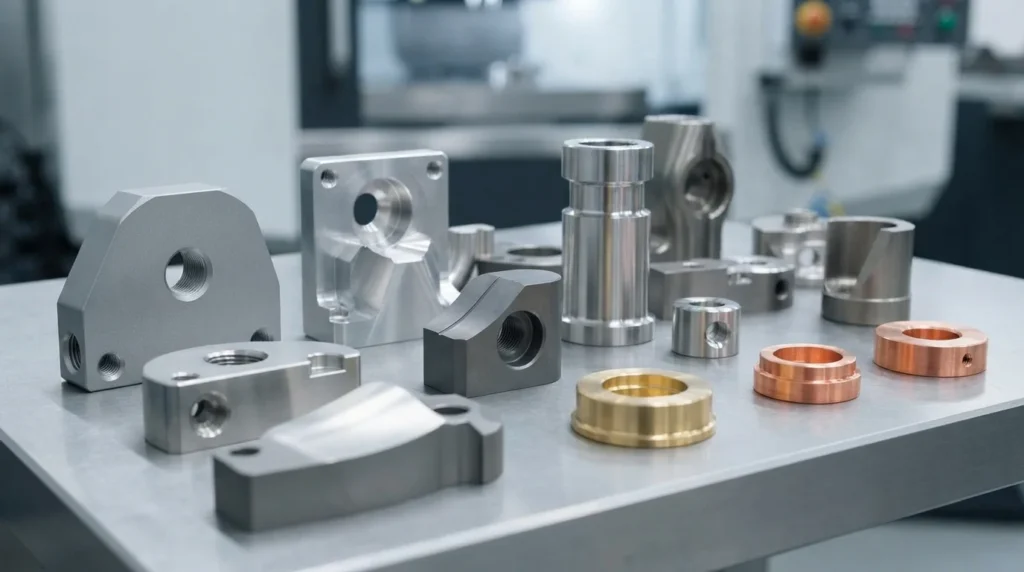
Matériaux métalliques pour pièces CNC
When does aluminum make the most sense?
Aluminum is often evaluated first for lightweight brackets, housings, heat-transfer components, fixtures, and prototypes. It can support efficient material removal and a broad finishing menu, but the exact alloy and temper still matter. Designers should check thread strength, bearing surfaces, deflection, cosmetic requirements, and whether anodizing or another finish is required. Aluminum is not a universal substitute for steel when contact stress, wear, or stiffness dominates.
How should stainless steel and alloy steel be separated?
Stainless steel is usually selected for corrosion resistance, hygiene, or a controlled appearance; alloy and tool steels are more often chosen for strength, hardness, wear, or load-bearing service. Stainless grades can generate heat, work-harden, and punish unstable setups. Heat-treated steels can add distortion, tool wear, and inspection effort. The drawing should define the grade, condition, hardness or treatment, because “steel” is not enough for a production quote.
Where do titanium, copper, and brass fit?
Titanium is considered when strength-to-weight, corrosion resistance, or demanding service conditions justify a more controlled machining route. Copper is valuable for electrical or thermal paths but can be gummy and sensitive to burrs and surface damage. Brass can support fittings, electrical components, decorative parts, and turned features, but the alloy still affects cutting behavior and finishing. The CNC metal materials guide is the correct internal destination for these families, while exact grades should be confirmed against the drawing and material certificate requirements.
Matériaux plastiques pour pièces CNC

When are POM, nylon, ABS, and PC practical choices?
POM is commonly considered for low-friction and dimensionally stable components. Nylon may suit wear, impact, and lightweight requirements, but moisture can change its dimensions and behavior. ABS can support general housings and prototypes, while polycarbonate may be selected for impact resistance or transparency-related needs. These descriptions are starting points only; the part’s temperature, load, environment, and required fit determine whether a family is acceptable.
Why do PEEK and PTFE need a different review?
PEEK and PTFE can be valuable in demanding chemical, thermal, friction, or insulation applications, but their machining behavior and cost require deliberate planning. Flexible stock, heat, tool sharpness, chip control, and stress release can affect the final part. A drawing should distinguish virgin, filled, reinforced, or otherwise modified material when that distinction affects performance. The plastic materials guide can support the initial comparison without replacing a grade-specific review.
Comment le choix du matériau modifie-t-il le risque d'usinage ?

- Heat management: poor heat evacuation can soften plastics, affect finishes, or accelerate tool wear in difficult alloys.
- Deflection and support: soft or flexible stock may need shorter tool reach, lighter clamping, support ribs, or a revised operation sequence.
- Chip control: stringy, gummy, abrasive, or brittle chips require different tooling and evacuation strategies.
- Residual stress: uneven stock removal or heat treatment can move thin sections after machining or after the part is unclamped.
- Inspection stability: thermal expansion, moisture, and flexible surfaces can make a measurement result depend on when and how it is taken.
A strong supplier explains these risks during DFM instead of waiting for a failed first article. Material choice, fixture design, toolpath order, and inspection method should be treated as one manufacturing decision.
Implications pour la DFM et l'état de surface
Material selection can force changes in geometry and finishing. A small internal radius that is harmless in aluminum may become important in a hard alloy. A thin wall that survives a rigid metal setup may deflect in plastic. A cosmetic finish may expose tool marks, grain variation, embedded chips, or inconsistent preparation.
Which drawing details reduce material-related surprises?
- State the exact material family, grade, temper, hardness, or reinforcement when it affects performance.
- Identify critical dimensions, datums, fits, threads, and surfaces instead of applying a tight tolerance everywhere.
- Define surface roughness, appearance zones, masking, coating thickness, color, and acceptance samples.
- Call out heat treatment, stress relief, passivation, anodizing, plating, polishing, or cleaning requirements.
- Explain the part’s function so the engineer can challenge an over-specified material or recommend a safer alternative.
Flux de travail de sélection des matériaux CNC
Use a repeatable decision path so a prototype choice does not become an accidental production standard:
- Define the job: record loads, environment, temperature, wear, electrical behavior, appearance, and expected service life.
- Build a short list: compare metal and plastic families against function before narrowing to a grade.
- Check manufacturability: review stock form, geometry, tooling, workholding, heat treatment, and likely inspection method.
- Check finishing: confirm that the required coating, polish, color, passivation, or cleaning process is compatible with the material.
- Check supply and documentation: confirm availability, certificate format, traceability, minimum order constraints, and replacement-grade rules.
- Release the specification: put the selected grade, condition, finish, and inspection requirements in the controlled drawing or purchase specification.
The final choice should be explainable in one sentence: “We selected this grade because it meets the dominant service requirement, can be machined and inspected with controlled risk, and supports the required finish and supply documentation.” If that sentence cannot be written, the selection is probably still incomplete.
Liste de contrôle RFQ pour l'approvisionnement des matériaux
Send enough information for a supplier to quote the real part rather than a simplified version of it. Include:
- Current CAD model, controlled drawing, revision, units, and quantity.
- Material grade, temper, hardness, reinforcement, grain direction, or certificate requirement.
- Critical tolerances, GD&T, fits, threads, sealing faces, cosmetic areas, and surface roughness.
- Heat treatment, coating, anodizing, passivation, plating, polishing, marking, cleaning, or assembly requirements.
- Inspection reports, first article expectations, sampling, traceability, packaging, and shipping destination.
- Functional context for unusual materials, difficult geometry, flexible features, or high-risk interfaces.
When the package is ready, submit it through the supplier’s quoting workflow. A material-focused RFQ gives the engineering team a chance to identify substitution risk, finish incompatibility, or inspection concerns before the first cut.
FAQ sur les matériaux d'usinage CNC
What is the most common material for CNC machining?
Aluminum is a common starting point for prototypes, housings, brackets, fixtures, and lightweight parts because it can offer a practical balance of weight, machinability, finish options, and availability. It is not automatically the best production material; load, wear, corrosion, heat, electrical behavior, and the required grade must still be checked.
Should I choose metal or plastic for a CNC part?
Choose metal when stiffness, load, heat transfer, wear, or electrical conduction dominates. Choose plastic when low weight, insulation, low friction, chemical resistance, transparency, or lower contact noise is more important. The correct decision also depends on creep, moisture, temperature, tolerance stability, and the finishing process.
Does material affect CNC machining cost?
Yes. Material affects stock price, cutting time, tool wear, fixturing, chip control, heat treatment, finishing, inspection, and scrap risk. A cheaper raw material can become more expensive if it adds difficult operations or fails in service. Compare total manufacturing risk rather than raw material price alone.
Why can a plastic part change size after machining?
Plastic can respond to moisture, temperature, residual stress, and clamping force. Flexible features may also deflect during cutting or measurement. A stable process may require material conditioning, controlled support, lighter clamping, staged machining, and a measurement plan that defines temperature and timing.
Can a supplier recommend a different CNC material?
A supplier can flag a potential alternative when the functional requirement is clear, but a substitution should be approved by the design authority. The review should cover performance, compatibility, finish, inspection, certification, regulatory needs, and whether the drawing or customer specification permits an alternate grade.