
CNC-Bearbeitungsmaterialien sollten anhand der Aufgabe des Bauteils, der Umgebung, der Geometrie, des Prüfplans und der Produktionsmenge ausgewählt werden – nicht anhand einer allgemeinen Liste der “stärksten” oder “günstigsten” Werkstoffe. Aluminium kann für ein leichtes Gehäuse die richtige Wahl sein, während Edelstahl, Titan, Messing, PEEK, POM oder ein anderer technischer Kunststoff bei Korrosion, Verschleiß, Hitze, Isolierung oder Maßhaltigkeit besser geeignet sein können. Dieser Leitfaden bietet Ingenieuren und Einkäufern einen praktischen Rahmen, um Materialoptionen einzugrenzen, bevor programmiert und kalkuliert wird – in einem Shenzhener Präzisionsfertigungszentrum.
Was macht ein CNC-Material für ein Bauteil geeignet?

Wie sollte die Betriebsumgebung die erste Wahl leiten?
Beginnen Sie mit dem, was das Bauteil überstehen muss. Listen Sie statische und dynamische Lasten, Kontakt mit Wasser oder Chemikalien, Temperatureinwirkung, Verschleiß, elektrische Anforderungen, Sterilisation, Außenbewitterung und Aussehen auf. Ein Gehäuse, eine Welle, ein Verteiler, ein Halter, eine Vorrichtung und ein Isolierabstandshalter können alle CNC-gefräst werden, aber sie benötigen nicht dasselbe Materialverhalten.
- Last und Steifigkeit: Berücksichtigen Sie Festigkeit, Modul, Ermüdung, Schlag und die Art und Weise, wie das Teil gelagert wird.
- Gewicht: Bewerten Sie die Dichte zusammen mit der Steifigkeit und der Materialmenge, die die Geometrie erfordert.
- Wärme: Prüfen Sie Einsatztemperatur, Wärmeausdehnung, Wärmeübertragung und das Risiko, dass der Sitz nach Temperaturänderungen verloren geht.
- Umgebung: Prüfen Sie Korrosion, Chemikalien, Feuchtigkeit, UV-Bestrahlung, Verschleiß sowie Reinigungs- oder Sterilisationsbedingungen.
- Elektrisches Verhalten: Entscheiden Sie, ob das Teil leiten, isolieren, Wärme ableiten oder statische Aufladung verhindern soll.
- Aussehen und Oberfläche: Bestätigen Sie, ob die Oberfläche eloxiert, passiviert, plattiert, poliert, lackiert oder spanend bearbeitet belassen wird.
Verwenden Sie die Überblick über die CNC-Bearbeitung der Website als grundlegenden Servicekontext und wechseln Sie dann in die dedizierte CNC-Materialbibliothek , wenn eine bestimmte Familie oder Güte verglichen werden muss.
Materialauswahlmatrix: Anforderungen vor der Werkstoffsorte abgleichen

| Primäre Anforderung | Zu bewertende Werkstoffgruppen | Fragen vor der Freigabe |
|---|---|---|
| Geringes Gewicht und allgemeine Zerspanbarkeit | Aluminiumlegierungen | Sind Festigkeit, Verschleiß, Gewinde und Oberflächenqualität ausreichend? |
| Korrosionsbeständigkeit oder Hygiene | Edelstähle, ausgewählte Kunststoffe | Welchen Medien, welcher Reinigungsmethode und welchem Oberflächenzustand wird das Teil ausgesetzt sein? |
| Hohe Festigkeit oder Verschleiß | Legierter Stahl, Werkzeugstahl, Titan | Ist eine Wärmebehandlung erforderlich, und kann sie die Größe verändern oder Verzug verursachen? |
| Elektrische oder thermische Funktion | Kupfer, Aluminium, Messing, technische Kunststoffe | Do conductivity, heat paths, burr control, and surface treatment align? |
| Insulation, low friction, or chemical resistance | POM, PEEK, PTFE, nylon, ABS, PC | Will moisture, creep, heat, clamping, and post-machining movement be controlled? |
Why is “machinability” not enough to choose a grade?
Machinability describes how readily a material can be cut under a given process, but it does not describe service life. A free-cutting material can machine efficiently and still fail a load, wear, temperature, or corrosion requirement. Conversely, a difficult material may be justified when its performance prevents a larger failure in the field. Selection should balance material behavior, cycle time, tooling, inspection, finishing, and total part risk.
Metallwerkstoffe für CNC-Teile
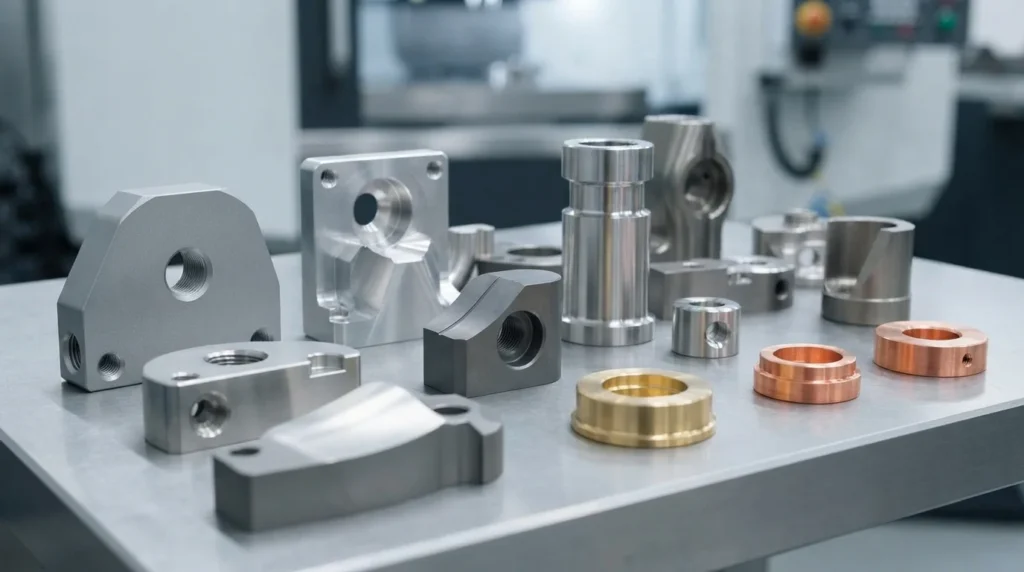
When does aluminum make the most sense?
Aluminum is often evaluated first for lightweight brackets, housings, heat-transfer components, fixtures, and prototypes. It can support efficient material removal and a broad finishing menu, but the exact alloy and temper still matter. Designers should check thread strength, bearing surfaces, deflection, cosmetic requirements, and whether anodizing or another finish is required. Aluminum is not a universal substitute for steel when contact stress, wear, or stiffness dominates.
How should stainless steel and alloy steel be separated?
Stainless steel is usually selected for corrosion resistance, hygiene, or a controlled appearance; alloy and tool steels are more often chosen for strength, hardness, wear, or load-bearing service. Stainless grades can generate heat, work-harden, and punish unstable setups. Heat-treated steels can add distortion, tool wear, and inspection effort. The drawing should define the grade, condition, hardness or treatment, because “steel” is not enough for a production quote.
Where do titanium, copper, and brass fit?
Titanium is considered when strength-to-weight, corrosion resistance, or demanding service conditions justify a more controlled machining route. Copper is valuable for electrical or thermal paths but can be gummy and sensitive to burrs and surface damage. Brass can support fittings, electrical components, decorative parts, and turned features, but the alloy still affects cutting behavior and finishing. The CNC metal materials guide is the correct internal destination for these families, while exact grades should be confirmed against the drawing and material certificate requirements.
Kunststoffe für CNC-Teile

When are POM, nylon, ABS, and PC practical choices?
POM is commonly considered for low-friction and dimensionally stable components. Nylon may suit wear, impact, and lightweight requirements, but moisture can change its dimensions and behavior. ABS can support general housings and prototypes, while polycarbonate may be selected for impact resistance or transparency-related needs. These descriptions are starting points only; the part’s temperature, load, environment, and required fit determine whether a family is acceptable.
Why do PEEK and PTFE need a different review?
PEEK and PTFE can be valuable in demanding chemical, thermal, friction, or insulation applications, but their machining behavior and cost require deliberate planning. Flexible stock, heat, tool sharpness, chip control, and stress release can affect the final part. A drawing should distinguish virgin, filled, reinforced, or otherwise modified material when that distinction affects performance. The plastic materials guide can support the initial comparison without replacing a grade-specific review.
Wie verändert die Materialwahl das Bearbeitungsrisiko?

- Heat management: poor heat evacuation can soften plastics, affect finishes, or accelerate tool wear in difficult alloys.
- Deflection and support: soft or flexible stock may need shorter tool reach, lighter clamping, support ribs, or a revised operation sequence.
- Chip control: stringy, gummy, abrasive, or brittle chips require different tooling and evacuation strategies.
- Residual stress: uneven stock removal or heat treatment can move thin sections after machining or after the part is unclamped.
- Inspection stability: thermal expansion, moisture, and flexible surfaces can make a measurement result depend on when and how it is taken.
A strong supplier explains these risks during DFM instead of waiting for a failed first article. Material choice, fixture design, toolpath order, and inspection method should be treated as one manufacturing decision.
Auswirkungen auf DFM und Oberflächengüte
Material selection can force changes in geometry and finishing. A small internal radius that is harmless in aluminum may become important in a hard alloy. A thin wall that survives a rigid metal setup may deflect in plastic. A cosmetic finish may expose tool marks, grain variation, embedded chips, or inconsistent preparation.
Which drawing details reduce material-related surprises?
- State the exact material family, grade, temper, hardness, or reinforcement when it affects performance.
- Identify critical dimensions, datums, fits, threads, and surfaces instead of applying a tight tolerance everywhere.
- Define surface roughness, appearance zones, masking, coating thickness, color, and acceptance samples.
- Call out heat treatment, stress relief, passivation, anodizing, plating, polishing, or cleaning requirements.
- Explain the part’s function so the engineer can challenge an over-specified material or recommend a safer alternative.
Workflow zur CNC-Materialauswahl
Use a repeatable decision path so a prototype choice does not become an accidental production standard:
- Define the job: record loads, environment, temperature, wear, electrical behavior, appearance, and expected service life.
- Build a short list: compare metal and plastic families against function before narrowing to a grade.
- Check manufacturability: review stock form, geometry, tooling, workholding, heat treatment, and likely inspection method.
- Check finishing: confirm that the required coating, polish, color, passivation, or cleaning process is compatible with the material.
- Check supply and documentation: confirm availability, certificate format, traceability, minimum order constraints, and replacement-grade rules.
- Release the specification: put the selected grade, condition, finish, and inspection requirements in the controlled drawing or purchase specification.
The final choice should be explainable in one sentence: “We selected this grade because it meets the dominant service requirement, can be machined and inspected with controlled risk, and supports the required finish and supply documentation.” If that sentence cannot be written, the selection is probably still incomplete.
RFQ-Checkliste für die Materialbeschaffung
Send enough information for a supplier to quote the real part rather than a simplified version of it. Include:
- Current CAD model, controlled drawing, revision, units, and quantity.
- Material grade, temper, hardness, reinforcement, grain direction, or certificate requirement.
- Critical tolerances, GD&T, fits, threads, sealing faces, cosmetic areas, and surface roughness.
- Heat treatment, coating, anodizing, passivation, plating, polishing, marking, cleaning, or assembly requirements.
- Inspection reports, first article expectations, sampling, traceability, packaging, and shipping destination.
- Functional context for unusual materials, difficult geometry, flexible features, or high-risk interfaces.
When the package is ready, submit it through the supplier’s quoting workflow. A material-focused RFQ gives the engineering team a chance to identify substitution risk, finish incompatibility, or inspection concerns before the first cut.
FAQs zu CNC-Bearbeitungsmaterialien
What is the most common material for CNC machining?
Aluminum is a common starting point for prototypes, housings, brackets, fixtures, and lightweight parts because it can offer a practical balance of weight, machinability, finish options, and availability. It is not automatically the best production material; load, wear, corrosion, heat, electrical behavior, and the required grade must still be checked.
Should I choose metal or plastic for a CNC part?
Choose metal when stiffness, load, heat transfer, wear, or electrical conduction dominates. Choose plastic when low weight, insulation, low friction, chemical resistance, transparency, or lower contact noise is more important. The correct decision also depends on creep, moisture, temperature, tolerance stability, and the finishing process.
Does material affect CNC machining cost?
Yes. Material affects stock price, cutting time, tool wear, fixturing, chip control, heat treatment, finishing, inspection, and scrap risk. A cheaper raw material can become more expensive if it adds difficult operations or fails in service. Compare total manufacturing risk rather than raw material price alone.
Why can a plastic part change size after machining?
Plastic can respond to moisture, temperature, residual stress, and clamping force. Flexible features may also deflect during cutting or measurement. A stable process may require material conditioning, controlled support, lighter clamping, staged machining, and a measurement plan that defines temperature and timing.
Can a supplier recommend a different CNC material?
A supplier can flag a potential alternative when the functional requirement is clear, but a substitution should be approved by the design authority. The review should cover performance, compatibility, finish, inspection, certification, regulatory needs, and whether the drawing or customer specification permits an alternate grade.