
Short answer: Good Vespel machining starts by confirming the exact grade and stock form, then holding the shape with only enough force to prevent movement. Unlike a metal blank, a polymer shape can deform in a chuck or collet and can respond to cutting heat and release of stress. The finished dimension therefore depends on the part’s support, tool path, temperature, and when it is measured—not only on the programmed size.
Vespel is a DuPont polyimide product family, not one interchangeable material. SP-1, SP-21, SP-22, SP-211, and other shapes have different compositions and attributes. Confirm the specified grade, manufacturing form, stock supplier, and applicable drawing before selecting a machining route. This guide addresses machining supplied polymer stock into parts; it does not imply that a particular grade is suitable for an application without engineering review.
Confirm grade, stock form, and the surfaces that matter
Before Vespel machining, reconcile the material callout with the stock certificate and shape. A billet, slab, rod, or directly formed blank can present different geometry and material history. If a part is being redesigned from a metal component, the drawing may need to distinguish functional dimensions from surfaces that were only convenient in the original design.
Map critical bores, faces, sealing lands, and thin arms to the way the stock will be held. Determine which datum features can remain accessible through roughing and finishing. For a thin ring or flat washer, the risk may be distortion under clamping; for a long sleeve, it may be deflection or chatter; for a pocketed plate, it may be stress release as material is removed.
Choose workholding that restrains the shape without squeezing it
DuPont’s Vespel machining guide emphasizes preventing deflection from the fixture, collet, or chuck. It describes collets as a reliable holding option when the force is only high enough to prevent movement, and suggests a six-jaw chuck to distribute pressure. Apply such guidance to the part geometry and grade; verify clamping force with a safe setup rather than assuming that a metal-part pressure is acceptable.
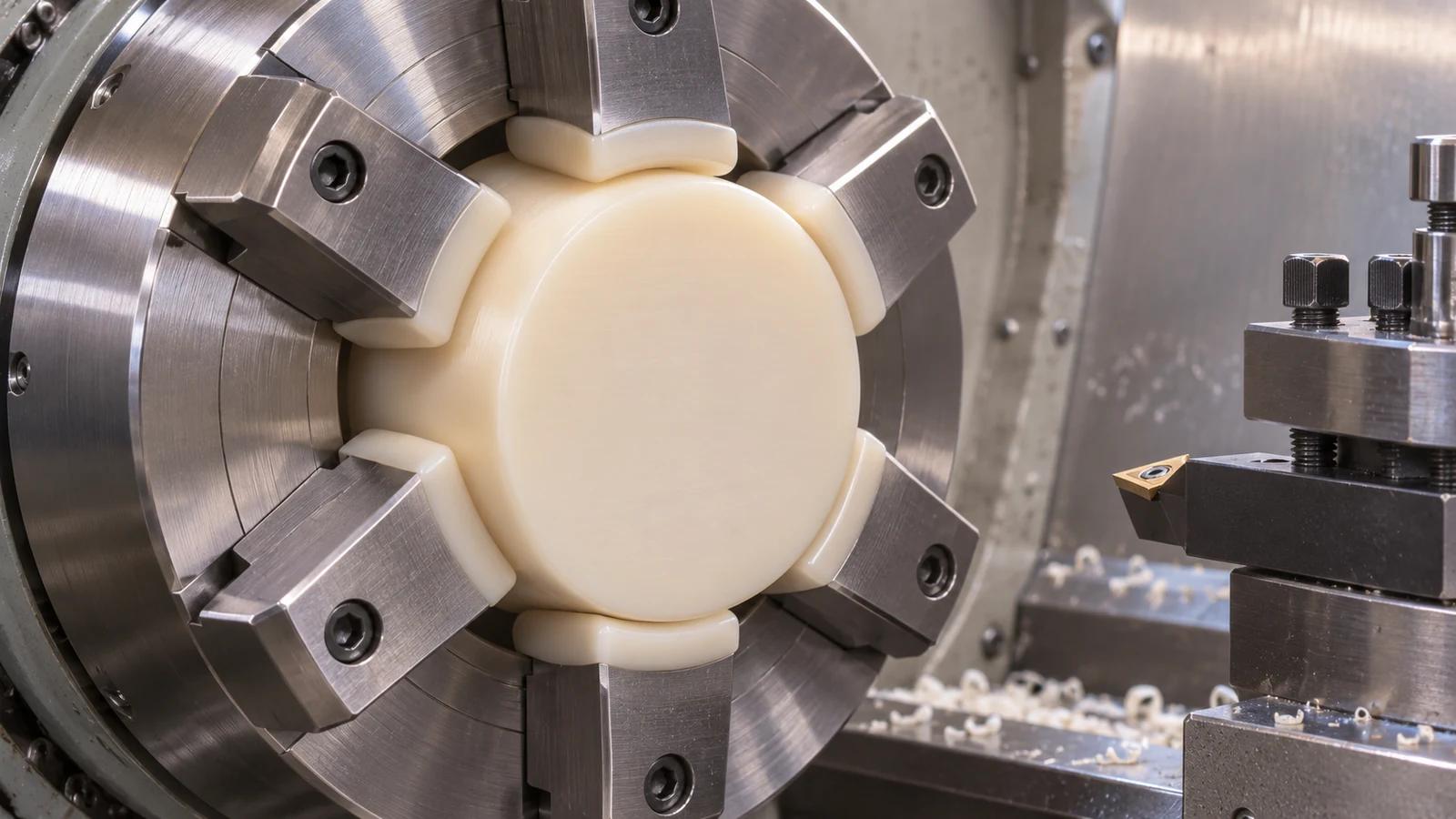 Use soft jaws, a close-fitting mandrel, a broad support, or a sacrificial fixture when the geometry requires it. Avoid narrow contact points that leave a mark or squeeze an unsupported wall into shape. A part that measures in tolerance while clamped can spring after release, so define whether the inspection fixture supports the part or leaves it in a free state.
Keep heat and cutting force from becoming hidden dimensions
In polymer machining, friction and cutting heat can affect the immediate measurement and the part’s behavior after it returns to room conditions. A long, rubbing tool path can warm a bore or thin wall; the dimension read hot may not represent the dimension after equilibration. Keep edges sharp, avoid dwell, clear chips, and use a cooling method compatible with the grade and part.
DuPont’s guide notes that coolant may be used to minimize thermal effects and maintain dimensional stability, while cold air blast is generally preferred in its guidance. That is not a rule that every job must use one coolant. Confirm chemical compatibility, cleanliness, chip removal, and any customer restrictions, then compare measurements after the part has stabilized.
Use a cutting sequence that preserves the datum and support
Roughing should remove material without leaving a fragile geometry that is difficult to hold for finishing. Leave enough stock on precision features to clean up after stress and thermal effects settle, but do not use a generic allowance unrelated to the blank and drawing. For a sleeve, a supported sequence may rough the outside and bore before completing a thin wall; for a plate, rough both faces in a balanced order before finishing the datum side.
Turning is suitable for concentric forms when the workholding does not crush the stock. Milling can produce flats, pockets, or drilled patterns, but part support and tool reach need attention as the section becomes thin. The plastic materials overview provides the broader material-family context, while the verified standard CNC turning scope covers the rotational features that may apply to sleeves and bushings.
Measure the part after release and temperature recovery
Set the measurement condition before qualifying a Vespel machining process. Record whether the part is clamped, supported, or free; how long it has stabilized; and which instrument and contact force are appropriate. A probe that presses a soft or thin feature can deflect it, while an unsupported part can sag under its own weight.
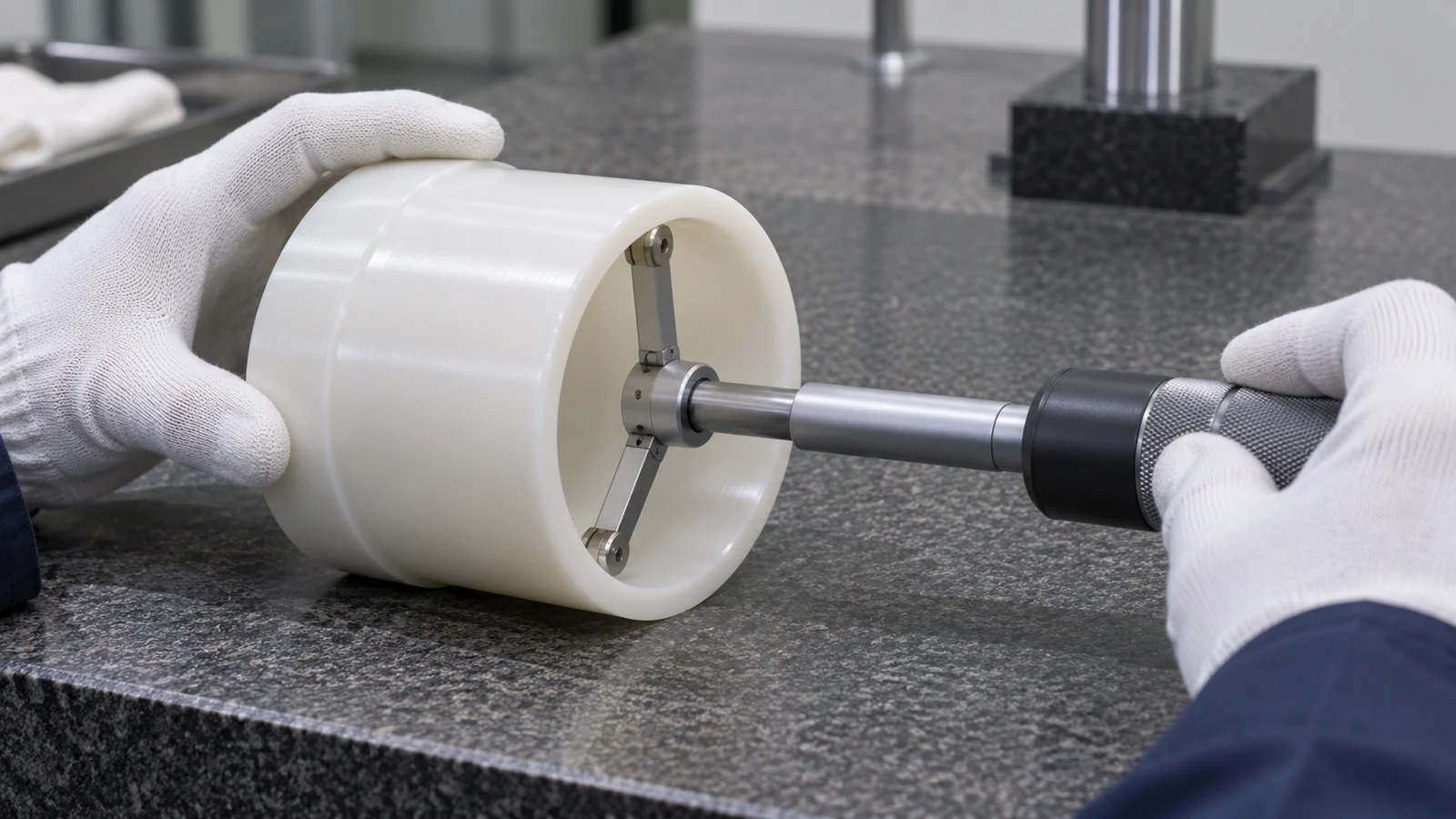 For close dimensions, inspect the feature after the cutting heat has dissipated and the part has reached the agreed measurement condition. Compare a datum bore or face with the drawing’s functional relationships, not just an isolated diameter. If a part shifts after release, change the support or sequence and repeat a controlled trial before adjusting the nominal program dimension.
Illustrative review: a thin flanged sleeve
Consider a hypothetical polyimide sleeve with a long bore and a thin flange. A rigid metal chuck would grip the outer diameter quickly, but it could compress the flange and make the bore appear smaller during cutting. The process review instead considers distributed support, a light grip, staged material removal, and a final measurement after the sleeve is released and stabilized.
If the first part springs out of round after unclamping, the team does not simply enlarge the programmed bore. It checks whether the blank’s form, chuck pressure, support length, or roughing order is causing the movement. This is an illustrative engineering scenario, not a customer case or a claim that one fixture fits every Vespel grade.
Information to include when ordering Vespel machined parts
- Exact grade and stock form, with material identification and certification requirements.
- Drawing revision, CAD model, quantity, datum scheme, and the dimensions critical to assembly.
- Wall thickness, unsupported lengths, pocket depth, and surfaces that must remain cosmetic or functional.
- Inspection condition, stabilization requirement, report expectations, and any coolant or cleanliness restrictions.
- Whether the material is customer-supplied and which downstream finishing or assembly operations are in scope.
Vespel machining questions
Can Vespel be held in a standard chuck?
It may be held with appropriate contact and pressure, but the fixture must not deform the stock. DuPont’s guidance discusses distributed holding and only enough clamping force to prevent movement; confirm the actual setup for the grade and geometry.
Should every Vespel part be machined dry?
No universal coolant rule applies to every grade and part. Manufacturer guidance discusses coolant for thermal control and generally favors cold air blast; verify compatibility, cleanliness, chip removal, and customer requirements for the specific job.
Why does a polymer dimension change after unclamping?
Clamping can elastically deform the part, and material removal can release stress. The observed change depends on stock form, geometry, temperature, and support. Measure in the agreed free or supported condition.
Can SP-1 machining data be applied to every Vespel grade?
No. Confirm the exact grade and stock form. A process qualified on one formulation should not be assumed to produce the same result on another.