
A Torlon component can meet its dimensions and still have an unresolved material-state requirement. Torlon machining removes material from a stock shape whose grade, manufacturing route and cure history affect the surface left behind. Decide whether the finished application requires a further cure with the stock supplier and design authority, then agree when final machining and inspection occur. A second thermal treatment is not automatically required for every part, and a generic polymer annealing cycle is not a substitute for a Torlon-specific instruction.
Consider a turned guide ring with a working bore and an external locating shoulder. Its drawing may identify the polymer and dimensions but omit whether the wear surface remains in the stock’s cured outer region or is newly exposed by boring. Resolving that omission early is more useful than choosing a spindle speed from a table without knowing the material state.
The purchase description must identify more than PAI
Torlon is a polyamide-imide, commonly abbreviated PAI. The trade name covers grades and stock forms with different reinforcement and processing histories. An extruded rod, a compression-molded blank and an injection-molded near-net shape are not interchangeable process inputs simply because all are called Torlon. Record the producer, exact grade, blank dimensions and supplied condition against the drawing revision.
Drake’s fabrication guidance describes a cured outer layer on its extruded Torlon shapes and advises consultation when a further cure is planned. That is a reason to discuss the actual supplied stock, not permission to assume the same surface depth or thermal history for every producer. Ask the supplier to distinguish the original stock cure from any treatment proposed after machining. Preserve that answer in the manufacturing record.
The engineering plastics overview provides material-family context. It cannot resolve a particular PAI grade’s cure requirement. A material substitution should therefore return to technical review even when the replacement blank has the same nominal dimensions.
Build the cutting plan around the final working surface
For the guide ring, mark the working bore, locating shoulder and nonfunctional relief. Decide which surfaces may be used for holding and which need protection through later operations. If the bore will be finished after an agreed treatment, preserve a measurable reference that can locate it again. If it is finished before that treatment, the drawing must still say how any subsequent dimensional change will be evaluated.
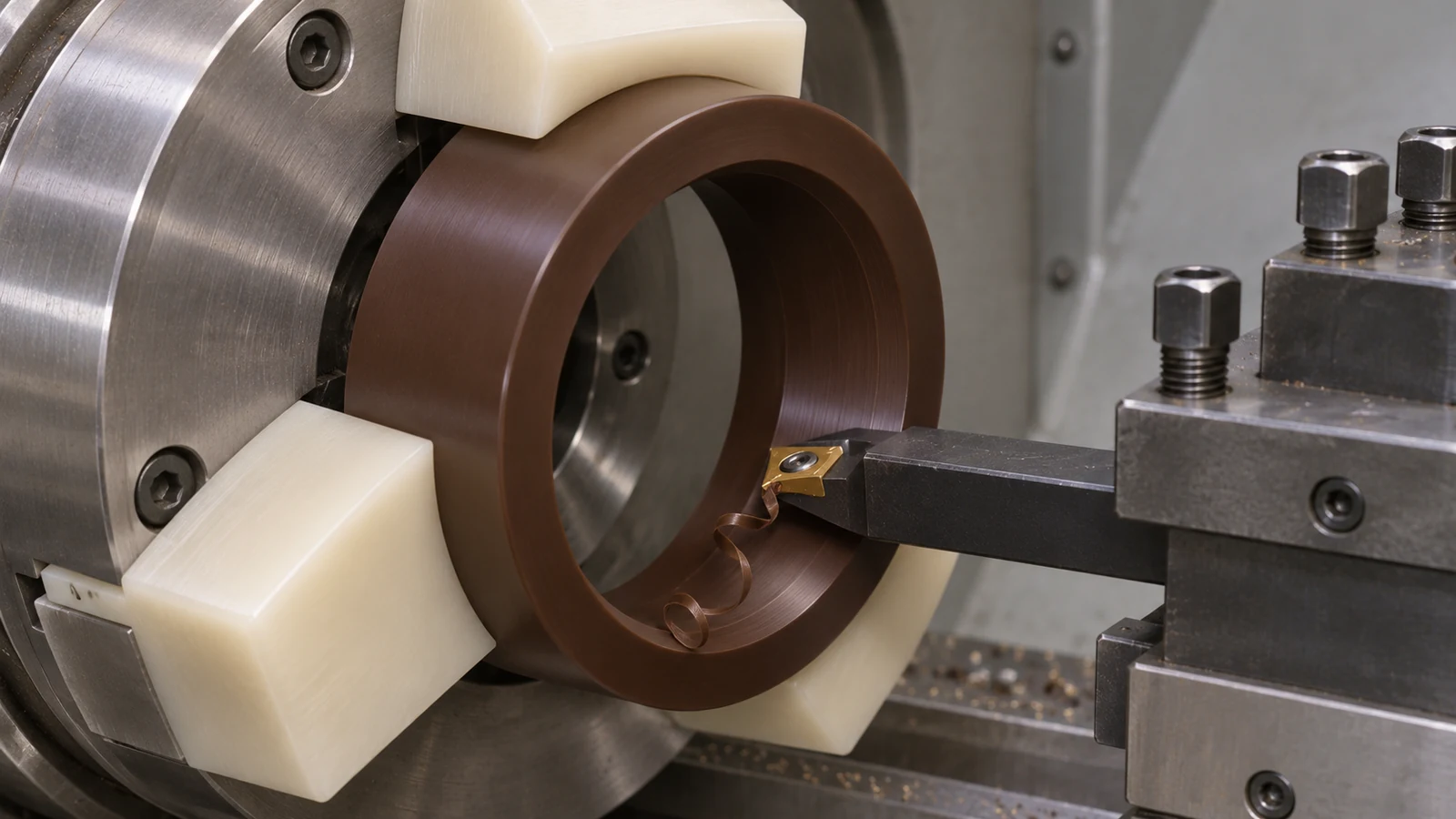 Torlon machining also needs a deliberate tooling plan. Reinforced grades can be abrasive, while a worn edge may rub or pull material instead of making a clean cut. Inspect the cut surface and cutting edge together. A rough patch is not proof of porosity in the blank; investigate whether localized pullout follows the tool path, an unsupported edge or a change in engagement.
Keep chips clear of finished features and choose coolant with the material supplier’s compatibility guidance. Tooling, coolant and cutting conditions should be qualified on the actual grade and geometry. A short trial that produces an attractive surface does not yet establish tool life for the full batch. Track the condition of the edge at the same feature through the trial rather than increasing several cutting variables together.
For rotational parts, Torlon machining may use a turning route with distributed support. The fixture must resist cutting force without forcing a thin ring into the required shape. Check released geometry before accepting the setup as stable.
A guide-ring review with two different outcomes
In this hypothetical example, the ring operates against a mating shaft and also locates in a metal carrier. Engineering identifies a wear requirement for the bore, while the outside shoulder primarily establishes assembly position. The first review question is whether the supplied grade and completed route support that bore duty. It is not whether the ring is simply “high-temperature plastic.”
One possible outcome is that the supplier confirms the delivered stock and intended machining route are appropriate without an additional cure for that application. The team then qualifies cutting, release and inspection in the agreed state. Another is that the design authority requires a further cure. In that case the route must preserve finishing access, references and stock where needed, and check final dimensions after the specified sequence. Neither outcome follows from the trade name alone.
If the treated ring later fails an outside fit, polishing the bore is irrelevant. Compare the diameter, roundness and locating relationship before and after the treatment, with the measurement conditions recorded. That separates a material-state change from a holding error or a tool-wear trend. This scenario is illustrative; it is not a customer order or a validated production recipe.
Make acceptance describe the delivered state
The drawing and purchase order should agree on which dimensions are critical, what treatment records are required and whether the part is inspected after any agreed conditioning. Specify the datums used for bore-to-shoulder relationships, allowed edge treatment, visible damage criteria and the protection of finished surfaces during transport.
 Record the material lot with the part or batch identity. If a wear test, chemical-resistance requirement or service trial is needed, define it separately from dimensional inspection. A bore report demonstrates the measured geometry under the stated conditions; it does not establish wear performance in an unspecified assembly. Torlon machining is ready for release when the material-state question and the geometry question have both been answered.
Questions about machined Torlon
Does removing the dark surface prove a part is unsuitable?
No. Appearance alone does not determine acceptance. Establish the stock’s actual condition, the exposed surface’s duty and any producer-supported requirement for a further cure.
Can the machinist substitute stress relief for a specified cure?
No. The two instructions address different objectives. Obtain an approved route for the grade and shape rather than treating their names as interchangeable.
Should a tight fit be checked while the ring is held?
Clamped readings help control the operation, but a released part may have a different shape. Define the delivery-state measurement and any assembly restraint explicitly.
What makes two Torlon quotations comparable?
The same grade and stock form, ownership of additional treatment, finishing stage, critical interfaces, inspection conditions and required records. A price comparison without those items may compare different deliverables.