
Vous avez conçu un magnifique composant en acrylique transparent. Le modèle CAO semblait parfait. Puis la pièce usinée est arrivée—voilée, fissurée sur les bords, ou couverte de vilaines marques de contrainte blanches autour de chaque trou. Si cela vous semble familier, vous n'êtes pas seul. L'usinage CNC de l'acrylique représente l'un des défis les plus frustrants de la fabrication de précision, et le problème n'est presque jamais la machine elle-même. Le véritable coupable est presque toujours une inadéquation entre le comportement du matériau et la stratégie d'usinage. Ce guide explique pourquoi les pièces en acrylique échouent, comment l'usinage CNC de l'acrylique fonctionne réellement lorsqu'il est bien réalisé, et ce qui distingue un service de découpe CNC d'acrylique fiable d'un autre qui livre de la ferraille.
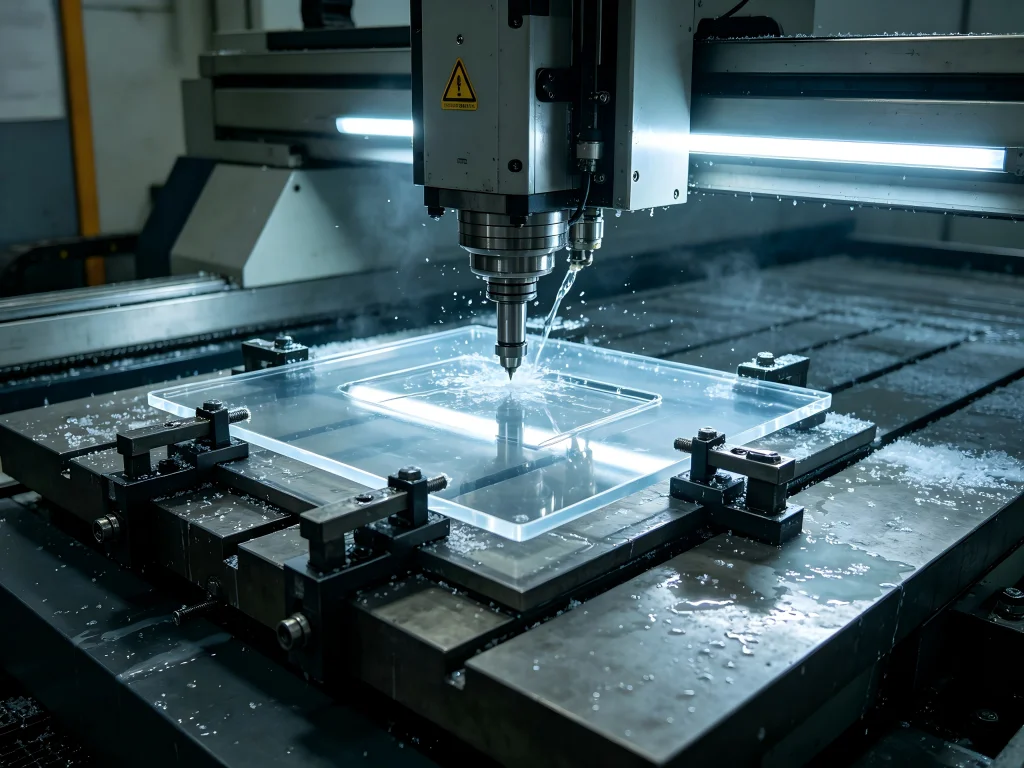
Le vrai problème avec l'acrylique : il vous ment
L'acrylique ressemble à du verre mais ne se comporte pas comme du verre. Il ne se comporte pas non plus comme du métal. Le PMMA (polyméthacrylate de méthyle) est un thermoplastique rigide et transparent qui s'usine à merveille lorsque les conditions sont réunies—et échoue catastrophiquement lorsqu'elles ne le sont pas. Le matériau est cassant, sensible à la chaleur et sujet à la fissuration sous contrainte. Contrairement à l'aluminium, qui vous donne des signes d'avertissement visibles avant qu'un outil ne casse, l'acrylique peut sembler parfait sur la machine et se fissurer trois jours plus tard lors de l'assemblage.
Voici ce qui va généralement mal dans un atelier standard :
- Fissuration autour des trous et des bords: la contrainte interne du matériau se libère pendant l'usinage, créant des microfractures qui se propagent avec le temps.
- Voile et opacification de la surface: la chaleur de coupe ramollit la surface du matériau, créant un aspect laiteux que le polissage ne peut pas totalement éliminer.
- Blanchiment des bords: Des outils émoussés ou des avances incorrectes font que l'acrylique “ s'étale ” au lieu de se cisailer proprement.
- Dérive dimensionnelle: L'acrylique se dilate considérablement avec la chaleur—environ 0,000040 pouce par pouce par degré Fahrenheit—ce qui signifie qu'une pièce mesurée à chaud ne s'ajustera pas lorsqu'elle refroidira.
Ces problèmes ne sont pas hypothétiques. Les discussions sur les forums d'usinage mettent systématiquement en évidence les mêmes frustrations : “ L'acrylique peut se troubler pendant l'usinage ” et “ il est pratiquement impossible d'usiner l'acrylique et d'obtenir une finition optiquement claire, à moins de pratiquer l'usinage au diamant sur des machines vraiment sophistiquées ”. La réalité est que l'usinage CNC de l'acrylique exige une approche fondamentalement différente de la découpe des métaux ou même des autres plastiques.
Ce qu'est réellement l'usinage CNC de l'acrylique
L'usinage CNC de l'acrylique désigne le procédé de fabrication soustractive à commande numérique utilisé pour créer des pièces à partir de plaques ou de blocs d'acrylique. Une machine CNC suit des instructions numériques pour enlever de la matière à l'aide d'outils de coupe rotatifs, produisant tout, des simples panneaux plats aux géométries 3D complexes avec des poches, des contre-dépouilles et des caractéristiques精细.
Contrairement à la découpe laser, qui utilise la chaleur pour vaporiser la matière, la découpe CNC de l'acrylique repose sur une force mécanique. Cette distinction est énorme. La découpe laser produit des bords polis à la flamme sur les feuilles minces, mais ne peut pas traiter les blocs d'acrylique épais, crée des zones affectées thermiquement et peine avec les caractéristiques tridimensionnelles. L'usinage CNC, en revanche, peut créer des structures porteuses, des trous percés, des lamages et des cavités internes complexes que la découpe laser ne peut tout simplement pas réaliser.
Le processus comporte généralement plusieurs étapes :
-
- Sélection du matériau: Choisir entre l'acrylique coulé et l'acrylique extrudé, qui se comportent très différemment pendant l'usinage.
- Programmation CAO/FAO: Créer des trajectoires d'outil qui minimisent la génération de chaleur et la concentration de contraintes.
- Maintien en position: Fixer la pièce sans appliquer une pression de serrage excessive.
- Découpe: Utiliser des outils affûtés avec des vitesses et des avances optimisées pour produire des copeaux nets plutôt que du plastique fondu.
- Post-traitement: Polissage, lissage à la vapeur ou autres opérations de finition pour restaurer la clarté optique.
Acrylique coulé vs. extrudé : la décision qui détermine tout
L'une des erreurs les plus courantes en l'usinage CNC de l'acrylique est de traiter tout l'acrylique comme interchangeable. Ce n'est pas le cas. L'acrylique coulé et l'acrylique extrudé semblent identiques en rayon, mais se comportent comme des matériaux totalement différents sous un outil de coupe.
| Caractéristique | Acrylique coulé | Acrylique extrudé |
|---|---|---|
| Procédé de fabrication | Polymérisé entre des plaques de verre ; production lente, par lots | Poussé à travers une filière ; production continue, à grand volume |
| Contrainte interne | Low; molecular chains are long and randomly oriented | High; polymer chains are stretched and aligned |
| Machining behavior | Produces clean chips; forgiving of heat | Prone to melting and gumming; stress-sensitive |
| Polishing potential | Excellent; achieves optical-grade clarity | Limited; internal stress can cause crazing during polishing |
| Best applications | Optical lenses, display cases, medical devices, automotive lighting | Signage, light panels, simple flat enclosures |
| Cost | Higher | Lower |
At Jucheng Precision, the material decision is treated as the first step of manufacturing, not an afterthought. The company exclusively uses high-quality cell cast acrylic for precision CNC machining and prototyping projects. This choice reflects a fundamental understanding: cast acrylic’s lower internal stress and superior machining characteristics make it the only reliable option for parts that require optical clarity, tight tolerances, or long-term stability.
One engineering manager from a medical device company put it this way in a forum discussion: “Selecting the wrong raw material is like building a skyscraper on a foundation of loose sand”. The material’s “genetic makeup” will eventually fight against your design, no matter how carefully you program the toolpaths.
Why Most Shops Fail at Acrylic CNC Machining
The machining community frequently discusses why acrylic causes so many problems. The short answer is that l'usinage CNC de l'acrylique requires a level of discipline that many shops do not maintain. Here are the most common failure points:
Gestion thermique
Heat is the single biggest enemy in la découpe CNC de l'acrylique. Acrylic softens at relatively low temperatures—around 160 to 180 degrees Fahrenheit for most grades. Once the material softens, it smears instead of cutting cleanly. The resulting surface haze is difficult or impossible to remove, even with aggressive polishing.
Proper heat management requires several simultaneous actions:
-
-
- Using sharp tools with the correct geometry for plastics
- Maintaining appropriate feed rates—too slow creates friction heat, too fast causes tool deflection
- Applying compressed air or mist cooling directly at the cutting zone
- Programming toolpaths that avoid dwelling in any single area
-
Tool Condition
Dull tools do not just cut slowly—they damage acrylic permanently. A worn cutting edge drags across the material rather than shearing it, creating friction that generates heat and produces a rough, cloudy surface. In metal machining, dull tools might produce a slightly rougher finish. In l'usinage CNC de l'acrylique, dull tools produce scrap.
Jucheng Precision addresses this by using diamond-polished tools specifically designed for acrylic. These tools produce a transparent chip and a semi-clear surface directly off the machine, significantly reducing post-processing time.
Clamping and Fixturing
Acrylic is brittle. Excessive clamping pressure causes stress concentrations that lead to cracking during or after machining. Many shops use the same vises and fixtures for acrylic that they use for aluminum, applying the same clamping force. This approach reliably produces cracked parts.
Proper fixturing for l'usinage CNC de l'acrylique involves distributing pressure evenly. Vacuum tables and double-sided tape fixtures work well for flat parts. For three-dimensional work, custom fixtures that support the part without over-clamping are essential.
Material Stress
Acrylic sheets often contain internal stresses from manufacturing, transportation, and storage. These invisible stresses can release during machining, causing parts to crack or warp. Extruded acrylic contains particularly high residual stress because of the manufacturing process.
In some cases, shops perform annealing—a controlled heating and cooling process—to relieve internal stress before precision machining. This step adds time and cost but dramatically improves machining stability, especially for thick sheets and optical-grade components.
What Jucheng Precision Does Differently
Jucheng Precision approaches l'usinage CNC de l'acrylique as a specialized discipline rather than a generic plastic-cutting service. The company’s facility in Shenzhen houses 150+ CNC machines, including 25+ Haas and Mazak units, covering 3-axis, 4-axis, and 5-axis configurations. The 8,000-square-meter facility employs 190+ people, including 30 highly skilled technicians.
Several factors distinguish Jucheng’s approach:
Material expertise: The company maintains a deep inventory of both cast and extruded acrylic in clear, tinted, and frosted varieties. Rather than letting customers specify “acrylic” and hoping for the best, Jucheng’s engineers guide material selection based on the specific application requirements.
Advanced capabilities: While many shops struggle with basic acrylic cutting, Jucheng’s 5-axis CNC mills can create complex 3D shapes, pockets, and undercuts in acrylic blocks. The company routinely holds tolerances of ±0.05mm for plastic parts. For context, this is approximately ±0.002 inches—tighter than the industry standard for many acrylic applications.
Quality certifications: Jucheng holds ISO 9001:2015, ISO 14001, ISO 13485 (medical devices), and IATF 16949 (automotive) certifications. These certifications require documented processes, rigorous inspection protocols, and traceability that many prototype shops lack. The metrology lab includes CMM, optical comparator, surface profilometer, and hardness tester equipment.
Post-processing expertise: Machining is only half the battle. Restoring optical clarity requires specialized finishing techniques. Jucheng offers vapor polishing for internal features, hand buffing for high-gloss surfaces, and sandblasting for diffusion effects. The goal is to achieve 92% light transmission—comparable to molded or extruded parts.
Rapid turnaround: For prototyping and low-volume production, speed matters. Jucheng delivers quotes within hours and can produce parts in as fast as 4 days. This capability is particularly valuable for design iterations where engineers need to validate form, fit, and function before committing to production tooling.
Applications That Demand Professional Acrylic CNC Machining
Not every acrylic part requires 5-axis precision. Simple flat panels with straight cuts can be handled by basic routing or even laser cutting. However, certain applications demand the capabilities of a professional service de découpe CNC d'acrylique:
Éclairage automobile
Taillight lenses, instrument cluster covers, and interior ambient lighting components require optical clarity, precise geometry, and UV stability. These parts often have complex curves, undercuts, and light-guiding features that only multi-axis CNC machining can produce. Extruded acrylic’s internal stress makes it unsuitable for these applications—cast acrylic is the only reliable choice.
Dispositifs médicaux
Medical manifolds, fluid handling components, and diagnostic equipment housings demand both optical clarity and dimensional precision. The ISO 13485 certification that Jucheng holds is not optional for these applications—it is a requirement. Cleanability, chemical resistance, and stress-free surfaces are non-negotiable.
Display and Retail
High-end retail displays, museum showcases, and premium product presentations use acrylic for its optical properties. These applications often involve intricate acrylic CNC cutting designs that combine aesthetic appeal with structural requirements. The backlit acrylic panels used in modern retail environments require precise edge finishing to distribute light evenly.
Architectural Models
Acrylic structural prototypes are widely used in architectural models, product displays, and artwork production. The material’s clarity and ease of fabrication make it ideal for representing glass, water, and transparent surfaces in scaled models. CNC machining allows for precise engraving and cutting of intricate patterns.
Religious and Decorative Items
CNC-cut acrylic panels with intricate jali work, mandala patterns, and devotional motifs have become increasingly popular. Designs for mandir panels, temple backdrops, and religious gift items often feature fine details that require precision cutting. The clean edges and optical clarity of machined acrylic enhance the visual impact of backlit decorative panels.
How to Choose an Acrylic CNC Machining Partner
Choisir un l'usinage CNC de l'acrylique provider involves more than comparing price quotes. The following factors separate reliable partners from those who will deliver scrap:
Material knowledge: Does the provider understand the difference between cast and extruded acrylic? Can they recommend the appropriate grade for your application? A shop that treats all acrylic the same way will produce inconsistent results.
Equipment capability: Does the shop have the right machines for your parts? 3-axis machining works for flat parts, but complex geometries require 4-axis or 5-axis capability. The machine fleet should include options for both prototyping and production volumes.
Quality systems: Certifications like ISO 9001 and ISO 13485 indicate documented quality processes. However, certifications alone do not guarantee quality—ask about inspection equipment, measurement protocols, and how the shop handles non-conforming parts.
Post-processing capabilities: Machining creates only part of the final product. The provider should offer finishing services appropriate for your application—vapor polishing for optical clarity, mechanical buffing for high gloss, or sandblasting for diffusion effects.
Communication and responsiveness: The prototyping process often involves design iterations. A provider who responds quickly to questions, provides clear feedback on manufacturability, and delivers quotes promptly will save time and frustration.
Common Questions About Acrylic CNC Machining
What is the typical tolerance for acrylic CNC machining?
Standard tolerances for l'usinage CNC de l'acrylique range from ±0.005 inches to ±0.02 inches depending on part dimensions and complexity. Professional shops like Jucheng Precision routinely hold ±0.05mm (±0.002 inches) for plastic parts. Tighter tolerances are possible but may increase cost and lead time.
Can acrylic be machined with standard metal-cutting tools?
Yes, but the results will be poor. Acrylic requires sharp tools with correct geometry for plastics. Standard metal-cutting tools often have dull edges or incorrect rake angles, producing heat, melting, and surface haze. Diamond-polished tools designed specifically for acrylic produce cleaner cuts and reduce post-processing requirements.
What is the difference between CNC machining and laser cutting for acrylic?
Laser cutting uses heat to vaporize material, producing polished edges on thin sheets but creating heat-affected zones. CNC machining uses mechanical force, allowing for thicker materials, three-dimensional features, drilled holes, and better dimensional stability. Laser cutting is faster for simple 2D profiles; CNC machining is necessary for complex geometries and functional parts.
How much does acrylic CNC machining cost?
Costs vary widely based on part complexity, material selection, tolerances, quantity, and finishing requirements. Desktop CNC machines for hobby use start around $500-$600, while industrial 5-axis systems can exceed $60,000. Professional acrylic CNC cutting services typically quote per part based on setup time, machining time, material cost, and finishing operations. Requesting quotes from multiple providers with clear specifications helps identify competitive pricing.
How do I find acrylic CNC machining services near me?
Searching for “acrylic CNC machine near me” or “acrylic CNC cutting near me” will return local providers. However, geographic proximity is less important than capability for precision work. Many engineering teams work with overseas providers like Jucheng Precision who offer rapid shipping and competitive pricing. The key factors are quality, communication, and the provider’s ability to meet your specifications.
Can acrylic be polished after CNC machining?
Yes, polishing is essential for restoring optical clarity after la découpe CNC de l'acrylique. Mechanical buffing works for flat surfaces; flame polishing produces high-gloss edges but carries thermal risks; vapor polishing is the gold standard for intricate features. The best approach depends on part geometry and the required level of clarity.
What designs work well for acrylic CNC cutting?
Acrylic CNC cutting designs should incorporate radii at internal corners—at least 10% larger than the cutting tool’s radius. Pocket depths should be less than three times the tool diameter. Designs that avoid sharp internal corners, thin walls, and abrupt changes in cross-section are more likely to machine successfully without cracking.
Why do acrylic parts sometimes crack weeks after machining?
Delayed cracking is usually caused by internal stress in the material. The machining process can release some stress immediately, but residual stress may remain. Over time, temperature changes, solvent exposure, or mechanical loads can trigger crack propagation. Using cast acrylic, proper fixturing, and appropriate toolpaths minimizes this risk.
Getting Started with Professional Acrylic CNC Machining
The difference between frustration and success in l'usinage CNC de l'acrylique comes down to expertise. The material is unforgiving, but predictable when handled correctly. Shops that understand acrylic’s unique behavior—its heat sensitivity, brittleness, and stress characteristics—consistently produce parts that meet specifications. Shops that treat acrylic like any other plastic deliver inconsistent results.
Jucheng Precision has built its reputation on mastering difficult materials and challenging geometries. The company’s combination of advanced equipment, rigorous quality systems, and deep material knowledge makes it a reliable partner for projects ranging from single prototypes to production volumes. Whether you need automotive lighting components, medical device housings, or decorative acrylic panels with intricate acrylic CNC cutting designs, the right machining partner makes the difference between a part that works and one that fails.
Before committing to a provider, request samples of their acrylic work. Examine the edges under magnification. Look for haze, tool marks, and stress cracks. Ask about their material sourcing, tooling strategy, and quality inspection process. The answers will tell you whether they truly understand l'usinage CNC de l'acrylique or are simply hoping for the best.
When you are ready to move forward, Jucheng Precision offers the capabilities, certifications, and experience to deliver acrylic parts that meet your specifications—on time and within budget. The company’s one-stop service model covers everything from prototype verification to batch production, with flexible production scheduling to meet your timeline.