
Diseñó un hermoso componente de acrílico transparente. El modelo CAD parecía impecable. Luego llegó la pieza mecanizada: turbia, agrietada en los bordes o cubierta de feas marcas blancas de tensión alrededor de cada agujero. Si esto le suena familiar, no está solo. El mecanizado CNC de acrílico presenta uno de los desafíos más frustrantes en la fabricación de precisión, y el problema casi nunca es la máquina en sí. El verdadero culpable casi siempre es una falta de coincidencia entre el comportamiento del material y la estrategia de mecanizado. Esta guía explica por qué fallan las piezas de acrílico, cómo el mecanizado CNC de acrílico funciona realmente cuando se hace correctamente, y qué distingue a un servicio confiable de corte CNC de acrílico de uno que entrega desperdicio.
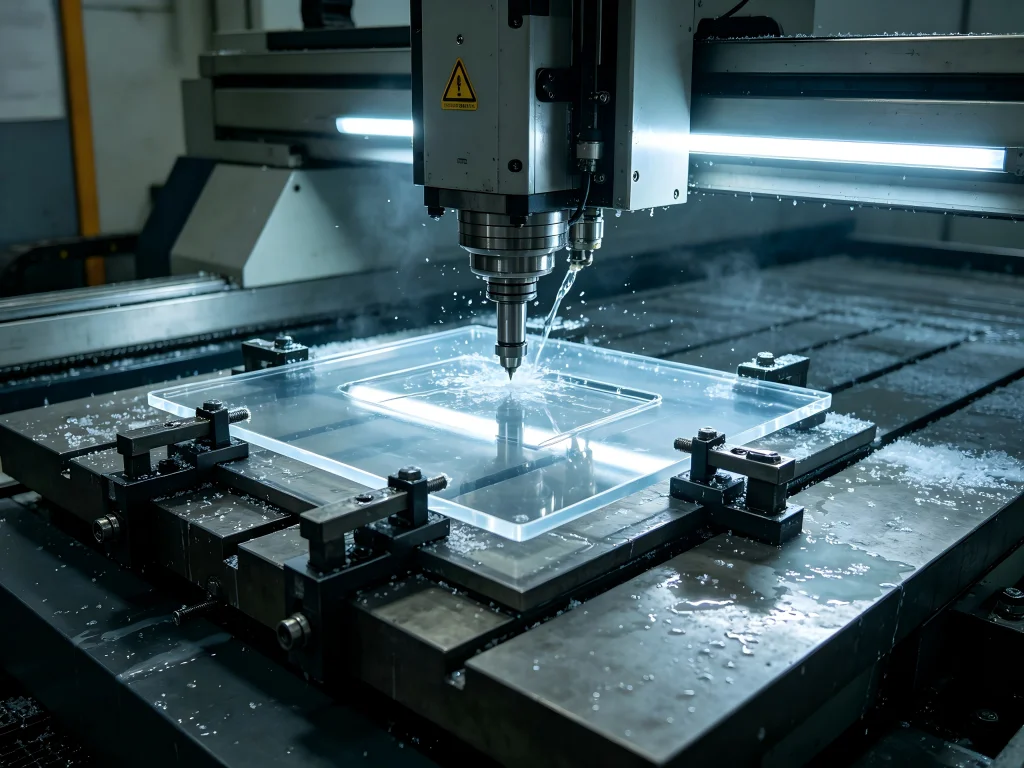
El verdadero problema con el acrílico: le miente a usted
El acrílico parece vidrio pero no se comporta como vidrio. Tampoco se comporta como metal. El PMMA (polimetilmetacrilato) es un termoplástico rígido y transparente que se mecaniza maravillosamente cuando las condiciones son las adecuadas, y falla catastróficamente cuando no lo son. El material es frágil, sensible al calor y propenso al agrietamiento por tensión. A diferencia del aluminio, que le da señales de advertencia visibles antes de que se rompa una herramienta, el acrílico puede verse perfecto en la máquina y agrietarse tres días después durante el ensamblaje.
Esto es lo que suele salir mal en un taller estándar:
- Agrietamiento alrededor de agujeros y bordes: La tensión interna del material se libera durante el mecanizado, creando microfracturas que se propagan con el tiempo.
- Opacidad y nebulosidad superficial: El calor de corte reblandece la superficie del material, creando una apariencia lechosa que el pulido no puede eliminar por completo.
- Blanqueamiento de bordes: Las herramientas desafiladas o las velocidades de avance incorrectas hacen que el acrílico se “embarre” en lugar de cortarse limpiamente.
- Deriva dimensional: El acrílico se expande significativamente con el calor—aproximadamente 0,000040 pulgadas por pulgada por grado Fahrenheit—lo que significa que una pieza medida en caliente no encajará cuando se enfríe.
Estos problemas no son hipotéticos. Las discusiones en los foros de mecanizado destacan consistentemente las mismas frustraciones: “El acrílico puede volverse turbio a medida que lo mecanizas” y “es prácticamente imposible mecanizar acrílico y obtener un acabado ópticamente transparente a menos que te dediques al mecanizado con diamante en máquinas realmente sofisticadas”. La realidad es que el mecanizado CNC de acrílico exige un enfoque fundamentalmente diferente al de cortar metales o incluso otros plásticos.
Qué es realmente el mecanizado CNC de acrílico
El mecanizado CNC de acrílico se refiere al proceso de fabricación sustractiva controlado por computadora que se utiliza para crear piezas a partir de láminas o bloques de acrílico. Una máquina CNC sigue instrucciones digitales para eliminar material usando herramientas de corte giratorias, produciendo desde paneles planos simples hasta geometrías 3D complejas con cavidades, rebajes y精细 características.
A diferencia del corte por láser, que utiliza calor para vaporizar el material, el corte CNC de acrílico se basa en la fuerza mecánica. Esta distinción es enormemente importante. El corte por láser produce bordes pulidos a la llama en láminas delgadas, pero no puede manejar bloques gruesos de acrílico, crea zonas afectadas por el calor y tiene dificultades con características tridimensionales. El mecanizado CNC, por el contrario, puede crear estructuras portantes, agujeros perforados, avellanados y cavidades internas complejas que el corte por láser simplemente no puede lograr.
El proceso generalmente implica varios pasos:
-
- Selección de material: Elegir entre acrílico colado y extruido, que se comportan de manera muy diferente durante el mecanizado.
- Programación CAD/CAM: Crear trayectorias de herramienta que minimicen la generación de calor y la concentración de tensiones.
- Sujeción: Asegurar la pieza de trabajo sin aplicar una presión de sujeción excesiva.
- Corte: Usar herramientas afiladas con velocidades y avances optimizados para producir virutas limpias en lugar de plástico derretido.
- Postprocesamiento: Pulido, alisado por vapor u otras operaciones de acabado para restaurar la claridad óptica.
Acrílico fundido vs. extruido: la decisión que lo determina todo
Uno de los errores más comunes en el mecanizado CNC de acrílico es tratar todo el acrílico como intercambiable. No lo es. El acrílico fundido y el extruido se ven idénticos en el estante, pero se comportan como materiales completamente diferentes bajo una herramienta de corte.
| Característica | Acrílico colado | Acrílico extruido |
|---|---|---|
| Proceso de fabricación | Polimerizado entre placas de vidrio; producción lenta por lotes | Extruido a través de una matriz; producción continua de gran volumen |
| Tensión interna | Baja; las cadenas moleculares son largas y están orientadas aleatoriamente | Alta; las cadenas poliméricas están estiradas y alineadas |
| Comportamiento en el mecanizado | Produces clean chips; forgiving of heat | Prone to melting and gumming; stress-sensitive |
| Polishing potential | Excellent; achieves optical-grade clarity | Limited; internal stress can cause crazing during polishing |
| Best applications | Optical lenses, display cases, medical devices, automotive lighting | Signage, light panels, simple flat enclosures |
| Cost | Higher | Lower |
At Jucheng Precision, the material decision is treated as the first step of manufacturing, not an afterthought. The company exclusively uses high-quality cell cast acrylic for precision CNC machining and prototyping projects. This choice reflects a fundamental understanding: cast acrylic’s lower internal stress and superior machining characteristics make it the only reliable option for parts that require optical clarity, tight tolerances, or long-term stability.
One engineering manager from a medical device company put it this way in a forum discussion: “Selecting the wrong raw material is like building a skyscraper on a foundation of loose sand”. The material’s “genetic makeup” will eventually fight against your design, no matter how carefully you program the toolpaths.
Why Most Shops Fail at Acrylic CNC Machining
The machining community frequently discusses why acrylic causes so many problems. The short answer is that el mecanizado CNC de acrílico requires a level of discipline that many shops do not maintain. Here are the most common failure points:
Gestión del calor
Heat is the single biggest enemy in el corte CNC de acrílico. Acrylic softens at relatively low temperatures—around 160 to 180 degrees Fahrenheit for most grades. Once the material softens, it smears instead of cutting cleanly. The resulting surface haze is difficult or impossible to remove, even with aggressive polishing.
Proper heat management requires several simultaneous actions:
-
-
- Using sharp tools with the correct geometry for plastics
- Maintaining appropriate feed rates—too slow creates friction heat, too fast causes tool deflection
- Applying compressed air or mist cooling directly at the cutting zone
- Programming toolpaths that avoid dwelling in any single area
-
Tool Condition
Dull tools do not just cut slowly—they damage acrylic permanently. A worn cutting edge drags across the material rather than shearing it, creating friction that generates heat and produces a rough, cloudy surface. In metal machining, dull tools might produce a slightly rougher finish. In el mecanizado CNC de acrílico, dull tools produce scrap.
Jucheng Precision addresses this by using diamond-polished tools specifically designed for acrylic. These tools produce a transparent chip and a semi-clear surface directly off the machine, significantly reducing post-processing time.
Clamping and Fixturing
Acrylic is brittle. Excessive clamping pressure causes stress concentrations that lead to cracking during or after machining. Many shops use the same vises and fixtures for acrylic that they use for aluminum, applying the same clamping force. This approach reliably produces cracked parts.
Proper fixturing for el mecanizado CNC de acrílico involves distributing pressure evenly. Vacuum tables and double-sided tape fixtures work well for flat parts. For three-dimensional work, custom fixtures that support the part without over-clamping are essential.
Material Stress
Acrylic sheets often contain internal stresses from manufacturing, transportation, and storage. These invisible stresses can release during machining, causing parts to crack or warp. Extruded acrylic contains particularly high residual stress because of the manufacturing process.
In some cases, shops perform annealing—a controlled heating and cooling process—to relieve internal stress before precision machining. This step adds time and cost but dramatically improves machining stability, especially for thick sheets and optical-grade components.
What Jucheng Precision Does Differently
Jucheng Precision approaches el mecanizado CNC de acrílico as a specialized discipline rather than a generic plastic-cutting service. The company’s facility in Shenzhen houses 150+ CNC machines, including 25+ Haas and Mazak units, covering 3-axis, 4-axis, and 5-axis configurations. The 8,000-square-meter facility employs 190+ people, including 30 highly skilled technicians.
Several factors distinguish Jucheng’s approach:
Material expertise: The company maintains a deep inventory of both cast and extruded acrylic in clear, tinted, and frosted varieties. Rather than letting customers specify “acrylic” and hoping for the best, Jucheng’s engineers guide material selection based on the specific application requirements.
Advanced capabilities: While many shops struggle with basic acrylic cutting, Jucheng’s 5-axis CNC mills can create complex 3D shapes, pockets, and undercuts in acrylic blocks. The company routinely holds tolerances of ±0.05mm for plastic parts. For context, this is approximately ±0.002 inches—tighter than the industry standard for many acrylic applications.
Quality certifications: Jucheng holds ISO 9001:2015, ISO 14001, ISO 13485 (medical devices), and IATF 16949 (automotive) certifications. These certifications require documented processes, rigorous inspection protocols, and traceability that many prototype shops lack. The metrology lab includes CMM, optical comparator, surface profilometer, and hardness tester equipment.
Post-processing expertise: Machining is only half the battle. Restoring optical clarity requires specialized finishing techniques. Jucheng offers vapor polishing for internal features, hand buffing for high-gloss surfaces, and sandblasting for diffusion effects. The goal is to achieve 92% light transmission—comparable to molded or extruded parts.
Rapid turnaround: For prototyping and low-volume production, speed matters. Jucheng delivers quotes within hours and can produce parts in as fast as 4 days. This capability is particularly valuable for design iterations where engineers need to validate form, fit, and function before committing to production tooling.
Applications That Demand Professional Acrylic CNC Machining
Not every acrylic part requires 5-axis precision. Simple flat panels with straight cuts can be handled by basic routing or even laser cutting. However, certain applications demand the capabilities of a professional corte CNC de acrílico:
Iluminación automotriz
Taillight lenses, instrument cluster covers, and interior ambient lighting components require optical clarity, precise geometry, and UV stability. These parts often have complex curves, undercuts, and light-guiding features that only multi-axis CNC machining can produce. Extruded acrylic’s internal stress makes it unsuitable for these applications—cast acrylic is the only reliable choice.
Dispositivos médicos
Medical manifolds, fluid handling components, and diagnostic equipment housings demand both optical clarity and dimensional precision. The ISO 13485 certification that Jucheng holds is not optional for these applications—it is a requirement. Cleanability, chemical resistance, and stress-free surfaces are non-negotiable.
Display and Retail
High-end retail displays, museum showcases, and premium product presentations use acrylic for its optical properties. These applications often involve intricate acrylic CNC cutting designs that combine aesthetic appeal with structural requirements. The backlit acrylic panels used in modern retail environments require precise edge finishing to distribute light evenly.
Architectural Models
Acrylic structural prototypes are widely used in architectural models, product displays, and artwork production. The material’s clarity and ease of fabrication make it ideal for representing glass, water, and transparent surfaces in scaled models. CNC machining allows for precise engraving and cutting of intricate patterns.
Religious and Decorative Items
CNC-cut acrylic panels with intricate jali work, mandala patterns, and devotional motifs have become increasingly popular. Designs for mandir panels, temple backdrops, and religious gift items often feature fine details that require precision cutting. The clean edges and optical clarity of machined acrylic enhance the visual impact of backlit decorative panels.
How to Choose an Acrylic CNC Machining Partner
Seleccionar un el mecanizado CNC de acrílico provider involves more than comparing price quotes. The following factors separate reliable partners from those who will deliver scrap:
Material knowledge: Does the provider understand the difference between cast and extruded acrylic? Can they recommend the appropriate grade for your application? A shop that treats all acrylic the same way will produce inconsistent results.
Equipment capability: Does the shop have the right machines for your parts? 3-axis machining works for flat parts, but complex geometries require 4-axis or 5-axis capability. The machine fleet should include options for both prototyping and production volumes.
Quality systems: Certifications like ISO 9001 and ISO 13485 indicate documented quality processes. However, certifications alone do not guarantee quality—ask about inspection equipment, measurement protocols, and how the shop handles non-conforming parts.
Post-processing capabilities: Machining creates only part of the final product. The provider should offer finishing services appropriate for your application—vapor polishing for optical clarity, mechanical buffing for high gloss, or sandblasting for diffusion effects.
Communication and responsiveness: The prototyping process often involves design iterations. A provider who responds quickly to questions, provides clear feedback on manufacturability, and delivers quotes promptly will save time and frustration.
Common Questions About Acrylic CNC Machining
What is the typical tolerance for acrylic CNC machining?
Standard tolerances for el mecanizado CNC de acrílico range from ±0.005 inches to ±0.02 inches depending on part dimensions and complexity. Professional shops like Jucheng Precision routinely hold ±0.05mm (±0.002 inches) for plastic parts. Tighter tolerances are possible but may increase cost and lead time.
Can acrylic be machined with standard metal-cutting tools?
Yes, but the results will be poor. Acrylic requires sharp tools with correct geometry for plastics. Standard metal-cutting tools often have dull edges or incorrect rake angles, producing heat, melting, and surface haze. Diamond-polished tools designed specifically for acrylic produce cleaner cuts and reduce post-processing requirements.
What is the difference between CNC machining and laser cutting for acrylic?
Laser cutting uses heat to vaporize material, producing polished edges on thin sheets but creating heat-affected zones. CNC machining uses mechanical force, allowing for thicker materials, three-dimensional features, drilled holes, and better dimensional stability. Laser cutting is faster for simple 2D profiles; CNC machining is necessary for complex geometries and functional parts.
How much does acrylic CNC machining cost?
Costs vary widely based on part complexity, material selection, tolerances, quantity, and finishing requirements. Desktop CNC machines for hobby use start around $500-$600, while industrial 5-axis systems can exceed $60,000. Professional acrylic CNC cutting services typically quote per part based on setup time, machining time, material cost, and finishing operations. Requesting quotes from multiple providers with clear specifications helps identify competitive pricing.
How do I find acrylic CNC machining services near me?
Searching for “acrylic CNC machine near me” or “acrylic CNC cutting near me” will return local providers. However, geographic proximity is less important than capability for precision work. Many engineering teams work with overseas providers like Jucheng Precision who offer rapid shipping and competitive pricing. The key factors are quality, communication, and the provider’s ability to meet your specifications.
Can acrylic be polished after CNC machining?
Yes, polishing is essential for restoring optical clarity after el corte CNC de acrílico. Mechanical buffing works for flat surfaces; flame polishing produces high-gloss edges but carries thermal risks; vapor polishing is the gold standard for intricate features. The best approach depends on part geometry and the required level of clarity.
What designs work well for acrylic CNC cutting?
Acrylic CNC cutting designs should incorporate radii at internal corners—at least 10% larger than the cutting tool’s radius. Pocket depths should be less than three times the tool diameter. Designs that avoid sharp internal corners, thin walls, and abrupt changes in cross-section are more likely to machine successfully without cracking.
Why do acrylic parts sometimes crack weeks after machining?
Delayed cracking is usually caused by internal stress in the material. The machining process can release some stress immediately, but residual stress may remain. Over time, temperature changes, solvent exposure, or mechanical loads can trigger crack propagation. Using cast acrylic, proper fixturing, and appropriate toolpaths minimizes this risk.
Getting Started with Professional Acrylic CNC Machining
The difference between frustration and success in el mecanizado CNC de acrílico comes down to expertise. The material is unforgiving, but predictable when handled correctly. Shops that understand acrylic’s unique behavior—its heat sensitivity, brittleness, and stress characteristics—consistently produce parts that meet specifications. Shops that treat acrylic like any other plastic deliver inconsistent results.
Jucheng Precision has built its reputation on mastering difficult materials and challenging geometries. The company’s combination of advanced equipment, rigorous quality systems, and deep material knowledge makes it a reliable partner for projects ranging from single prototypes to production volumes. Whether you need automotive lighting components, medical device housings, or decorative acrylic panels with intricate acrylic CNC cutting designs, the right machining partner makes the difference between a part that works and one that fails.
Before committing to a provider, request samples of their acrylic work. Examine the edges under magnification. Look for haze, tool marks, and stress cracks. Ask about their material sourcing, tooling strategy, and quality inspection process. The answers will tell you whether they truly understand el mecanizado CNC de acrílico or are simply hoping for the best.
When you are ready to move forward, Jucheng Precision offers the capabilities, certifications, and experience to deliver acrylic parts that meet your specifications—on time and within budget. The company’s one-stop service model covers everything from prototype verification to batch production, with flexible production scheduling to meet your timeline.