
Cuando los ingenieros y diseñadores de productos necesitan componentes de precisión que combinen resistencia, propiedades de ligereza y flexibilidad de diseño, las piezas plásticas CNC a menudo surgen como la solución óptima. A diferencia de las alternativas metálicas, los componentes plásticos mecanizados ofrecen una resistencia química excepcional, aislamiento eléctrico y la capacidad de lograr geometrías complejas sin los costos de utillaje asociados con el moldeo por inyección. Esta guía completa explora todo, desde la selección de materiales hasta el control de calidad, ayudándole a tomar decisiones informadas para su próximo proyecto.
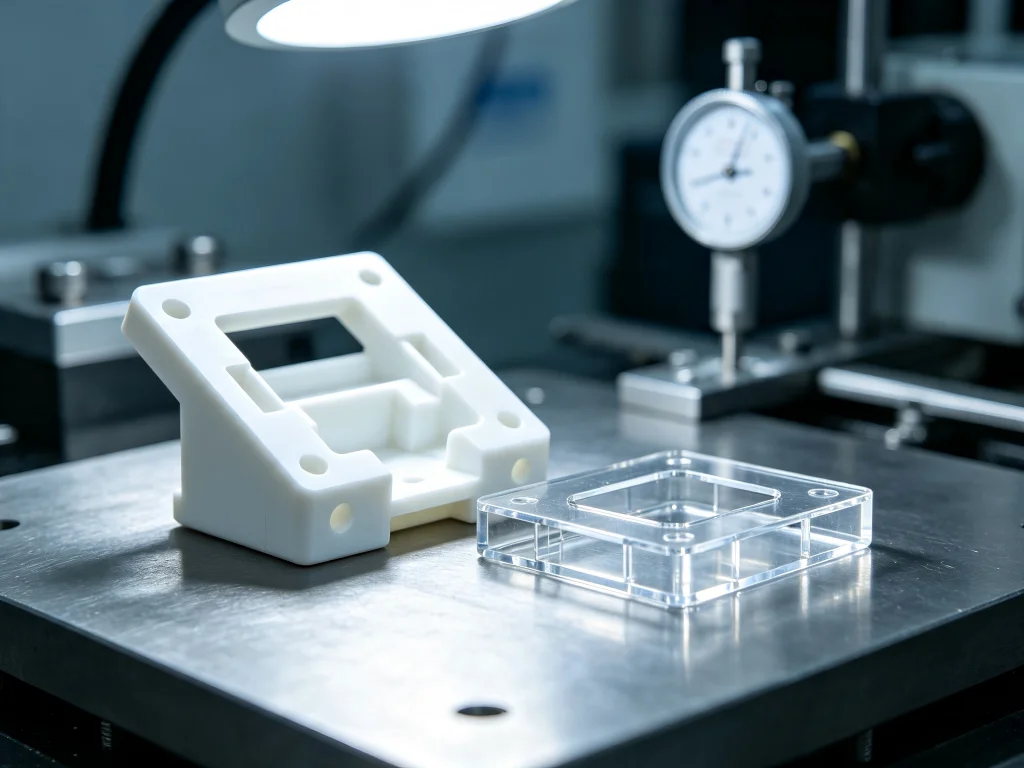
¿Qué son las piezas plásticas CNC y cómo funcionan?
las piezas plásticas CNC son componentes fabricados mediante procesos de mecanizado controlados por computadora que eliminan material de una pieza sólida de plástico—como barras, láminas o bloques—para crear productos terminados de precisión. El proceso comienza con un modelo CAD, que se traduce en trayectorias de herramienta mediante software CAM. Estas instrucciones digitales guían las herramientas de corte con una precisión notable, dando forma a los plásticos de ingeniería hasta convertirlos en componentes funcionales que cumplen especificaciones exigentes.
La distinción fundamental entre el mecanizado de plástico y de metal radica en el comportamiento del material. Los plásticos presentan una menor conductividad térmica, mayores coeficientes de expansión térmica y propiedades viscoelásticas que exigen enfoques especializados. A diferencia de los metales, que disipan el calor de manera eficiente, los plásticos retienen la energía térmica, creando riesgos de fusión, deformación o distorsión inducida por tensiones si no se gestionan adecuadamente.
Los centros de mecanizado CNC modernos emplean capacidades de fresado de 3, 4 y 5 ejes junto con operaciones de torneado y rectificado. Las máquinas multieje permiten la producción de geometrías cada vez más complejas—rebajes, características anguladas y cavidades internas intrincadas—que serían imposibles con equipos convencionales de 3 ejes. Esta flexibilidad hace que el mecanizado CNC sea particularmente valioso para la creación de prototipos, la producción de bajo volumen y los componentes que requieren tolerancias estrictas.
¿Por qué elegir el mecanizado CNC en lugar del moldeo por inyección para piezas plásticas?
La decisión entre el mecanizado CNC y el moldeo por inyección depende en gran medida del volumen de producción, la complejidad de la pieza y los requisitos de plazo. El mecanizado CNC sobresale en varios escenarios en los que el moldeo por inyección no es suficiente.
Los volúmenes bajos a medios representan el punto óptimo para los componentes plásticos mecanizados. El moldeo por inyección requiere utillaje costoso que puede costar decenas de miles de dólares, lo que lo hace económicamente viable solo para producciones de alto volumen. El mecanizado CNC no conlleva costos de utillaje, lo que permite una producción económica desde prototipos individuales hasta varios miles de unidades.
La flexibilidad de diseño ofrece otra ventaja convincente. Los cambios de diseño en el mecanizado CNC requieren solo actualizaciones de CAD y CAM—sin modificaciones costosas de moldes. Esta agilidad resulta invaluable durante el desarrollo de productos, cuando los diseños evolucionan rápidamente según los comentarios de las pruebas.
Selección de material presenta una tercera consideración. El mecanizado CNC puede procesar más de 30 plásticos de ingeniería diferentes, incluidos materiales que resisten el moldeo por inyección debido a sus altas temperaturas de fusión o características de flujo. Esta versatilidad permite a los ingenieros seleccionar materiales óptimos para aplicaciones específicas sin que las limitaciones de fabricación restrinjan sus opciones.
Selección crítica de materiales para piezas plásticas mecanizadas por CNC
La selección de materiales influye fundamentalmente en el rendimiento de la pieza, la maquinabilidad y el costo. Los diferentes plásticos de ingeniería ofrecen perfiles de propiedades distintos adecuados para aplicaciones específicas.
Plásticos de ingeniería para el mecanizado CNC
ABS (Acrilonitrilo butadieno estireno) se destaca como uno de los plásticos más comúnmente mecanizados, disponible en variantes natural, negra y ignífuga. Ofrece una excelente resistencia al impacto, buena estabilidad dimensional y facilidad de mecanizado. Las aplicaciones incluyen componentes interiores automotrices, carcasas electrónicas y envolventes de productos de consumo.
POM (polioximetileno / acetal / Delrin) brinda una estabilidad dimensional excepcional, baja fricción y una resistencia al desgaste sobresaliente. Estas propiedades lo hacen ideal para engranajes, cojinetes y componentes mecánicos móviles. El POM se mecaniza de forma limpia con un excelente acabado superficial, aunque requiere herramientas afiladas para evitar la fusión.
PEEK (poliéter éter cetona) representa el extremo premium de los plásticos de ingeniería. Este polímero de alto rendimiento soporta temperaturas superiores a 250 °C mientras mantiene sus propiedades mecánicas. El PEEK ofrece una resistencia química excepcional y una relación resistencia-peso sobresaliente, lo que lo hace adecuado para aplicaciones aeroespaciales, médicas y de petróleo y gas. Sin embargo, su alto costo de material y su difícil maquinabilidad exigen operadores experimentados y herramientas especializadas.
Nailon (PA / poliamida) proporciona una excelente resistencia, resistencia al desgaste y baja fricción. Disponible en variantes natural, negra y con 30% de fibra de vidrio, el nailon es adecuado para engranajes, componentes estructurales y aplicaciones de cojinetes. Sin embargo, la naturaleza higroscópica del nailon —que absorbe la humedad del aire— crea desafíos de estabilidad dimensional que requieren un acondicionamiento cuidadoso del material y una inspección en ambiente con clima controlado.
PMMA (Acrílico) ofrece una claridad óptica excepcional con hasta 92% de transmisión de luz. Este termoplástico transparente sirve como una alternativa ligera y resistente a los impactos al vidrio. Las aplicaciones incluyen lentes, guías de luz, pantallas de visualización y componentes de iluminación automotriz. El PMMA requiere herramientas de diamante especializadas y técnicas de pulido para lograr claridad óptica.
PC (Policarbonato) brinda una resistencia al impacto y una estabilidad dimensional sobresalientes. Disponible en variantes transparente y negra, el policarbonato es adecuado para aplicaciones que requieren transparencia combinada con tenacidad: protectores de seguridad, guardas de máquinas y envolventes transparentes.
PTFE (Teflón) ofrece una resistencia química excepcional y el coeficiente de fricción más bajo entre los plásticos de ingeniería. Aunque es difícil de mecanizar debido a su naturaleza blanda y gomosa, el PTFE resulta invaluable para sellos, juntas y componentes antiadherentes en equipos de procesamiento químico.
Marco de decisión para la selección de materiales
Elegir el material óptimo requiere equilibrar múltiples factores. Considere estas preguntas al seleccionar materiales para custom CNC plastic parts:
- What loads will the part experience? Structural applications demand materials like glass-filled nylon or PEEK, while non-load-bearing components might use ABS or acrylic.
- What temperatures will the part encounter? High-temperature environments require PEEK, PEI, or PPS rather than ABS or acrylic.
- What chemical exposure exists? PTFE, PEEK, and polypropylene resist aggressive chemicals better than ABS or nylon.
- What tolerances must the part maintain? POM, PEEK, and acrylic achieve the tightest tolerances, while nylon’s moisture absorption complicates dimensional control.
- What surface finish is required? PC, acrylic, and PEEK deliver the best surface finishes.
- What is the production volume? Higher volumes may justify more expensive materials if they reduce downstream costs.
Design for Manufacturability: Creating Machinable Plastic Parts
Design decisions directly impact machining cost, quality, and lead time. Understanding DFM principles for CNC machining plastic parts helps engineers create designs that balance functionality with manufacturability.
Wall Thickness Considerations
Minimum wall thickness for machined plastic parts typically ranges from 1.2mm to 1.5mm. Thinner walls risk warping during machining due to heat generation and reduced rigidity. For parts requiring very thin walls, consider material selection carefully—some plastics maintain rigidity better than others at minimal thicknesses.
Excessively thick walls also present challenges. Thick sections create uneven cooling and stress concentrations that can lead to warping or internal voids. Maintain consistent wall thickness throughout the design to promote dimensional stability.
Corner Radii and Tool Access
CNC cutting tools have cylindrical shapes with flat or spherical ends, creating inherent limitations on internal corner geometry. Sharp internal corners cannot be machined directly—they require either electrical discharge machining (EDM) or feature redesign. Design internal corners with radii at least 1mm to allow standard tool access.
Tool access also constrains deep cavities and narrow features. Deep pockets require long tool extensions that reduce rigidity and increase vibration. Consider splitting complex features into multiple components or using EDM for inaccessible areas.
Hole and Thread Design
Hole depth-to-diameter ratios affect machining cost and quality. Ratios exceeding 4:1 require specialized tooling and extended cycle times. Threads in plastic parts should consider material properties—fine threads in soft plastics may strip under load, while coarse threads provide better engagement in engineering plastics.
Draft Angles and Undercuts
Unlike injection molding, CNC machining does not require draft angles for part ejection. Vertical walls machine efficiently without taper. However, undercuts require specialized tooling or multiple setups, increasing cost. Where possible, design features accessible from the primary machining direction.
Machining Strategies for Different Plastic Types
Different plastics demand different machining approaches. Understanding these distinctions helps achieve optimal results while minimizing scrap and rework.
Machining Nylon: Managing Moisture and Heat
Nylon presents four critical challenges that require specialized strategies:
Moisture absorption represents the single biggest threat to precision in machined nylon parts. A part machined to precise tolerance in a dry environment may grow out of tolerance by several thousandths of an inch when exposed to normal humidity. Professional shops condition nylon stock before machining by storing it in climate-controlled environments or performing mild annealing to achieve equilibrium moisture content.
Heat generation from cutting tools poses a dual risk—the part can soften and melt, or it can distort and warp as internal stress releases. High-speed cutting with light, fast passes removes material quickly and prevents heat buildup. Compressed air cooling evacuates chips rapidly while preventing hot chips from re-melting onto the part surface.
Clamping stress must be controlled carefully. Over-tightening clamps induces stress that releases during machining, causing significant warpage and tolerance failure. Light but secure clamping prevents deformation while maintaining part stability.
Glass-filled variants (PA+GF30) offer superior mechanical strength but create tool wear challenges. Glass fibers rapidly dull standard tooling, requiring diamond-coated or polycrystalline diamond (PCD) tools for economical production.
Machining Acrylic (PMMA): Achieving Optical Clarity
Acrylic machining requires mastering surface finish to achieve optical clarity. Jucheng employs diamond tooling and optimized cutting paths to minimize tool marks, followed by specialized polishing to restore 92% light transmission.
Key considerations for acrylic machining include:
- Stress cracking prevention: Avoid alcohol or solvent-based cutting fluids that cause immediate crazing
- Selección de herramientas: Diamond-polished tools produce transparent chips and semi-clear surfaces directly off the machine
- Sujeción: Vacuum tables or double-sided tape distribute pressure evenly, preventing cracking
- Post-processing: Progressive sanding (up to 2000 grit) followed by buffing or vapor polishing restores final clarity
General Machining Guidelines
Several principles apply across all plastic machining operations:
Tool sharpness proves critical for successful plastic machining. Tools must feature extremely sharp cutting edges with polished flutes and high rake angles to slice material cleanly rather than pushing it. Dull tools generate friction, increasing heat and creating poor surface finish.
Chip evacuation requires careful attention. Plastics like nylon produce long, stringy chips that can wrap around tools and fixtures. Compressed air or specialized chip breakers prevent chip entanglement while maintaining cutting zone visibility.
Cutting parameters differ significantly from metal machining. Recommended surface speeds for plastics range between 100 and 400 m/min, lower than aluminum but higher than steel. Feed rates and depths of cut must balance material removal with heat management.
Industries and Applications for CNC Plastic Parts
CNC machine plastic parts serve diverse industries where precision, performance, and reliability matter.
Industria de automoción
The automotive sector relies heavily on machined plastic components for prototyping and production. Jucheng produces engine and powertrain components, lighting systems, suspension and steering parts, braking system components, HVAC systems, and safety systems. Functional prototypes enable rigorous testing before production tooling investment.
Automotive applications demand materials that withstand temperature extremes, chemical exposure, and mechanical stress. PEEK, nylon, and polycarbonate appear frequently in under-hood applications, while acrylic and polycarbonate serve lighting applications requiring optical clarity.
Fabricación de Dispositivos Médicos
Medical device prototyping demands exceptional precision and material compatibility. Jucheng produces components for handheld devices, dental instruments, surgical robots, prosthetic components, and implantable devices.
Medical applications require materials that meet biocompatibility standards and withstand sterilization processes. PEEK, titanium, and medical-grade stainless steel serve implantable applications, while ABS and polycarbonate appear in device housings. Jucheng’s ISO 13485 certification demonstrates commitment to medical quality standards.
Robotics and Automation
Robotics applications demand lightweight, high-strength components with tight tolerances. Jucheng produces operational prototypes for precision robotic components using 3 and 5-axis micro-milling, turning, and industrial 3D printing.
Plastic parts in automation equipment must fit precisely with guideways, bearings, and motors. Hole diameters, spacing, and clearance require tight control to prevent friction, noise, or assembly issues.
Aeroespacial y Defensa
Aerospace applications demand materials that combine light weight with exceptional strength and temperature resistance. PEEK, PEI, and PPS appear frequently in aircraft interiors, structural components, and engine-adjacent applications. Stringent quality requirements demand ISO 9001 and AS9100 compliance.
Quality Control and Inspection Standards
Quality control for custom CNC plastic parts encompasses multiple inspection stages from material verification through final part measurement.
Material Inspection
Quality control begins with material verification. Certificate of Analysis (COA) verification from suppliers confirms material composition and properties. Spectroscopic analysis provides additional confirmation for critical applications. Visual inspection identifies surface defects—cracks, bubbles, or discoloration—that could affect machining outcomes.
In-Process Inspection
During machining, operators monitor critical dimensions and surface quality. Coordinate Measuring Machines (CMM) verify dimensional accuracy against CAD models. Surface profilometers measure finish quality, ensuring Ra values meet specifications.
Final Inspection
Completed parts undergo comprehensive inspection using precision metrology tools. Dimensional verification confirms all features meet tolerance requirements. Surface finish inspection ensures aesthetic and functional requirements are satisfied. For critical applications, parts may undergo additional testing—pressure testing, electrical testing, or functional verification.
For plastics sensitive to environmental conditions, inspection conditions matter significantly. Nylon parts, for example, must be inspected in climate-controlled environments to ensure accurate measurement. Parts measured immediately after machining may shrink out of tolerance upon cooling—always stabilize parts at 68°F (20°C) before final inspection.
Cost Optimization Strategies for CNC Plastic Parts
Understanding cost drivers helps optimize las piezas plásticas CNC production without compromising quality.
Material Cost Considerations
Material selection significantly impacts overall cost. Engineering plastics like PEEK, PPS, and PTFE carry high stock costs and may require careful, slower handling. Conversely, POM (Acetal) and PVC machine easily and economically. Select materials that meet performance requirements without over-specifying—avoid choosing “over-performance” materials that add cost without functional benefit.
Design Optimization for Cost Reduction
Design decisions directly affect machining time and cost. Several strategies reduce production expenses:
- Simplify part geometry: Minimize sharp internal corners, deep pockets, and intricate features that increase machining time
- Use rounded internal corners: Sharp corners require EDM or specialized tooling
- Avoid deep internal cavities: Deep features require extended tooling and multiple passes
- Maintain adequate wall thickness: Thin walls slow machining speeds and increase warpage risk
- Engrave rather than emboss text: Engraving removes less material and reduces cycle time
Batch Production Economics
Batch machining reduces unit costs through economies of scale. Setup time amortizes across multiple parts, and optimized toolpaths improve efficiency. For low-volume production, consider combining parts on a single fixture to reduce setup time.
Surface Finish and Tolerance Optimization
Specifying unnecessarily tight tolerances or fine surface finishes adds significant cost. Standard CNC machining delivers surface finishes around Ra 1.6μm on flat surfaces. Achieving smoother finishes requires additional polishing, bead blasting, or coating operations that add time and expense.
Comparison of Plastic Machining vs. Other Manufacturing Methods
| Factor | CNC Machining | Injection Molding | Impresión 3D |
|---|---|---|---|
| Tooling Cost | Ninguno | High ($5,000-$100,000+) | Ninguno |
| Per-Unit Cost | Medium (volume-dependent) | Low (at high volumes) | High (per-part) |
| Lead Time | Days to weeks | Weeks to months | Hours to days |
| Material Options | 30+ engineering plastics | Limited by flow properties | Limited to printable materials |
| Design Changes | Easy (CAD/CAM update) | Difficult (mold modification) | Easy (CAD update) |
| Production Volume | 1-10,000+ units | 10,000+ units | 1-100 units |
| Acabado superficial | Excellent (Ra 0.8-3.2μm) | Excellent (mold-dependent) | Fair to good (layer lines) |
| Tolerances | ±0.01mm achievable | ±0.05mm typical | ±0.1-0.3mm typical |
| Material Properties | Full engineering properties | Full engineering properties | Often reduced |
Common Questions About CNC Plastic Parts
What tolerances can CNC plastic parts achieve?
CNC machining can achieve tolerances down to ±0.01mm for plastic components. However, achievable tolerances depend on material selection, part geometry, and environmental conditions. POM, PEEK, and acrylic achieve the tightest tolerances, while nylon’s moisture absorption complicates dimensional control. For most applications, ±0.05mm represents a practical, cost-effective tolerance specification.
How does CNC plastic machining compare to metal machining?
Plastic machining differs fundamentally from metal machining in several ways. Plastics exhibit lower thermal conductivity, requiring careful heat management to prevent melting or warping. Cutting speeds for plastics typically range between 100-400 m/min, lower than aluminum but higher than steel. Tool geometry differs—plastic machining requires sharper cutting edges with higher rake angles to slice rather than push material. Chip formation also differs, with plastics often producing stringy chips requiring active evacuation.
What surface finishes are achievable on machined plastic parts?
Standard CNC machining delivers surface finishes around Ra 1.6μm on flat surfaces. With additional finishing operations, surfaces can achieve Ra 0.8μm or better. Polishing can create high-gloss, reflective, or mirror-like surfaces. Surface finish depends on material selection—PC, acrylic, and PEEK deliver the best as-machined finishes.
Can CNC machining produce transparent plastic parts?
Yes, CNC machining produces transparent components from materials like acrylic (PMMA) and polycarbonate. Achieving optical clarity requires specialized approaches—diamond tooling, optimized cutting paths, and post-processing techniques like vapor polishing or hand buffing. Jucheng’s post-processing capabilities restore up to 92% light transmission in machined acrylic components.
What materials work best for CNC plastic machining?
Several engineering plastics machine exceptionally well. POM (Acetal) offers excellent dimensional stability and surface finish. ABS provides good machinability with balanced mechanical properties. PEEK machines well with appropriate tooling but carries higher material cost. Acrylic machines cleanly with sharp tooling but requires careful heat management. Nylon machines successfully with proper moisture conditioning and heat control.
How does production volume affect the choice between CNC machining and injection molding?
CNC machining typically proves more economical for volumes up to several thousand units due to zero tooling costs. Injection molding becomes cost-effective at higher volumes where tooling costs amortize across many parts. For prototyping and low-volume production, CNC machining offers clear advantages—faster lead times, design flexibility, and no tooling investment.
What quality certifications should a CNC plastic parts manufacturer hold?
Reputable manufacturers hold certifications demonstrating quality commitment. IATF 16949 certification indicates automotive quality standards compliance. ISO 13485 certification demonstrates medical device manufacturing capability. ISO 9001 certification provides general quality management system verification. For aerospace applications, AS9100 certification may be required. Jucheng holds IATF 16949 and ISO 13485 certifications.
How long does it take to produce custom CNC plastic parts?
Lead times vary based on part complexity, quantity, and material availability. Simple parts in standard materials may ship within days. Complex parts requiring specialized materials or extensive finishing may require several weeks. Jucheng offers global delivery within days for many projects, with expedited options available for urgent requirements.
Why Choose Jucheng for Your CNC Plastic Parts
Jucheng Precision Technology stands as a trusted partner for CNC machining China operations, combining extensive capabilities with rigorous quality standards.
Manufacturing infrastructure supports projects of any scale. With 150+ CNC machines including 25+ 5-axis centers, 30+ sheet metal fabrication units, 50+ industrial 3D printing systems, and 35+ injection presses, Jucheng handles everything from single prototypes to production runs.
Technical expertise ensures successful outcomes. A team of 190+ skilled professionals includes 30+ senior engineers with 13+ years of experience. This depth of knowledge enables effective design for manufacturability consultation, material selection guidance, and problem-solving throughout the production process.
Material capabilities span over 30 engineering plastics. From commodity plastics like ABS and polypropylene to high-performance polymers like PEEK and PEI, Jucheng stocks materials for diverse applications. Post-processing capabilities include polishing, painting, anodizing, plating, and other finishing operations.
Quality certifications demonstrate commitment to excellence. IATF 16949 and ISO 13485 certifications confirm adherence to automotive and medical quality standards. Rigorous inspection processes ensure every part meets specifications.
Global delivery capability serves customers worldwide. With efficient logistics and responsive communication, Jucheng delivers precision components wherever they’re needed.
Whether you require functional prototypes for design validation, low-volume production for market testing, or full-scale manufacturing, Jucheng provides the capabilities and expertise to bring your plastic components to life.
Contact Jucheng Precision today to discuss your las piezas plásticas CNC requirements and discover how their manufacturing excellence can support your next project.