
When engineers and product designers need precision components that combine strength, lightweight properties, and design flexibility, CNC plastic parts often emerge as the optimal solution. Unlike metal alternatives, machined plastic components offer exceptional chemical resistance, electrical insulation, and the ability to achieve complex geometries without a dedicated injection mold, although programming, cutting tools, workholding and setup still contribute to cost. This comprehensive guide explores everything from material selection to quality control, helping you make informed decisions for your next project.
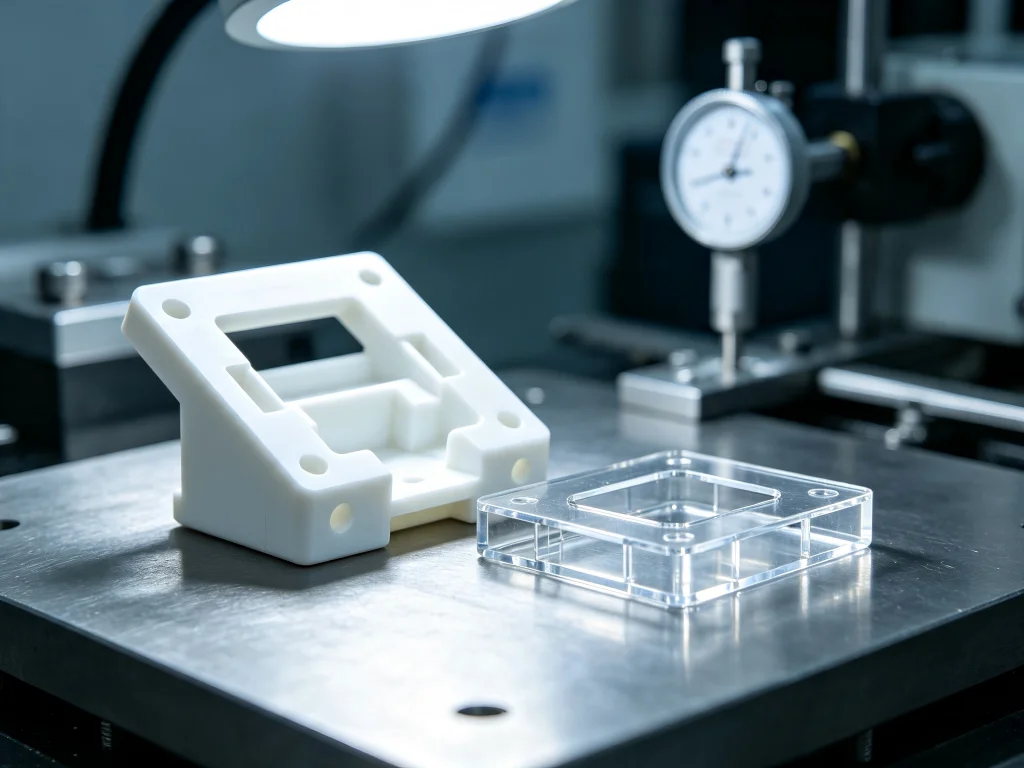
What Are CNC Plastic Parts and How Do They Work?
CNC plastic parts are components manufactured through computer-controlled machining processes that remove material from solid plastic stock—such as rods, sheets, or blocks—to create precise finished products. The process begins with a CAD model, which is translated into toolpaths through CAM software. These digital instructions guide cutting tools with remarkable precision, shaping engineering plastics into functional components that meet exacting specifications.
The fundamental distinction between plastic and metal machining lies in material behavior. Plastics exhibit lower thermal conductivity, higher coefficients of thermal expansion, and viscoelastic properties that demand specialized approaches. Unlike metals that dissipate heat efficiently, plastics retain thermal energy, creating risks of melting, warping, or stress-induced distortion if not managed properly.
Modern CNC machining centers employ 3, 4, and 5-axis milling capabilities alongside turning and grinding operations. Multi-axis machines enable the production of increasingly complex geometries—undercuts, angled features, and intricate internal cavities—that would be impossible with conventional 3-axis equipment. This flexibility makes CNC machining particularly valuable for prototyping, low-volume production, and components requiring tight tolerances.
Why Choose CNC Machining Over Injection Molding for Plastic Parts?
The decision between CNC machining and injection molding depends heavily on production volume, part complexity, and timeline requirements. CNC machining excels in several scenarios where injection molding falls short.
Low to medium volumes represent the sweet spot for machined plastic components. Injection molding requires a dedicated mold; CNC machining requires programming, cutting tools and workholding. Compare the complete quotation at the required quantity, including setup, stock waste and inspection. There is no universal volume at which one process becomes cheaper.
Design flexibility offers another compelling advantage. Design changes in CNC machining require only CAD and CAM updates—no expensive mold modifications. This agility proves invaluable during product development when designs evolve rapidly based on testing feedback.
Material selection presents a third consideration. CNC machining can process over 30 different engineering plastics, including materials that resist injection molding due to high melt temperatures or flow characteristics. This versatility allows engineers to select optimal materials for specific applications without manufacturing constraints limiting their choices.
Critical Material Selection for CNC Plastic Parts
Material selection fundamentally influences part performance, machinability, and cost. Different engineering plastics offer distinct property profiles suited to specific applications.
Engineering Plastics for CNC Machining
ABS (Acrylonitrile Butadiene Styrene) stands as one of the most commonly machined plastics, available in natural, black, and flame-retardant variants. It offers excellent impact resistance, good dimensional stability, and ease of machining. Applications include automotive interior components, electronic housings, and consumer product enclosures.
POM (Polyoxymethylene / Acetal / Delrin) delivers exceptional dimensional stability, low friction, and outstanding wear resistance. These properties make it ideal for gears, bearings, and moving mechanical components. POM machines cleanly with excellent surface finish, though it requires sharp tooling to prevent melting.
PEEK (Polyether Ether Ketone) represents the premium end of engineering plastics. This high-performance polymer withstands temperatures exceeding 250°C while maintaining mechanical properties. PEEK offers exceptional chemical resistance and strength-to-weight ratio, making it suitable for aerospace, medical, and oil and gas applications. However, its high material cost and challenging machinability demand experienced operators and specialized tooling.
Nylon (PA / Polyamide) provides excellent strength, wear resistance, and low friction. Available in natural, black, and 30% glass-filled variants, nylon suits gears, structural components, and bearing applications. However, nylon’s hygroscopic nature—absorbing moisture from the air—creates dimensional stability challenges that require careful material conditioning and climate-controlled inspection.
PMMA (Acrylic) offers exceptional optical clarity with up to 92% light transmission. This transparent thermoplastic serves as a lightweight, shatter-resistant alternative to glass. Applications include lenses, light guides, display screens, and automotive lighting components. PMMA requires specialized diamond tooling and polishing techniques to achieve optical clarity.
PC (Polycarbonate) delivers outstanding impact resistance and dimensional stability. Available in clear and black variants, polycarbonate suits applications requiring transparency combined with toughness—safety shields, machine guards, and transparent enclosures.
PTFE (Teflon) offers exceptional chemical resistance and the lowest coefficient of friction among engineering plastics. While challenging to machine due to its soft, gummy nature, PTFE proves invaluable for seals, gaskets, and non-stick components in chemical processing equipment.
Material Selection Decision Framework
Choosing the optimal material requires balancing multiple factors. Consider these questions when selecting materials for custom CNC plastic parts:
- What loads will the part experience? Structural applications demand materials like glass-filled nylon or PEEK, while non-load-bearing components might use ABS or acrylic.
- What temperatures will the part encounter? High-temperature environments require PEEK, PEI, or PPS rather than ABS or acrylic.
- What chemical exposure exists? PTFE, PEEK, and polypropylene resist aggressive chemicals better than ABS or nylon.
- What tolerances must the part maintain? POM, PEEK, and acrylic achieve the tightest tolerances, while nylon’s moisture absorption complicates dimensional control.
- What surface finish is required? PC, acrylic, and PEEK deliver the best surface finishes.
- What is the production volume? Higher volumes may justify more expensive materials if they reduce downstream costs.
Design for Manufacturability: Creating Machinable Plastic Parts
Design decisions directly impact machining cost, quality, and lead time. Understanding DFM principles for CNC machining plastic parts helps engineers create designs that balance functionality with manufacturability.
Wall Thickness Considerations
Minimum wall thickness for machined plastic parts typically ranges from 1.2mm to 1.5mm. Thinner walls risk warping during machining due to heat generation and reduced rigidity. For parts requiring very thin walls, consider material selection carefully—some plastics maintain rigidity better than others at minimal thicknesses.
Excessively thick walls also present challenges. Thick sections create uneven cooling and stress concentrations that can lead to warping or internal voids. Maintain consistent wall thickness throughout the design to promote dimensional stability.
Corner Radii and Tool Access
CNC cutting tools have cylindrical shapes with flat or spherical ends, creating inherent limitations on internal corner geometry. A rotating end mill leaves a radius in an internal pocket corner. For ordinary nonconductive plastics such as unfilled ABS, POM and PTFE, conventional electrical discharge machining (EDM) is not an appropriate solution: the process requires an electrically conductive workpiece. Add an internal radius or a relief feature where the fit permits, and agree on the radius with the machinist based on tool diameter and reach. Where a sharp feature is essential, review a suitable mechanical secondary operation or a split-part design.
Tool access also constrains deep cavities and narrow features. Deep pockets require long tool extensions that reduce rigidity and increase vibration. Consider splitting the part or changing the access direction. A tool still needs a collision-free cutting path; multiple axes do not make a fully enclosed cavity accessible. Confirm the process for each feature before release.
Process reference: Makino explains EDM and its electrically conductive workpiece requirement.
Hole and Thread Design
Hole depth-to-diameter ratios affect machining cost and quality. Ratios exceeding 4:1 require specialized tooling and extended cycle times. Threads in plastic parts should consider material properties—fine threads in soft plastics may strip under load, while coarse threads provide better engagement in engineering plastics.
Draft Angles and Undercuts
Unlike injection molding, CNC machining does not require draft angles for part ejection. Vertical walls machine efficiently without taper. However, undercuts require specialized tooling or multiple setups, increasing cost. Where possible, design features accessible from the primary machining direction.
Machining Strategies for Different Plastic Types
Different plastics demand different machining approaches. Understanding these distinctions helps achieve optimal results while minimizing scrap and rework.
Machining Nylon: Managing Moisture and Heat
Nylon presents four critical challenges that require specialized strategies:
Moisture absorption represents the single biggest threat to precision in machined nylon parts. A part machined to precise tolerance in a dry environment may grow out of tolerance by several thousandths of an inch when exposed to normal humidity. Professional shops condition nylon stock before machining by storing it in climate-controlled environments or performing mild annealing to achieve equilibrium moisture content.
Heat generation from cutting tools poses a dual risk—the part can soften and melt, or it can distort and warp as internal stress releases. High-speed cutting with light, fast passes removes material quickly and prevents heat buildup. Compressed air cooling evacuates chips rapidly while preventing hot chips from re-melting onto the part surface.
Clamping stress must be controlled carefully. Over-tightening clamps induces stress that releases during machining, causing significant warpage and tolerance failure. Light but secure clamping prevents deformation while maintaining part stability.
Glass-filled variants (PA+GF30) offer superior mechanical strength but create tool wear challenges. Glass fibers rapidly dull standard tooling, requiring diamond-coated or polycrystalline diamond (PCD) tools for economical production.
Machining Acrylic (PMMA): Achieving Optical Clarity
Acrylic machining requires mastering surface finish to achieve optical clarity. Jucheng employs diamond tooling and optimized cutting paths to minimize tool marks, followed by specialized polishing to restore 92% light transmission.
Key considerations for acrylic machining include:
- Stress cracking prevention: Avoid alcohol or solvent-based cutting fluids that cause immediate crazing
- Tool selection: Diamond-polished tools produce transparent chips and semi-clear surfaces directly off the machine
- Clamping: Vacuum tables or double-sided tape distribute pressure evenly, preventing cracking
- Post-processing: Progressive sanding (up to 2000 grit) followed by buffing or vapor polishing restores final clarity
General Machining Guidelines
Several principles apply across all plastic machining operations:
Tool sharpness proves critical for successful plastic machining. Tools must feature extremely sharp cutting edges with polished flutes and high rake angles to slice material cleanly rather than pushing it. Dull tools generate friction, increasing heat and creating poor surface finish.
Chip evacuation requires careful attention. Plastics like nylon produce long, stringy chips that can wrap around tools and fixtures. Compressed air or specialized chip breakers prevent chip entanglement while maintaining cutting zone visibility.
Cutting parameters differ significantly from metal machining. Recommended surface speeds for plastics range between 100 and 400 m/min, lower than aluminum but higher than steel. Feed rates and depths of cut must balance material removal with heat management.
Industries and Applications for CNC Plastic Parts
CNC machine plastic parts serve diverse industries where precision, performance, and reliability matter.
Automotive Industry
The automotive sector relies heavily on machined plastic components for prototyping and production. Jucheng produces engine and powertrain components, lighting systems, suspension and steering parts, braking system components, HVAC systems, and safety systems. Functional prototypes enable rigorous testing before production tooling investment.
Automotive applications demand materials that withstand temperature extremes, chemical exposure, and mechanical stress. PEEK, nylon, and polycarbonate appear frequently in under-hood applications, while acrylic and polycarbonate serve lighting applications requiring optical clarity.
Medical Device Manufacturing
Medical device prototyping demands exceptional precision and material compatibility. Jucheng produces components for handheld devices, dental instruments, surgical robots, prosthetic components, and implantable devices.
Medical applications require materials that meet biocompatibility standards and withstand sterilization processes. PEEK, titanium, and medical-grade stainless steel serve implantable applications, while ABS and polycarbonate appear in device housings. Jucheng’s ISO 13485 certification demonstrates commitment to medical quality standards.
Robotics and Automation
Robotics applications demand lightweight, high-strength components with tight tolerances. Jucheng produces operational prototypes for precision robotic components using 3 and 5-axis micro-milling, turning, and industrial 3D printing.
Plastic parts in automation equipment must fit precisely with guideways, bearings, and motors. Hole diameters, spacing, and clearance require tight control to prevent friction, noise, or assembly issues.
Aerospace and Defense
Aerospace applications demand materials that combine light weight with exceptional strength and temperature resistance. PEEK, PEI, and PPS appear frequently in aircraft interiors, structural components, and engine-adjacent applications. Stringent quality requirements demand ISO 9001 and AS9100 compliance.
Quality Control and Inspection Standards
Quality control for custom CNC plastic parts encompasses multiple inspection stages from material verification through final part measurement.
Material Inspection
Quality control begins with material verification. Certificate of Analysis (COA) verification from suppliers confirms material composition and properties. Spectroscopic analysis provides additional confirmation for critical applications. Visual inspection identifies surface defects—cracks, bubbles, or discoloration—that could affect machining outcomes.
In-Process Inspection
During machining, operators monitor critical dimensions and surface quality. Coordinate Measuring Machines (CMM) verify dimensional accuracy against CAD models. Surface profilometers measure finish quality, ensuring Ra values meet specifications.
Final Inspection
Completed parts undergo comprehensive inspection using precision metrology tools. Dimensional verification confirms all features meet tolerance requirements. Surface finish inspection ensures aesthetic and functional requirements are satisfied. For critical applications, parts may undergo additional testing—pressure testing, electrical testing, or functional verification.
For plastics sensitive to environmental conditions, inspection conditions matter significantly. Nylon parts, for example, must be inspected in climate-controlled environments to ensure accurate measurement. Parts measured immediately after machining may shrink out of tolerance upon cooling—always stabilize parts at 68°F (20°C) before final inspection.
Cost Optimization Strategies for CNC Plastic Parts
Understanding cost drivers helps optimize CNC plastic parts production without compromising quality.
Material Cost Considerations
Material selection significantly impacts overall cost. Engineering plastics like PEEK, PPS, and PTFE carry high stock costs and may require careful, slower handling. Conversely, POM (Acetal) and PVC machine easily and economically. Select materials that meet performance requirements without over-specifying—avoid choosing “over-performance” materials that add cost without functional benefit.
Design Optimization for Cost Reduction
Design decisions directly affect machining time and cost. Several strategies reduce production expenses:
- Simplify part geometry: Minimize sharp internal corners, deep pockets, and intricate features that increase machining time
- Use rounded internal corners: Specify a machinable radius or functional corner relief; conventional EDM is unsuitable for ordinary nonconductive plastics
- Avoid deep internal cavities: Deep features require extended tooling and multiple passes
- Maintain adequate wall thickness: Thin walls slow machining speeds and increase warpage risk
- Engrave rather than emboss text: Engraving removes less material and reduces cycle time
Batch Production Economics
Batch machining reduces unit costs through economies of scale. Setup time amortizes across multiple parts, and optimized toolpaths improve efficiency. For low-volume production, consider combining parts on a single fixture to reduce setup time.
Surface Finish and Tolerance Optimization
Specifying unnecessarily tight tolerances or fine surface finishes adds significant cost. Standard CNC machining delivers surface finishes around Ra 1.6μm on flat surfaces. Achieving smoother finishes requires additional polishing, bead blasting, or coating operations that add time and expense.
Comparison of Plastic Machining vs. Other Manufacturing Methods
| Factor | CNC Machining | Injection Molding | 3D Printing |
|---|---|---|---|
| Tooling Cost | No dedicated mold; programming, tools, fixtures and setup still apply | Dedicated mold investment; quote depends on design and tool requirements | No dedicated mold; preparation, supports and post-processing may apply |
| Per-Unit Cost | Medium (volume-dependent) | Low (at high volumes) | High (per-part) |
| Lead Time | Days to weeks | Weeks to months | Hours to days |
| Material Options | 30+ engineering plastics | Limited by flow properties | Limited to printable materials |
| Design Changes | Easy (CAD/CAM update) | Difficult (mold modification) | Easy (CAD update) |
| Production Volume | 1-10,000+ units | 10,000+ units | 1-100 units |
| Surface Finish | Excellent (Ra 0.8-3.2μm) | Excellent (mold-dependent) | Fair to good (layer lines) |
| Tolerances | ±0.01mm achievable | ±0.05mm typical | ±0.1-0.3mm typical |
| Material Properties | Full engineering properties | Full engineering properties | Often reduced |
Common Questions About CNC Plastic Parts
What tolerances can CNC plastic parts achieve?
CNC machining can achieve tolerances down to ±0.01mm for plastic components. However, achievable tolerances depend on material selection, part geometry, and environmental conditions. POM, PEEK, and acrylic achieve the tightest tolerances, while nylon’s moisture absorption complicates dimensional control. For most applications, ±0.05mm represents a practical, cost-effective tolerance specification.
How does CNC plastic machining compare to metal machining?
Plastic machining differs fundamentally from metal machining in several ways. Plastics exhibit lower thermal conductivity, requiring careful heat management to prevent melting or warping. Cutting speeds for plastics typically range between 100-400 m/min, lower than aluminum but higher than steel. Tool geometry differs—plastic machining requires sharper cutting edges with higher rake angles to slice rather than push material. Chip formation also differs, with plastics often producing stringy chips requiring active evacuation.
What surface finishes are achievable on machined plastic parts?
Standard CNC machining delivers surface finishes around Ra 1.6μm on flat surfaces. With additional finishing operations, surfaces can achieve Ra 0.8μm or better. Polishing can create high-gloss, reflective, or mirror-like surfaces. Surface finish depends on material selection—PC, acrylic, and PEEK deliver the best as-machined finishes.
Can CNC machining produce transparent plastic parts?
Yes, CNC machining produces transparent components from materials like acrylic (PMMA) and polycarbonate. Achieving optical clarity requires specialized approaches—diamond tooling, optimized cutting paths, and post-processing techniques like vapor polishing or hand buffing. Jucheng’s post-processing capabilities restore up to 92% light transmission in machined acrylic components.
What materials work best for CNC plastic machining?
Several engineering plastics machine exceptionally well. POM (Acetal) offers excellent dimensional stability and surface finish. ABS provides good machinability with balanced mechanical properties. PEEK machines well with appropriate tooling but carries higher material cost. Acrylic machines cleanly with sharp tooling but requires careful heat management. Nylon machines successfully with proper moisture conditioning and heat control.
How does production volume affect the choice between CNC machining and injection molding?
CNC machining avoids a dedicated injection mold, which can help when quantities are small or designs are changing. Setup, fixtures, cutting tools, stock and inspection remain part of its cost. Injection molding can reduce unit cost as mold investment is spread over more parts. Request quotations at the actual quantities and compare total delivered cost; the crossover depends on geometry, material, tolerances and design stability.
What quality certifications should a CNC plastic parts manufacturer hold?
Reputable manufacturers hold certifications demonstrating quality commitment. IATF 16949 certification indicates automotive quality standards compliance. ISO 13485 certification demonstrates medical device manufacturing capability. ISO 9001 certification provides general quality management system verification. For aerospace applications, AS9100 certification may be required. Jucheng holds IATF 16949 and ISO 13485 certifications.
How long does it take to produce custom CNC plastic parts?
Lead times vary based on part complexity, quantity, and material availability. Simple parts in standard materials may ship within days. Complex parts requiring specialized materials or extensive finishing may require several weeks. Jucheng offers global delivery within days for many projects, with expedited options available for urgent requirements.
Why Choose Jucheng for Your CNC Plastic Parts
Jucheng Precision Technology stands as a trusted partner for CNC machining China operations, combining extensive capabilities with rigorous quality standards.
Manufacturing infrastructure supports projects of any scale. With 150+ CNC machines including 25+ 5-axis centers, 30+ sheet metal fabrication units, 50+ industrial 3D printing systems, and 35+ injection presses, Jucheng handles everything from single prototypes to production runs.
Technical expertise ensures successful outcomes. A team of 190+ skilled professionals includes 30+ senior engineers with 13+ years of experience. This depth of knowledge enables effective design for manufacturability consultation, material selection guidance, and problem-solving throughout the production process.
Material capabilities span over 30 engineering plastics. From commodity plastics like ABS and polypropylene to high-performance polymers like PEEK and PEI, Jucheng stocks materials for diverse applications. Post-processing capabilities include polishing, painting, anodizing, plating, and other finishing operations.
Quality certifications demonstrate commitment to excellence. IATF 16949 and ISO 13485 certifications confirm adherence to automotive and medical quality standards. Rigorous inspection processes ensure every part meets specifications.
Global delivery capability serves customers worldwide. With efficient logistics and responsive communication, Jucheng delivers precision components wherever they’re needed.
Whether you require functional prototypes for design validation, low-volume production for market testing, or full-scale manufacturing, Jucheng provides the capabilities and expertise to bring your plastic components to life.
Contact Jucheng Precision today to discuss your CNC plastic parts requirements and discover how their manufacturing excellence can support your next project.