
Start With the Costed Process, Not a Discount Target
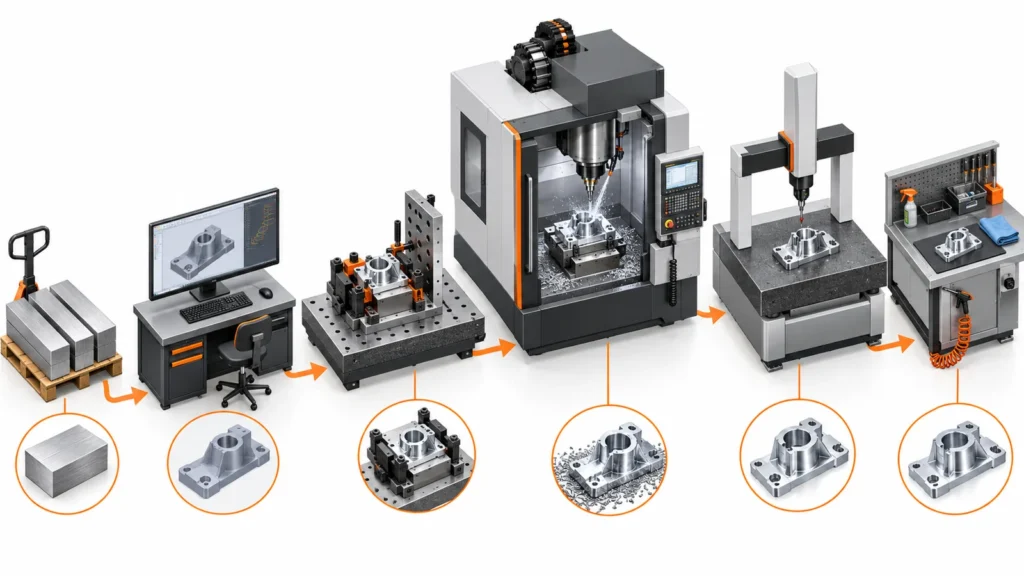 A CNC quote is the price of a proposed manufacturing route. It reflects stock selection, programming, workholding, setup, cutting, tool changes, inspection, finishing, handling, documentation, and risk. Before changing the CAD model, ask which operation or requirement controls the estimate.
The parent guide to Kosten der CNC-Bearbeitung explains how these categories build a quote. A cost-reduction review goes one step further: it links each expensive requirement to a controlled alternative and checks whether the alternative still supports the part’s function.
A CNC quote is the price of a proposed manufacturing route. It reflects stock selection, programming, workholding, setup, cutting, tool changes, inspection, finishing, handling, documentation, and risk. Before changing the CAD model, ask which operation or requirement controls the estimate.
The parent guide to Kosten der CNC-Bearbeitung explains how these categories build a quote. A cost-reduction review goes one step further: it links each expensive requirement to a controlled alternative and checks whether the alternative still supports the part’s function.
| Quote signal | Likely process burden | First engineering question |
|---|---|---|
| High setup or fixture charge | Multiple orientations, unstable clamping, or custom workholding | Can features share a datum and be reached from fewer directions? |
| Long cycle time | Large stock removal, small tools, deep features, or fine finishing passes | Which feature consumes the most spindle time? |
| Expensive inspection | Broad tight tolerances, difficult datums, or full reporting | Which characteristics actually control function or compliance? |
| High scrap allowance | Distortion, fragile geometry, uncertain requirements, or late-stage processing risk | Can the process be stabilized before the final critical operation? |
| Long lead time | Unusual stock, special tooling, outsourced finishing, or repeated clarification | Can the specification use available inputs without changing performance? |
This diagnosis prevents random redesign. Increasing every radius, changing material, or deleting drawing notes may create new problems while leaving the actual cost driver untouched.
The Cost-Reduction Ladder: Remove Setups Before Chasing Seconds
 Not all savings have equal leverage. A small feed-rate improvement may save seconds, while eliminating an entire setup can remove handling, probing, datum transfer, fixture preparation, and an inspection checkpoint. Review the process in descending order of structural impact.
This sequence also clarifies whether a higher hourly machine rate is truly more expensive. A multi-axis route may cost more per machine hour but less per accepted part if it replaces fixtures and datum transfers. Cost should be compared at the completed-part level, not by hourly rate alone.
Geometry Edits That Give the Tool a Better Job
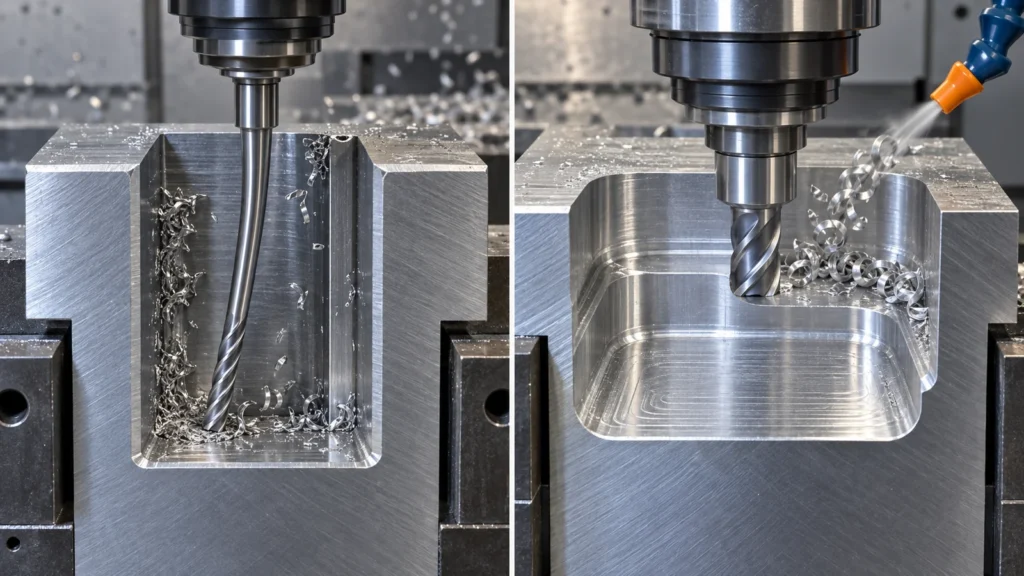 The highest-value geometry changes improve tool access and rigidity. They let the process use a larger cutter, a shorter tool, fewer passes, or a more secure clamp. The exact limit depends on material, feature size, depth, tolerance, and available equipment, so treat fixed ratios as discussion starters rather than universal rules.
Do not simplify geometry in isolation. A two-piece design may machine faster but add alignment, fasteners, sealing, assembly labor, and failure modes. The correct comparison is total delivered cost and functional risk.
Tolerance and Inspection: Spend Precision Where It Protects Function
 A tight tolerance can change the process route. It may require a finish pass, controlled clamping, temperature awareness, staged measurement, a different machine, or a larger scrap allowance. The cost increases again when the drawing does not provide a usable datum scheme or acceptance method.
Use the CNC machining tolerance guide to separate general dimensions from fit, seal, motion, alignment, and load-bearing characteristics. Then review each controlled feature through four questions:
A tight tolerance can change the process route. It may require a finish pass, controlled clamping, temperature awareness, staged measurement, a different machine, or a larger scrap allowance. The cost increases again when the drawing does not provide a usable datum scheme or acceptance method.
Use the CNC machining tolerance guide to separate general dimensions from fit, seal, motion, alignment, and load-bearing characteristics. Then review each controlled feature through four questions:
- What failure occurs if this feature reaches either limit?
- Does size alone control function, or is form, orientation, position, or surface condition more relevant?
- Can the supplier measure it repeatably from the stated datums?
- Must every part receive a full report, or can the inspection plan reflect risk and production stage?
Cost reduction does not mean deleting inspection. It means making acceptance evidence proportional to risk. A clear critical-characteristics list is usually more useful than applying the same tolerance and reporting burden to the entire drawing. JUCHENG’s quality control workflow can be referenced when defining dimensional reports, traceability, and inspection expectations.
Material, Stock, and Finish Can Cost More Than the CAD Suggests
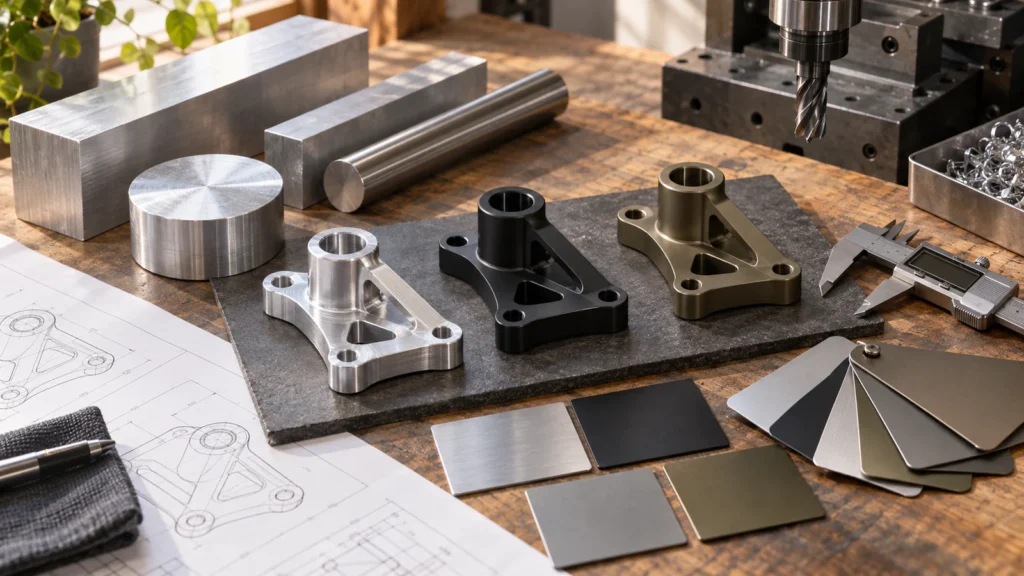 The model shows finished geometry, but the shop buys starting stock. Cost depends on grade, condition, stock size, minimum purchase quantity, certification, yield, and how much material becomes chips. A small finished part can still be expensive when it must be cut from an oversized or difficult-to-source blank.
Review the CNC-Materialbibliothek to compare viable material families, but do not substitute solely on purchase price. A cheaper alloy can increase tool wear, distortion, finishing difficulty, or rejection risk. Confirm strength, corrosion, temperature, wear, electrical, chemical, and compliance requirements before changing grade or condition.
The model shows finished geometry, but the shop buys starting stock. Cost depends on grade, condition, stock size, minimum purchase quantity, certification, yield, and how much material becomes chips. A small finished part can still be expensive when it must be cut from an oversized or difficult-to-source blank.
Review the CNC-Materialbibliothek to compare viable material families, but do not substitute solely on purchase price. A cheaper alloy can increase tool wear, distortion, finishing difficulty, or rejection risk. Confirm strength, corrosion, temperature, wear, electrical, chemical, and compliance requirements before changing grade or condition.
Surface requirements deserve the same discipline. A blanket fine-roughness callout can add finishing passes to faces that never seal, slide, locate, or appear to the user. Multiple cosmetic treatments, selective masking, polishing before coating, or a finish that changes critical dimensions can add handling and inspection. Define the purpose of each treatment, then use the site’s surface finishing options to discuss suitable routes.
Illustrative DFM Review: An Expensive Housing Without a “Bad” Feature
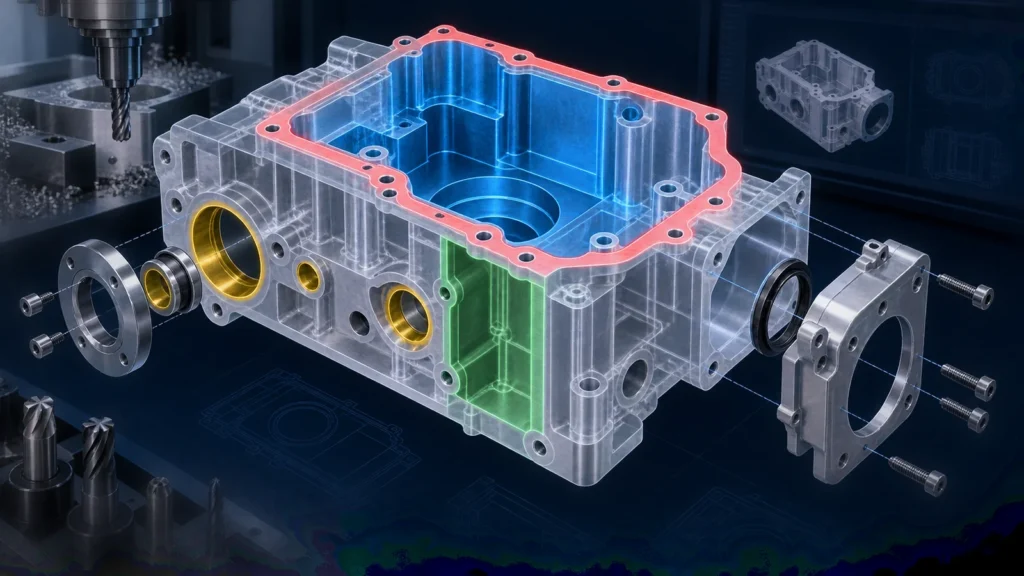 Consider an aluminum electronics housing that receives a higher-than-expected quote. No single feature is impossible. The cost comes from the interaction of several ordinary decisions: a deep pocket with small internal radii, cosmetic treatment on all faces, tightly controlled non-mating dimensions, side holes in multiple orientations, and a full dimensional report.
A disciplined review would not begin by changing the alloy or removing quality checks. It would trace the route:
Consider an aluminum electronics housing that receives a higher-than-expected quote. No single feature is impossible. The cost comes from the interaction of several ordinary decisions: a deep pocket with small internal radii, cosmetic treatment on all faces, tightly controlled non-mating dimensions, side holes in multiple orientations, and a full dimensional report.
A disciplined review would not begin by changing the alloy or removing quality checks. It would trace the route:
The redesign might enlarge nonfunctional corner radii, relocate selected holes to a common orientation, identify only the connector and sealing interfaces as critical, and limit cosmetic requirements to visible surfaces. The housing still performs the same job, but the manufacturing route becomes easier to fixture, cut, finish, and verify.
This example is illustrative rather than a claimed customer result. Actual savings cannot be predicted from geometry alone; they depend on material, size, quantity, equipment, inspection scope, supplier process, and the accepted design changes.
Do Not “Save” Cost by Removing the Evidence or Function You Need
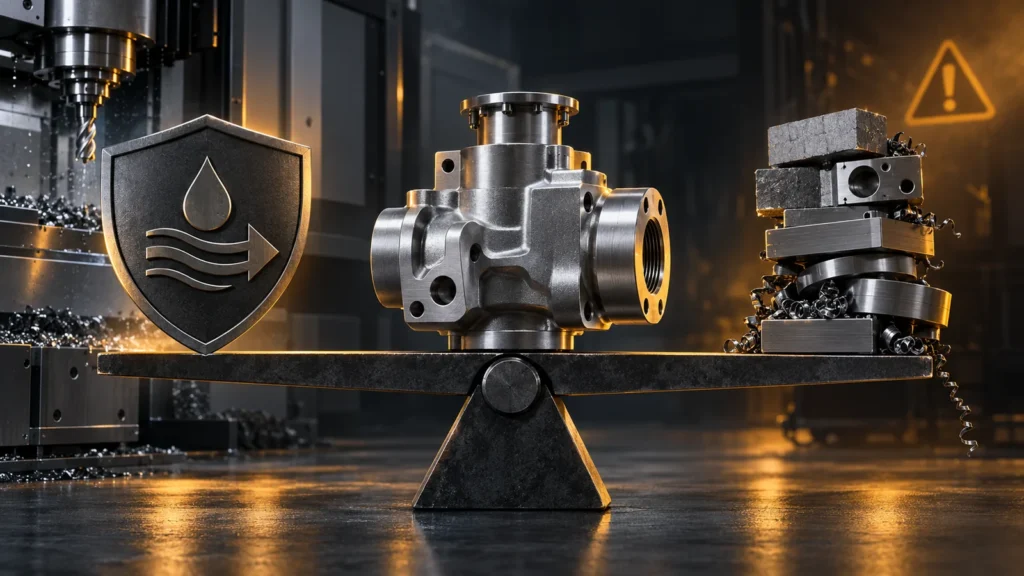 Some quote reductions are false economies. They lower the initial price while increasing assembly problems, field failures, rework, or supplier disputes. Preserve requirements that control safety, fit, sealing, fatigue, sterilization, traceability, regulatory compliance, or validated appearance.
A Quote-Ready Package Makes Cost Drivers Visible
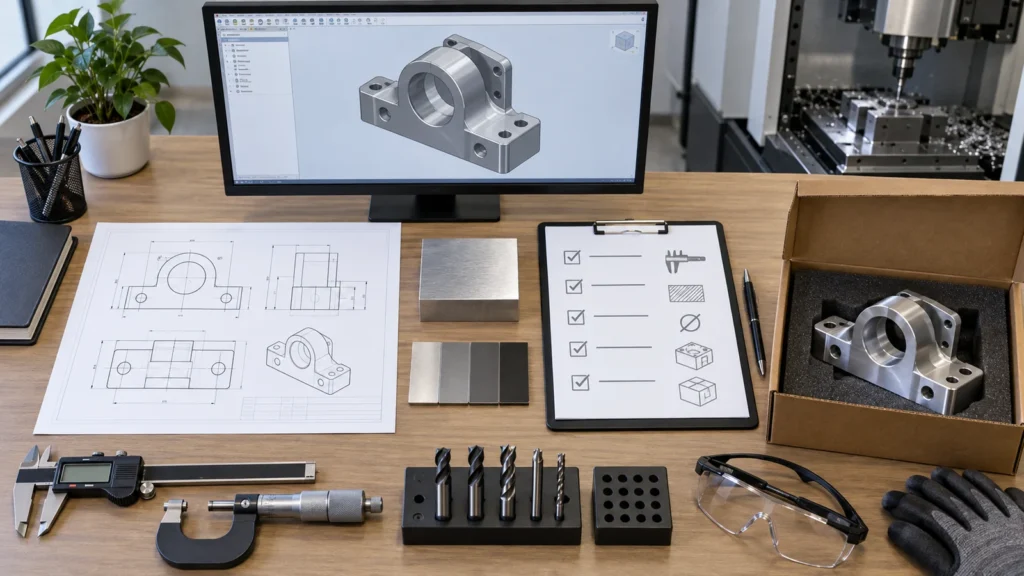 Incomplete RFQs create uncertainty, and uncertainty is often priced as risk. A useful package lets the supplier distinguish fixed requirements from negotiable preferences and propose alternatives without guessing.
Ask suppliers to identify the top two or three cost drivers and price meaningful alternatives separately. A controlled option—such as a revised radius, a different stock condition, or a reduced reporting scope—creates a decision you can review. A blanket discount request does not explain what changed.
CNC Machining Cost Reduction FAQs

What usually produces the largest CNC cost reduction?
Removing a setup, shortening tool reach, reducing heavy stock removal, or limiting demanding tolerances to functional features often has more leverage than small cycle-time adjustments. The largest opportunity varies by part, so the supplier should identify the operation or requirement driving the quote.
Does using a three-axis machine always cost less?
No. A three-axis machine may have a lower hourly rate, but multiple setups and fixtures can increase total cost and datum-transfer risk. A multi-axis route can be more economical when it completes more features in one controlled setup.
Should I loosen every tolerance to reduce price?
No. Loosen only requirements that do not protect function, assembly, safety, or compliance. Keep critical features clearly controlled and measurable. A functional tolerance strategy is safer than applying either extremely tight or extremely loose limits across the entire drawing.
Can ordering more parts lower the unit cost?
Often, because programming, setup, fixturing, and first-part work can be distributed across more units. However, material, cycle time, finishing, inspection, inventory, and revision risk remain. Compare realistic quantity breaks rather than ordering excess parts solely for a lower unit price.
What information should I send for a cost-reduction review?
Send the current CAD model and drawing, quantities, material and finish, critical interfaces, inspection requirements, delivery needs, and a note identifying what can or cannot change. That context helps engineering teams reduce process burden without weakening the part’s intended function.