
Why can the same CNC part receive very different quotes? The answer is usually not a mysterious markup difference. Each supplier is pricing a manufacturing route: material and stock form, programming, setups, workholding, cutting time, tooling, finishing, inspection, documentation, packaging, and the technical risk created by the drawing. Understanding those drivers helps engineers reduce avoidable cost and helps buyers compare quotations on the same scope.
A CNC Quote Is a Manufacturing Plan

Two quotes can therefore both be technically reasonable while covering different scopes. One may include material certificates, full dimensional reporting, finishing, protective packaging, and a conservative process route. Another may price machining only and leave those items open. The first question when a quote looks high is not “Can you discount it?” but “Which requirement or assumption is driving the route?”
For background on how CAD requirements become setups, toolpaths, finishing, and inspection, see the site’s CNC machining process guide.
The Cost Drivers Behind a Machined Part

| Cost category | What creates the cost | Buyer question |
|---|---|---|
| Engineering and setup | DFM review, programming, workholding, tool setup, datum alignment, and first-part prove-out | Which non-recurring costs are included or amortized? |
| Material and yield | Grade, temper, stock size, cutting allowance, waste, and certification | Are all suppliers quoting the same material condition and stock assumption? |
| Machining time | Material removal, tool changes, workpiece rotations, tool reach, and finishing passes | What geometry or process step is consuming the most time? |
| Post-processing | Heat treatment, anodizing, plating, passivation, polishing, marking, and cleaning | Are outside processes specified and included on the same basis? |
| Quality and logistics | Inspection scope, reports, traceability, packaging, schedule, and delivery terms | Does the low quote omit evidence or delivery scope needed by the project? |
Geometry: Where Minutes Become Money
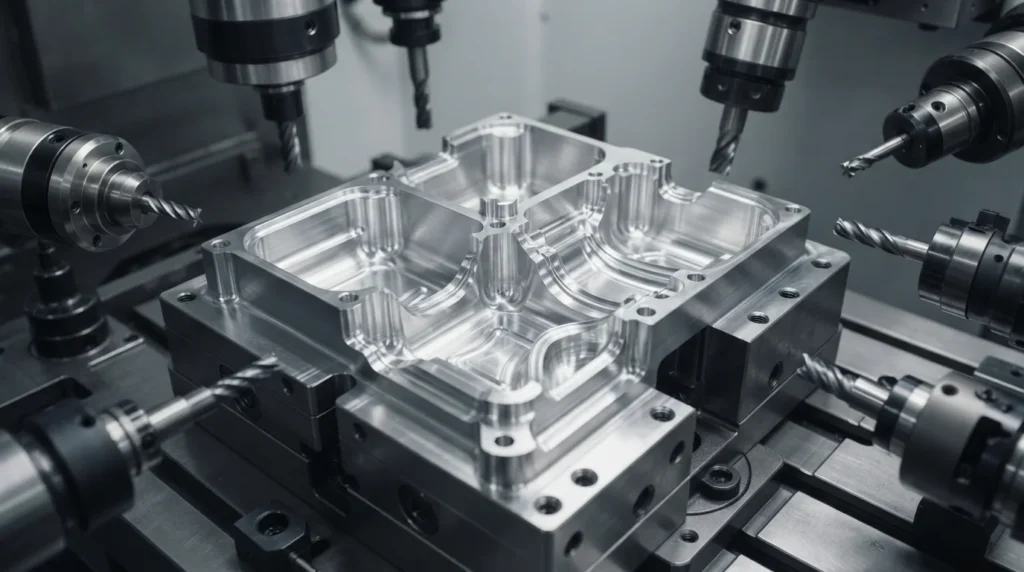
Features that often increase process time
- Deep pockets or narrow cavities that require long-reach tooling and slower cutting.
- Very small internal radii that require small tools and additional passes.
- Thin walls, tall ribs, or flexible sections that need support and conservative cutting.
- Complex three-dimensional surfaces that require more toolpath control and finishing.
- Features located on many faces, increasing repositioning, probing, and datum-transfer work.
- Large stock-to-part volume differences that increase roughing time and material waste.
A part does not become inexpensive simply because its finished volume is small. A small part with difficult access can take longer than a larger part with simple, open geometry. Ask the supplier to identify the feature or setup that is driving the estimate.
Material and Stock Form
Material affects both direct cost and process risk. The grade, temper, hardness, availability, stock form, and certification requirement can change tooling, cutting strategy, cycle time, finishing, and inspection.
Do not compare only the raw material name
“Aluminum,” “stainless steel,” or “plastic” is not always a complete commercial specification. Different grades and conditions can have different machinability, strength, surface behavior, and availability. A certified plate, a bar, a billet, or a customer-supplied blank may lead to different yield and documentation assumptions.
Use the CNC materials library as a starting point for material-family discussions, then put the exact grade, condition, and documentation requirement in the RFQ.
Tolerance, Finish, and Inspection Risk
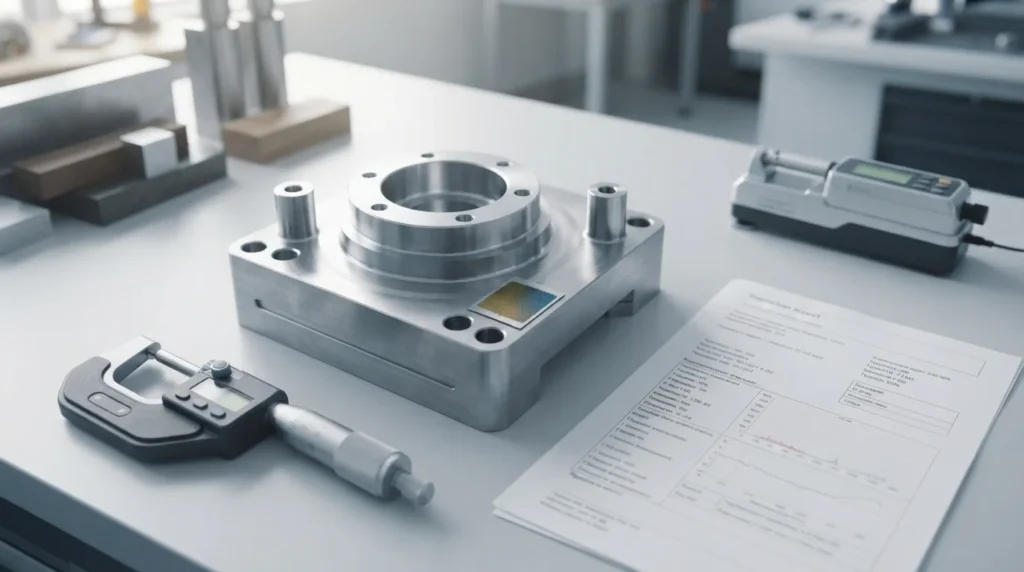
Pay for function, not habit
A useful cost review marks which features control fit, sealing, motion, alignment, load, or appearance. General features can often use a sensible general tolerance, while functional interfaces receive individual controls and an agreed inspection method. The site’s CNC tolerance guide explains how to make that distinction before tightening every dimension.
Inspection is part of the product scope
A quote for routine checks is not necessarily equivalent to one that includes a full dimensional report, material evidence, traceability, functional assembly, or special measurement conditions. State the inspection deliverables so suppliers are pricing the same acceptance burden.
Why Quantity Changes the Cost Model
Setup, programming, fixturing, inspection planning, and material preparation are often distributed across the quantity. A one-piece prototype carries those non-recurring tasks on a single part. A repeat run can spread them across a batch, while higher volume may justify a more efficient fixture, tool strategy, inspection sampling plan, or process route.
| Project stage | Main cost concern | Useful commercial question |
|---|---|---|
| Prototype or first article | Engineering time, setup, learning, and one-time risk | Which setup or tooling costs are non-recurring? |
| Small batch | Setup allocation and material yield per part | What is the unit price at the actual quantity break? |
| Repeat production | Process repeatability, replenishment, inspection sampling, and schedule | What remains fixed, and what changes with volume or revision? |
How to Compare CNC Quotes Fairly

- Confirm that the same drawing revision, CAD model, units, quantity, and delivery destination were quoted.
- Compare exact material grade, condition, stock form, certification, and traceability assumptions.
- Check whether tolerances, GD&T, surface roughness, finishing, deburring, cleaning, and packaging are included.
- Ask whether programming, setup, fixtures, tooling, first-article inspection, and reports are separate charges.
- Check the process route, lead-time basis, shipping terms, payment assumptions, and validity period.
- Ask what exclusions, substitutions, deviations, or engineering assumptions could change the final price.
The lowest unit price may simply represent a narrower scope. The best quote is the one whose price, quality evidence, schedule, and technical assumptions match the project’s real needs.
A DFM Route to Lower Cost
Cost reduction should begin with the drawing and function, not with an arbitrary request to cut the supplier’s margin. A focused DFM review can ask:
- Can non-critical tight tolerances be relaxed without changing fit or performance?
- Can internal radii, pocket depths, wall thicknesses, or tool access be made easier to machine?
- Can several features share a datum or setup without weakening the functional design?
- Can the material grade, stock size, or finish be selected for the actual environment and appearance?
- Can inspection focus on critical characteristics instead of measuring every feature with the same burden?
- Can the quantity, batch size, or release schedule distribute setup and fixture cost more effectively?
Cost and precision are not opposites. Clearer functional priorities often allow a supplier to protect the important features while simplifying the rest of the process.
What to Include in an RFQ
A complete RFQ reduces uncertainty and makes quotes comparable. Include the current 2D drawing and 3D model, revision, quantity, delivery requirement, material and condition, finish, critical tolerances, GD&T, threads, inspection documents, packaging, and any regulatory or traceability requirement.
Explain the function of unusual features, the assembly interfaces, and the dimensions that cannot be changed. When the package is ready, submit it through the CNC machining quote workflow and ask the supplier to state major assumptions in the response.
CNC Machining Cost FAQs
What is the biggest factor in CNC machining cost?
There is no universal single factor. Geometry, setup count, machining time, material, tolerance, finishing, inspection, quantity, and schedule risk interact. For many parts, the most useful question is which feature or requirement creates the longest or riskiest process step.
Why do two CNC suppliers quote different prices?
They may be assuming different material, setups, machines, tooling, finishing, inspection scope, lead time, packaging, or risk. A lower quote may exclude work that another supplier has included. Compare scope and assumptions before comparing totals.
Does quantity reduce CNC part price?
Often it can, because setup, programming, fixture, and first-part costs may be distributed across more parts. The actual effect depends on geometry, process stability, material yield, inspection plan, batch size, and whether the design changes between releases.
Do tight tolerances increase price?
They can increase finishing, process-control, measurement, and scrap risk. The best cost strategy is to apply tight controls only to features that need them and to define the datum and inspection method clearly.
How can I reduce CNC machining cost without reducing quality?
Use DFM to simplify tool access, internal radii, setups, stock, material, tolerances, finishing, and inspection while protecting function. Ask the supplier to identify the actual cost driver and propose a controlled alternative rather than removing requirements blindly.