
Cast and billet aluminum describe different stock histories, not a simple quality ranking. Cast stock begins as metal solidified in a mold; “billet” in CNC sourcing usually means a wrought plate, bar, or block that will be machined, although the term can also mean a cast billet upstream. Before comparing quotes, clarify what each supplier means by the term and whether the finished part will be machined from a cast blank or from wrought stock.
If the design is already qualified around a specific alloy, temper, and material specification, changing stock form can alter properties, internal soundness expectations, machining allowance, and verification needs. If the design is still open, choose by the part’s loads, geometry, volume, surface requirements, and evidence needed—not by assuming that one form is always stronger, cheaper, or more precise.
Clarify what cast and billet mean
Cast aluminum is produced by pouring or injecting molten alloy into a mold and allowing it to solidify. The casting process can create near-net shapes, but the resulting structure and potential discontinuities depend on alloy, mold, process controls, and location within the casting. A casting may then receive heat treatment and CNC machining. The fact that a feature is machined does not remove the need to specify the casting alloy, condition, inspection level, and any required acceptance criteria.
Wrought aluminum stock has been mechanically worked into forms such as plate, bar, or extrusion before machining. Buyers often call a machined-from-solid block a “billet part.” That shorthand does not identify the alloy, temper, product form, or specification. A 6061-T651 plate and a casting alloy are not interchangeable merely because both arrive as rectangular stock.
There is a terminology trap: metal producers may call a cast semi-finished ingot a billet before rolling or extrusion. In a CNC RFQ, use explicit wording such as “machine from certified wrought plate, alloy/temper…” or “machine cast blank to drawing, casting specification…” rather than relying on the single word “billet.” The site’s aluminum material section can help locate listed grades, but the drawing and purchase specification control the actual requirement.
Compare the part, not the labels
| Entscheidungsfaktor | Cast blank followed by machining | Wrought stock followed by machining |
|---|---|---|
| Starting geometry | Can be shaped closer to a complex near-net form, subject to foundry tooling and process | Starts from plate, bar, or extrusion; material is removed to create the part |
| Material definition | Specify casting alloy, process/condition, and applicable acceptance evidence | Specify alloy, temper, product form, and material certification requirements |
| Internal condition | Evaluate casting-specific risks and inspection requirements for critical zones | Evaluate the selected wrought product form, directionality, and stock condition |
| Machining plan | Plan datums, stock allowance, and machining sequence around the blank and its features | Plan workholding, material removal, and distortion control around the solid stock |
| Economic question | Tooling and casting economics depend on quantity, complexity, and supplier route | Material removal, cycle time, stock size, and scrap depend on part geometry and volume |
These are route-level differences, not guarantees. A cast blank may reduce machining from a large block, yet it adds foundry tooling, lead-time, and casting qualification considerations. Wrought stock may avoid casting-specific discontinuities, but a heavily pocketed part can remove substantial material and create stress-release or workholding challenges. Compare total delivered cost and risk for the actual design and expected quantity.
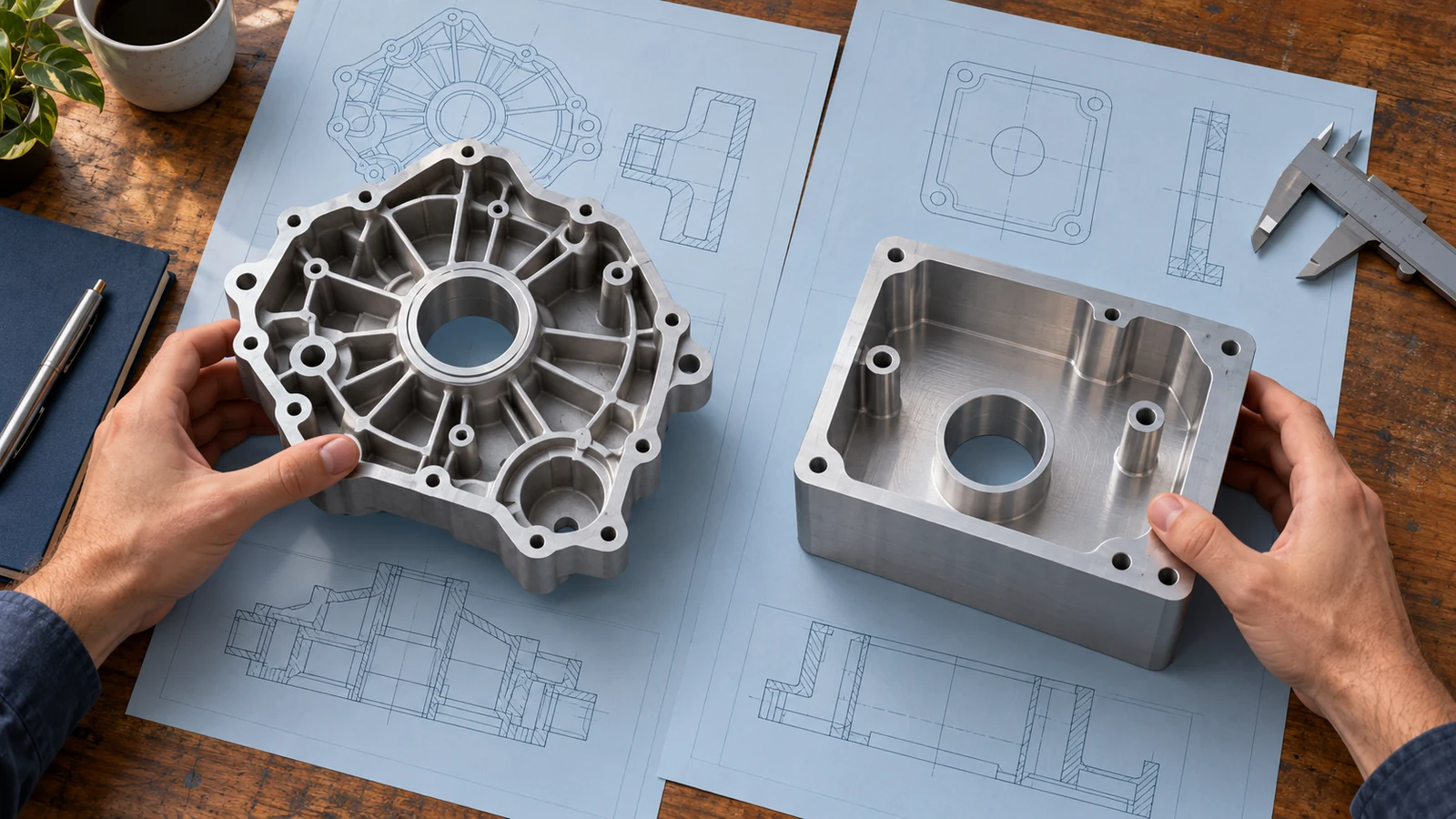
Functional load paths matter more than a generic “stronger” label. The relevant properties depend on alloy, temper, product form, orientation, heat treatment, and the way the part is loaded. For pressure, fatigue, sealing, or safety-critical uses, the design authority should define material and inspection requirements with the applicable engineering basis. Do not infer finished-part strength from a material name alone.
Choose a route around geometry and quantity
Cast blanks can suit shapes with deep external contours, bosses, ribs, or internal geometry that would be wasteful to carve from solid stock, provided the design tolerates casting constraints and the process is qualified. Wrought plate or bar is often a more direct choice for prismatic parts, prototypes, or designs whose material specification already requires a wrought product. Neither observation replaces a quote based on the drawing.
Ask how the part will be fixtured and machined. A cast blank may need locating surfaces or stock allowances that let the supplier establish reliable datums. A billet-machined part may require staged roughing, stress relief if specified, or a sequence that preserves stiffness until critical features are finished. For small quantities, avoiding dedicated casting tooling may matter; at larger quantities, a near-net blank may change the economics. The break-even point depends on geometry, supplier pricing, finish operations, and yield, so do not assume a universal quantity threshold. The low-volume production route is relevant when comparing early runs and repeat orders.
Review the consequences of a material change before approving it. A drawing that specifies a wrought alloy and temper cannot be silently fulfilled with a casting grade. If the design permits alternate forms, state the allowable specifications and required evidence, then have the responsible engineer assess whether the substitution preserves function.
Make the stock form explicit in the RFQ
Send the drawing revision, alloy and temper, product form, blank requirements, annual or order quantity, critical surfaces, machining allowance if controlled, and any inspection or traceability requirement. If a casting is involved, specify the blank source and applicable casting standard or acceptance documents only when they are defined by the design authority. If wrought stock is required, state whether plate, bar, or extrusion is acceptable and whether material direction matters.
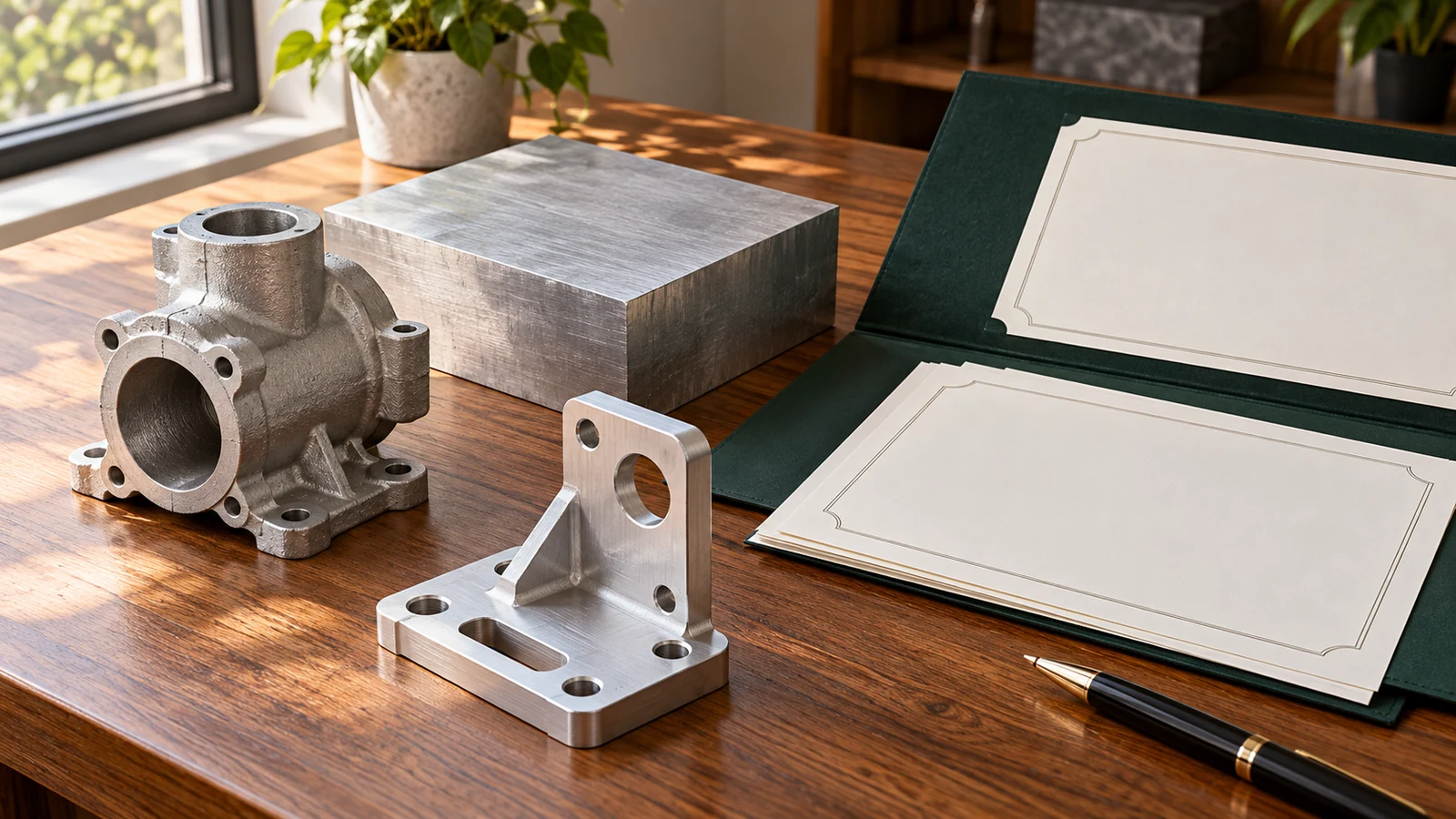
Ask suppliers to identify assumptions in the quote: starting form, material certificate scope, included machining operations, secondary processing, inspection level, and what happens if a blank defect appears in a critical region. This makes bids comparable without asking the supplier to invent engineering acceptance criteria.
For production planning, keep the stock form and revision traceable from the purchase order to the part record. A change from cast to wrought stock—or the reverse—is an engineering change, not merely a purchasing substitution.
Häufig gestellte Fragen
Is billet aluminum always stronger than cast aluminum?
No. Strength depends on alloy, temper, product form, orientation, processing, and service conditions. The correct comparison uses the specified material data and design basis, not the stock-form label alone.
Does machining remove porosity from a casting?
Machining removes material only from the surfaces and volumes cut. It cannot guarantee that internal discontinuities are absent from the remaining part. Critical applications need defined casting quality and inspection requirements.
Can a cast part be machined to the same dimensions as a billet part?
Both can be machined to drawing requirements if the blank, fixture, process, and inspection plan support them. Dimensional capability must be evaluated for the actual geometry and supplier route rather than assumed from stock form.