
CNC machining for food processing equipment should begin with two questions: will this component contact food, and how will the equipment be cleaned? Those answers influence material selection, accessible geometry, finish and the records needed at acceptance. Calling a part “food grade” or specifying 316 stainless steel does not define its cleanability or establish compliance of the finished machine.
Consider three hypothetical conveyor components: a support bracket beneath the product path, a shaft sleeve near a bearing and a removable guide beside the product. They may share a drawing package but face different exposure, cleaning and inspection tasks. Treating them as identical stainless parts can conceal the interface where residue or cleaning liquid is actually retained.
Describe contact and cleaning before choosing the grade
Identify direct product contact, possible splash or residue exposure, and areas separated from the product. Use the equipment’s applicable hygiene assessment to define those zones rather than assigning them from the part name. A bracket below a conveyor can still receive product residue or wash liquid even when it does not intentionally guide food.
Record the food or process medium, relevant temperature range, cleaning chemicals and their operating conditions, rinsing and drying practice, and whether cleaning requires dismantling. Include periods when the equipment remains wet or unused if they are part of the duty. Material compatibility concerns the combined conditions, not a cleaner’s name in isolation.
Festo’s food-safety guidance distinguishes exposure zones and links component design with cleaning. EHEDG also distinguishes the evaluated surfaces and cleaning arrangements in its equipment work. These sources support documenting the real exposure. They do not authorize a machining supplier to declare every component or assembly hygienically approved.
304 or 316 is a conditional comparison
Both 304 and 316 austenitic stainless steels are used in food-related equipment, but their suitability depends on the medium, cleaning and design. Molybdenum-containing 316 is commonly evaluated when the corrosion conditions make 304 less suitable. It is not immune to pitting, crevice attack or an unsuitable cleaning practice. Selection should consider the actual exposure and applicable equipment requirements.
Also identify whether the specification calls for a particular product form or low-carbon grade. Welding, fabrication and other downstream work can add requirements beyond machining. A supplier should not substitute a free-machining grade solely to reduce cutting time without approval of its corrosion and application implications.
| Question | Why the answer matters | Information to send |
|---|---|---|
| What touches the component? | Material suitability depends on actual exposure | Product, cleaning media and relevant operating conditions |
| Where can liquid remain? | Local retention can differ from general exposure | Assembly orientation, gaps and drainage route |
| Will the part be welded or further processed? | The completed condition may differ from the machined blank | Fabrication sequence and final acceptance stage |
| Which records are required? | Material identity and machine approval are different deliverables | Certificate, inspection and other specifically required documents |
The stainless steel material page provides an overview of the material family. For stainless steel food processing equipment parts, the released grade and condition should follow the equipment assessment rather than a blanket promise that one alloy is appropriate for every food or cleaning regime.
Review the bracket in its installed orientation
A bracket can be easy to machine and difficult to clean. A horizontal ledge, recessed fastener or close gap against a frame may collect residue that a smooth outside face does not reveal. Review the installed part, its mating surface and the approach of cleaning tools or spray together.
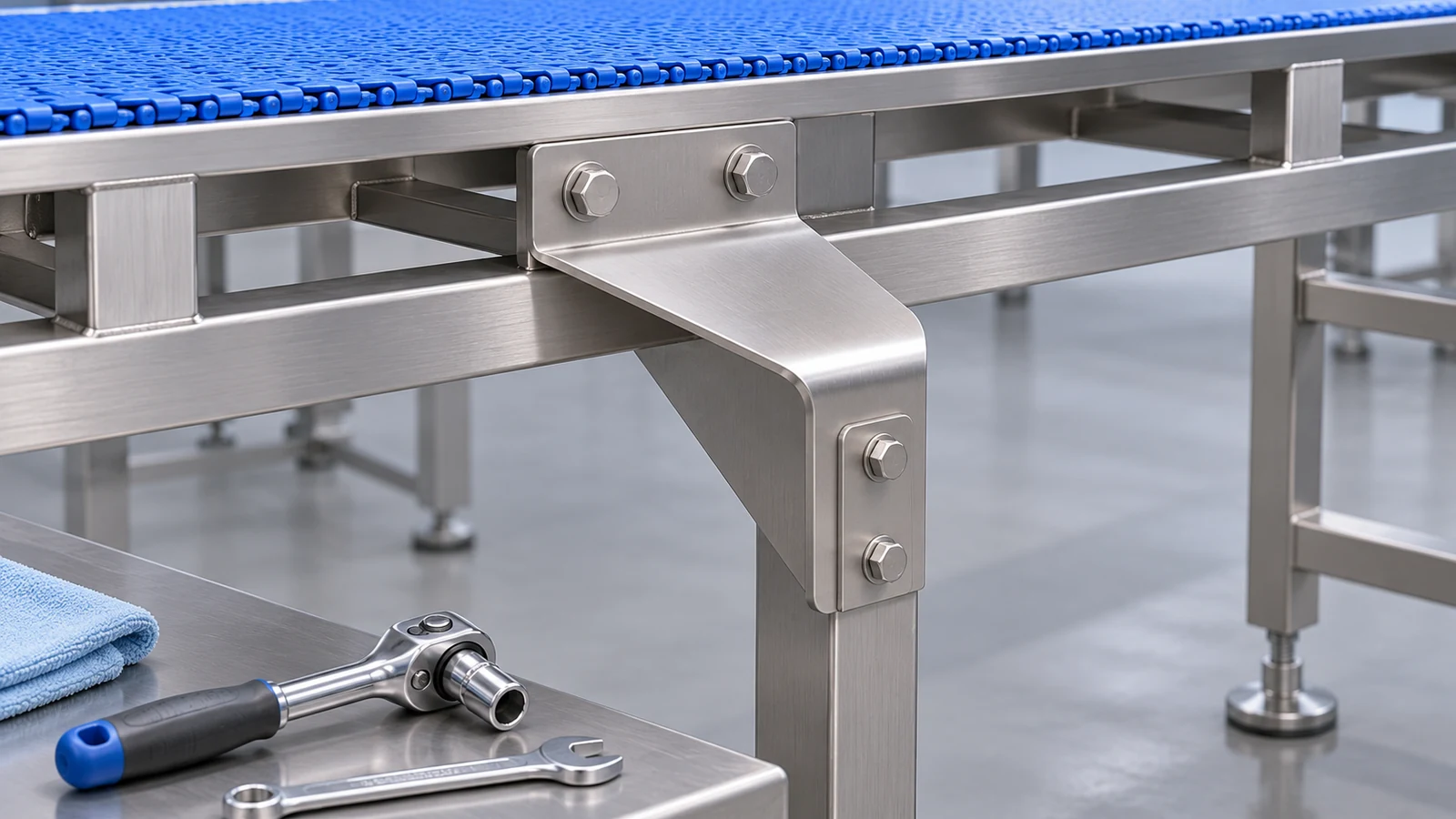 Ask whether the bracket can be reached without dismantling and whether the chosen cleaning method actually reaches the hidden interface. If it must be removed, show the disassembly access and how it will be reinstalled in the correct position. Reducing the number of inaccessible pockets may be more useful than polishing a surface that is already easy to reach.
For CNC machining for food processing equipment, specify permitted internal radii and avoid unnecessary sharp pocket corners. Tool access and cleanability can support the same design change, but a radius chosen for machining convenience still needs to satisfy the equipment’s functional and hygiene requirements.
A sleeve adds interfaces that its outside finish cannot fix
A turned sleeve introduces a bore, shoulders, mating shaft surfaces and possibly an interface against a seal or bearing. Identify which surfaces locate the part, which move relative to another component and which are exposed to product or wash liquid. A smooth outside diameter does not eliminate a narrow retention gap at an assembled shoulder.
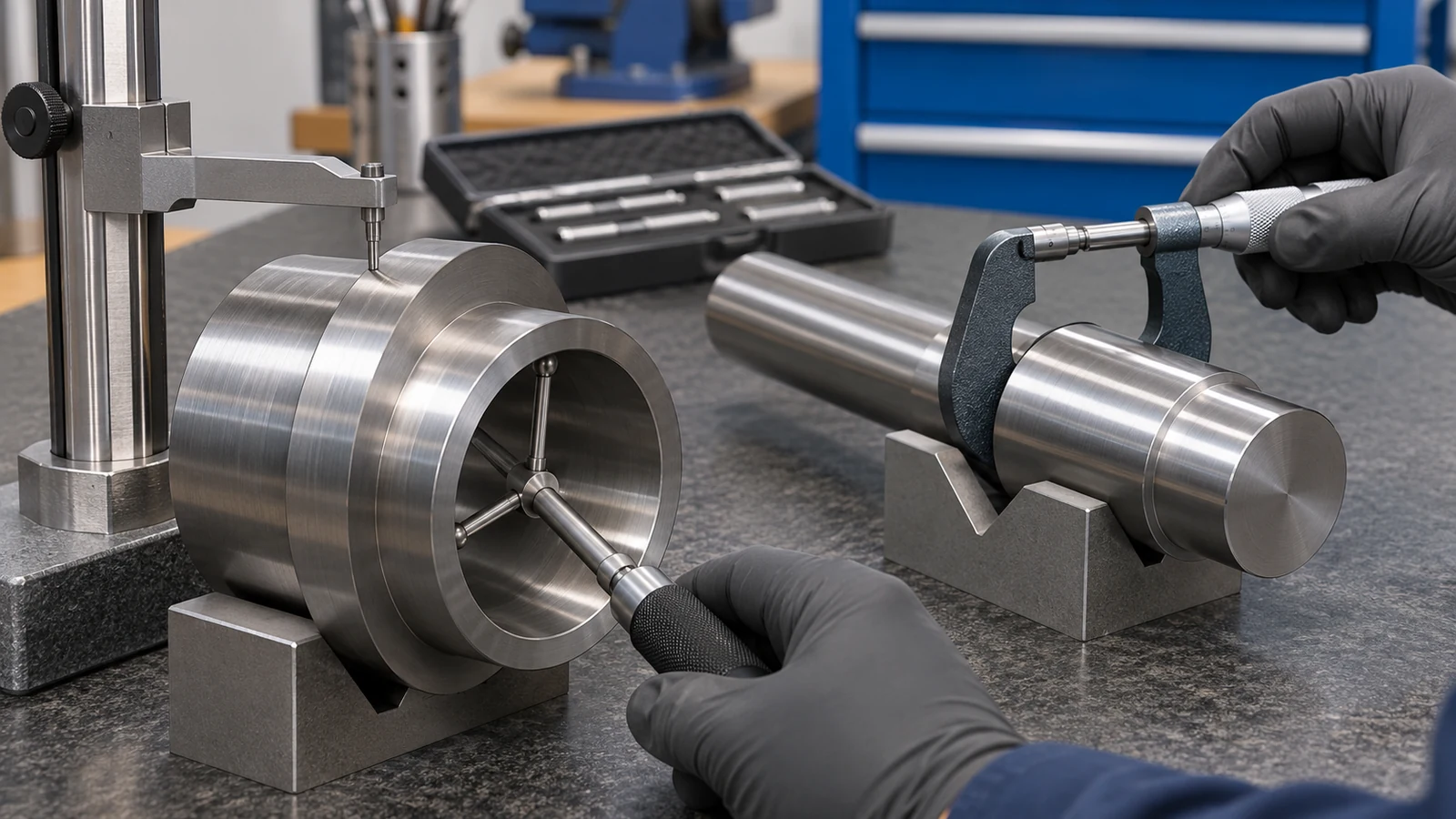 Define the fit and the method of retention with the assembly information available. If the sleeve is removable for cleaning, include the surfaces that must remain accessible and the criteria for damage after handling. If it is intended to remain assembled, the equipment designer must address the suitability of that joint and its cleaning arrangement.
The CNC turning route can establish rotational geometry, but the drawing should show datum relationships and any sealing or sliding requirements. Do not tighten every diameter to compensate for uncertainty about how the sleeve is used. That can increase restraint or complicate removal without resolving the actual contamination risk.
Specify surface condition where it controls the task
A surface-roughness value should identify the relevant surface and the condition in which it applies. Average roughness alone does not describe a deep scratch, isolated pit, burr, crevice or inaccessible joint. Define those conditions separately where they affect cleanability, product contact or assembly.
Avoid prescribing one roughness limit for every part and zone without an engineering basis. The required texture and acceptance method depend on the applicable design criteria and duty. A support surface away from food can have a different task from a product-contact guide, while both may need control of burrs and retained contamination.
If polishing, passivation, electropolishing or another treatment is required, identify the process and its place in the sequence. Material removal can affect fits and edges. Passivation is not a substitute for removing burrs or correcting a poor joint, and a bright finish is not evidence of validated cleaning.
Protect completed stainless surfaces from contamination during machining, handling and transport through the agreed process. Nickel Institute guidance discusses cleaning stainless surfaces before sanitary service; the buyer and supplier should define the required delivery condition instead of assuming any workshop cleaning method establishes readiness for food production.
A hypothetical redesign that improves the drawing
Suppose a conveyor guide is specified as “316, food grade, polish all over,” yet its mounting screws sit in a deep upward-facing recess. The quotation can include polishing without resolving the recess’s ability to retain material. The design review therefore begins with the installed orientation and cleaning method, not a request for an even finer general finish.
The team identifies which face contacts product, which gap closes against the support and whether removal is necessary for cleaning. It then reviews a more accessible mounting arrangement, a controlled transition at the contact edge and a specific finish on the relevant face. General surfaces retain requirements appropriate to their task.
The revised drawing also defines the material certificate, dimensional inspection and agreed final treatment. Any cleanability validation remains an equipment-level requirement with its owner identified. This example is illustrative. It shows how CNC machining for food processing equipment can support hygienic design without claiming that machining alone approves a machine for food service.
Replace “food grade” with a complete RFQ
Send the material specification and product form, model and dimensioned drawing, contact-zone information, cleaning and operating conditions, assembly orientation and mating parts where relevant. Mark critical fits, functional radii, controlled surfaces, permitted edge treatments and the final state in which dimensions are accepted.
List the documents required at delivery: material traceability, the scope of dimensional reporting, treatment records where specified, and any separately agreed cleanliness or other test evidence. Do not ask a material certificate to prove the cleanability of a hidden assembled joint. Do not ask a dimensional report to establish an untested chemical or regulatory claim.
For stainless steel food processing equipment parts, this information lets suppliers identify inaccessible features, incompatible requirements and missing acceptance criteria before producing the first component. It also keeps responsibility clear between the part manufacturer, the machine builder and the party validating the installed process.
Food-equipment component questions
Does specifying 316 make a finished component compliant?
No. Grade identity is only one input. Design, surface condition, cleaning, intended use and applicable requirements must also be addressed by the responsible parties.
Should a noncontact bracket be ignored in the hygiene review?
No. Consider its actual splash, residue and wash exposure, plus whether it creates a difficult-to-clean interface near the product path.
Does polishing remove the need to specify burrs and gaps?
No. Polishing can alter a surface but does not define an assembled joint or guarantee removal of attached material at an inaccessible feature.
What is the minimum useful information beyond the drawing?
Describe contact media, cleaning conditions, installed orientation and required records. If the drawing already contains these, identify the controlling revision and acceptance requirements in the order.