
For a low-volume plastic part, the better route depends less on the process label than on what must be learned or delivered. CNC machining usually makes sense when geometry is still changing, the required quantity is limited, or the part must come from engineering-grade stock. Injection molding becomes more attractive when a stable design needs repeated production and tooling cost can be spread across enough units. Compare the full route—tooling, part price, design freedom, material form, validation, and schedule—not only the quoted price per piece.
This distinction matters for buyers ordering prototypes, pilot builds, replacement components, or early production lots. A molded part can have a low recurring unit cost, yet the initial tool and design-for-molding work may dominate a small order. A machined part can cost more per unit but avoid a dedicated mold and preserve the option to revise a feature before the design is frozen.
Compare the whole route, not unit price
A useful comparison separates nonrecurring cost from recurring cost. CNC machining typically avoids a mold investment, while each part requires machine time, setup, workholding, tool changes, and inspection. Injection molding requires tooling, mold trials, and process setup, but a stable cycle can produce repeated parts with less processing per unit. Neither pattern guarantees a lower total cost: quantity, part size, resin, tolerances, cosmetic requirements, and secondary operations shift the break-even point.
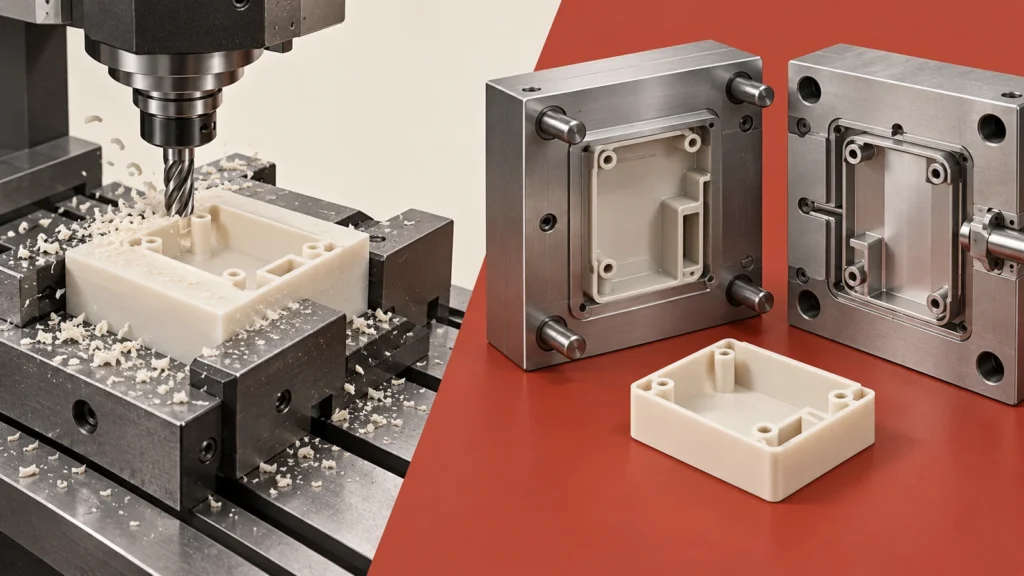
Ask suppliers to show the assumptions behind their comparison. Does “piece price” include material certification, finishing, inspection, packaging, or mold amortization? Is the quote based on a finished drawing or a preliminary model? A comparison that excludes a tool from one route or inspection from the other is not decision-ready.
When CNC machining is the safer first move
Machining is often the practical choice when the design is not yet stable. A mounting hole may move after a fit test; a wall may need thickening after a stiffness review; or a sealing land may need a different width after an assembly trial. Without a mold cavity to rework, engineering can evaluate a revised geometry in a subsequent build. This does not make every revision free: new programming, material, setup, and inspection still have cost and lead-time implications.
It is also useful when a part needs a material that is available as machinable plate, rod, or block but is not being considered as a molding resin in the project. The requested grade and stock form must be confirmed, because “same polymer family” does not mean the machined and molded parts behave identically. Grain or extrusion direction, residual stress, moisture conditioning, and wall thickness can all affect measurements and use.
Geometry imposes a real boundary. Deep internal cavities, thin ribs, undercuts, and enclosed passages can be inaccessible to a cutting tool or expensive to machine. Designers should check tool reach, corner radii, workholding faces, and whether the part can be made in one setup or requires multiple orientations. A useful review can reference the site’s CNC rapid prototyping capability 및 low-volume production options when those are relevant to the build plan.
When injection molding earns its tooling cost
Molding becomes more compelling when the product geometry and material are sufficiently settled, repeated demand is credible, and the molded design can be validated. The mold is not just a cost item; it is part of the process definition. Gate location, flow length, venting, cooling, ejection, shrinkage, and parting-line placement influence the part. Those decisions may affect appearance, dimensional stability, weld lines, and how the component fits with neighboring parts.
Before approving a mold, define which features are critical and how they will be measured. A nominal CAD surface is not an acceptance plan. Specify datums, tolerances, material grade, cosmetic zones, and the conditions under which dimensions are checked. If the component is loaded, sealed, or aligned in an assembly, identify the functional interfaces rather than applying tight tolerances indiscriminately.
Tooling economics also depend on expected revisions. If a pilot build is likely to expose interface changes, the cost of modifying a mold should be included in the plan. Conversely, continuing to machine a mature design at a volume that would justify tooling can make recurring part cost needlessly high. The right comparison is a range of plausible quantities and engineering changes, not a single optimistic forecast.
Material form changes what a prototype proves
A prototype is useful only if its evidence matches the question. A machined plastic component can answer questions about envelope, assembly access, basic fit, and some functional loads. It may not predict molded shrinkage, knit-line strength, fiber orientation, or surface appearance. A molded sample can test the actual molding process more directly, but the first trial may still need adjustment before it represents a stable production condition.
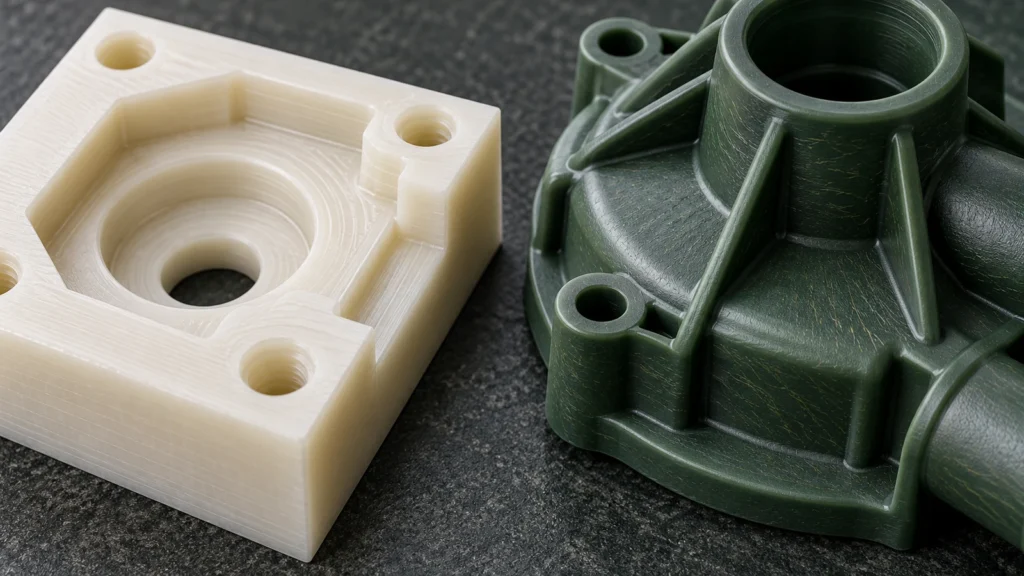
Validation should follow the risk of the component. A noncritical cover may need dimensional and assembly checks. A pressure boundary, bearing support, or sealing component may need functional testing under defined temperature, load, fluid, and cycle conditions. A quick prototype can screen concepts; it cannot replace qualification that belongs to the final material and production process.
A practical route-selection check
Use these questions before requesting quotes:
- How many parts are needed for the first build, and how likely is that quantity to repeat?
- Which dimensions, surfaces, or interfaces control fit and function?
- Is the model frozen, or should the next build preserve room for changes?
- Does the part contain features that are difficult to reach with a cutter or difficult to mold and eject?
- Must the prototype represent the production resin and manufacturing process, or is it only a form-and-fit model?
- What inspection records, material documents, and tests are needed for acceptance?
Then compare at least two scenarios: the expected pilot quantity and a realistic repeat-production quantity. Include engineering changes, tooling maintenance or modification, secondary operations, inspection, and scrap assumptions. If the answer changes sharply with volume, keep the decision open until demand and design maturity are clearer.
Keep the transition between routes controlled
Moving from a machined prototype to a molded part is a design transfer, not a simple process swap. Recheck wall sections, ribs, bosses, draft, radii, and tolerance strategy against the molding process. Revisit interfaces that were machined from stock because molded shrinkage and process variation may change the fit. Conversely, do not redesign every feature for molding until the material, tool concept, and functional requirements are known.
A concise handoff package should include the controlled drawing or model revision, material specification, critical-to-function dimensions, inspection method, intended validation tests, and a record of open design risks. That gives the manufacturing and quality teams a common basis for comparing prototype evidence with production evidence.
자주 묻는 질문
Is CNC machining always cheaper for a small quantity?
No. It often avoids a dedicated mold, but part complexity, stock price, machining time, setup, finishing, and inspection can still make a small run expensive. Compare total project cost using the actual design and quantity.
Can a machined prototype represent an injection-molded part?
It can represent selected geometry and interfaces, but it does not automatically reproduce molding-related shrinkage, flow orientation, weld lines, or surface effects. Define which questions the prototype is meant to answer.
When should a team move to a mold?
Consider tooling when design and material are stable enough to validate, repeat demand supports the investment, and the molded geometry can meet the part’s functional and inspection requirements.