
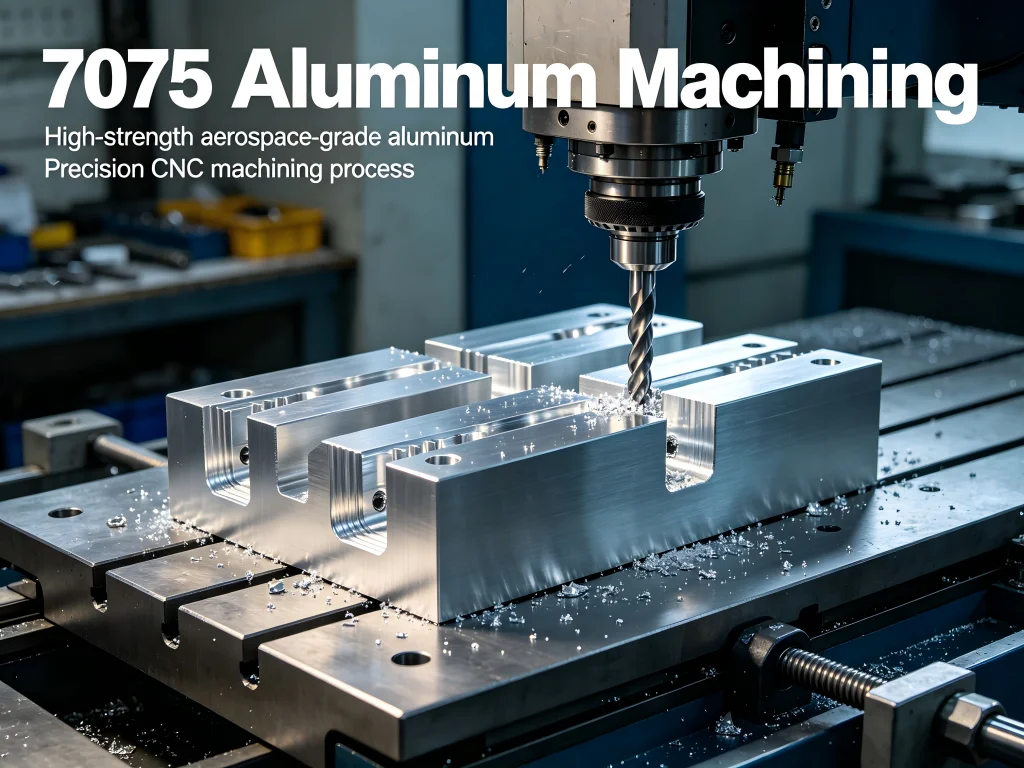
만약 여러분이 정기적으로 7075 알루미늄 가공 를 다룬다면, 이 소재가 일반적인 알루미늄 합금처럼 거동하지 않는다는 것을 아마 눈치챘을 것입니다. 이는 6061보다 더 단단하고, 더 연마성이 강하며, 덜 관대하지만, 무게는 약 3분의 1에 불과하면서도 많은 강철에 필적하는 강도를 제공합니다. 이 가이드는 재료 과학의 기초부터 실제 생산 환경에서 실제로 통하는 현장 전략까지, 7075-T6 가공, 에 대해 알아야 할 모든 것을 안내합니다.
기술 연구, 가공 포럼에서 공유된 현장 경험, 그리고 매년 수천 건의 7075 알루미늄 CNC 작업을 수행하는 제조업체들의 통찰을 바탕으로, 이 종합 자료는 숙련된 기계 가공자들이 시행착오를 통해 터득한 내용을 정리한 것입니다. 프로토타이핑 엔지니어, 생산 관리자, 또는 공급업체를 평가하는 구매자이든, 여기 있는 정보는 이 뛰어난 합금을 다루는 데 관한 더 나은 결정을 내리는 데 도움이 될 것입니다.
이 가이드에서 다루는 내용
- 7075 알루미늄이란 무엇이며 그 조성이 성능을 어떻게 좌우하는가
- 템퍼 상태의 과학과 그것이 가공에 중요한 이유
- 다양한 작업을 위한 절삭 속도 권장 사항과 이송 속도 최적화
- 공구 수명을 연장하고 표면 품질을 개선하는 공구 선택 전략
- 현장 기계 가공자들의 실용적인 냉각 및 칩 관리 기법
- 항공우주, 자동차, 방위, 스포츠 용품 분야의 주요 응용
- 뒤틀림, 구성인선, 태핑 문제와 같은 일반적인 가공 과제에 대한 해결책
- 올바른 공급업체를 선택하고 품질 인증을 평가하는 방법
- 기술적 깊이와 실용적 관점을 모두 갖춘 자주 묻는 질문에 대한 답변
7075 알루미늄 이해하기: 조성, 특성, 그리고 이것이 다른 점
7075 알루미늄 가공 이 합금이 실제로 무엇인지 이해하는 것부터 시작됩니다. 7075는 알루미늄 합금의 7000 계열에 속하며, 아연이 주요 합금 원소로 사용됩니다. 조성은 약 5.1~6.1%의 아연, 2.1~2.9%의 마그네슘, 1.2~2.0%의 구리, 0.18~0.28%의 크롬을 포함하며, 나머지는 알루미늄입니다. 이러한 화학 조성이 7075에 뛰어난 강도 특성을 부여합니다. 아연과 구리는 열처리 중에 강화 석출물을 형성하기 위해 함께 작용하며, 마그네슘은 고용체 강화에 기여합니다.
CNC 기계를 운용하는 사람에게 이것이 무엇을 의미할까요? 이 조성에서 비롯되는 기계적 특성이 현장에서 진정으로 중요한 요소입니다. 가공에 가장 흔히 사용되는 상태인 T6 템퍼에서 7075는 약 83 ksi(572 MPa)의 최대 인장 강도와 약 73 ksi(503 MPa)의 항복 강도를 달성합니다. 브리넬 경도는 일반적으로 약 150 HB로 측정되며, 이는 약 95 HB인 6061보다 상당히 단단합니다. 파단 연신율은 5~8% 사이로, 이는 재료가 강하면서도 연성이 더 높은 합금에 비해 다소 취성이 있음을 나타냅니다.
7075-T6의 전단 강도는 약 48 ksi(331 MPa)이며, 피로 강도는 약 23 ksi입니다. 이 수치들은 실제 성능으로 직결됩니다. 7075로 구조용 브래킷을 가공할 때, 그 부품은 항공기 날개 스파에서 6061 부품보다 반복 하중을 훨씬 더 잘 견딜 수 있습니다. 그러나 그 대가로 가공성이 떨어집니다. 7075의 가공성 등급은 약 60%로, 6061의 70%에 비해 낮으므로 절삭 속도가 느려지고, 공구 교체가 더 잦아지며, 공정 변수에 더 많은 주의를 기울여야 합니다.
7075에도 한계가 있다는 점은 주목할 가치가 있습니다. 내식성은 보통 수준에 불과하며, 특히 6061이나 5052와 비교할 때 그렇습니다. 염화물이 많은 환경이나 해양 응용 분야에서 7075는 일반적으로 아노다이징이나 도장과 같은 보호 코팅이 필요합니다. 용접성은 좋지 않으며, 융합 용접은 열간 균열과 상당한 강도 손실을 초래할 수 있습니다. 이러한 이유로 7075 부품을 접합할 때는 일반적으로 기계적 체결이나 접착제 접합이 선호됩니다.
템퍼의 결정적 역할: T6, T651, T73, T7351 설명
논의할 때 CNC 7075 작업에서는 템퍼 명칭을 무시할 수 없습니다. 템퍼는 재료가 어떻게 열처리되고 응력 제거되었는지를 알려주며, 가공성과 최종 부품 성능 모두에 직접 영향을 미칩니다. 이러한 차이를 이해하면 전체 생산 배치를 폐기하는 일을 피할 수 있습니다.
T6 템퍼 는 최대 강도 상태를 나타냅니다. 재료는 용체화 열처리 후 인공 시효를 거칩니다. 이는 최대 강도를 생성하지만 담금질 과정에서 상당한 잔류 응력을 남깁니다. T6 재료를 가공할 때, 재료를 제거함에 따라 이러한 내부 응력이 재분배되어 뒤틀림이나 변형을 일으킬 수 있습니다. T6는 가장 높은 강도를 제공하지만 가공 중 이동 위험이 가장 큽니다.
T651 템퍼 응력 문제를 직접적으로 해결합니다. 용체화 열처리 후 인공 시효 전에, 재료는 약 1~3퍼센트의 제어된 인장(stretching)을 거칩니다. 이 인장은 급랭으로 유발된 잔류 응력의 상당 부분을 완화합니다. 그 결과 여전히 매우 높은 강도를 달성하면서도 가공 중 훨씬 더 나은 치수 안정성을 유지하는 재료가 됩니다. 많은 업체가 정밀 가공에 T651을 선호하는데, 7075 알루미늄 가공 이는 부품이 더 평평하게 유지되고 더 엄격한 공차를 유지하기 때문입니다.
T73 및 T7351 템퍼 는 다른 접근 방식을 취합니다. 이들은 일부 강도를 희생하여 응력 부식 균열 저항성을 크게 향상시킨 과시효(over-aged) 상태입니다. T73 템퍼는 약 72 ksi의 인장 강도를 제공하는데, 이는 T6보다 낮지만 응력 부식이 우려될 수 있는 환경에서 훨씬 더 나은 성능을 제공합니다. T7351은 T73 공정에 응력 완화 인장 단계를 추가합니다. 이러한 템퍼는 최대 강도보다 부식 환경에서의 장기 신뢰성이 더 중요한 항공우주 응용 분야에서 흔히 사용됩니다.
이들 중에서 어떻게 선택합니까? 대부분의 일반적인 7075 알루미늄 CNC 작업의 경우, T651이 강도, 안정성 및 가공성의 최상의 균형을 제공합니다. 응용 분야가 부식 환경이나 높은 습도에 지속적으로 노출되는 경우, T73 또는 T7351이 강도 손실을 감수할 가치가 있을 수 있습니다. 최대 강도가 절대적인 우선순위이고 고정구 및 러핑 전략을 통해 변형 위험을 관리할 수 있는 응용 분야의 경우, T6은 여전히 유효한 선택입니다.
7075 알루미늄 가공을 위한 절삭 속도 및 이송
에 대한 파라미터를 올바르게 설정하는 것이 7075-T6 가공 순조롭게 진행되는 작업과 공구가 부러지는 악몽 사이의 차이를 만듭니다. 수치는 6061에 사용할 수 있는 것과 크게 다르며, 많은 업체가 값비싼 대가를 치르고 이 교훈을 배웠습니다.
연구에 따르면 이송 속도는 7075 밀링에서 표면 거칠기에 영향을 미치는 가장 중요한 파라미터이며, 회전 속도는 칩 두께 비율에 가장 강하게 영향을 미칩니다. 이 발견은 실질적인 의미를 갖습니다. 표면 조도가 주된 관심사라면, 이송 속도 최적화에 집중하는 것이 스핀들 속도만 조정하는 것보다 더 즉각적인 결과를 제공할 것입니다.
초경 공구를 사용한 엔드 밀링 작업의 경우, 다음 파라미터는 현장 경험과 실험실 테스트를 기반으로 입증된 시작점을 제공합니다:
| 작업 | 공구 직경 | 절삭 속도 (m/min) | 스핀들 속도 (RPM) | 이송 속도 (mm/분) | 칩 부하 (mm/날) |
|---|---|---|---|---|---|
| 황삭 | 10 mm | 180-220 | 5,700-7,000 | 800-1,000 | 0.05-0.08 |
| 정삭 | 10 mm | 250-300 | 8,000-9,500 | 500-700 | 0.03-0.05 |
| 황삭 | 6 mm | 180-220 | 9,500-11,600 | 600-800 | 0.04-0.07 |
| 정삭 | 6 mm | 250-300 | 13,300-15,900 | 400-600 | 0.02-0.04 |
| 고속 가공 | 모두 | 450-600 | 가변적 | 0.10-0.15 mm/날 | 가변적 |
한 경험 많은 CNC 엔지니어가 가공 포럼에서 드론 제조업체가 7075를 6061 속도로 가공하여 분당 300미터까지 밀어붙인 사례를 공유했습니다. 열 축적으로 인해 프로펠러 허브에 내부 응력 균열이 발생하여 $200,000의 손실과 두 달간의 생산 중단을 초래했습니다. 해결책은 추가 냉각수를 사용하면서 분당 200미터로 낮추는 것이었습니다. 이 사례는 더 광범위한 진실을 보여줍니다: 7075 알루미늄 가공 보수적인 파라미터 선택에는 보상을 주고 공격적인 속도 추구에는 벌을 줍니다.
선삭 작업의 경우, 연구에 따르면 절삭 속도와 이송 속도를 높이면 가공 온도가 상승하며, 최소한의 구성층(built-up layer)과 구성인선(built-up edge)은 높은 절삭 속도와 이송 속도 수준에서 발생합니다. 이는 단순히 느리게 가공하는 것보다 더 세심한 접근이 필요함을 시사합니다. 적절한 냉각과 함께 더 높은 속도를 사용하면 실제로 7075 가공을 괴롭히는 부착 문제를 줄일 수 있습니다.
분당 미터가 아닌 분당 표면 피트(SFM)로 작업하는 경우, 일반적인 범위는 7075 알루미늄 절삭 속도 공구 선택과 가공 방법에 따라 300~500 SFM 사이입니다. 최적의 표면 조도를 얻으려면 일반적으로 날당 0.004~0.012인치의 재료 제거율이 필요합니다. 이 수치는 안전한 시작 영역을 제공하지만, 특정 기계의 강성, 공구 홀더 품질, 냉각수 설정에 따라 최적 파라미터가 실제로 결정됩니다.
7075 알루미늄 CNC 작업을 위한 공구 선택 전략
적합한 절삭 공구를 선택하는 것은 7075 알루미늄 가공 재료의 거동을 이해하고 나면 복잡하지 않습니다. 높은 아연 함량과 경화된 템퍼는 7075를 6061보다 더 연마성이 강하게 만들어, 공구 재질과 형상이 더 중요해집니다.
본격적인 7075 가공에는 초경 공구가 표준 권장 사항입니다. 초경의 더 높은 경도는 이 합금의 연마성 마모 특성을 다룰 때 절삭날의 예리함을 더 오래 유지합니다. 고속도강 공구는 경부하 또는 간헐적 작업에는 효과가 있을 수 있지만, 훨씬 빠르게 마모되는 경향이 있습니다.
엔드밀의 경우 여러 형상 특징이 중요합니다. 45~50도 범위의 높은 헬릭스 각도는 표준 30도 헬릭스 공구에 비해 더 나은 방열과 칩 배출을 제공합니다. 2날과 3날 초경 엔드밀은 모두 일반적인 선택이며, 3날 설계는 종종 칩 배출과 공구 강성 사이에서 더 나은 균형을 제공합니다. 일부 기계 가공자는 더 나은 내열성을 위해 TiAlN 코팅이 적용된 2날 초경 엔드밀로 성공했다고 보고합니다.
가변 형상 엔드밀은 7075의 고속 가공에서 인기를 얻고 있습니다. 이 공구는 뛰어난 절삭날 예리함을 유지하면서 공구 강성을 제공하는 독특한 날 형상을 갖추어 채터를 줄이고 복잡한 윤곽에서 표면 조도를 개선하는 데 도움을 줍니다. 트로코이달 밀링 또는 다이내믹 밀링 전략에는 7000계열 알루미늄 전용으로 설계된 3날 무코팅 초경 엔드밀이 강한 성능을 보여주었습니다.
공구를 선택할 때 연마된 날에 주의하십시오. 연마되거나 예리하게 처리된 날은 칩을 더 빠르게 배출하고 구성날 형성을 방지하는 데 도움을 주며, 이는 알루미늄 합금 가공 시 흔한 문제입니다. 이는 재료 부착이 표면 조도를 빠르게 저하시킬 수 있는 7075에서 특히 중요합니다.
가공 포럼에서 반복적으로 나타나는 실제 팁: 7075 드릴링의 경우 초경 드릴은 특히 스핀들 관통 냉각수를 사용할 때 센터 드릴링 없이도 종종 작업할 수 있습니다. HSS 드릴의 경우 일반적으로 흔들림을 방지하기 위해 센터 드릴링이 권장됩니다. 코발트 포물선 플루트 스크루 머신 드릴은 펙 없이 심공 드릴링에 효과적인 것으로 입증되었지만, 제조사 피드 표를 면밀히 따르십시오.
태핑의 경우, 7075에서는 성형 탭(롤 탭이라고도 함)이 절삭 탭보다 종종 더 우수한 성능을 발휘합니다. 성형 탭은 재료를 절삭하는 대신 변형시켜 더 강한 나사산과 더 나은 피로 저항성을 만들어냅니다. 또한 막힌 구멍에서 칩 배출 문제를 제거합니다. 한 포럼 기여자는 성형 탭이 7075 알루미늄에서 더 나은 품질의 나사산, 더 긴 탭 수명, 그리고 훨씬 낮은 탭 파손 위험을 제공한다고 언급했습니다. 관통 구멍용 스파이럴 포인트 탭과 막힌 구멍용 스파이럴 플루트 탭도 적절한 윤활제를 사용할 때 신뢰할 수 있는 옵션입니다.
냉각수 전략 및 칩 관리
열은 성공적인 가공의 적입니다 7075 알루미늄 가공. 이 재료는 다른 일부 합금만큼 효율적으로 열을 발산하지 못하며, 과도한 열은 구성날, 불량한 표면 조도, 가속화된 공구 마모, 그리고 극단적인 경우 내부 응력 균열을 초래합니다.
플러드 냉각수는 전통적인 접근 방식이며 대부분의 작업에 잘 작동합니다. 적절한 냉각수 적용은 절삭 계면의 마찰을 줄이고, 절삭 영역에서 열을 빼내며, 공구에서 칩을 씻어내는 데 도움을 줍니다. 그러나 플러드 냉각수만으로는 고속 또는 높은 재료 제거율의 작업에 충분하지 않을 수 있습니다.
액체 이산화탄소를 사용한 극저온 냉각은 7075 밀링에 유망한 결과를 보여주었습니다. 연구에 따르면 극저온 냉각은 건식 가공에 비해 더 나은 표면 조도와 칩 제어를 생성하며, 기존 플러드 냉각수 시스템보다 환경 친화적입니다. 이 연구는 AL7075 밀링에 극저온 냉각을 권장했는데, 여러 성능 지표에서 건식 가공보다 더 나은 결과를 만들어냈기 때문입니다.
최소량 윤활은 또 다른 대안을 제공합니다. MQL은 윤활제의 미세 안개를 절삭날에 직접 전달하여, 플러드 냉각수와 관련된 낭비와 청소 없이 마찰을 줄일 만큼 충분한 윤활을 제공합니다. 일부 작업장은 7075의 경절삭 및 정삭 작업에 MQL로 성공했다고 보고했습니다.
칩 형성은 특히 주의를 기울일 가치가 있습니다. 7075와 같은 전신 알루미늄 합금은 특히 피드와 속도가 최적화되지 않았을 때 절삭 중 길고 끈적한 칩을 생성하는 경향이 있습니다. 이러한 끈적한 칩은 공구 주위에 엉키고, 플루트를 막고, 완성된 표면을 긁고, 제거를 위한 빈번한 정지를 강제할 수 있습니다.
Contrary to some assumptions, 7075 generally produces shorter, more manageable chips than 6061. One Practical Machinist forum discussion noted that 6061 creates much worse stringing issues, while 7075 offers decent chip formation in most billet applications. However, chip breakers on inserts or programmed chip-breaking toolpaths may still be beneficial, particularly in turning operations.
The relationship between feed rate and chip thickness is the most critical factor in chip control. Insufficient feed produces thin, ribbon-like chips that wrap around tools. Aggressive feeding produces thicker chips that break more readily but may compromise surface finish. Finding the balance point for your specific operation is essential for efficient 7075-T6 가공.
Managing Warpage and Residual Stresses
Perhaps the most frustrating challenge in 7075 알루미늄 가공 is part distortion. Thin-walled parts, large plates, and components with uneven material removal are particularly susceptible to warping. A shop reported a nightmare scenario where 80 pieces of 7075 thin-wall shells with 1.2 mm wall thickness bowed 0.35 mm after machining, resulting in a complete rejection and a loss of 26,000 RMB. Even worse, 50 pieces of a 120×80×40 mm shell with a 1.0 mm wall bowed 0.4 mm, and the customer rejected the entire lot.
These failures typically trace back to residual stresses introduced during the material’s manufacturing process. When aluminum plate is quenched during heat treatment, the rapid cooling creates internal stress gradients throughout the material. As you machine away material, these stresses redistribute, and the part moves.
The T651 temper was specifically developed to address this problem. By stretching the material after quenching, a significant portion of the residual stress is relieved. For critical applications or large plates, using T651 instead of straight T6 can dramatically reduce warpage.
Beyond material selection, machining strategy plays a crucial role. Roughing and finishing in separate setups, allowing the part to stress-relieve naturally between operations, can help. Some shops use a strategy of roughing the part with stock allowance, letting it sit for hours or even days to allow residual stresses to equalize, then finishing to final dimensions. This approach adds time but often pays off in reduced scrap rates.
For thin-wall parts, several techniques can help. Using smaller radial depths of cut reduces cutting forces that could deflect thin sections. Climbing milling generally produces lower cutting forces than conventional milling. Supporting thin walls with backing material or fixturing that provides rigid support on both sides minimizes deflection. Some machinists also report success with cryogenic cooling for thin-wall 7075 parts, as the lower temperatures help maintain dimensional stability during cutting.
Post-Machining Considerations: Surface Finish and Anodizing
After completing your 7075 알루미늄 CNC operations, surface finish and post-processing deserve careful attention. 7075 can achieve excellent surface finishes, with typical roughness values reaching Ra 0.8 to 1.6 micrometers under optimal conditions. Achieving these numbers requires sharp tooling, stable machine conditions, and appropriate cutting parameters.
Research on 7075 milling confirms that both cutting speed and feed rate influence surface roughness, with feed rate showing the strongest effect. Optimizing feed rate for your specific operation should be the first priority when surface finish requirements are tight.
Anodizing 7075 requires special consideration. The high zinc content can cause uneven coloration, streaking, or dark spots compared to the more predictable results achievable with 6061. Some sources do not recommend decorative anodizing for 7075 due to the potential for inconsistent appearance.
However, hard anodizing (Type III) works well on 7075. The process creates a thick, dense oxide layer that provides excellent wear resistance and corrosion protection, even if cosmetic appearance is less uniform. For functional applications where wear resistance matters more than appearance, hard anodizing is often the preferred choice.
If cosmetic anodizing is required, several practices can improve results. Consistent surface finish from sharp, consistent tooling is essential. Maintaining steady feed rates and spindle speeds across all cosmetic surfaces helps produce uniform surface conditions that anodize more consistently. Automated deburring processes like tumbling are preferable to manual methods for achieving consistent edge conditions.
Key Applications of 7075 Aluminum
What is 7075 aluminum used for? The answer spans industries where strength-to-weight ratio matters most. The aerospace and defense sector remains the largest consumer, accounting for approximately $2.3 billion in 7075-T6 aluminum consumption in 2024, with projected growth at a compound annual rate of 8.3 percent through 2034.
Within aerospace, 7075 appears in critical structural components including aircraft fuselage frames, wing spars, landing gear components, and bulkheads. The alloy’s high fatigue strength makes it particularly suitable for components subjected to cyclic loading over long service lives. One technical review notes that 7075 is mainly employed in aircraft fuselage and wing applications due to its remarkable physical and mechanical properties.
The automotive industry increasingly relies on 7075 for high-performance parts where weight reduction directly improves performance. Racing suspension components, chassis reinforcements, drivetrain brackets, and structural chassis elements all benefit from the alloy’s high strength-to-weight characteristics.
Military and defense applications represent another major market. Armored vehicle components, weapon system parts, and tactical equipment housings take advantage of 7075’s combination of light weight and high strength. The alloy’s fatigue resistance proves particularly valuable in military applications where reliability under extreme conditions is non-negotiable.
Sporting goods manufacturers have embraced 7075 for premium equipment. High-end bicycle frames and components, climbing gear, baseball bats, and archery equipment all utilize the alloy. The material’s ability to withstand repeated impact loading while remaining lightweight makes it ideal for products where every gram counts.
Marine applications appear less frequently due to corrosion concerns, but properly coated or anodized 7075 components can be found in high-performance boat fittings and structural elements where strength requirements outweigh corrosion resistance demands.
How strong is 7075 aluminum compared to alternatives? In the T6 temper, its tensile strength reaches approximately 570 to 700 MPa, yield strength ranges from 460 to 540 MPa, and hardness hits around 150 HB. This puts it roughly on par with some mild steels while weighing approximately 63 percent less. For applications where weight is the constraint and strength is the requirement, 7075 often represents the optimal choice.
Selecting a CNC Machining Partner for 7075 Aluminum Parts
When you need aluminium 7075 Malaysia manufacturing services or 7075 supplier malaysia support, evaluating potential partners requires looking beyond basic capability claims. The following factors should guide your decision.
Material certification and traceability matters enormously for 7075 work, particularly in aerospace and defense applications. A reliable supplier maintains complete material certifications from mill to finished part. They should provide documentation showing alloy composition, temper verification, and heat treat lot numbers. One CNC engineer with decades of experience warned about running 500 parts labeled as 6061 that turned out to be 7075, requiring scrapping the entire batch when the client needed bending operations. Do not let this happen to you.
Stress relief capability separates average suppliers from exceptional ones. The T651 temper helps, but additional multi-stage stress relief processes can ensure large structural plates and thin-wall components stay flat after machining. JUCHENG, for example, specializes in nuanced 7075 알루미늄 가공 utilizing multi-stage stress relief to ensure dimensional stability on large structural plates.
Machine capability and quality control directly affect what tolerances and surface finishes your parts can achieve. Look for suppliers with modern CNC equipment capable of maintaining the tolerances your application requires. Typical achievable tolerances for 7075 CNC machining run around ±0.02 mm, and surface finishes of Ra 1.6 µm or better should be standard for well-executed work.
Inspection and quality systems provide confidence in consistent results. ISO 9001 certification is standard for serious shops. For aerospace work, AS9100 certification becomes essential. Suppliers should offer CMM inspection reporting, first article inspection documentation, and full material traceability. If your application demands zero-defect quality, ensure your supplier maintains rigorous process control and documented inspection procedures.
Capacity and lead time matter for production planning. A supplier with 100+ CNC machining centers and 8,000+ square feet of manufacturing space can typically handle larger volumes and maintain shorter lead times than smaller operations. Ask about typical lead times for prototypes versus production runs, and verify that the supplier has capacity for your anticipated volume.
Why Jucheng Excels at 7075 Aluminum CNC Machining
JUCHENG has established itself as a specialized partner for demanding 7075 알루미늄 가공 projects. The company maintains a massive inventory of certified 6061 and 7075 알루미늄 bars and plates, ensuring material availability and eliminating sourcing delays. With over 100 CNC machining centers operating from an 8,000-plus-square-foot facility, JUCHENG handles both prototyping and production volumes efficiently.
Technical expertise sets JUCHENG apart. The company specializes in the nuanced machining of 7075 aluminum, utilizing multi-stage stress relief techniques to ensure large structural plates remain flat within tight tolerances. This capability addresses the single biggest challenge in 7075 work: managing residual stresses that cause warping during and after machining. JUCHENG’s vertically integrated operations provide security through transparent processes and certified quality systems, making them a low-risk partner for prototypes and low-volume production alike.
Quality control at JUCHENG follows rigorous standards. The company maintains material traceability throughout the manufacturing process, from incoming raw material certification through final inspection. CMM-verified data accompanies finished parts, providing documented proof of conformance to your specifications. For aerospace and defense clients where mission-critical reliability is mandatory, JUCHENG operates on a zero-defect culture with documented process controls.
JUCHENG also provides comprehensive post-machining services. Anodizing, hard anodizing, polishing, and coating options are available to meet your surface finish and corrosion protection requirements. The company’s experience across multiple industries including aerospace, automotive, medical, and defense means they understand the specific quality demands of each sector and can advise on optimal finishing choices for your application.
For engineers and buyers seeking a reliable partner for 7075 알루미늄 CNC projects, JUCHENG offers the combination of technical expertise, production capacity, and quality systems required for successful outcomes. Visit jccncmachining.com to learn more about their capabilities or request a quote for your next project.
Frequently Asked Questions About 7075 Aluminum Machining
Q1: What is the main difference between 6061 and 7075 aluminum for CNC machining?
6061 offers better machinability, higher corrosion resistance, and lower cost, making it suitable for general applications where extreme strength is not required. 7075 provides approximately double the tensile strength of 6061 but requires slower cutting speeds, causes more tool wear, and costs significantly more. Choose 7075 when strength-to-weight ratio is the driving requirement, not when you need easy machining or low cost.
Q2: How do I prevent warping when machining thin-wall 7075 parts?
Use T651 temper material rather than straight T6 for better stress relief. Implement a roughing cycle with stock allowance, allow the part to stress-relieve naturally (often by letting it sit overnight), then finish to final dimensions. Use smaller radial depths of cut to reduce cutting forces, support thin walls with rigid fixturing or backing material, and consider cryogenic cooling to maintain dimensional stability during cutting.
Q3: Can 7075 aluminum be welded successfully?
Welding 7075 is generally not recommended. The alloy has poor weldability and fusion welding typically leads to hot cracking and significant loss of strength in the heat-affected zone. For most applications, mechanical fastening, adhesive bonding, or redesigning to eliminate welds are better approaches.
Q4: What cutting speed should I use for 7075-T6 on a CNC mill?
Start with 180-220 m/min for roughing operations and 250-300 m/min for finishing when using carbide tooling with appropriate coolant. Do not use the same speeds you would run for 6061, which typically run 20-30 percent faster. Running 7075 too fast generates excessive heat that leads to built-up edge, poor finish, and potential stress cracking.
Q5: Does 7075 anodize well?
Hard anodizing (Type III) works very well on 7075, providing excellent wear resistance and corrosion protection. Decorative anodizing can be challenging because the high zinc content may cause uneven coloration, streaking, or dark spots. If cosmetic anodizing is required, consistent surface preparation and finish are essential for acceptable results.
Q6: How much does 7075 aluminum cost compared to 6061?
Raw 7075 material typically costs 30 to 50 percent more than 6061. The machining cost difference can be even larger because 7075 requires slower cutting speeds, shorter tool life, and more careful process control, all of which increase per-part manufacturing expenses.
Q7: What is the best tool coating for machining 7075 aluminum?
TiAlN coating provides good heat resistance and works well for high-speed operations. Uncoated polished carbide tools also perform well, particularly when chip evacuation is the primary concern. For general-purpose 7075 work, TiAlN-coated carbide end mills with 2-3 flutes and 45-50 degree helix angles represent a strong starting choice.
Q8: Why does 7075 produce stringy chips during turning operations?
Like most wrought aluminum alloys, 7075 tends to produce continuous chips when feed rates are too low. Increasing feed rate thickens the chip, helping it break more readily. Using chipbreaker inserts designed for aluminum and ensuring proper coolant application also help manage chip formation. Some machinists report that 7075 actually produces better chip control than 6061 in turning operations when parameters are optimized.
Q9: Can I use the same fixtures for 7075 that I use for 6061?
Yes, but be aware that cutting forces on 7075 can be higher due to the material’s greater hardness. Ensure your fixturing provides adequate clamping force and rigidity to prevent part movement or deflection. For thin-wall parts, additional support or backing material may be necessary.
Q10: Is 7075 suitable for high-speed machining (HSM) strategies?
Yes, with appropriate parameters. Trochoidal milling and other HSM strategies work well for 7075 when using proper tooling and cooling. The key is reducing radial depth of cut while maintaining appropriate chip load, which keeps cutting forces lower and helps manage heat generation. Several tool manufacturers offer end mills specifically designed for HSM of 7000-series aluminum.