
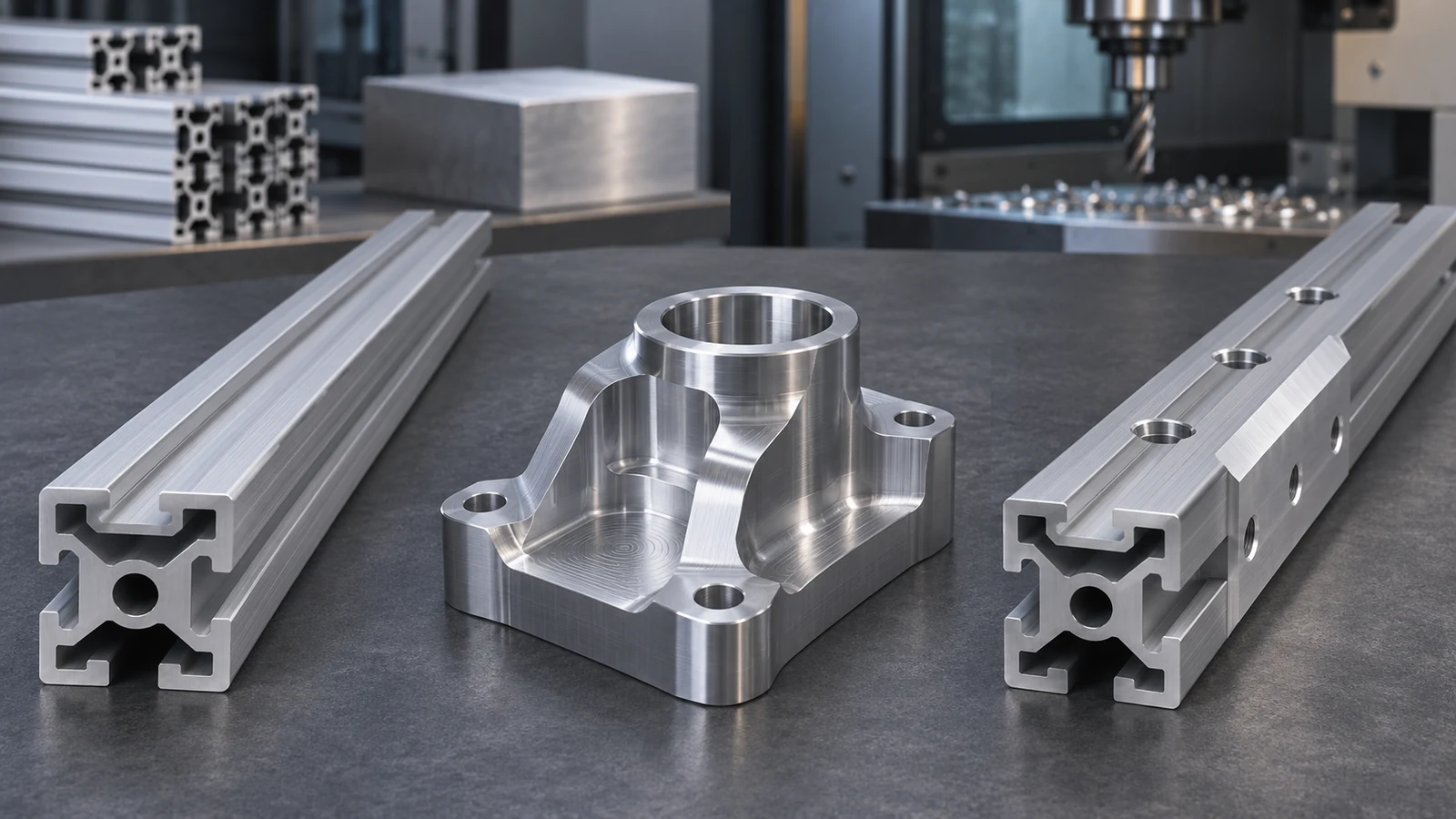
Aluminum extrusion is usually the stronger starting route when a part needs a long, repeatable cross-section; CNC machining is usually more direct when each part has changing three-dimensional geometry, custom faces, or low initial volume. Many production parts use both: the extrusion supplies a near-net structural profile, then machining creates the holes, ports, datum faces, and interfaces that control assembly.
The choice depends on how often the cross-section repeats, how much die investment the program can support, what tolerances apply to the profile and finished features, and whether the extrusion can be located reliably for secondary machining. A lower raw profile price does not settle the decision if straightness, cut length, material condition, or machining allowance create extra work downstream.
Ask whether the same section repeats
Extrusion forms material through a die to create a profile that continues along its length. It is useful when ribs, channels, mounting rails, or other section features repeat down that length. The die can integrate functions into the profile and reduce later material removal. The section must still be designed around the alloy, temper, wall distribution, die complexity, straightening, finish, and the extruder’s process limits.
CNC machining starts with stock such as plate, bar, billet, or a preform and removes material to create the part. It is flexible when the geometry changes from one face to another, when a feature does not run along the full length, or when a design is still being revised. Deep pockets, narrow slots, thin walls, and heavy material removal can make machining from solid stock slow or wasteful.
La pagina 6063-T6 material information discusses one aluminum alloy used in extruded products; alloy, temper, product form, and specification still need to match the actual drawing. The pagina di fresatura CNC provides process context for features that require material removal.
Compare routes across the production life
| Fattore decisionale | Estrusione | lavorazione CNC | Hybrid route |
|---|---|---|---|
| Geometry pattern | Constant or repeating cross-section along the length | Local 3D features and varying faces | Repeating profile plus critical local features |
| Upfront investment | Die design, tooling, and qualification may be required | Programming and workholding; no extrusion die for the part profile | Die plus secondary machining setup and process planning |
| Material use | Profile can place material near the needed section | Depends on stock envelope and material removed | Can reduce roughing while retaining machined interfaces |
| Main variation to manage | Profile dimensions, straightness, twist, cut length, and material condition | Setup, tool access, stock condition, clamping, and material removal | Profile variation, locating strategy, allowance, and datum transfer |
| Typical design question | Can required functions be built into one manufacturable section? | Can the finished geometry be reached and inspected economically? | Which dimensions belong to the profile and which must be machined? |
Tooling costs should be compared with realistic life-of-program volume and revision risk. Do not divide the die cost across an optimistic quantity that may never be ordered. Similarly, compare machined-part cost at the intended quantity and include material yield, setup, inspection, and finishing.
Where extrusion stops being a complete answer
Some details are easier to create after the profile is made. Cross-drilled holes, accurate end faces, counterbores, threads, ports, and perpendicular mounting surfaces often require secondary operations. Long profiles can also need cut-to-length, straightening, deburring, surface treatment, and machining fixtures. Each operation has to locate the profile without confusing the extrusion direction with the machine axes or the assembly datums.
Profile dimensions are not automatically identical to machined dimensions. Specify which profile surfaces locate or mate, which features are machined, and how the datum is established along the length. If a critical bore must align with the profile, define a controllable relationship and inspection method. A broad tolerance on the extrusion does not define a precise machined relationship unless the process creates and verifies it.
Where machining from solid stock becomes wasteful
Starting from a thick plate or billet to produce a long, thin section can consume substantial material and cutting time. The waste grows when the finished cross-section has repeated channels or ribs that an extrusion could form near-net. However, machining may remain preferable when there is no stable production volume, when the section changes frequently, or when tooling approval and revision costs outweigh the material saved.
Machining can also be a practical bridge for prototypes. A design team may machine a short run while the interface and section are changing, then evaluate extrusion after the cross-section stabilizes. That transition should preserve functional references and account for differences in material direction, surface condition, and stock form.
The hybrid route needs its own datums
A strong hybrid design separates profile functions from machined functions. The extrusion establishes the continuous section and structural envelope; CNC operations establish local features such as mounting holes, bearing seats, seal faces, or connector ports. Define where the extrusion is clamped, which surfaces are used as datums, and whether the profile is supported against twist or bow during cutting.
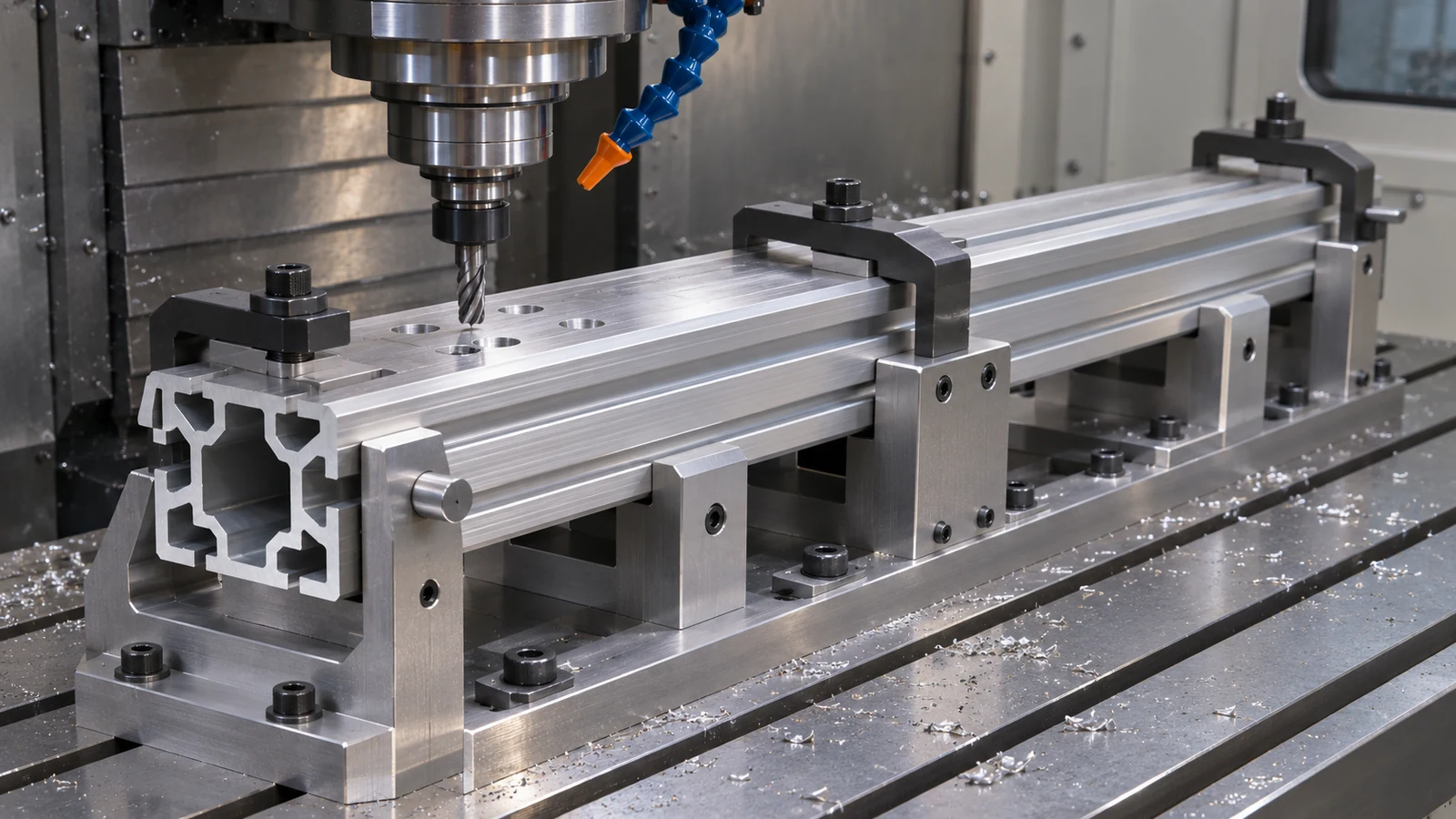
Provide enough machining allowance on surfaces that must clean up, but do not assume one allowance fits every profile and alloy. Review profile tolerance, cut length, straightness, local wall thickness, and finish before setting the allowance. If a secondary operation changes the part’s datum, identify the transition and inspect the functional relationship after machining.
For drawing review, make the distinction explicit: “extruded profile” requirements apply to the supplied section, while machined features have their own dimensions and datums. This prevents a quote from treating an as-extruded surface as a precision-machined reference without agreement.
Cosa inserire nella RFQ
- CAD and drawing at the same revision, with the profile and finished-part requirements clearly separated.
- Alloy, temper, product form, certification, finish, and any traceability requirements.
- Expected quantities by release and the likely program life, including prototype and production stages.
- Critical profile dimensions, straightness or twist requirements, cut length, machined datums, and functional interfaces.
- Inspection records, packaging, and any operation that must occur before or after machining or finishing.
Ask for the proposed route and assumptions. A useful quote shows die/tooling amortization separately from per-part extrusion, machining, finishing, and inspection, so the break-even discussion reflects the actual program rather than a single headline piece price.
Domande frequenti
Is extrusion always cheaper than CNC machining at higher volumes?
No. Volume can spread tooling cost, but profile complexity, alloy, tolerances, finishing, secondary machining, material yield, and revision risk all affect total cost. Compare the complete finished-part route.
Can an extrusion be CNC machined after it is produced?
Yes. Secondary machining can create holes, ports, end features, and precision interfaces. The process plan needs a stable locating method and enough allowance for the actual profile condition.
Should every aluminum extrusion feature be machined?
No. Machine only the features whose function requires a controlled machined surface or geometry. Applying tight machining requirements to every profile surface can add cost without improving assembly or performance.