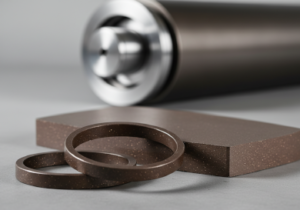
Available PTFE (Teflon) Grades
| Nuance |
Nom courant |
Caractéristiques clés |
Applications typiques |
| PTFE vierge |
Nuance électrique |
Pure white. Excellent chemical resistance, electrical insulation, and lowest friction. FDA compliant. |
Chemical seals, electrical insulators, medical tubing, food processing parts. |
| PTFE mécanique |
PTFE retraité |
Made from recycled resin. Lower tensile strength and purity but more cost-effective. Not FDA compliant. |
Entretoises non critiques, rondelles, patins d'usure. |
| PTFE chargé de verre |
15% / 25% Glass |
Reinforced with glass fibers to improve compressive strength and reduce cold flow (creep). |
Valve seats, gaskets, piston rings, structural chemical parts. |
| PTFE chargé de bronze |
Qualité roulement |
Bronze powder added for superior wear resistance and thermal conductivity. Higher friction than virgin. |
Hydraulic cylinder guides, bearings, slider plates. |
PTFE Machining Capabilities
| Capacité |
Description technique |
Avantage Jucheng |
| Complex Seal Turning |
Machining intricate lip profiles and grooves for hydraulic and pneumatic seals. |
Our specialized lathe setups ensure burr-free cuts, critical for maintaining a perfect vacuum or fluid seal. |
| Thin-Wall Machining |
Creating thin insulating sleeves and liners without deforming the soft material. |
We use air chucks and mandrels to support the part, achieving wall thicknesses as low as 0.5mm. |
| Finition de surface |
Achieving smooth sealing surfaces (Ra 0.8 or better) directly off the machine. |
Eliminates leakage paths in high-purity chemical or semiconductor applications. |
| Stress-Free Handling |
Managing the material’s tendency to “squirm” or change size with temperature. |
We machine in a temperature-controlled environment to ensure dimensions hold true at 20°C. |
Fabrication Guidelines for PTFE
Sensibilité au serrage :
PTFE is extremely soft and prone to deformation. Excessive clamping force will ruin the part. We use vacuum fixtures, potting, or soft jaws that encapsulate the part to distribute force.
Dilatation thermique :
PTFE has a very high coefficient of thermal expansion (CTE) and undergoes a phase transition at ~19°C where it expands significantly. We recommend machining and inspecting at stable room temperatures.
Outillage :
Extremely sharp, high-rake carbide tools are required. Dull tools will compress the material rather than cut it, causing size issues and burrs.
Ébavurage :
Burrs on PTFE are stringy and difficult to remove. We use cryogenic deburring or manual trimming under microscopes for critical medical parts.
Principaux secteurs d'application
Traitement chimique
Pièces clés : Valve seats, pump diaphragms, pipe gaskets.
Why PTFE: Universal chemical inertness prevents corrosion from acids and solvents.
Food & Medical
Pièces clés : Mixing paddles, surgical guides, fluid seals.
Why PTFE: FDA compliance, non-stick surface (easy to clean), and high-temperature sterilization resistance.
Aérospatiale
Pièces clés : Wire insulation, fuel hose liners, standoff insulators.
Why PTFE: Excellent dielectric properties and remains flexible at cryogenic temperatures.
Automobile
Pièces clés : Shock absorber seals, power steering seals, bearings.
Why PTFE: Low friction coefficient reduces wear and improves efficiency in moving parts.