
There is no universal minimum order quantity for CNC machining. A supplier may accept a single custom part, while a particular project can still have a practical minimum created by material purchasing, setup effort, finishing batches, inspection, or commercial terms. The useful question is not simply “What is your MOQ?” but “Which fixed costs and process constraints change when I order one, ten, or one hundred pieces?”
Why CNC orders may have no fixed MOQ
CNC machining is often suited to low-volume work because the part geometry is created by programming and cutting rather than by a dedicated production mold. That does not make every quantity equally economical. A one-piece order can require the same drawing review, CAM programming, fixture preparation, tool selection, and first-piece verification as a small batch. Those activities do not disappear just because the order is small.
Minimums can also come from outside the machine shop. Raw stock may be sold in standard bar, plate, or block sizes; finishing vendors may process parts in batches; special packaging or documentation may add a fixed handling step. A supplier’s stated minimum can therefore describe its business policy, the project’s process economics, or a dependency in the supply chain. Ask which one applies before comparing offers.
This distinction matters for buyers building prototypes, spare parts, or pilot lots. The site’s CNC prototyping and production overview discusses why low-volume feasibility and repeat-production readiness are related but different decisions.
Separate fixed work from per-part work
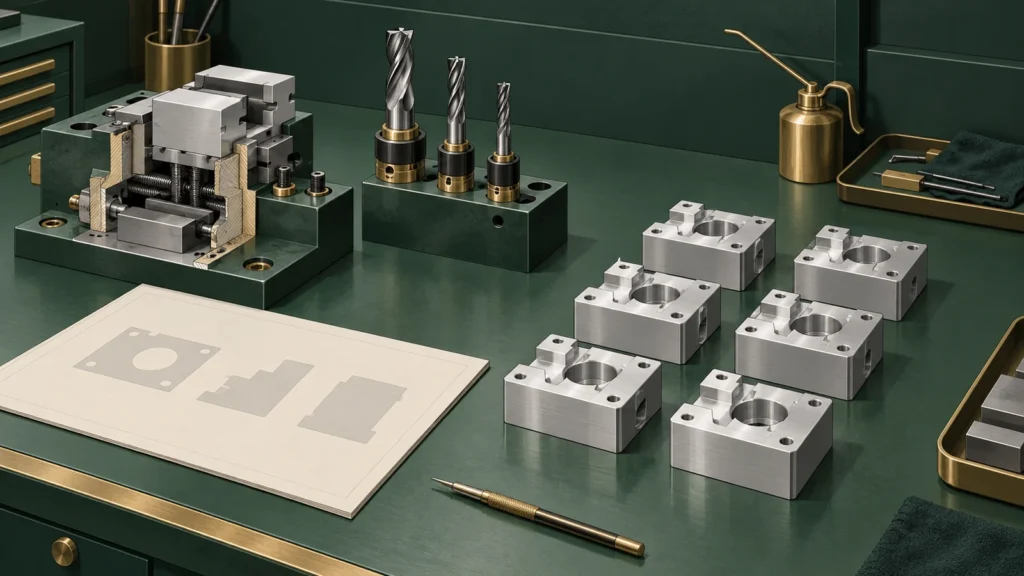 A useful quote separates costs that occur once from costs that scale with quantity. Setup/programming and order administration are commonly fixed or semi-fixed; material, machine time, finishing, and packaging often vary by piece or batch. Inspection may be a mix: first-piece approval has a fixed component, while sampling and reporting can grow with lot size.
For illustration only, imagine a job with a fixed setup charge and a variable machining cost per part. Ordering ten pieces spreads the setup over more parts than ordering one, so the unit price may fall even if the cutting time for each part is unchanged. This is not a quote or a promise of a particular price curve; the actual break-even point depends on the geometry, route, material, and required controls.
How quantity changes the route
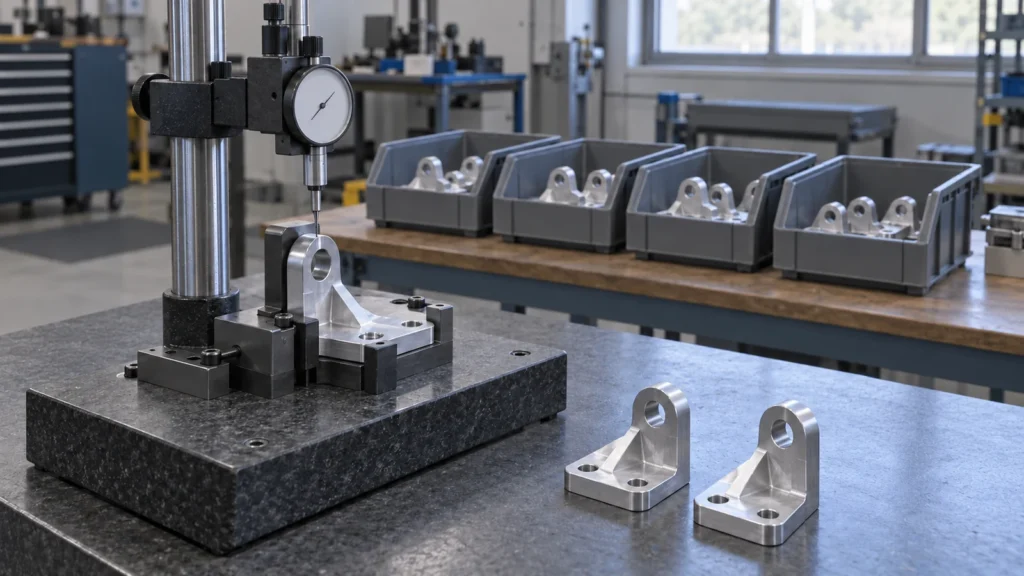 At prototype quantities, the priority may be learning: verify a fit, expose a design issue, or test assembly. Buyers can often avoid unnecessary cost by identifying which dimensions and surfaces must be representative and which checks are required before the design is frozen. For a production lot, repeatability, process documentation, inspection sampling, and material traceability may become more important than minimizing the first-unit cost.
A quantity break can also change how the supplier plans work. A handful of parts may be scheduled as a short job; a larger lot may justify dedicated workholding or a revised operation sequence. Conversely, more pieces can require more material, more in-process checks, and longer completion time. Quantity alone does not determine either price or lead time.
Compare like with like: same drawing revision, material, finish, inspection level, delivery state, and shipping basis. Otherwise a lower per-part number may simply exclude a setup, report, or downstream operation. The CNC machining cost guide gives a broader framework for separating design and process cost drivers.
At prototype quantities, the priority may be learning: verify a fit, expose a design issue, or test assembly. Buyers can often avoid unnecessary cost by identifying which dimensions and surfaces must be representative and which checks are required before the design is frozen. For a production lot, repeatability, process documentation, inspection sampling, and material traceability may become more important than minimizing the first-unit cost.
A quantity break can also change how the supplier plans work. A handful of parts may be scheduled as a short job; a larger lot may justify dedicated workholding or a revised operation sequence. Conversely, more pieces can require more material, more in-process checks, and longer completion time. Quantity alone does not determine either price or lead time.
Compare like with like: same drawing revision, material, finish, inspection level, delivery state, and shipping basis. Otherwise a lower per-part number may simply exclude a setup, report, or downstream operation. The CNC machining cost guide gives a broader framework for separating design and process cost drivers.
Questions that reveal a practical minimum
- Can you quote one prototype and a separate quantity break for the likely next order?
- Which charges are one-time, and which recur on a repeat order?
- Does the material supplier or finishing route impose a batch minimum?
- Can unused stock or setup data be retained for a repeat run, and under what conditions?
- Does the proposed inspection plan change between prototype and production quantities?
- Would splitting a lot or delivering a first article early change total cost or schedule?
Ask for an explanation, not only a minimum number. If a supplier requires a minimum, the reason should map to an identifiable constraint—stock purchase, setup policy, outside processing, or administrative handling. That helps engineering decide whether to redesign, change material form, split requirements, or keep the lot intact.
For a small order, preserve the evidence needed for the next one: approved drawing revision, material specification, any accepted deviations, and inspection results. A prototype that passed once is useful, but repeat production still depends on controlling the process and confirming that the specification has not changed.
Frequently asked questions
Can I order only one CNC machined part?
Many CNC suppliers can quote one-off parts, but acceptance depends on their workflow and the project requirements. A single part can carry fixed programming, setup, material, and inspection costs.
Why does a small order have a high unit price?
Fixed engineering and setup effort is spread over fewer pieces. Material minimums, special inspection, finishing, and packing can also contribute.
Should I order extra prototype parts?
Consider the cost of a failed test, destructive evaluation, assembly trials, and the likelihood of design changes. The appropriate quantity depends on what the prototype must prove—not on a universal rule.
Does ordering more always reduce the unit price?
No. A larger lot may reduce fixed cost per piece, but it can trigger more material, handling, inspection, or finishing work. Request comparable quantity breaks with the same scope.