Understanding Multi-Axis CNC Machining: A Comprehensive Overview
In the modern manufacturing landscape, precision, complexity, and efficiency are paramount. Multi-axis CNC machining represents a pinnacle of subtractive manufacturing technology, enabling the production of intricate parts that were once impossible or prohibitively expensive to create. Unlike traditional 3-axis machining, which moves a cutting tool linearly along the X, Y, and Z axes, multi-axis machining adds rotational movements, allowing the tool or the workpiece to tilt and rotate. This capability dramatically expands the geometric possibilities and operational efficiency of CNC machines, making them indispensable in industries ranging from aerospace to medical devices.
At its core, multi-axis CNC machining refers to any computer numerical control (CNC) machine that operates on more than three axes simultaneously. The most common configurations are 4-axisand5-axismachines, though advanced systems can incorporate 6, 7, or even more axes. The fundamental principle is that by adding rotational axes—typically labeled A (rotation around X), B (rotation around Y), and C (rotation around Z)—the machine can approach the workpiece from virtually any angle without requiring manual repositioning. This continuous, synchronized movement of linear and rotational axes is what defines true multi-axis machining.
The Mechanics of Multi-Axis Systems
How It Works: Linear and Rotational Axes
To grasp multi-axis machining, one must first understand the axis naming convention. In a standard 3-axis machine, the spindle moves along the X (left-right), Y (forward-backward), and Z (up-down) axes. A 4-axis machine adds a rotational axis, typically the A-axis, which rotates the workpiece around the X-axis. This allows for machining features on multiple sides of a part in a single setup, such as drilling holes on the top and sides of a block.
A 5-axis machine introduces a second rotational axis, commonly the B-axis (rotation around Y) or C-axis (rotation around Z). This configuration enables the cutting tool to approach the workpiece from any direction. There are two primary types of 5-axis machines: trunnion-styleandswivel-headmachines. Trunnion machines tilt the workpiece table, while swivel-head machines tilt the spindle head. Both achieve the same goal—full contouring capability—but each has distinct advantages in terms of rigidity, work envelope, and part size.
Simultaneous vs. 3+2 Machining
It is crucial to distinguish between two key operational modes: simultaneous 5-axis machiningand3+2 machining(also called positional 5-axis machining). In 3+2 machining, the machine positions the workpiece or tool at a fixed angle using the rotational axes, then performs standard 3-axis cutting in that orientation. This is ideal for complex undercuts, angled holes, or features that require access from a specific direction. It reduces setup time but does not involve continuous axis motion.
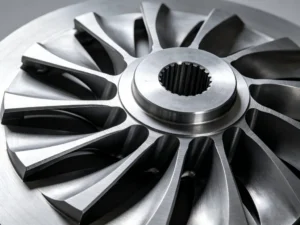
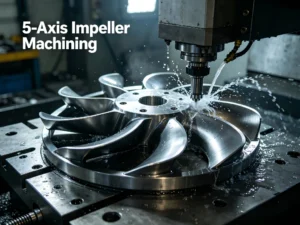
Simultaneous 5-axis machining, by contrast, moves all five axes at the same time during the cutting path. This is essential for creating complex freeform surfaces, such as turbine blades, impellers, or medical implants. The tool remains constantly engaged with the material at an optimal angle, maintaining consistent chip load and surface finish. Simultaneous machining requires sophisticated CAM (Computer-Aided Manufacturing) software and post-processors to generate the complex toolpaths.
Key Benefits of Multi-Axis CNC Machining
The adoption of multi-axis technology delivers transformative advantages over traditional 3-axis methods. These benefits extend beyond mere capability, directly impacting production costs, lead times, and part quality.
- Reduced Setup Time and Fixturing Costs: A single 5-axis machine can often complete a part that would require multiple setups on a 3-axis machine. By accessing five sides of a part in one operation, manufacturers eliminate the need for complex jigs and manual repositioning. This dramatically reduces non-cutting time and the risk of errors from re-clamping.
- Superior Surface Finish and Accuracy:Because the tool can maintain a tangential or optimal cutting angle to the workpiece, multi-axis machining reduces tool deflection and vibration. Shorter, more rigid cutting tools can be used, leading to better surface finishes and tighter tolerances. This is particularly critical for high-value components in aerospace and mold making.
- Ability to Machine Complex Geometries:Undercuts, deep cavities, and contoured surfaces are easily achievable with multi-axis machines. Parts like impellers, hip implants, and aerospace structural components often have geometries that are simply impossible to produce on a 3-axis mill without extensive EDM (Electrical Discharge Machining) or manual finishing.
- Extended Tool Life:By continuously orienting the tool to maintain a favorable cutting angle, multi-axis machining distributes wear more evenly across the cutting edge. This reduces localized heat and stress, often doubling or tripling tool life compared to aggressive 3-axis plunging or profiling.
- Increased Productivity and Throughput:Combining multiple operations into a single setup means fewer machine changes, less operator intervention, and faster overall cycle times. For complex parts, a 5-axis machine can reduce total machining time by 30% to 50% compared to a 3-axis process requiring multiple setups.
Applications Across Industries
Multi-axis CNC machining is not a niche technology; it is a cornerstone of advanced manufacturing. Its applications span virtually every sector where precision and complexity are demanded.
Aerospace and Defense
The aerospace industry was an early adopter of 5-axis machining, driven by the need for lightweight, high-strength components. Turbine blades, blisks (bladed disks), engine casings, and structural airframe parts are routinely machined from exotic alloys like titanium, Inconel, and aluminum-lithium. Multi-axis capability allows for the creation of aerodynamic contours and cooling channels that optimize engine performance and fuel efficiency. Furthermore, the ability to machine complex parts from a single billet reduces the number of fasteners and joints, improving structural integrity and reducing weight.
Medical and Dental
In the medical field, multi-axis machining is used to produce custom implants, surgical instruments, and orthopedic devices. Hip stems, knee replacements, and spinal implants require complex, organic shapes that mimic human anatomy. 5-axis machining enables the production of these parts from biocompatible materials such as titanium, cobalt-chrome, and PEEK (polyether ether ketone) with exceptional surface finish and dimensional accuracy. Dental laboratories also rely on multi-axis milling machines to fabricate crowns, bridges, and abutments from zirconia and other ceramics.
Automotive and Motorsports
High-performance automotive components frequently utilize multi-axis machining. Engine blocks, cylinder heads, intake manifolds, and suspension components benefit from the ability to machine complex port geometries and internal passages. In motorsports, where weight reduction and strength are critical, 5-axis machines produce intricate brackets, uprights, and aerodynamic components from billet aluminum or carbon fiber composites. The technology also enables rapid prototyping of custom parts for concept cars and racing vehicles.
Mold, Die, and Tooling
The mold-making industry relies heavily on multi-axis machining to create injection molds, die-cast dies, and stamping tools. These tools often feature deep cavities, sharp corners, and complex parting lines. 5-axis machining allows for the use of shorter, more rigid tools to reach deep into cavities, reducing the need for hand polishing and EDM finishing. This results in faster mold production and longer tool life.
Best Practices for Multi-Axis Machining
Successfully implementing multi-axis CNC machining requires more than just purchasing a capable machine. It demands a holistic approach to programming, tooling, and process planning.
Invest in Advanced CAM Software and Post-Processors
Multi-axis machining is impossible without robust CAM software. Programs like Siemens NX, Mastercam, and HyperMill offer specialized modules for 5-axis toolpath generation. A critical component is the post-processor, which translates CAM toolpaths into machine-specific G-code. A poorly configured post-processor can cause collisions, axis limits violations, or inaccurate motion. Always validate post-processors with simulation software before running a program on the machine.
Prioritize Workholding and Fixture Design
Workholding is arguably the most challenging aspect of multi-axis machining. Since the part may be tilted and rotated during machining, the fixture must provide secure clamping without obstructing tool access. Common solutions include custom vise jaws, vacuum chucks, and modular fixturing systems. For complex parts, soft jawsmachined to the part's contour are often used. It is also essential to consider the center of rotation and ensure that the part's geometry does not exceed the machine's travel limits or collide with the spindle head.
Optimize Toolpath Strategies
Toolpath selection directly impacts cycle time, surface finish, and tool life. For roughing, trochoidal milling or dynamic milling strategies can efficiently remove material while managing chip load. For finishing, constant scallop heightorstreamline toolpathsensure consistent surface quality on complex surfaces. Avoid sharp directional changes that cause tool deflection. When machining deep cavities, use aswarf cuttingstrategy where the side of the tool engages the material, maximizing material removal rate.
Implement Rigorous Simulation and Collision Avoidance
Collisions are a significant risk in multi-axis machining due to the proximity of the tool holder, spindle, and workpiece. Always run full machine simulation before cutting. Modern CAM software includes collision detectionfor the tool, holder, and machine components. Additionally, verify the toolpath for axis limit violations and ensure that the machine's rotary axes do not exceed their mechanical stops. It is also wise to perform a dry run at a reduced feed rate on the actual machine before cutting material.
Select Appropriate Tooling and Cutting Parameters
Tool selection is critical. Use the shortest possible tool length to maximize rigidity. For 5-axis work, ball-end millsare commonly used for finishing, whilecorner radius end millsare preferred for roughing. Consider usingindexable insert toolsfor high-volume production. Cutting parameters—speeds, feeds, and depth of cut—must be adjusted for the specific material and tool engagement angle. Because the tool may be cutting on its side (swarf milling), chip thinning is a common phenomenon that requires feed rate compensation.
Conclusion
Multi-axis CNC machining represents a quantum leap in manufacturing capability. By enabling the production of highly complex, precise parts with fewer setups and superior surface finishes, it has become an essential technology for modern industry. From the life-saving implants in medical devices to the high-performance components in aerospace, the impact of 4-axis and 5-axis machining is profound. However, mastering this technology requires a deep understanding of kinematics, CAM programming, and process optimization. As machine tool technology continues to evolve—with faster spindles, better controllers, and more intuitive software—the barriers to entry are lowering, making multi-axis machining accessible to an ever-wider range of manufacturers. For those willing to invest in the necessary skills and equipment, the rewards in terms of quality, efficiency, and competitive advantage are substantial. The future of precision manufacturing is multi-dimensional, and multi-axis CNC machining is the key to unlocking it.