5 axis cnc milling services solutions are available with stable quality control, flexible manufacturing capacity, and responsive technical support. Contact us for drawings review and quotation.

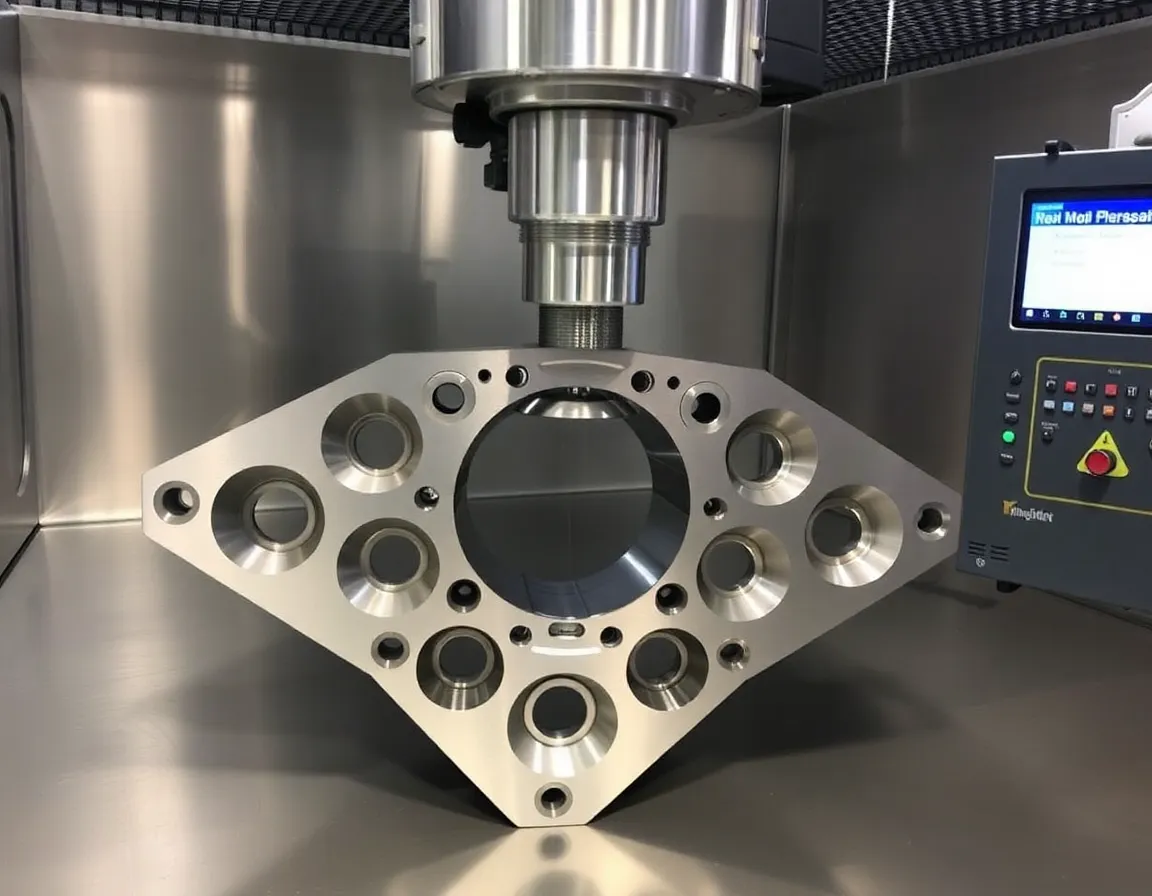
High-precision 5 axis CNC milling services for aerospace, impellers, and complex prototypes in aluminum, titanium & stainless steel. Get a quote.
Machines intricate geometries without repositioning, ensuring perfect accuracy and alignment.
Optimal tool positioning reduces manual finishing, delivering smoother, higher-quality surfaces.
Single setup and simultaneous 5-axis movement drastically cut machining cycle times.
Eliminates need for complex custom fixtures, lowering overall project setup costs.
5 axis cnc milling services solutions are available with stable quality control, flexible manufacturing capacity, and responsive technical support. Contact us for drawings review and quotation.
5 axis CNC milling services involve machining a part from solid material using a cutting tool that can move along five different axes simultaneously. Unlike 3-axis machining (X, Y, Z), a 5-axis machine adds two rotational axes (typically A and B), allowing the tool to approach the workpiece from virtually any direction. This means the part can be set up once and complex geometries, undercuts, and contours on multiple sides can be machined in a single operation. It's a transformative technology that enables the production of highly intricate, organic shapes—common in aerospace, automotive, and medical components—that are simply impossible or prohibitively inefficient to produce with traditional 3-axis methods.
The process begins with you providing a 3D CAD model (e.g., STEP or IGES file) of your part. The engineering team then analyzes the design for manufacturability and may suggest optimizations. Using advanced CAM software, a programmer creates the toolpaths, simulating the entire machining process to avoid collisions and ensure precision. The machine setup involves loading the raw material (like metal or plastic block) and the necessary cutting tools. During machining, the computer-controlled machine dynamically moves the cutting tool and/or rotates the workpiece on the two additional axes, allowing it to reach complex angles without manual repositioning. Finally, the finished part is inspected for quality before shipment. Clear communication and accurate models are key to a smooth process.
The primary benefits are unparalleled design freedom, improved accuracy, and reduced production time. You can manufacture complex, sculpted geometries in a single setup, which eliminates errors from repositioning and significantly boosts precision. This single-setup advantage also drastically cuts lead times and labor costs. Furthermore, 5-axis machining allows for the use of shorter cutting tools that can move at higher speeds, resulting in better surface finishes and extended tool life. It enables the production of lighter, stronger parts with internal features that are otherwise unachievable. Whether you need prototypes or end-use components, these services provide superior part integrity, reduced assembly needs (by machining as one piece), and overall cost-effectiveness for complex designs.
Absolutely. While the hourly machine rate for 5-axis services is typically higher than for 3-axis, the total project cost for complex parts is often lower and the value is greater. For prototypes and small batches, the ability to machine a part in one setup eliminates costly fixtures and multiple operations, saving significant time and reducing cumulative error. The accuracy is exceptional, as the part isn't moved between setups, maintaining tight tolerances across all features. This makes it ideal for prototyping functional components that mimic final production performance. Many machine shops offer these services specifically for low-volume, high-value projects. The key is to discuss your budget and requirements upfront; for suitably complex designs, 5-axis machining is frequently the most efficient and precise choice, even for small quantities.
Pricing and lead time depend on several key factors: Part Complexity dictates programming and machining time—intricate geometries take longer. Material Choice affects both raw material cost and machining parameters (e.g., titanium vs. aluminum). Required Tolerances and Surface Finish influence machining speed, inspection time, and potential secondary operations. Quantity determines if costs are amortized across multiple parts. Finally, the shop's expertise and machine availability are crucial. The process generally involves a quote based on your CAD model, which includes material, programming, machine time, and post-processing. While per-hour costs are higher, the single-setup efficiency often results in a faster overall turnaround compared to multi-step 3-axis machining for complex parts. Always request a detailed quote to understand the cost breakdown.
Our aerospace prototype required impossibly tight tolerances on complex organic shapes. The 5-axis m
Overall, fantastic work on our medical device molds. The undercuts and intricate channels were machi
Game-changer for our custom automotive parts business. We sent them a 3D model for a turbo manifold,
Used their service for a small batch of architectural aluminum sculptures. The ability to machine fr