
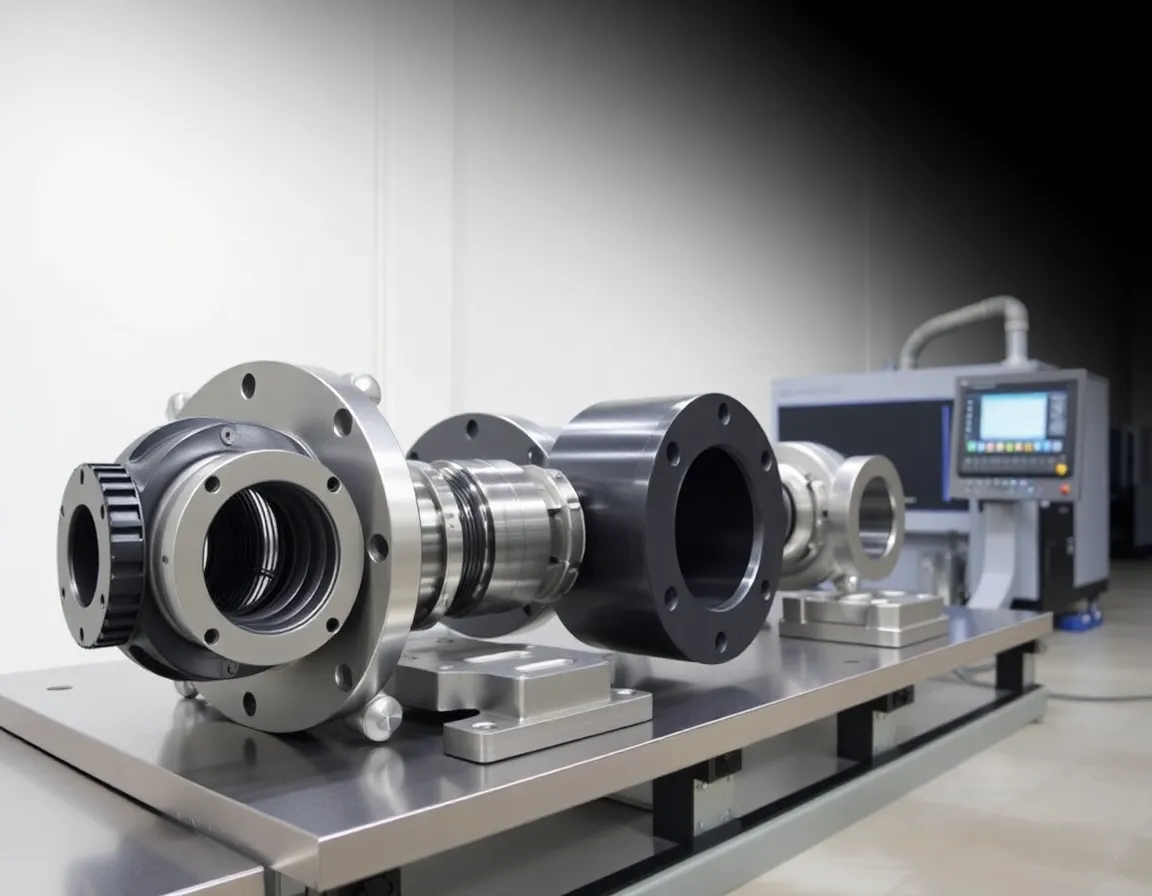
3+2 axis cnc machining solutions are available with stable quality control, flexible manufacturing capacity, and responsive technical support. Contact us for drawings review and quotation.
In the world of precision manufacturing, 3+2 axis CNC machining represents a sophisticated evolution beyond standard three-axis milling, offering a powerful balance of flexibility, accuracy, and efficiency.
Machines intricate features and undercuts in a single setup, expanding design possibilities.
Reduces manual repositioning, significantly cutting cycle times and boosting throughput.
Optimal tool orientation minimizes tool marks, delivering smoother, more precise parts.
Eliminates need for expensive 5-axis machines or multiple fixtures, reducing part cost.
3+2 axis cnc machining solutions are available with stable quality control, flexible manufacturing capacity, and responsive technical support. Contact us for drawings review and quotation.
3+2 axis CNC machining, also known as positional 5-axis machining, is a process where a 3-axis milling program is executed while the cutting tool and the workpiece are held in a fixed, tilted position using the two rotational axes of the machine. Unlike continuous 5-axis machining where all axes move simultaneously during cutting, in 3+2 the rotary axes position the part, then lock in place for a 3-axis cutting operation. The key difference from standard 3-axis machining is this ability to tilt the part, allowing the tool to approach the workpiece from multiple angles in a single setup. This enables machining of complex features on five sides of a part without manual repositioning, bridging a significant capability gap between 3-axis and full 5-axis machining.
In practice, 3+2 axis CNC machining works by using the machine's two rotational axes (typically an A-axis that tilts and a C-axis that rotates) to orient the workpiece at a specific, fixed angle relative to the spindle. Once the optimal angle is achieved—for example, to get a drill or end mill perpendicular to a slanted surface—the rotations stop and lock. The machine then performs a standard 3-axis (X, Y, Z linear movement) cutting operation on that now-accessible surface. The programmer creates the toolpath for this tilted plane, often using CAM software capable of multi-axis positioning. This sequence repeats for different part orientations within the same program. It effectively allows a single setup to machine multiple faces and complex angles, drastically reducing setup time and improving accuracy compared to manually re-fixturing the part on a 3-axis machine.
The primary benefits of 3+2 axis CNC machining are reduced setup time, improved accuracy for complex parts, and access to geometries difficult for 3-axis machines. By machining five sides of a part in one fixture setup, you eliminate the cumulative errors that come from manually repositioning the workpiece multiple times, leading to higher precision and better feature alignment. It allows the use of shorter, more rigid cutting tools because the head can be tilted to maintain an optimal tool angle, which improves surface finish, extends tool life, and allows for higher feed rates. Furthermore, it enables the machining of undercuts and angled features without specialized fixtures. This makes it a highly cost-effective solution for complex components like molds, aerospace brackets, and automotive parts that require multi-sided machining but may not need the simultaneous motion of full 5-axis.
A common concern is that 3+2 axis CNC machining is not suitable for machining highly complex, organic contours like impellers or turbine blades, which require the continuous, simultaneous movement of all five axes (true 5-axis). Its limitation is that it's a positional, not continuous, process. There can also be challenges with tool clearance and potential collisions in tightly tilted positions, requiring careful CAM programming and simulation. Furthermore, while it reduces setups, the initial programming is more complex and time-consuming than for a standard 3-axis job, which can impact upfront costs for simple parts. Not all machine shops have the necessary equipment or skilled programmers. It's crucial to discuss your specific part geometry with the manufacturer to determine if 3+2 is the optimal process or if 3-axis or continuous 5-axis would be more efficient.
3+2 axis CNC machining often has a higher hourly machine rate than 3-axis due to the more advanced equipment, but it can be significantly more cost-effective overall for suitable parts. The savings from reduced setup time, fewer fixtures, and completing a part in one operation frequently offset the higher machine cost. The process for getting a quote is similar to other CNC machining: you provide a detailed 3D CAD model (STEP or SLDPRT) and drawing with critical tolerances, materials, and finish requirements. The manufacturer will analyze the part to determine the optimal orientations and toolpaths. They will quote based on total machine time (including programming and setup), material cost, and any secondary operations. Be prepared to discuss your production volume, as this influences fixturing strategies. Always clarify if the quote includes full 5-axis simultaneous machining or the positional 3+2 approach, as costs and capabilities differ.
Our prototype parts needed complex contours and undercuts that our old 3-axis couldn't handle. Switc
Great results overall on our aluminum enclosures. The 3+2 machining allowed us to get clean holes an
As a small engineering firm, we outsource our complex components. Found a shop with 3+2 axis capabil
Used 3+2 machining for a limited run of sculptural architectural brackets. The ability to tilt the s