
In the high-stakes world of aerospace, energy, and automotive engineering, the demand for components that can withstand extreme pressures while maintaining peak efficiency is non-negotiable. Among these critical components, the impeller stands out as one of the most complex geometries to manufacture. Achieving the perfect balance of aerodynamic performance and structural integrity requires a specialized process known as 5 axis impeller machining. At Jucheng, we understand that producing these intricate parts is not just about having the right hardware; it involves a deep synergy between advanced software, expert craftsmanship, and a rigorous commitment to precision.
Whether you are sourcing components for a turbocharger, a jet engine, or a centrifugal pump, understanding the nuances of the manufacturing process may significantly impact your project outcomes. This guide explores the technical depths of impeller 5 axis production, the software environments that make it possible, and why choosing an experienced partner like jucheng is essential for your supply chain success.
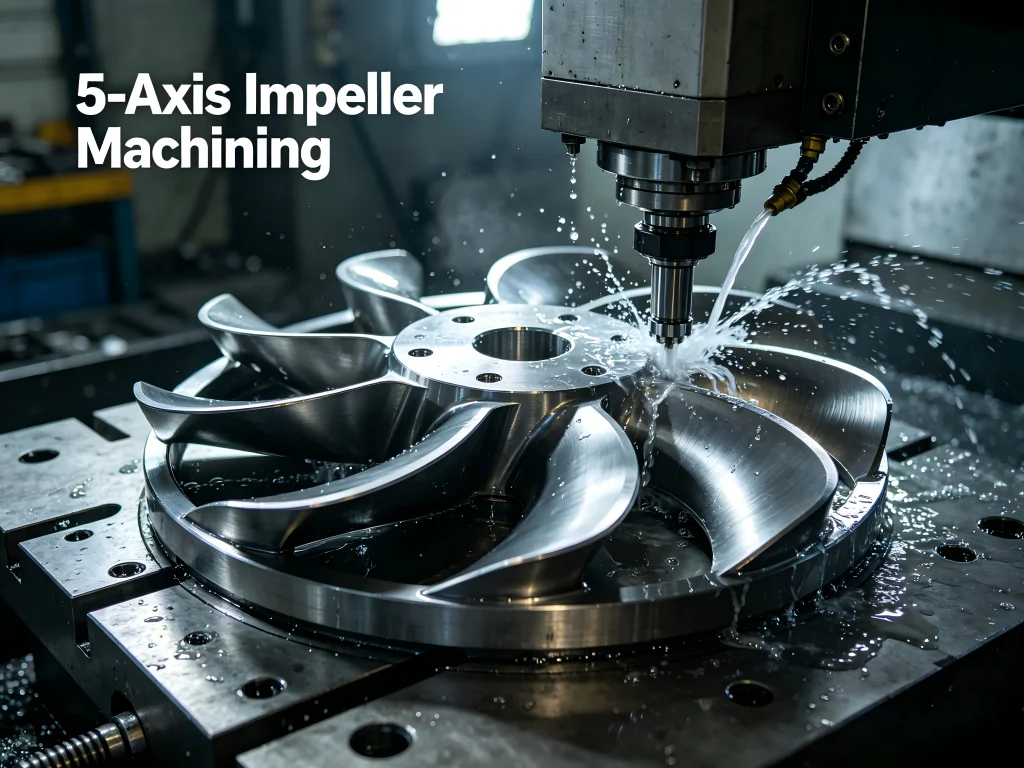
Understanding the Fundamentals: What is 5 Axis Machining?
To appreciate the complexity of impeller fabrication, one must first address the foundational question: what is 5 axis machining? In traditional machining, a tool moves across three linear axes: X, Y, and Z. While this is sufficient for flat or simple contoured parts, it fails when dealing with “undercuts” or deeply curved surfaces where the tool must tilt to avoid colliding with the workpiece.
Continuous 5-axis machining adds two rotational axes, typically referred to as A and B (or C). This allows the cutting tool to approach the workpiece from any direction. For an impeller, which consists of twisted blades radiating from a central hub, the ability to tilt the tool dynamically is the only way to reach the narrow channels between the blades. Without this technology, the smooth, aerodynamic surfaces required for fluid dynamics would be impossible to achieve in a single setup.
Industry professionals on platforms like Reddit and various CNC forums often discuss the “learning curve” associated with these machines. It is not merely about the movement; it is about the coordination. 5 axis impeller machining requires the machine to maintain a constant tool center point while the part rotates and tilts. This level of synchronization ensures that the surface finish remains consistent, reducing the need for manual polishing which could otherwise compromise the aerodynamic profile.
The Geometry Challenge: Why Impellers Require 5-Axis Precision
Impellers are designed to move fluids—liquids or gases—by rotation. The blades are often thin, tapered, and highly curved. When we look at impeller 5 axis requirements, we see several challenges that 3-axis or even 3+2 axis machining cannot solve:
- Accessibility: The narrow spacing between blades means the tool must enter at an angle to avoid the “shroud” or the adjacent blade.
- Surface Integrity: Any vibration or tool chatter during the machining of thin blades can lead to scrap. 5-axis movement allows for shorter tool lengths, which increases rigidity.
- Constant Chip Load: By tilting the tool, the machine can maintain the optimal cutting angle, ensuring that the material is removed efficiently without overheating the part.
At jucheng, our engineering team utilizes high-end multi-axis centers to navigate these tight tolerances. We recognize that even a micron-level deviation in the blade thickness can lead to catastrophic failure in high-speed applications like turbo-machinery. Therefore, the integration of hardware and software becomes the backbone of our production strategy.
Software Mastery: Navigating 5 Axis Machining CATIA Workflows
The bridge between a design concept and a physical part is the CAM (Computer-Aided Manufacturing) software. In the world of high-end CNC, 5 axis machining catia is often considered the gold standard. CATIA provides a robust environment for defining complex toolpaths that are specifically optimized for turbomachinery.
When engineers use 5 axis machining catia modules, they can simulate the entire cutting process before a single chip is even made. This is crucial for 5 axis impeller machining because the risk of tool collision is extremely high. The software allows for:
- Multi-Blade Toolpath Generation: Automatically generating paths for the main blades and the “splitter” blades often found in modern impellers.
- Flank Milling: Using the side of the tool to finish the blade in a single pass, which significantly improves surface finish and reduces cycle time.
- Collision Avoidance: Real-time monitoring of the machine’s spindle, tool holder, and table to ensure no part of the machine touches the workpiece unexpectedly.
Our experts at jucheng rely on these advanced digital twins to verify that every impeller 5 axis project meets the exact specifications provided by our clients. This digital-first approach ensures that when we move to the physical machine, the process is predictable, repeatable, and efficient.
Core Application Scenarios for High-Precision Impellers
The versatility of 5 axis impeller machining makes it indispensable across various sectors. Each industry has unique demands regarding material and precision.
| Industry | Application | Primary Material | Key Requirement |
|---|---|---|---|
| Aerospace | Jet Engine Compressors | Titanium / Inconel | Extreme Heat Resistance |
| Automotive | Turbochargers | Aluminum Alloys | High Strength-to-Weight Ratio |
| Energy | Gas Turbines / Pumps | Stainless Steel | Corrosion Resistance |
| Medical | Centrifugal Blood Pumps | Medical Grade Plastics/Titanium | Biocompatibility & Smooth Flow |
In the automotive sector, for instance, the focus may be on mass-producing lightweight aluminum impellers that can spin at over 100,000 RPM. Conversely, in the energy sector, an impeller might be several feet in diameter and made of hardened stainless steel to withstand abrasive fluids. jucheng has the capacity to handle this spectrum of requirements, providing tailored solutions regardless of the application’s scale.
Critical Factors When Sourcing 5-Axis Machining Services
Choosing a vendor for 5 axis impeller machining is a high-stakes decision. If you are a procurement officer or an engineer, you should evaluate potential partners based on the following criteria:
1. Machine Capability and Rigidity
Not all 5-axis machines are equal. For high-precision impeller 5 axis work, the machine must have high dynamic stability. Look for providers who use premium brands like Hermle, Mazak, or DMG Mori. These machines offer the thermal stability needed for long finishing cycles where even a small temperature shift could alter the part’s dimensions.
2. Technical Expertise in Programming
As mentioned, the proficiency in 5 axis machining catia or similar platforms is vital. Ask your provider about their toolpath strategies. Do they use point-to-point milling or flank milling? Their answer will tell you a lot about their understanding of surface finish and production efficiency.
3. Material Experience
Machining titanium is vastly different from machining aluminum. Titanium’s low thermal conductivity means heat stays at the cutting edge, which could lead to rapid tool wear. A provider like jucheng, with experience in exotic alloys, knows how to manage tool coatings and coolant pressures to maintain part integrity.
4. Inspection and Quality Control
An impeller is only as good as its verification. Ensure your partner uses Coordinate Measuring Machines (CMM) and perhaps even 3D laser scanning to verify the blade profiles against the original CAD model. At jucheng, we provide comprehensive inspection reports to guarantee that every dimension is within tolerance.
Installation and Maintenance of CNC Equipment
While most of our clients are looking for finished parts, some are interested in the operational side of 5 axis impeller machining. Maintaining a 5-axis environment requires a specialized approach:
- Calibration: The geometric accuracy of a 5-axis machine must be checked regularly using a “ball bar” test. Any misalignment in the rotary axes will result in errors that compound as the tool moves.
- Spindle Health: Since impeller machining often involves high speeds for long durations, spindle vibration monitoring is crucial to prevent premature failure.
- Tool Management: Using high-quality solid carbide end mills with specialized coatings (like AlTiN) is necessary for tough materials. Routine replacement schedules prevent tool breakage that could ruin a nearly finished impeller.
Why Choose Jucheng for Your CNC Machining Needs?
When it comes to 5 axis impeller machining, jucheng stands at the intersection of technology and experience. Our facility is equipped with state-of-the-art multi-axis centers designed to tackle the most demanding geometries. But our true strength lies in our people. Our engineers are experts in 5 axis machining catia, allowing us to optimize toolpaths for both speed and precision.
We take pride in our ISO-certified quality management systems, ensuring that every impeller 5 axis component we ship meets international standards for safety and performance. Our clients choose us because we offer:
- Rapid turnaround times without sacrificing quality.
- Competitive pricing through optimized manufacturing processes.
- Deep technical support from design for manufacturability (DFM) to final inspection.
- A commitment to transparency and communication throughout the project lifecycle.
By partnering with jucheng, you are not just getting a parts supplier; you are gaining a strategic ally dedicated to the success of your most complex engineering challenges.
Frequently Asked Questions (FAQ)
What is the primary benefit of 5 axis impeller machining over traditional methods?
The primary benefit is the ability to machine complex, curved surfaces and undercuts in a single setup. This leads to much higher precision, better surface finishes, and reduced lead times by eliminating the need for multiple fixtures.
How does Jucheng ensure the balance of high-speed impellers?
We use high-precision CNC equipment to maintain symmetrical material removal. After machining, we can perform dynamic balancing tests to ensure the part operates smoothly at high RPMs without vibration.
Can you machine impellers from hardened steel or titanium?
Yes, jucheng has extensive experience in machining difficult-to-cut materials. We use specialized tooling and optimized 5 axis impeller machining strategies to handle the high heat and forces associated with these metals.
Is 5 axis machining catia the only software used for this process?
While CATIA is a leader in the field, other platforms like Mastercam or Hypermill are also used. However, CATIA’s integration with aerospace design standards makes it a preferred choice for complex impeller 5 axis projects.
What tolerances can be achieved in 5-axis machining?
Depending on the material and part size, we could achieve tolerances as tight as +/- 0.005mm. However, standard tolerances for most impellers are typically within the +/- 0.02mm range to balance cost and performance.
Does Jucheng offer prototyping services for new impeller designs?
Absolutely. We often work with R&D departments to produce single prototypes for testing. Our 5 axis impeller machining capabilities allow us to iterate designs quickly before moving to full-scale production.
What is the typical lead time for a custom impeller?
Lead times vary based on complexity and material availability. Generally, a custom impeller 5 axis project might take anywhere from 2 to 6 weeks, including material sourcing and final quality inspections.
How do I get a quote for my impeller project?
You may visit our website at jucheng and upload your CAD files. Our team will review the geometry and provide a detailed quote, often within 24-48 hours.
Conclusion: The Future of Precision Manufacturing
As industries push for higher efficiency and lower emissions, the role of the impeller becomes even more critical. The evolution of 5 axis impeller machining continues to move toward more automated, software-driven processes that minimize human error. Whether it is through the sophisticated algorithms in 5 axis machining catia or the incredible hardware precision found at jucheng, the goal remains the same: perfection in motion.
If your project demands the highest level of accuracy and reliability, it is time to work with a team that understands the complexities of impeller 5 axis fabrication. We invite you to explore the possibilities of precision CNC with jucheng, where your most challenging designs become a reality.
Ready to elevate your manufacturing standards? Contact jucheng today to discuss your next 5 axis impeller machining project. Our team of experts is standing by to provide the technical insight and production capacity you need to succeed in today’s competitive landscape.