
A CNC machining lead time is the calendar interval from a usable order release to the point when conforming parts are ready for the agreed next step—not the number of minutes a cutter spends removing material. A date can move even when the programmed cycle time is unchanged: a drawing clarification, material availability, a first-article correction, finishing queue, or inspection hold may sit outside the spindle schedule. To evaluate a quoted date, ask which events it includes, what starts the clock, and which inputs are still open.
Define the clock before comparing dates
“Lead time” is often used for several different measures. A supplier may quote time to first article, time to ship the first accepted lot, or time to complete the full order. Those are not interchangeable. Nor is quoted production lead time necessarily the same as transit time, customs clearance, or the date parts arrive at your dock.
Before comparing suppliers, align the start and finish points. Does the clock begin after purchase-order receipt, deposit, drawing approval, material confirmation, or completion of a design-for-manufacturing review? Does it stop at machining completion, inspection release, surface-treatment completion, packing, or carrier pickup? A short written definition prevents a low-looking number from concealing excluded steps.
It also helps to separate elapsed calendar time from active processing time. Programming, machine setup, cutting, deburring, measurement, outside finishing, and shipping can each be active tasks, but the total calendar interval also contains queueing and handoffs. A part may spend more time waiting for a decision or a finishing slot than it spends under a cutting tool.
Where calendar time accumulates
 A typical sequence starts with a complete RFQ package, followed by drawing and model review, clarification, process planning, material procurement, programming, workholding preparation, machining, deburring, inspection, optional finishing, final verification, packing, and dispatch. The actual route depends on geometry, quantity, material, drawing requirements, and the required delivery condition; not every job needs every stage.
The process map matters because the first date estimate may be made before every dependency is known. For example, machining can be ready to start while a material certificate, revised model, approved finish sample, or inspection criterion remains unresolved. If the supplier and buyer do not identify the owner of that decision, the schedule appears to “slip” without a visible change to the machine plan.
For a broader view of how review, programming, machining, and inspection connect, see the site’s CNC 가공 공정 가이드. For work moving from a prototype quantity toward repeat production, the prototyping and production overview explains why a proven sample does not automatically remove every production-readiness step.
A typical sequence starts with a complete RFQ package, followed by drawing and model review, clarification, process planning, material procurement, programming, workholding preparation, machining, deburring, inspection, optional finishing, final verification, packing, and dispatch. The actual route depends on geometry, quantity, material, drawing requirements, and the required delivery condition; not every job needs every stage.
The process map matters because the first date estimate may be made before every dependency is known. For example, machining can be ready to start while a material certificate, revised model, approved finish sample, or inspection criterion remains unresolved. If the supplier and buyer do not identify the owner of that decision, the schedule appears to “slip” without a visible change to the machine plan.
For a broader view of how review, programming, machining, and inspection connect, see the site’s CNC 가공 공정 가이드. For work moving from a prototype quantity toward repeat production, the prototyping and production overview explains why a proven sample does not automatically remove every production-readiness step.
What makes two similar parts take different time
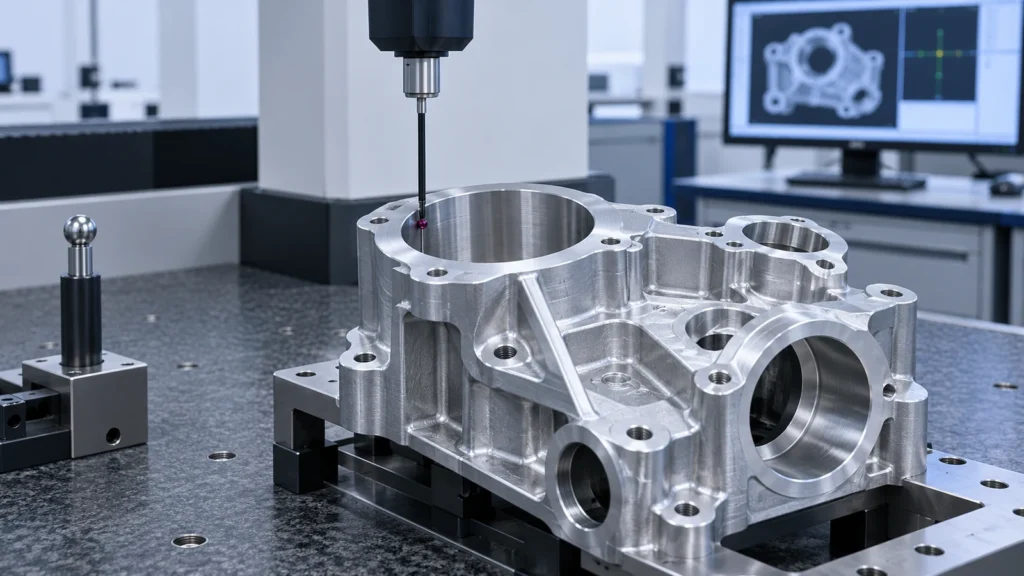 Part size alone is a poor predictor. The features that create schedule risk are often the ones that require an extra setup, a special tool, careful workholding, a controlled sequence, or a measurement that cannot be completed until another operation is finished.
Quantity changes the route as well. A one-off may require programming and setup that are not repeated for every piece; a larger lot may need staged inspection, additional material planning, or multiple machine loads. That does not mean higher quantity always takes longer—the relevant question is which constraint governs the whole order.
Very tight or ambiguous tolerances can also add process planning and verification. The objective is not to relax functional requirements, but to distinguish critical interfaces from non-critical dimensions and state how each will be inspected. The CNC 가공 공차 가이드 covers how drawing requirements affect manufacturing and measurement decisions.
How buyers can reduce avoidable waiting
The most reliable schedule improvement often comes before the purchase order. Send a single package containing the current 2D drawing, the matching 3D model, material and finish requirements, quantity, ship-to location, required documents, and the date by which parts must be usable. Call out critical dimensions and functional relationships instead of asking a supplier to infer them from scattered notes.
- Freeze the drawing revision for quotation and identify the approver for later changes.
- Resolve whether material substitutions, split shipments, or partial first-article approval are acceptable.
- Provide the inspection plan early, especially for position, profile, fit, or special reporting requirements.
- Respond to clarification requests through one decision owner and return consolidated answers.
- Confirm whether finishing is included in the required delivery state, not merely in the machining estimate.
These actions do not guarantee a shorter quoted interval; they reduce uncertainty that can otherwise turn into idle time or a late change. On the supplier side, a credible schedule should identify assumptions and milestone gates rather than hiding them behind one unexplained number. Cost and timing often share the same process drivers, as outlined in the CNC machining cost article.
When expediting helps—and when it does not
Expediting can help when the constraint is controllable: a confirmed machine slot, a decision that can be made sooner, an approved split shipment, or a finish route with available capacity. It is less useful when the bottleneck is an unavailable specified material, a required approval that has not been assigned, or a feature that needs a genuinely different process sequence. Moving work faster through one stage can simply create a queue at the next.
Ask for a revised milestone plan: what can move, what cannot, what tradeoff is involved, and whether the expedited route changes inspection coverage, batch consistency, finishing, or freight. Do not treat a faster promise as equivalent if it silently removes a required acceptance step.
A practical delivery commitment is therefore a shared plan, not just a date. It connects a defined clock to a frozen technical package, visible dependencies, and agreed acceptance criteria. The more complete those inputs are at release, the more useful the quoted CNC machining lead time becomes for production planning.
자주 묻는 질문
Does CNC machining lead time include shipping?
Not automatically. Confirm whether the quoted interval ends at machining completion, inspection release, dispatch, or delivery at your facility. Transit and customs may be separate.
Is cycle time the same as lead time?
No. Cycle time is the active time to run an operation or part. Lead time includes queueing, material procurement, setup, processing, inspection, finishing, approval, packing, and any other agreed stages.
Why can a repeat order still take longer than expected?
A repeat order may still depend on current material availability, revised drawings, changed quantities, finishing capacity, or a new inspection requirement. Confirm what is unchanged and what must be revalidated.
What should I send to get a dependable delivery estimate?
Provide a controlled drawing and matching model, material and finish specifications, quantity, critical inspection requirements, delivery destination, and any approval or documentation needs. Identify who can answer technical questions promptly.