
Vous avez passé des semaines à concevoir un composant critique — une poignée d'instrument chirurgical, un boîtier de capteur aérospatial ou un porte-galet de plaquette semi-conductrice. La spécification matériau exige du PEEK vierge, et vous vous êtes procuré la matière première coûteuse. Puis l'usinage CNC commence et, en quelques heures, la pièce se gauchit, l'état de surface ressemble à du papier de verre et l'outil s'est usé au-delà des limites acceptables. Ce scénario se répète chaque jour dans les ateliers d'usinage du monde entier. La bonne nouvelle ? Il est tout à fait évitable. Ce guide explique précisément comment usiner le PEEK vierge avec succès — de la compréhension de ce qui rend ce matériau extraordinaire à la maîtrise des vitesses, des avances et des techniques qui garantissent des résultats précis et constants.
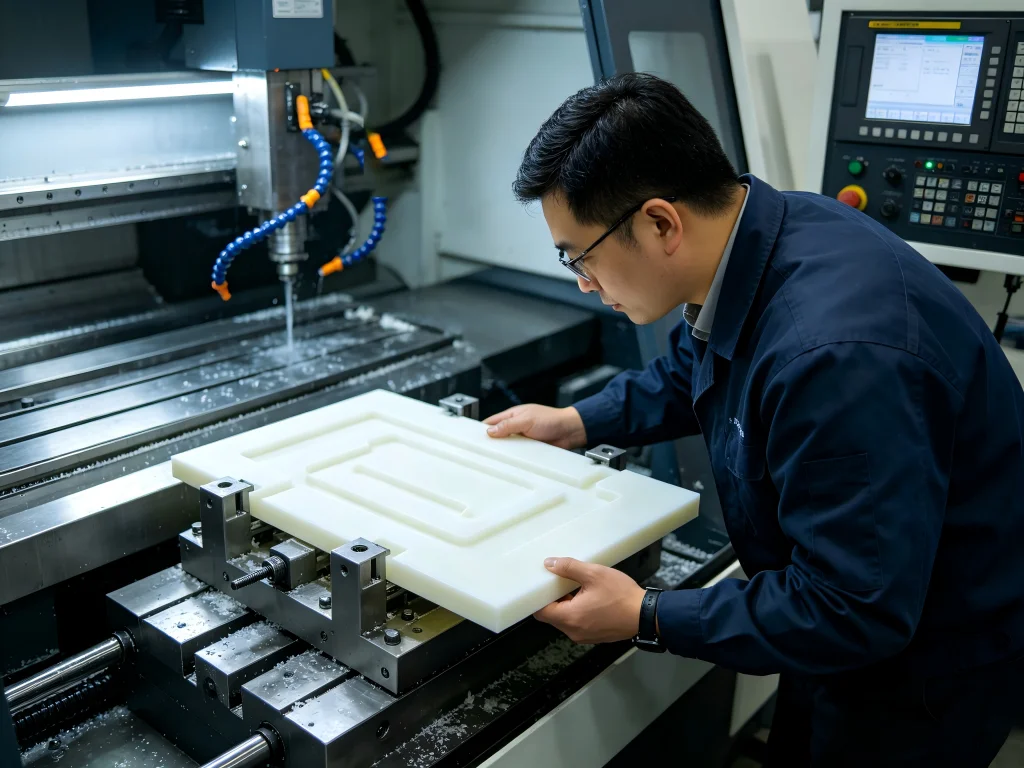
Ce qui rend le PEEK vierge différent de tous les autres plastiques que vous avez usinés
Le PEEK vierge — polyétheréthercétone sous sa forme pure, non chargée — se situe au sommet de la pyramide des thermoplastiques techniques. C'est un polymère semi-cristallin avec une température de service continu de 260 °C (500 °F) et un point de fusion d'environ 343 °C (649 °F). Le matériau offre une résistance chimique exceptionnelle, d'excellentes propriétés de frottement et une remarquable stabilité dimensionnelle. Il résiste à l'hydrolyse, à la vapeur surchauffée et à un large éventail de produits chimiques agressifs. À l'état vierge, il présente la ténacité et l'allongement les plus élevés de toutes les nuances de PEEK, ce qui le rend particulièrement adapté aux implants médicaux, aux isolateurs électriques et aux composants de transformation alimentaire.
Mais voici ce que la fiche technique du matériau ne vous dit pas. Le PEEK vierge ne se comporte pas du tout comme l'acétal, le nylon ou les autres plastiques techniques que vous avez pu usiner. Sa température de transition vitreuse de 143 °C (289 °F) signifie qu'il reste rigide à des températures où d'autres polymères deviennent collants. C'est excellent pour la pièce finie, mais cela crée de réels défis en atelier. Le matériau ne forme pas les copeaux faciles à briser que produit l'acétal — les copeaux peuvent être filandreux et se ressouder à la surface si les vitesses de coupe sont trop faibles.
Le facteur le plus critique qui distingue un usinage réussi du PEEK vierge des échecs coûteux est peut-être les contraintes internes. Les barres et plaques de PEEK extrudé refroidissent de l'extérieur vers l'intérieur, emprisonnant des contraintes de compression dans la couche superficielle et des contraintes de traction dans le cœur. Lorsque vous enlevez de la matière, vous perturbez cet équilibre de contraintes. Sur une barre de 100 mm de diamètre en matière non recuite, un déplacement de 0,13 à 0,38 mm après ébauche est tout à fait possible. C'est plus grand que de nombreuses tolérances CNC standard. Une coupe droite peut se transformer en forme de banane sous vos yeux.
Et il y a ensuite la considération de coût. Une barre de PEEK vierge non chargé de 50 mm de diamètre sur 300 mm de long coûte de $150 à $300 selon la nuance. Mettre une pièce au rebut ne coûte pas seulement du temps de cycle — cela coûte plus de $100 en matière première à lui seul. C'est pourquoi l'usinage du PEEK vierge exige plus de planification, plus de contrôle du processus et plus de connaissances spécifiques au matériau que tout autre plastique technique.
Les cinq défis majeurs de l'usinage du PEEK vierge
Comprendre les obstacles est la première étape pour les surmonter. D'après une vaste expérience en atelier et les retours des communautés d'usinage, voici les cinq défis qui reviennent systématiquement lorsque les ateliers tentent d'usiner le PEEK vierge.
1. Accumulation de chaleur et gestion thermique
Le PEEK vierge a une faible conductivité thermique. Il ne dissipe pas la chaleur comme les métaux. La chaleur générée à l'interface de coupe reste concentrée, ramollissant le polymère et provoquant des bavures, une fusion ou une déformation. C'est la cause la plus fréquente d'un mauvais état de surface et d'une dérive dimensionnelle lors de l'usinage du PEEK.
Les machinistes expérimentés sur les forums soulignent fréquemment que la gestion de la chaleur est plus importante que tout autre paramètre. Un utilisateur de Reddit a noté : “ Traitez le PEEK comme s'il voulait fondre si vous le regardez de travers — parce qu'avec les mauvaises vitesses et avances, c'est pratiquement ce qui se passe. ” Le consensus parmi les professionnels est clair : gardez l'outil en mouvement, évitez les temps d'arrêt et privilégiez l'évacuation des copeaux.
2. Contraintes résiduelles et gauchissement
Comme mentionné précédemment, les contraintes internes issues du processus d'extrusion sont l'ennemi caché de l'usinage de précision du PEEK. Les ateliers conventionnels qui traitent le PEEK vierge comme n'importe quel autre plastique ne découvrent souvent le gauchissement qu'après le retrait de la pièce du montage — moment où il est trop tard. Les composants à parois minces sont particulièrement vulnérables.
Un fournisseur aérospatial a rapporté que l'omission de l'étape de recuit a entraîné un taux de rejet de 22% dû à l'ovalisation et à la distorsion. Après la mise en œuvre de procédures appropriées de relaxation des contraintes, ce taux est tombé en dessous de 1%.
3. Tool Wear and Selection
Virgin PEEK may be unfilled, but it is still abrasive enough to dull standard carbide cutters rapidly. Dull tools increase cutting forces, generate more heat, and produce poor surface finishes. The machining community consistently recommends micro-grain solid carbide tools with polished flutes for unfilled PEEK. Silicon carbide tools are another good option.
One shop supervisor put it this way: “If you hear your tool squeaking or see any discoloration on the chips, stop immediately. Your tool is already gone, and you are just burning money.”
4. Chip Control and Evacuation
Virgin PEEK produces stringy, continuous chips that can wrap around the tool or reweld to the workpiece surface. Poor chip evacuation leads to re-cutting, increased heat, and surface defects. Compressed air or vacuum systems are essential for clearing chips effectively.
5. Surface Finish and Burr Formation
PEEK tends to fray and burr, especially around small features, internal threads, or edges. For medical and aerospace components where debris is unacceptable, this creates significant quality challenges. High-speed micro-deburring tools, laser deburring, and single-flute reamers are common solutions.
Machining Virgin PEEK: Speeds, Feeds, and Parameters That Work
Getting the numbers right transforms Virgin PEEK machining from a gamble into a predictable process. The following parameters represent industry consensus based on extensive testing and real-world production experience.
Recommended Cutting Parameters for Virgin PEEK
| Operation | Cutting Speed (m/min) | Feed Rate | Depth of Cut | Tool Recommendation |
|---|---|---|---|---|
| Milling – Roughing | 150 – 300 | 0.05 – 0.15 mm/tooth | 0.5 – 1.0 mm axial | Micro-grain carbide, 2-3 flute |
| Milling – Finishing | 200 – 400 | 0.05 – 0.10 mm/tooth | 0.1 – 0.3 mm | Sharp carbide, polished flutes |
| Turning | 200 – 400 | 0.10 – 0.30 mm/rev | 0.5 – 2.0 mm | Carbide with positive rake |
| Drilling | 50 – 100 | 0.05 – 0.15 mm/rev | N/A | Sharp HSS or carbide, frequent retract |
Source: Industry machining guides and parameter databases
The sweet spot for unfilled Virgin PEEK milling is generally 300–600 SFM (91–183 m/min)—roughly twice the speed used for acetal. For a 6 mm two-flute carbide cutter at 180 m/min, this converts to approximately 9,550 RPM with a feed of about 764 mm/min at 0.04 mm/tooth.
Climb milling is strongly preferred over conventional milling. It produces lower cutting forces, better surface finish, and less heat input. For threading, single-point threading on a lathe produces the most accurate PEEK threads.
Cooling Strategies That Protect Both Tool and Part
The cooling approach depends on the application. For industrial-grade Virgin PEEK, flood coolant with a water-soluble or light oil-based coolant works well. High-pressure nozzles should target the tool-workpiece interface directly.
For medical-grade Virgin PEEK, however, oil-based coolants must be avoided to maintain biocompatibility. Compressed air at 5–7 bar or deionized water is the standard approach. Keep the air nozzle moving to avoid local chilling, which can induce brittleness.
Some shops report success with minimum quantity lubrication (MQL) for less aggressive operations. Flood coolant is generally not recommended for PEEK, as thermal shock from cold coolant on a warm part can induce micro-cracks.
The Annealing Protocol: Your Insurance Policy Against Warping
If there is one step that separates professionals from amateurs in Virgin PEEK machining, it is annealing. This thermal treatment relieves internal stresses, increases crystallinity to 35–40%, and stabilizes the material structure. Skipping it risks dimensional drift and part rejection during final inspection.
Annealing raw Virgin PEEK stock before machining is standard practice. The process involves:
- Ramp: Heat the material gradually to 200–220°C in a controlled oven
- Soak: Maintain temperature for 1–2 hours, with approximately 30 minutes per 10 mm of material thickness
- Slow Cool: Turn off the oven and allow the material to cool to room temperature over several hours—never remove parts while hot
For complex parts with heavy material removal, an intermediate anneal after rough machining and before finishing is highly recommended. This allows stresses released during roughing to stabilize before the final precision cuts.
One Jucheng Precision engineer describes the annealing process as the “secret that unlocks the full potential of Virgin PEEK”. The material arrives with internal stresses that are invisible but very real. Cutting away the stressed outer layers without first relieving those stresses causes the material to move, warp, or bend during machining.
Where Virgin PEEK Components Make the Difference
Virgin PEEK’s unique combination of properties—biocompatibility, chemical resistance, thermal stability, and mechanical strength—makes it the material of choice across multiple demanding industries.
Medical and Healthcare Applications
Virgin PEEK’s biocompatibility and radiolucency (transparency to X-rays) have revolutionized medical device manufacturing. It is used for spinal fusion cages, cranial implants, surgical instruments, and endoscope components. The material can be sterilized repeatedly via steam autoclave, gamma radiation, or ethylene oxide without degradation.
Medical-grade Virgin PEEK must meet ISO 10993 and USP Class VI standards. Machining these parts requires exceptionally clean environments and processes that maintain material purity.
Aérospatiale et défense
In aerospace applications, Virgin PEEK replaces metal in mission-critical but non-structural components: clips, spacers, insulators, and fluid connectors. The material offers a strength-to-weight ratio comparable to aluminum at half the weight. Its flame retardancy (UL 94 V-0 rating) and low smoke emission make it suitable for aircraft interior applications.
Semiconductor and Electronics
Virgin PEEK’s electrical insulation properties, chemical resistance, and thermal stability make it ideal for semiconductor wafer carriers, electrical insulators, and connector housings. The material maintains its properties in cleanroom environments and resists the aggressive chemicals used in semiconductor manufacturing.
Oil and Gas
Downhole drilling environments demand materials that withstand extreme temperatures, pressures, and chemical exposure. Virgin PEEK components—seals, backup rings, and electrical connectors—perform reliably where other plastics fail.
Achievable Tolerances and Quality Standards
With proper technique and process control, Virgin PEEK can hold surprisingly tight tolerances. For most applications, standard machining achieves tolerances of ±0.05 mm (±0.002″). For high-precision components under controlled conditions, tolerances as tight as ±0.012 mm (±0.0005″) are achievable.
Surface finish requirements vary by application. Medical and aerospace components often specify Ra values below 0.8 μm. Achieving this requires sharp tools, fine finishing passes, and proper chip evacuation.
Quality verification typically involves coordinate measuring machine (CMM) inspection. Advanced shops like Jucheng Precision use Zeiss CMM metrology to verify every critical dimension.
Why Partner with a Specialist for Virgin PEEK Machining
Virgin PEEK machining is not a process that can be learned overnight. The material demands specific knowledge, disciplined processes, and specialized equipment. This is where partnering with an experienced CNC machining provider makes the difference between success and costly failure.
Jucheng Precision has extensive expertise in Virgin PEEK CNC machining services, processing premium PEEK grades from standard virgin material to specialized implantable grades. The company operates a high-precision manufacturing floor certified to AS9100 (aerospace), ISO 13485 (medical devices), IATF 16949 (automotive), and ISO 9001 quality standards.
What sets Jucheng apart in Virgin PEEK machining is the systematic approach to thermal management. The company has elevated annealing to a science, ensuring every component is dimensionally stable and structurally “dead”—meaning no residual stress remains to cause future warping. Their facility includes dedicated clean-room 5-axis CNC workstations managed by certified technicians.
The company’s knowledge base includes detailed guides on PEEK annealing, high-temperature stabilization, tool selection, and achieving low-volume precision for medical and aerospace prototypes. With over 150 CNC machines and advanced metrology equipment, Jucheng delivers components that meet the most demanding specifications.
For design engineers and procurement professionals, the value proposition is clear: Virgin PEEK is too expensive and too demanding to trust to a generalist shop. Working with a specialist who understands the material’s “personality” and has the process controls to match reduces risk, improves quality, and ultimately lowers total cost.
Frequently Asked Questions About Machining Virgin PEEK
1. What is the difference between Virgin PEEK and filled PEEK grades?
Virgin PEEK is the pure, unfilled polymer. It offers the highest toughness, elongation, and chemical resistance of all PEEK grades. Glass-filled PEEK (GF30) adds glass fibers for increased stiffness and creep resistance but is more abrasive to tools. Carbon-filled PEEK (CF30) provides the highest strength, stiffness, and wear resistance. Virgin PEEK is generally easier to machine than reinforced variants and is preferred for medical, food contact, and electrical insulation applications.
2. Can Virgin PEEK be machined on standard CNC equipment?
Yes, Virgin PEEK can be machined using standard metalworking CNC equipment. However, success depends on using the right tools, parameters, and processes. Standard metal-cutting parameters will not work—PEEK requires specific speeds, feeds, and cooling strategies. Shops without PEEK-specific experience often struggle with warping, poor surface finish, and excessive tool wear.
3. Why does Virgin PEEK warp during machining?
Warping occurs because extruded PEEK stock contains internal stresses from the cooling process. When you machine away material, you release these stresses unevenly, causing the part to deform. The solution is annealing—heating the material to 200–220°C before machining to relieve internal stresses. Intermediate annealing after roughing is also recommended for complex parts.
4. What tools work best for machining Virgin PEEK?
Micro-grain solid carbide tools with polished flutes provide the best combination of sharpness, edge retention, and cost for Virgin PEEK. Silicon carbide tools are another good option. Tools should have positive rake angles and sharp cutting edges. For filled PEEK grades, polycrystalline diamond (PCD) or diamond-coated tools may be necessary.
5. What are the recommended speeds and feeds for Virgin PEEK milling?
For milling Virgin PEEK, recommended cutting speeds range from 150–300 m/min for roughing and 200–400 m/min for finishing. Feed rates typically range from 0.05–0.15 mm/tooth. The sweet spot for unfilled PEEK is 300–600 SFM (91–183 m/min)—roughly twice the speed used for acetal. Climb milling is preferred over conventional milling.
6. What cooling method should I use for Virgin PEEK?
For industrial-grade Virgin PEEK, flood coolant with water-soluble or light oil-based coolant works well. For medical-grade PEEK, use compressed air at 5–7 bar or deionized water to maintain biocompatibility. Flood coolant is generally not recommended as thermal shock can induce micro-cracks. The primary goal is efficient chip removal.
7. What tolerances can Virgin PEEK achieve?
Standard machining achieves tolerances of ±0.05 mm (±0.002″) for most applications. Under controlled conditions with proper techniques, tolerances as tight as ±0.012 mm (±0.0005″) are possible. Achieving these tolerances requires annealing, sharp tools, proper cooling, and stable environmental conditions.
8. Is Virgin PEEK suitable for medical implants?
Yes, specific Virgin PEEK grades meet ISO 10993 and USP Class VI standards for biocompatibility. Medical-grade Virgin PEEK is used for spinal fusion cages, cranial implants, and surgical instruments. It is radiolucent (transparent to X-rays), allowing bone visibility in imaging. Machining medical-grade PEEK requires clean environments and processes that maintain material purity.
9. Why is Virgin PEEK so expensive?
Virgin PEEK is a high-performance engineering thermoplastic manufactured through complex polymerization processes. A 50 mm diameter by 300 mm long rod costs $150–300. The material’s exceptional properties—thermal stability to 260°C, chemical resistance, biocompatibility, and mechanical strength—justify the cost for mission-critical applications. Scrapping a part during machining adds significant expense, which is why proper process control is essential.
10. How does Virgin PEEK compare to metal for component manufacturing?
Virgin PEEK offers a strength-to-weight ratio comparable to some aluminum alloys at 50% lower weight. It provides chemical resistance that metals cannot match, resists corrosion, and is radiolucent for medical imaging. PEEK components can be machined to tight tolerances without the need for costly mold tooling. For applications requiring weight reduction, chemical resistance, or biocompatibility, Virgin PEEK often outperforms metal alternatives.
Putting It All Together: Your Virgin PEEK Machining Action Plan
Successful Virgin PEEK machining comes down to following a disciplined process. Here is a practical checklist based on industry best practices and shop-floor experience:
- Start with annealed stock—Never machine raw PEEK without first relieving internal stresses through controlled annealing
- Select the right tools—Micro-grain carbide with polished flutes for unfilled PEEK
- Optimize speeds and feeds—300–600 SFM for milling, with appropriate feed rates
- Use climb milling—Reduces cutting forces and heat generation
- Manage heat aggressively—Proper cooling and chip evacuation are non-negotiable
- Take light cuts—0.5–1.0 mm for roughing, 0.1–0.3 mm for finishing
- Avoid tool dwell—Keep the tool moving to prevent localized heating
- Consider intermediate annealing—For complex parts with heavy material removal
- Inspect regularly—Check tool edges and part dimensions throughout the run
- Work with specialists—Partner with a shop that understands PEEK’s unique requirements
Virgin PEEK machining is challenging, but it is not mysterious. The material behaves predictably when you understand its properties and respect its limitations. With the right knowledge, tools, and processes, you can consistently produce high-quality Virgin PEEK components that meet the most demanding application requirements.
Whether you are designing medical implants, aerospace components, or semiconductor equipment, the key to success lies in treating Virgin PEEK with the respect it deserves—and partnering with machining experts who have mastered the art and science of working with this extraordinary material.
Ready to discuss your Virgin PEEK machining project? Jucheng Precision’s team of PEEK machining specialists is available to review your design, recommend optimal grades and processes, and deliver precision components that meet your exact specifications. Contact Jucheng Precision today to start your project with a partner who understands what it takes to machine Virgin PEEK right the first time.