
Vous fixez une fiche technique de matériau. Deux colonnes. Le 303 à gauche. Le 304 à droite. Les chiffres se ressemblent : teneur en chrome similaire, pourcentages de nickel similaires, résistance à la traction similaire sur le papier. Mais tout machiniste vous le dira : ces deux alliages ne pourraient pas être plus différents sous un outil de coupe. L'un vous résiste à chaque étape. L'autre s'usine pratiquement tout seul.
Pour les ingénieurs, les spécialistes des achats et les responsables de production qui évaluent l'usinage de l'acier inoxydable 303 pour leur prochaine série de production, la décision porte rarement sur les seules propriétés du matériau. Elle porte sur le temps de cycle. La durée de vie des outils. Les taux de rebut. Le coût total par pièce finie. Et peut-être plus important encore, elle porte sur le choix d'un partenaire CNC qui sait comment tirer chaque once d'efficacité de cette remarquable nuance de décolletage.
Ce guide vous accompagne à travers les considérations essentielles pour l'usinage de l'acier inoxydable 303—de la compréhension de ce qui rend cet alliage unique à l'évaluation des fournisseurs et à la prise d'une décision d'achat en toute confiance. Que vous vous approvisionniez auprès d'un fournisseur d'acier inoxydable 303 en Malaisie ou que vous compariez des ateliers CNC dans le monde entier, le cadre présenté ici s'applique à tous les cas.
Le dilemme du machiniste : pourquoi le choix du matériau compte plus que vous ne le pensez
Imaginez ceci : vous avez une commande de production de 10 000 raccords en acier inoxydable. La conception exige une nuance d'inox austénitique avec une bonne résistance à la corrosion et une excellente usinabilité. Votre équipe d'ingénierie spécifie l'acier inoxydable 304 parce que c'est le choix “ standard ”. Six semaines plus tard, vous contemplez une montagne de rebuts, une usure excessive des outils et des temps de cycle qui ont fait exploser votre budget.
Qu'est-ce qui n'a pas fonctionné ? Le choix du matériau n'était pas aligné avec la réalité de la fabrication. Acier inoxydable 303 existe précisément pour éviter ce scénario. Comme l'a dit un machiniste sur Reddit : “ Le 303, c'est ce que le 304 souhaiterait pouvoir être quand les copeaux commencent à voler. ” Un autre utilisateur sur un forum CNC a noté : “ Je préfère usiner du 303 toute la journée plutôt que de me battre avec du 304 pendant une heure. La différence de durée de vie des outils à elle seule compense le surcoût du matériau. ”
Ce ne sont pas des opinions isolées. Elles reflètent une vérité fondamentale à propos de l'usinage de l'acier inoxydable 303: l'alliage a été conçu dès le départ pour résoudre un problème spécifique—la difficulté d'usiner les aciers inoxydables austénitiques standard.
Qu'est-ce que l'acier inoxydable 303 ? Le champion de l'usinage libre
Acier inoxydable 303 est la version à usinage libre de son célèbre cousin, le 304. La chimie de base est presque identique : tous deux sont des aciers inoxydables austénitiques 18-8 chrome-nickel avec une bonne résistance générale à la corrosion. Mais le 303 a un ingrédient secret—un ajout faible mais critique de soufre (généralement de 0,15% à 0,35%, avec des nuances premium comme celle d'Outokumpu offrant un minimum de 0,30%).
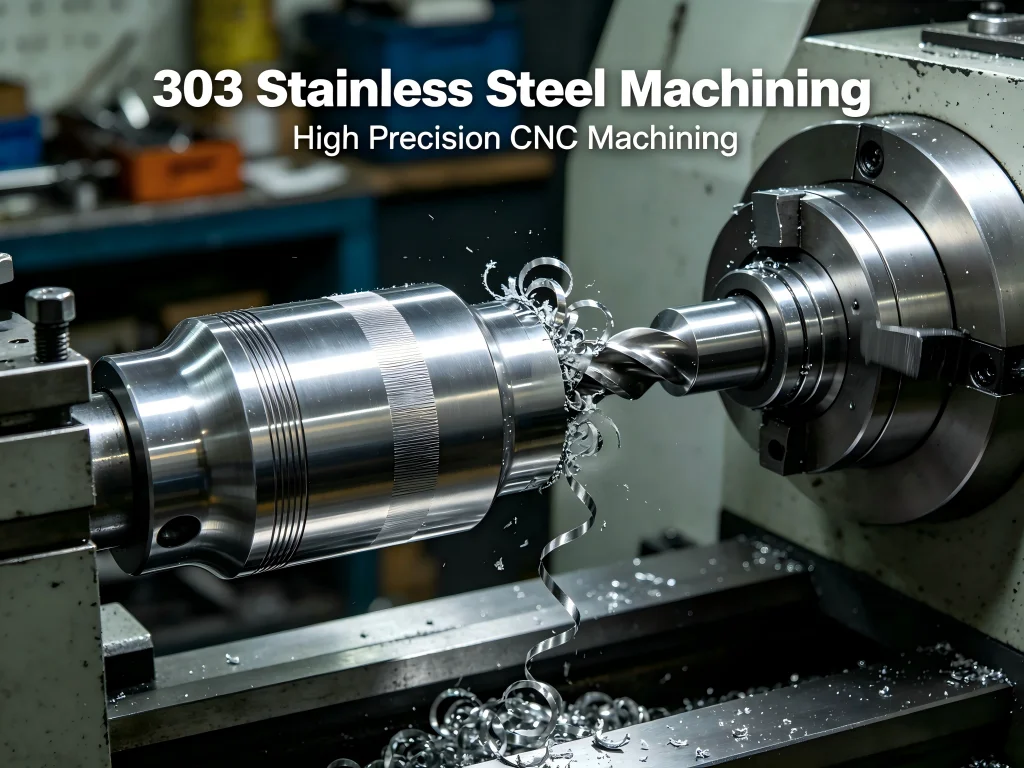
Cet ajout de soufre transforme le comportement du matériau pendant l'usinage de l'acier inoxydable 303. Le soufre forme de minuscules inclusions molles de sulfure de manganèse dans la microstructure de l'acier. Lorsqu'un outil de coupe rencontre l'une de ces inclusions, elle agit comme un brise-copeaux microscopique. Au lieu de former de longs copeaux filandreux et difficiles à gérer comme le 304, les copeaux du 303 se brisent en petits morceaux propres et faciles à gérer.
Ce n'est pas une amélioration mineure. L' indice d'usinabilité de l'acier inoxydable 303 est d'environ 75% à 78% du B1112, l'acier de référence à usinage libre. En termes pratiques, la, vitesse de coupe de l'acier inoxydable 303 peut être de 25% à 30% plus rapide que le 304 tout en maintenant une durée de vie d'outil acceptable. Pour la production à grande échelle, cela se traduit directement par un coût par pièce plus faible.
Cependant—et c'est un “ cependant ” critique—cet ajout magique de soufre est une arme à double tranchant. Les mêmes inclusions de sulfure qui rendent l'usinage si efficace peuvent aussi servir de points d'amorçage pour la corrosion. Bien que le 303 reste “ inoxydable ”, il n'est pas aussi résistant à la rouille et à la piqûration que le 304, surtout en milieu marin ou chimique. Plus critique encore, le soufre provoque de graves fissurations à chaud dans et autour des zones de soudure. Acier inoxydable 303 ne devrait jamais être utilisé pour une pièce nécessitant une soudure.
303 vs 304 : Le compromis fondamental
Comprendre les différences entre le 303 et le 304 est essentiel pour choisir le bon matériau. Voici une comparaison directe :
| Propriété | Acier inoxydable 303 | Acier inoxydable 304 |
|---|---|---|
| Usinabilité | Excellent (75-78 % de celui du B1112) | Médiocre à passable—tenace, collant, s'écrouit |
| Vitesse de coupe | 25-30 % plus rapide que le 304 | Référence—plus lent, plus conservateur |
| Résistance à la corrosion | Bon, mais inférieur au 304 | Excellent—résistance supérieure à la piqûration |
| Soudabilité | Non recommandé—risque de fissuration à chaud | Excellent—tous les procédés standards |
| Formation des copeaux | Copeaux petits, cassants, faciles à gérer | Copeaux longs, filandreux, difficiles |
| Usure des outils | Reduced—longer tool life | Higher—more frequent tool changes |
| Meilleure application | High-volume machined components | Welded structures, corrosive environments |
As one manufacturing engineer on Facebook’s CNC Machinist group summarized: “If you need to weld it, choose 304. If you need to machine it fast and cheap, choose 303. There is no wrong answer—only the wrong application.”
What Is 303 Stainless Steel Used For? Core Applications
What is 303 stainless steel used for? The answer spans a remarkably wide range of industries. Because of its exceptional machinability, 303 is the material of choice for parts that require extensive machining, grinding, or polishing where good corrosion resistance is also needed.
Common applications include:
- Screw machine products: Bolts, screws, nuts, fittings, and fasteners produced in high volume on automatic screw machines
- Aerospace components: Aircraft fittings, shafts, and precision hardware that demand tight tolerances
- Automotive parts: Valve trims, gears, and moving components where non-seizing properties are critical
- Architectural hardware: Decorative and functional hardware where both appearance and machinability matter
- Medical device components: Precision-machined parts for surgical instruments and diagnostic equipment
- Robotique et automatisation: Complex joints, motor mounts, and precision drive shafts
The common thread across all these applications is simple: the parts are machined, not welded. Acier inoxydable 303 excels in environments where the manufacturing process is predominantly material removal—turning, milling, drilling, and threading.
The 303 Stainless Steel Data Sheet: What the Numbers Tell You
A proper stainless steel 303 data sheet reveals why this alloy performs so well under cutting tools. The chemical composition, mechanical properties, and physical characteristics all contribute to its machinability advantage.
Key specifications from a typical stainless steel 303 data sheet include:
- Chemical Composition: Chromium 17.0-19.0%, Nickel 8.0-10.0%, Sulfur 0.15% minimum (0.30% in premium grades), Carbon 0.15% max
- Résistance à la traction: Approximately 85 ksi (585 MPa)
- Yield Strength (0.2% offset): Approximately 45 ksi (310 MPa)
- Dureté: Rockwell B 180 (typical)
- Densité: 0.285 lb/in³ (7.9 g/cm³)
- Modulus of Elasticity: 29 × 10⁶ psi
These properties position Acier inoxydable 303 as a material that offers good strength and corrosion resistance while prioritizing machinability above all else. It is non-magnetic in the annealed condition, though cold working may induce slight magnetism. It cannot be hardened by heat treatment.
303 Stainless Machining: Practical Considerations for CNC Production
When planning 303 stainless machining operations, several factors deserve close attention. The material’s excellent machinability does not mean it is foolproof—it simply means the challenges are different from those posed by 304.
Vitesses et avances de coupe
vitesse de coupe de l'acier inoxydable 303 recommendations vary by operation. For turning operations, speeds typically range from 270 to 360 surface feet per minute (SFM) with carbide tooling. Milling operations may run at 170 to 230 SFM. These speeds are significantly higher than what would be recommended for 304, reflecting the material’s superior machinability.
One critical rule for 303 stainless machining: cutting edges must be kept sharp. Dull edges cause excess work hardening, negating the material’s machinability advantage. As one experienced machinist noted on a machining forum: “303 will let you run fast, but it will punish you if you let the tool get dull. The sulfur helps, but it is not magic.”
Sélection de l'outil
Pour l'usinage de l'acier inoxydable 303, carbide tooling with appropriate coatings (such as PVD TiAlN) delivers the best combination of tool life and productivity. The material’s tendency to produce small, brittle chips reduces the risk of chip tangling and allows for more aggressive cutting parameters.
Maintien en position et bridage
Parce que Acier inoxydable 303 can be machined at higher speeds and feeds, workholding must be robust enough to handle the increased cutting forces. Rigid setups reduce vibration and improve surface finish quality.
Why Choose Jucheng for 303 Stainless Steel Machining
Selecting a CNC partner for l'usinage de l'acier inoxydable 303 is as important as selecting the material itself. The best material properties in the world cannot compensate for inadequate equipment, poor process control, or inexperienced machinists.
Jucheng Precision brings several distinct advantages to l'usinage de l'acier inoxydable 303 projects:
Advanced Equipment: Jucheng operates an extensive fleet of 5-axis machining centers and precision CNC lathes, enabling complex geometries and tight tolerances. The company’s Long Mill CNC systems and multi-axis machines deliver exceptional accuracy and efficiency.
Expertise des matériaux: Jucheng machines a wide range of materials, including stainless steel grades 303, 304, and 316. This breadth of experience means the team understands the nuances of each alloy—when to push the speed and when to back off.
Certifications de qualité: Jucheng operates under ISO 13485:2016 (medical devices) and IATF 16949 (automotive and aerospace supply chains). These certifications demand rigorous process control, documentation, and traceability—all of which benefit l'usinage de l'acier inoxydable 303 les projets.
Vertically Integrated Operations: With an 8,000 sq.ft. facility and vertically integrated capabilities, Jucheng offers the security of a certified partner committed to quality and reliability.
Global Reach: Whether you are a fournisseur d'acier inoxydable 303 en Malaisie or sourcing from international markets, Jucheng’s global manufacturing capabilities ensure consistent quality and competitive pricing.
As one Jucheng client noted in a project review: “We switched to Jucheng for our 303 stainless parts after struggling with inconsistent quality from our previous supplier. The difference was night and day—tighter tolerances, better surface finish, and faster delivery.”
Key Selection Factors for Your 303 Stainless Steel Machining Partner
When evaluating CNC shops for l'usinage de l'acier inoxydable 303, consider these factors:
- Material Sourcing: Does the supplier have reliable access to high-quality 303 stainless stock? Variations in sulfur content and overall quality affect machinability.
- Capacité de l’équipement: Does the shop have the right machines for your part geometry? Multi-axis capabilities matter for complex components.
- Process Control: Is there documented quality management? ISO and IATF certifications provide assurance.
- Stratégie d’outillage: Does the shop understand the specific tooling requirements for 303 stainless machining—sharp edges, appropriate coatings, optimal speeds and feeds?
- Production Volume: Can the shop handle your volume requirements, whether prototyping or high-volume production?
- Finition de surface: Does the shop offer secondary operations like passivation, polishing, or coating that may be needed for your application?
Frequently Asked Questions About 303 Stainless Steel Machining
Is 303 stainless steel free machining?
Yes—absolutely. Is 303 stainless steel free machining? The answer is a definitive yes. In fact, 303 is the most common free-machining stainless grade, specifically engineered with sulfur additions to improve chip breakage and reduce tool wear.
What is the 303 stainless steel machinability rating?
La indice d'usinabilité de l'acier inoxydable 303 is approximately 75% to 78% of B1112, the benchmark free-machining steel. This places it among the most machinable stainless steels available.
What is 303 stainless steel used for?
What is 303 stainless steel used for? It is used primarily for parts that require extensive machining—screw machine products, aerospace components, automotive parts, architectural hardware, medical devices, and robotics components.
What is the recommended 303 stainless steel cutting speed?
vitesse de coupe de l'acier inoxydable 303 for turning operations typically ranges from 270 to 360 SFM with carbide tooling. Milling operations run at 170 to 230 SFM. These speeds are significantly higher than those recommended for 304.
Can 303 stainless steel be welded?
No—Acier inoxydable 303 is not recommended for welding. The sulfur content causes hot cracking in and around the weld zone. If welding is absolutely necessary, specialized filler metals like AWS E312 may be considered, but the results are typically unsatisfactory.
How does 303 compare to 304 for machining?
303 offers significantly better machinability—25% to 30% faster cutting speeds, better chip formation, and longer tool life. However, 304 offers superior corrosion resistance and weldability. The choice depends on your application priorities.
Where can I find a stainless steel 303 supplier in Malaysia?
Pour fournisseur d'acier inoxydable 303 en Malaisie, Jucheng Precision offers comprehensive CNC machining services with global sourcing capabilities. The company’s ISO and IATF certifications ensure quality and reliability for Malaysian and international clients.
What should I look for in a stainless steel 303 data sheet?
A stainless steel 303 data sheet should include chemical composition (especially sulfur content), mechanical properties (tensile and yield strength, hardness), physical properties (density, thermal conductivity), and machinability recommendations.
Making the Smart Call: Your 303 Stainless Steel Machining Decision
The decision to use Acier inoxydable 303 for your CNC machining project comes down to one fundamental question: Does your part require welding or extreme corrosion resistance? If the answer is no—if your component is a monolithic, machined-only part—then 303 is very likely the right choice.
For high-volume production runs, the efficiency gains from l'usinage de l'acier inoxydable 303 translate directly into cost savings. Faster cycle times, longer tool life, and reduced scrap rates compound into meaningful bottom-line improvements.
But material selection is only half the equation. The other half—equally critical—is choosing a CNC partner who understands how to maximize the material’s potential. Jucheng Precision combines advanced equipment, rigorous quality systems, and deep material expertise to deliver exceptional results for l'usinage de l'acier inoxydable 303 les projets.
Whether you are prototyping a new medical device, scaling up automotive production, or sourcing precision components for aerospace applications, Jucheng has the capabilities and certifications to support your success.
Prêt à discuter de votre l'usinage de l'acier inoxydable 303 requirements? Contact Jucheng Precision today to explore how their expertise can bring your project to life with precision, efficiency, and quality you can count on.