
You are staring at a material data sheet. Two columns. 303 on the left. 304 on the right. The numbers look similar—similar chromium content, similar nickel percentages, similar tensile strength on paper. But any machinist will tell you: these two alloys could not feel more different under a cutting tool. One fights you every step of the way. The other practically machines itself.
For engineers, procurement specialists, and manufacturing managers evaluating 303 stainless steel machining for their next production run, the decision is rarely about material properties alone. It is about cycle time. Tool life. Scrap rates. Total cost per finished part. And perhaps most critically, it is about choosing a CNC partner who understands how to extract every ounce of efficiency from this remarkable free-machining grade.
This guide walks you through the essential considerations for 303 stainless steel machining—from understanding what makes this alloy unique to evaluating suppliers and making a confident purchasing decision. Whether you are sourcing stainless steel 303 supplier in Malaysia or comparing CNC shops globally, the framework here applies across the board.
The Machinist’s Dilemma: Why Material Choice Matters More Than You Think
Picture this: You have a production order for 10,000 stainless steel fittings. The design calls for an austenitic stainless grade with good corrosion resistance and excellent machinability. Your engineering team specifies 304 stainless steel because it is the “standard” choice. Six weeks later, you are staring at a mountain of scrap, excessive tool wear, and cycle times that have blown your budget apart.
What went wrong? The material choice did not align with the manufacturing reality. 303 stainless steel exists precisely to prevent this scenario. As one Reddit machinist put it: “303 is what 304 wishes it could be when the chips start flying.” Another user on a CNC forum noted: “I’d rather cut 303 all day than fight 304 for an hour. The difference in tool life alone pays for the material premium.”
These are not isolated opinions. They reflect a fundamental truth about 303 stainless steel machining: the alloy was engineered from the ground up to solve a specific problem—the difficulty of machining standard austenitic stainless steels.
What Is 303 Stainless Steel? The Free-Machining Champion
303 stainless steel is the free-machining version of its famous cousin, 304. The base chemistry is nearly identical: both are 18-8 chromium-nickel austenitic stainless steels with good general-purpose corrosion resistance. But 303 has a secret ingredient—a small but critical addition of sulfur (typically 0.15% to 0.35%, with premium grades like Outokumpu’s offering 0.30% minimum).
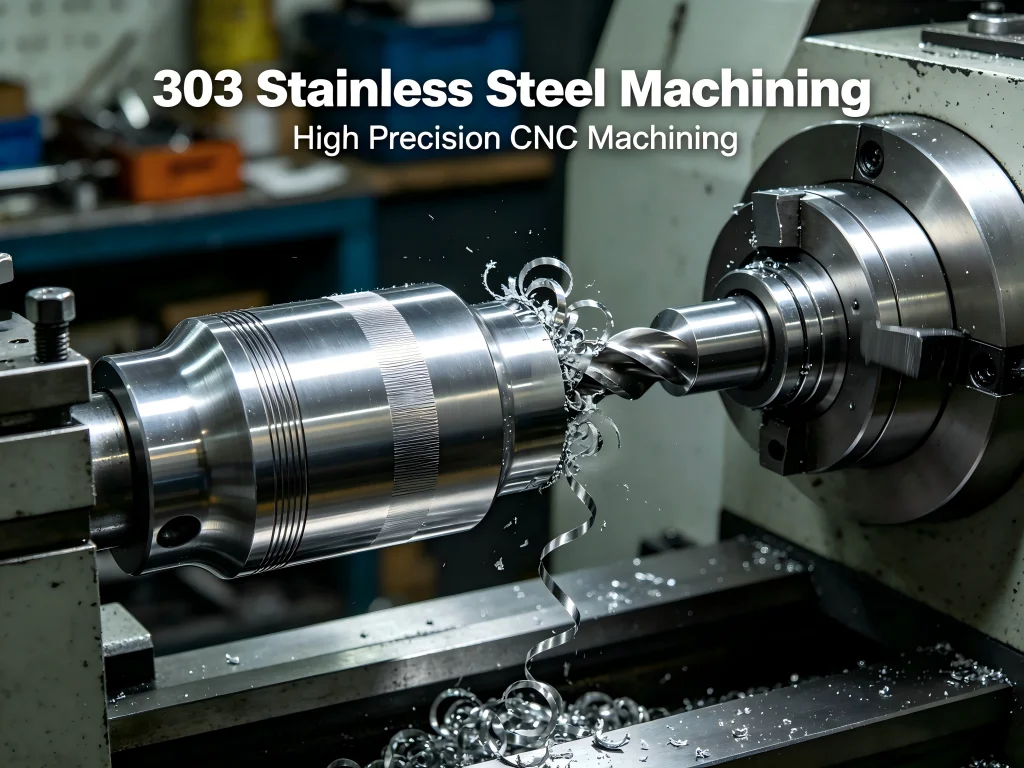
This sulfur addition transforms the material’s behavior during 303 stainless steel machining. The sulfur forms tiny, soft manganese sulfide inclusions within the steel’s microstructure. When a cutting tool encounters one of these inclusions, it acts as a microscopic chip breaker. Instead of forming long, stringy, difficult-to-manage chips like 304, the chips from 303 break off into small, clean, manageable pieces.
This is not a minor improvement. The 303 stainless steel machinability rating is approximately 75% to 78% of B1112, the benchmark free-machining steel. In practical terms, 303 stainless steel cutting speed can be 25% to 30% faster than 304 while maintaining acceptable tool life. For high-volume production, this translates directly into lower cost per part.
However—and this is a critical “however”—that magical sulfur addition is a double-edged sword. The same sulfide inclusions that make machining so efficient can also act as initiation points for corrosion. While 303 remains “stainless,” it is not as resistant to rust and pitting as 304, especially in marine or chemical environments. More critically, the sulfur causes severe hot cracking in and around weld zones. 303 stainless steel should never be used for any part that requires welding.
303 vs. 304: The Core Trade-Off
Understanding the differences between 303 and 304 is essential for selecting the right material. Here is a direct comparison:
| Property | 303 Stainless Steel | 304 Stainless Steel |
|---|---|---|
| Machinability | Excellent (75-78% of B1112) | Poor to fair—tough, gummy, work-hardens |
| Cutting Speed | 25-30% faster than 304 | Baseline—slower, more conservative |
| Corrosion Resistance | Good, but inferior to 304 | Excellent—superior pitting resistance |
| Weldability | Not recommended—hot cracking risk | Excellent—all standard processes |
| Chip Formation | Small, brittle, manageable chips | Long, stringy, difficult chips |
| Tool Wear | Reduced—longer tool life | Higher—more frequent tool changes |
| Best Application | High-volume machined components | Welded structures, corrosive environments |
As one manufacturing engineer on Facebook’s CNC Machinist group summarized: “If you need to weld it, choose 304. If you need to machine it fast and cheap, choose 303. There is no wrong answer—only the wrong application.”
What Is 303 Stainless Steel Used For? Core Applications
What is 303 stainless steel used for? The answer spans a remarkably wide range of industries. Because of its exceptional machinability, 303 is the material of choice for parts that require extensive machining, grinding, or polishing where good corrosion resistance is also needed.
Common applications include:
- Screw machine products: Bolts, screws, nuts, fittings, and fasteners produced in high volume on automatic screw machines
- Aerospace components: Aircraft fittings, shafts, and precision hardware that demand tight tolerances
- Automotive parts: Valve trims, gears, and moving components where non-seizing properties are critical
- Architectural hardware: Decorative and functional hardware where both appearance and machinability matter
- Medical device components: Precision-machined parts for surgical instruments and diagnostic equipment
- Robotics and automation: Complex joints, motor mounts, and precision drive shafts
The common thread across all these applications is simple: the parts are machined, not welded. 303 stainless steel excels in environments where the manufacturing process is predominantly material removal—turning, milling, drilling, and threading.
The 303 Stainless Steel Data Sheet: What the Numbers Tell You
A proper stainless steel 303 data sheet reveals why this alloy performs so well under cutting tools. The chemical composition, mechanical properties, and physical characteristics all contribute to its machinability advantage.
Key specifications from a typical stainless steel 303 data sheet include:
- Chemical Composition: Chromium 17.0-19.0%, Nickel 8.0-10.0%, Sulfur 0.15% minimum (0.30% in premium grades), Carbon 0.15% max
- Tensile Strength: Approximately 85 ksi (585 MPa)
- Yield Strength (0.2% offset): Approximately 45 ksi (310 MPa)
- Hardness: Rockwell B 180 (typical)
- Density: 0.285 lb/in³ (7.9 g/cm³)
- Modulus of Elasticity: 29 × 10⁶ psi
These properties position 303 stainless steel as a material that offers good strength and corrosion resistance while prioritizing machinability above all else. It is non-magnetic in the annealed condition, though cold working may induce slight magnetism. It cannot be hardened by heat treatment.
303 Stainless Machining: Practical Considerations for CNC Production
When planning 303 stainless machining operations, several factors deserve close attention. The material’s excellent machinability does not mean it is foolproof—it simply means the challenges are different from those posed by 304.
Cutting Speeds and Feeds
303 stainless steel cutting speed recommendations vary by operation. For turning operations, speeds typically range from 270 to 360 surface feet per minute (SFM) with carbide tooling. Milling operations may run at 170 to 230 SFM. These speeds are significantly higher than what would be recommended for 304, reflecting the material’s superior machinability.
One critical rule for 303 stainless machining: cutting edges must be kept sharp. Dull edges cause excess work hardening, negating the material’s machinability advantage. As one experienced machinist noted on a machining forum: “303 will let you run fast, but it will punish you if you let the tool get dull. The sulfur helps, but it is not magic.”
Tool Selection
For 303 stainless steel machining, carbide tooling with appropriate coatings (such as PVD TiAlN) delivers the best combination of tool life and productivity. The material’s tendency to produce small, brittle chips reduces the risk of chip tangling and allows for more aggressive cutting parameters.
Workholding and Fixturing
Because 303 stainless steel can be machined at higher speeds and feeds, workholding must be robust enough to handle the increased cutting forces. Rigid setups reduce vibration and improve surface finish quality.
Why Choose Jucheng for 303 Stainless Steel Machining
Selecting a CNC partner for 303 stainless steel machining is as important as selecting the material itself. The best material properties in the world cannot compensate for inadequate equipment, poor process control, or inexperienced machinists.
Jucheng Precision brings several distinct advantages to 303 stainless steel machining projects:
Advanced Equipment: Jucheng operates an extensive fleet of 5-axis machining centers and precision CNC lathes, enabling complex geometries and tight tolerances. The company’s Long Mill CNC systems and multi-axis machines deliver exceptional accuracy and efficiency.
Material Expertise: Jucheng machines a wide range of materials, including stainless steel grades 303, 304, and 316. This breadth of experience means the team understands the nuances of each alloy—when to push the speed and when to back off.
Quality Certifications: Jucheng operates under ISO 13485:2016 (medical devices) and IATF 16949 (automotive and aerospace supply chains). These certifications demand rigorous process control, documentation, and traceability—all of which benefit 303 stainless steel machining projects.
Vertically Integrated Operations: With an 8,000 sq.ft. facility and vertically integrated capabilities, Jucheng offers the security of a certified partner committed to quality and reliability.
Global Reach: Whether you are a stainless steel 303 supplier in Malaysia or sourcing from international markets, Jucheng’s global manufacturing capabilities ensure consistent quality and competitive pricing.
As one Jucheng client noted in a project review: “We switched to Jucheng for our 303 stainless parts after struggling with inconsistent quality from our previous supplier. The difference was night and day—tighter tolerances, better surface finish, and faster delivery.”
Key Selection Factors for Your 303 Stainless Steel Machining Partner
When evaluating CNC shops for 303 stainless steel machining, consider these factors:
- Material Sourcing: Does the supplier have reliable access to high-quality 303 stainless stock? Variations in sulfur content and overall quality affect machinability.
- Equipment Capability: Does the shop have the right machines for your part geometry? Multi-axis capabilities matter for complex components.
- Process Control: Is there documented quality management? ISO and IATF certifications provide assurance.
- Tooling Strategy: Does the shop understand the specific tooling requirements for 303 stainless machining—sharp edges, appropriate coatings, optimal speeds and feeds?
- Production Volume: Can the shop handle your volume requirements, whether prototyping or high-volume production?
- Surface Finishing: Does the shop offer secondary operations like passivation, polishing, or coating that may be needed for your application?
Frequently Asked Questions About 303 Stainless Steel Machining
Is 303 stainless steel free machining?
Yes—absolutely. Is 303 stainless steel free machining? The answer is a definitive yes. In fact, 303 is the most common free-machining stainless grade, specifically engineered with sulfur additions to improve chip breakage and reduce tool wear.
What is the 303 stainless steel machinability rating?
The 303 stainless steel machinability rating is approximately 75% to 78% of B1112, the benchmark free-machining steel. This places it among the most machinable stainless steels available.
What is 303 stainless steel used for?
What is 303 stainless steel used for? It is used primarily for parts that require extensive machining—screw machine products, aerospace components, automotive parts, architectural hardware, medical devices, and robotics components.
What is the recommended 303 stainless steel cutting speed?
303 stainless steel cutting speed for turning operations typically ranges from 270 to 360 SFM with carbide tooling. Milling operations run at 170 to 230 SFM. These speeds are significantly higher than those recommended for 304.
Can 303 stainless steel be welded?
No—303 stainless steel is not recommended for welding. The sulfur content causes hot cracking in and around the weld zone. If welding is absolutely necessary, specialized filler metals like AWS E312 may be considered, but the results are typically unsatisfactory.
How does 303 compare to 304 for machining?
303 offers significantly better machinability—25% to 30% faster cutting speeds, better chip formation, and longer tool life. However, 304 offers superior corrosion resistance and weldability. The choice depends on your application priorities.
Where can I find a stainless steel 303 supplier in Malaysia?
For stainless steel 303 supplier in Malaysia, Jucheng Precision offers comprehensive CNC machining services with global sourcing capabilities. The company’s ISO and IATF certifications ensure quality and reliability for Malaysian and international clients.
What should I look for in a stainless steel 303 data sheet?
A stainless steel 303 data sheet should include chemical composition (especially sulfur content), mechanical properties (tensile and yield strength, hardness), physical properties (density, thermal conductivity), and machinability recommendations.
Making the Smart Call: Your 303 Stainless Steel Machining Decision
The decision to use 303 stainless steel for your CNC machining project comes down to one fundamental question: Does your part require welding or extreme corrosion resistance? If the answer is no—if your component is a monolithic, machined-only part—then 303 is very likely the right choice.
For high-volume production runs, the efficiency gains from 303 stainless steel machining translate directly into cost savings. Faster cycle times, longer tool life, and reduced scrap rates compound into meaningful bottom-line improvements.
But material selection is only half the equation. The other half—equally critical—is choosing a CNC partner who understands how to maximize the material’s potential. Jucheng Precision combines advanced equipment, rigorous quality systems, and deep material expertise to deliver exceptional results for 303 stainless steel machining projects.
Whether you are prototyping a new medical device, scaling up automotive production, or sourcing precision components for aerospace applications, Jucheng has the capabilities and certifications to support your success.
Ready to discuss your 303 stainless steel machining requirements? Contact Jucheng Precision today to explore how their expertise can bring your project to life with precision, efficiency, and quality you can count on.