
Stai fissando una scheda tecnica del materiale. Due colonne. Il 303 a sinistra. Il 304 a destra. I numeri sembrano simili: contenuto di cromo simile, percentuali di nichel simili, resistenza alla trazione simile sulla carta. Ma qualsiasi operatore di macchina utensile te lo dirà: queste due leghe non potrebbero essere più diverse sotto un utensile da taglio. Una ti combatte a ogni passaggio. L'altra si lavora praticamente da sola.
Per ingegneri, specialisti degli acquisti e responsabili di produzione che valutano Lavorazione dell'acciaio inossidabile 303 per il loro prossimo ciclo produttivo, la decisione raramente riguarda solo le proprietà del materiale. Riguarda il tempo ciclo. La durata dell'utensile. I tassi di scarto. Il costo totale per pezzo finito. E forse, cosa più critica, riguarda la scelta di un partner CNC che sappia come estrarre ogni grammo di efficienza da questo straordinario grado a lavorabilità migliorata.
Questa guida ti accompagna attraverso le considerazioni essenziali per Lavorazione dell'acciaio inossidabile 303—dal comprendere cosa rende unica questa lega alla valutazione dei fornitori e all'assunzione di una decisione d'acquisto consapevole. Che tu stia cercando un fornitore di acciaio inossidabile 303 in Malaysia o confrontando officine CNC a livello globale, il quadro qui presentato si applica in ogni caso.
Il dilemma dell'operatore: perché la scelta del materiale conta più di quanto pensi
Immagina questo: hai un ordine di produzione per 10.000 raccordi in acciaio inossidabile. Il progetto richiede un grado inossidabile austenitico con buona resistenza alla corrosione ed eccellente lavorabilità. Il tuo team di ingegneria specifica l'acciaio inossidabile 304 perché è la scelta “standard”. Sei settimane dopo, stai fissando una montagna di scarti, un'usura eccessiva degli utensili e tempi ciclo che hanno fatto saltare il budget.
Cosa è andato storto? La scelta del materiale non era allineata con la realtà produttiva. Acciaio inossidabile 303 esiste proprio per prevenire questo scenario. Come ha detto un operatore di macchine su Reddit: “Il 303 è ciò che il 304 desidererebbe poter essere quando i trucioli iniziano a volare.” Un altro utente su un forum CNC ha osservato: “Preferirei tagliare il 303 tutto il giorno piuttosto che combattere con il 304 per un’ora. La sola differenza nella durata dell’utensile ripaga il sovrapprezzo del materiale.”
Queste non sono opinioni isolate. Riflettono una verità fondamentale sul Lavorazione dell'acciaio inossidabile 303: la lega è stata progettata fin dall’inizio per risolvere un problema specifico: la difficoltà di lavorare gli acciai inossidabili austenitici standard.
Che cos’è l’acciaio inossidabile 303? Il campione della lavorabilità a macchina
Acciaio inossidabile 303 è la versione a lavorabilità migliorata del suo famoso cugino, il 304. La chimica di base è quasi identica: entrambi sono acciai inossidabili austenitici 18-8 al cromo-nichel con buona resistenza generale alla corrosione. Ma il 303 ha un ingrediente segreto: una piccola ma critica aggiunta di zolfo (tipicamente dallo 0,15% allo 0,35%, con gradi premium come quello di Outokumpu che offrono un minimo dello 0,30%).
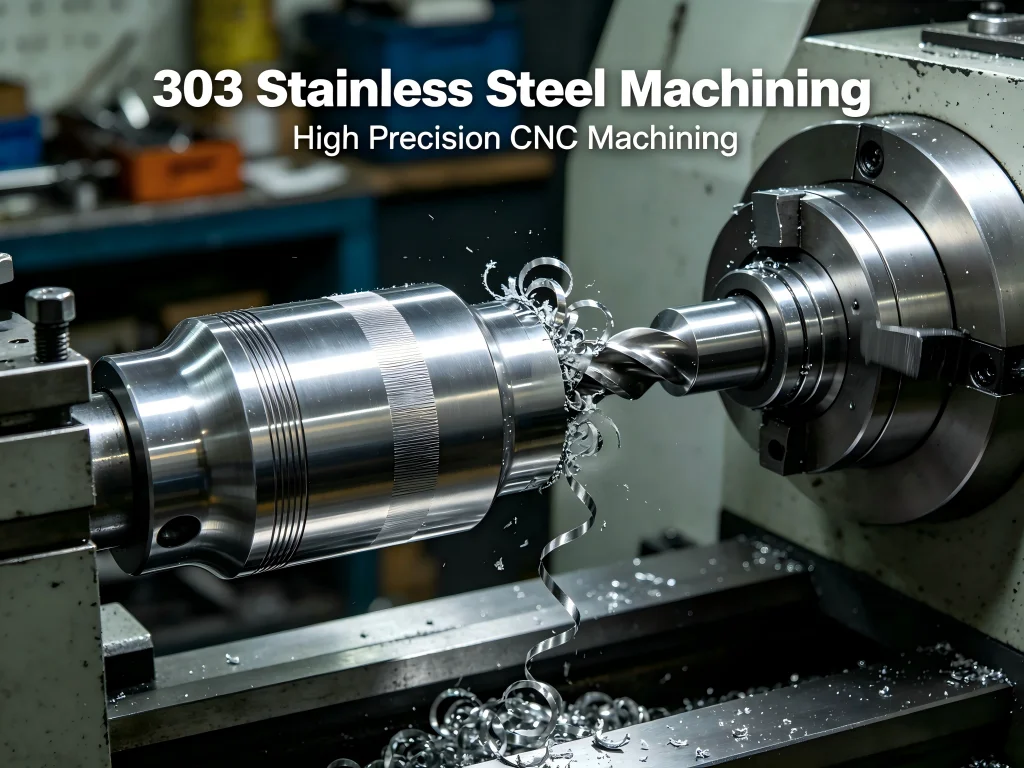
Questa aggiunta di zolfo trasforma il comportamento del materiale durante la Lavorazione dell'acciaio inossidabile 303. lavorazione. Lo zolfo forma minuscole e tenere inclusioni di solfuro di manganese all’interno della microstruttura dell’acciaio. Quando un utensile da taglio incontra una di queste inclusioni, essa agisce come un rompitruciolo microscopico. Invece di formare trucioli lunghi, filamentosi e difficili da gestire come nel 304, i trucioli del 303 si spezzano in pezzi piccoli, puliti e gestibili.
Questo non è un miglioramento da poco. L’ indice di lavorabilità dell’acciaio inossidabile 303 è di circa il 75%-78% rispetto al B1112, l’acciaio di riferimento per la lavorabilità a macchina. In termini pratici, la, velocità di taglio dell’acciaio inossidabile 303 può essere dal 25% al 30% più elevata rispetto al 304 mantenendo una durata dell’utensile accettabile. Per la produzione ad alto volume, questo si traduce direttamente in un costo per pezzo inferiore.
Tuttavia, e questo è un “tuttavia” critico, quell’aggiunta magica di zolfo è un’arma a doppio taglio. Le stesse inclusioni di solfuro che rendono la lavorazione così efficiente possono anche agire come punti di innesco per la corrosione. Sebbene il 303 rimanga “inossidabile”, non è resistente alla ruggine e alla vaiolatura quanto il 304, specialmente in ambienti marini o chimici. Ancora più critico, lo zolfo causa gravi cricche a caldo nelle zone di saldatura e nelle aree circostanti. Acciaio inossidabile 303 should never be used for any part that requires welding.
303 vs. 304: The Core Trade-Off
Understanding the differences between 303 and 304 is essential for selecting the right material. Here is a direct comparison:
| Proprietà | 303 Stainless Steel | Acciaio inossidabile 304 |
|---|---|---|
| Lavorabilità | Excellent (75-78% of B1112) | Poor to fair—tough, gummy, work-hardens |
| Cutting Speed | 25-30% faster than 304 | Baseline—slower, more conservative |
| Resistenza alla corrosione | Good, but inferior to 304 | Excellent—superior pitting resistance |
| Saldabilità | Not recommended—hot cracking risk | Excellent—all standard processes |
| Formazione del truciolo | Small, brittle, manageable chips | Long, stringy, difficult chips |
| Usura dell'utensile | Reduced—longer tool life | Higher—more frequent tool changes |
| Applicazione ideale | High-volume machined components | Welded structures, corrosive environments |
As one manufacturing engineer on Facebook’s CNC Machinist group summarized: “If you need to weld it, choose 304. If you need to machine it fast and cheap, choose 303. There is no wrong answer—only the wrong application.”
What Is 303 Stainless Steel Used For? Core Applications
What is 303 stainless steel used for? The answer spans a remarkably wide range of industries. Because of its exceptional machinability, 303 is the material of choice for parts that require extensive machining, grinding, or polishing where good corrosion resistance is also needed.
Common applications include:
- Screw machine products: Bolts, screws, nuts, fittings, and fasteners produced in high volume on automatic screw machines
- Aerospace components: Aircraft fittings, shafts, and precision hardware that demand tight tolerances
- Automotive parts: Valve trims, gears, and moving components where non-seizing properties are critical
- Architectural hardware: Decorative and functional hardware where both appearance and machinability matter
- Medical device components: Precision-machined parts for surgical instruments and diagnostic equipment
- Robotics and automation: Complex joints, motor mounts, and precision drive shafts
The common thread across all these applications is simple: the parts are machined, not welded. Acciaio inossidabile 303 excels in environments where the manufacturing process is predominantly material removal—turning, milling, drilling, and threading.
The 303 Stainless Steel Data Sheet: What the Numbers Tell You
A proper stainless steel 303 data sheet reveals why this alloy performs so well under cutting tools. The chemical composition, mechanical properties, and physical characteristics all contribute to its machinability advantage.
Key specifications from a typical stainless steel 303 data sheet includono:
- Chemical Composition: Chromium 17.0-19.0%, Nickel 8.0-10.0%, Sulfur 0.15% minimum (0.30% in premium grades), Carbon 0.15% max
- Resistenza alla trazione: Approximately 85 ksi (585 MPa)
- Yield Strength (0.2% offset): Approximately 45 ksi (310 MPa)
- Durezza: Rockwell B 180 (typical)
- Densità: 0.285 lb/in³ (7.9 g/cm³)
- Modulus of Elasticity: 29 × 10⁶ psi
These properties position Acciaio inossidabile 303 as a material that offers good strength and corrosion resistance while prioritizing machinability above all else. It is non-magnetic in the annealed condition, though cold working may induce slight magnetism. It cannot be hardened by heat treatment.
303 Stainless Machining: Practical Considerations for CNC Production
When planning 303 stainless machining operations, several factors deserve close attention. The material’s excellent machinability does not mean it is foolproof—it simply means the challenges are different from those posed by 304.
Velocità e avanzamenti di taglio
velocità di taglio dell’acciaio inossidabile 303 recommendations vary by operation. For turning operations, speeds typically range from 270 to 360 surface feet per minute (SFM) with carbide tooling. Milling operations may run at 170 to 230 SFM. These speeds are significantly higher than what would be recommended for 304, reflecting the material’s superior machinability.
One critical rule for 303 stainless machining: cutting edges must be kept sharp. Dull edges cause excess work hardening, negating the material’s machinability advantage. As one experienced machinist noted on a machining forum: “303 will let you run fast, but it will punish you if you let the tool get dull. The sulfur helps, but it is not magic.”
Selezione dell'utensile
Per Lavorazione dell'acciaio inossidabile 303, carbide tooling with appropriate coatings (such as PVD TiAlN) delivers the best combination of tool life and productivity. The material’s tendency to produce small, brittle chips reduces the risk of chip tangling and allows for more aggressive cutting parameters.
Bloccaggio del pezzo e attrezzaggio
Poiché Acciaio inossidabile 303 can be machined at higher speeds and feeds, workholding must be robust enough to handle the increased cutting forces. Rigid setups reduce vibration and improve surface finish quality.
Why Choose Jucheng for 303 Stainless Steel Machining
Selecting a CNC partner for Lavorazione dell'acciaio inossidabile 303 is as important as selecting the material itself. The best material properties in the world cannot compensate for inadequate equipment, poor process control, or inexperienced machinists.
Jucheng Precision brings several distinct advantages to Lavorazione dell'acciaio inossidabile 303 projects:
Advanced Equipment: Jucheng operates an extensive fleet of 5-axis machining centers and precision CNC lathes, enabling complex geometries and tight tolerances. The company’s Long Mill CNC systems and multi-axis machines deliver exceptional accuracy and efficiency.
Competenza sui materiali: Jucheng machines a wide range of materials, including stainless steel grades 303, 304, and 316. This breadth of experience means the team understands the nuances of each alloy—when to push the speed and when to back off.
Certificazioni di qualità: Jucheng operates under ISO 13485:2016 (medical devices) and IATF 16949 (automotive and aerospace supply chains). These certifications demand rigorous process control, documentation, and traceability—all of which benefit Lavorazione dell'acciaio inossidabile 303 i progetti.
Vertically Integrated Operations: With an 8,000 sq.ft. facility and vertically integrated capabilities, Jucheng offers the security of a certified partner committed to quality and reliability.
Global Reach: Whether you are a un fornitore di acciaio inossidabile 303 in Malaysia or sourcing from international markets, Jucheng’s global manufacturing capabilities ensure consistent quality and competitive pricing.
As one Jucheng client noted in a project review: “We switched to Jucheng for our 303 stainless parts after struggling with inconsistent quality from our previous supplier. The difference was night and day—tighter tolerances, better surface finish, and faster delivery.”
Key Selection Factors for Your 303 Stainless Steel Machining Partner
When evaluating CNC shops for Lavorazione dell'acciaio inossidabile 303, consider these factors:
- Material Sourcing: Does the supplier have reliable access to high-quality 303 stainless stock? Variations in sulfur content and overall quality affect machinability.
- Capacità delle attrezzature: Does the shop have the right machines for your part geometry? Multi-axis capabilities matter for complex components.
- Process Control: Is there documented quality management? ISO and IATF certifications provide assurance.
- Strategia di utensileria: Does the shop understand the specific tooling requirements for 303 stainless machining—sharp edges, appropriate coatings, optimal speeds and feeds?
- Production Volume: Can the shop handle your volume requirements, whether prototyping or high-volume production?
- Finitura superficiale: Does the shop offer secondary operations like passivation, polishing, or coating that may be needed for your application?
Frequently Asked Questions About 303 Stainless Steel Machining
Is 303 stainless steel free machining?
Yes—absolutely. Is 303 stainless steel free machining? The answer is a definitive yes. In fact, 303 is the most common free-machining stainless grade, specifically engineered with sulfur additions to improve chip breakage and reduce tool wear.
What is the 303 stainless steel machinability rating?
La indice di lavorabilità dell’acciaio inossidabile 303 is approximately 75% to 78% of B1112, the benchmark free-machining steel. This places it among the most machinable stainless steels available.
What is 303 stainless steel used for?
What is 303 stainless steel used for? It is used primarily for parts that require extensive machining—screw machine products, aerospace components, automotive parts, architectural hardware, medical devices, and robotics components.
What is the recommended 303 stainless steel cutting speed?
velocità di taglio dell’acciaio inossidabile 303 for turning operations typically ranges from 270 to 360 SFM with carbide tooling. Milling operations run at 170 to 230 SFM. These speeds are significantly higher than those recommended for 304.
Can 303 stainless steel be welded?
No—Acciaio inossidabile 303 is not recommended for welding. The sulfur content causes hot cracking in and around the weld zone. If welding is absolutely necessary, specialized filler metals like AWS E312 may be considered, but the results are typically unsatisfactory.
How does 303 compare to 304 for machining?
303 offers significantly better machinability—25% to 30% faster cutting speeds, better chip formation, and longer tool life. However, 304 offers superior corrosion resistance and weldability. The choice depends on your application priorities.
Where can I find a stainless steel 303 supplier in Malaysia?
Per un fornitore di acciaio inossidabile 303 in Malaysia, Jucheng Precision offers comprehensive CNC machining services with global sourcing capabilities. The company’s ISO and IATF certifications ensure quality and reliability for Malaysian and international clients.
What should I look for in a stainless steel 303 data sheet?
A stainless steel 303 data sheet should include chemical composition (especially sulfur content), mechanical properties (tensile and yield strength, hardness), physical properties (density, thermal conductivity), and machinability recommendations.
Making the Smart Call: Your 303 Stainless Steel Machining Decision
The decision to use Acciaio inossidabile 303 for your CNC machining project comes down to one fundamental question: Does your part require welding or extreme corrosion resistance? If the answer is no—if your component is a monolithic, machined-only part—then 303 is very likely the right choice.
For high-volume production runs, the efficiency gains from Lavorazione dell'acciaio inossidabile 303 translate directly into cost savings. Faster cycle times, longer tool life, and reduced scrap rates compound into meaningful bottom-line improvements.
But material selection is only half the equation. The other half—equally critical—is choosing a CNC partner who understands how to maximize the material’s potential. Jucheng Precision combines advanced equipment, rigorous quality systems, and deep material expertise to deliver exceptional results for Lavorazione dell'acciaio inossidabile 303 i progetti.
Whether you are prototyping a new medical device, scaling up automotive production, or sourcing precision components for aerospace applications, Jucheng has the capabilities and certifications to support your success.
Pronto a discutere il tuo Lavorazione dell'acciaio inossidabile 303 requirements? Contact Jucheng Precision today to explore how their expertise can bring your project to life with precision, efficiency, and quality you can count on.