
L'usinage CNC de l'acier constitue l'un des procédés de fabrication les plus critiques de l'industrie moderne, transformant l'acier brut en composants de précision qui alimentent tout, des moteurs automobiles aux dispositifs médicaux. Que vous soyez un ingénieur évaluant l'usinage CNC de l'acier pour un nouveau produit, un professionnel des achats à la recherche de services d'usinage CNC de l'acier fournisseurs, ou simplement en train d'explorer l'usinage CNC des métaux options, ce guide complet vous accompagne à travers tout ce que vous devez savoir—des principes fondamentaux aux critères de sélection avancés. La technologie de commande numérique par ordinateur (CNC) a révolutionné notre façon de travailler l'acier, permettant des tolérances aussi serrées que ±0,005 mm et des géométries qui seraient impossibles avec les méthodes conventionnelles.
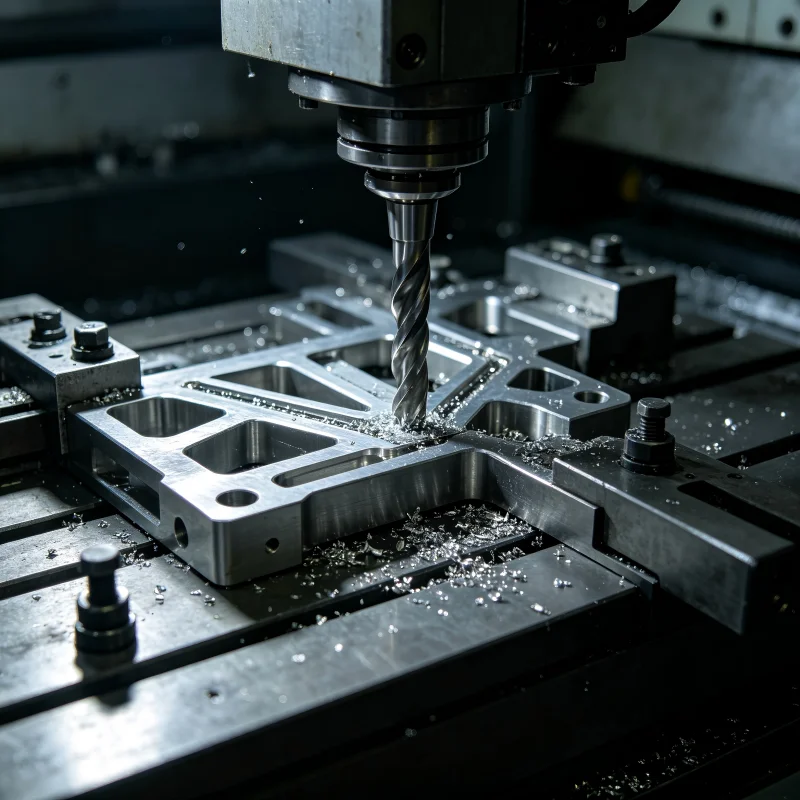
Qu'est-ce que l'usinage CNC de l'acier ? Comprendre les fondamentaux
L'usinage CNC de l'acier désigne l'utilisation de machines-outils à commande numérique par ordinateur pour enlever de la matière de pièces en acier, créant des pièces finies avec une précision et une répétabilité exceptionnelles. Le processus commence par un modèle 3D numérique, qui est converti en code lisible par machine (généralement du G-code) qui dirige le mouvement des outils de coupe le long de plusieurs axes.
Le principe fondamental derrière l'usinage CNC de l'acier est la fabrication soustractive—en partant d'un bloc ou d'une barre d'acier solide et en enlevant systématiquement de la matière jusqu'à ce que la forme souhaitée émerge. Cela contraste avec les procédés additifs comme l'impression 3D, et cela reste la méthode préférée pour les applications nécessitant des propriétés mécaniques supérieures, une stabilité dimensionnelle et un état de surface de qualité.
Comment fonctionne l'usinage CNC de l'acier : le déroulement du processus
Le typique l'usinage CNC de l'acier le flux de travail suit ces étapes :
- Conception et modélisation CAO : Les ingénieurs créent un modèle 3D détaillé de la pièce à l'aide d'un logiciel de CAO, en spécifiant les dimensions, les tolérances et les exigences de finition de surface.
- Programmation FAO : Le logiciel de fabrication assistée par ordinateur (FAO) génère les trajectoires d'outils et les instructions en code G en fonction du modèle, des propriétés du matériau et des capacités de la machine.
- Configuration de la machine : Les opérateurs fixent la pièce en acier à l'aide d'un montage approprié, sélectionnent les outils de coupe et saisissent le programme dans l'unité de commande de la machine CNC.
- Exécution de l'usinage : La machine CNC suit les instructions programmées, déplaçant les outils de coupe le long de trajectoires précises pour enlever la matière couche par couche.
- Contrôle qualité : Les pièces finies sont soumises à une inspection dimensionnelle à l'aide de machines à mesurer tridimensionnelles (MMT), de comparateurs optiques et d'autres équipements de métrologie afin de vérifier la conformité aux spécifications.
Principaux procédés d'usinage CNC pour l'acier
Différents l'usinage CNC de l'acier procédés conviennent à différentes géométries et exigences de pièces. Comprendre ces procédés aide à sélectionner l'approche adaptée à votre projet :
- Fraisage CNC : C'est le plus polyvalent l'usinage CNC de l'acier processus, utilisant des outils de coupe multipoints rotatifs pour enlever de la matière de la pièce. Le fraisage CNC peut créer des formes 3D complexes, des surfaces planes, des rainures, des poches et des contours complexes. Il est idéal pour des pièces comme les supports de moteur, les carters d'engrenages, les collecteurs hydrauliques et les composants de moules. La précision typique varie de ±0,02 à ±0,05 mm avec des états de surface de Ra 1,6–3,2 μm.
- Tournage CNC : Dans les opérations de tournage, la pièce en acier tourne tandis qu'un outil de coupe stationnaire enlève de la matière, créant des formes cylindriques ou coniques. Ce processus excelle dans la production d'arbres, de bagues, de goupilles, d'accouplements et de composants filetés. Le tournage CNC atteint généralement des tolérances de ±0,01 à ±0,03 mm.
- Perçage et taraudage CNC : Ces opérations créent des trous précis et des filetages internes dans les composants en acier, essentiels pour les applications d'assemblage et de fixation.
- Rectification CNC : Utilisée pour les opérations de finition qui exigent des tolérances extrêmement serrées ou des états de surface supérieurs, la rectification emploie des meules abrasives pour enlever de petites quantités de matière.
- Électroérosion à fil (EDM à fil) : Ce processus sans contact utilise des décharges électriques pour découper des formes complexes dans l'acier, particulièrement utile pour les matériaux durs ou les pièces nécessitant des tolérances serrées avec des détails fins.
Nuances d'acier pour l'usinage CNC : choisir le bon matériau
Le succès de tout l'usinage CNC de l'acier projet dépend fortement de la sélection de la nuance d'acier appropriée. Différents aciers offrent des combinaisons variées de résistance, de dureté, d'usinabilité, de résistance à la corrosion et de coût.
| Catégorie d'acier | Nuances courantes | Propriétés clés | Applications typiques |
|---|---|---|---|
| Acier à faible teneur en carbone | 1018, 1020, 12L14 | Excellent machinability, good weldability, moderate strength, cost-effective | General-purpose components, shafts, pins, fittings, automotive brackets |
| Acier à teneur moyenne en carbone | 1045, 1050 | Balanced strength and ductility, responds well to heat treatment | Gears, crankshafts, axles, machine parts requiring higher strength |
| Acier allié | 4140, 4340, 8620 | High strength, excellent fatigue resistance, good toughness, heat-treatable | Aerospace components, heavy-duty shafts, gears, structural parts |
| Acier à outils | D2, A2, M2, O1 | High hardness, excellent wear resistance, maintains edge retention | Cutting tools, dies, molds, precision forming tools |
| Stainless Steel (Austenitic) | 303, 304, 304L, 316, 316L | Excellent corrosion resistance, good strength, hygienic properties | Medical devices, food processing equipment, marine components, chemical equipment |
| Stainless Steel (Martensitic) | 410, 416, 420, 440C | High hardness, moderate corrosion resistance, heat-treatable | Surgical instruments, valve components, bearings, cutlery |
Each steel grade presents unique machining challenges. For instance, low-carbon steels like 1018 are relatively soft and ductile, making them suitable for high-speed machining with standard carbide tools. In contrast, alloy steels like 4140 generate more heat and tougher chips, requiring careful management of cutting parameters and tool selection. Stainless steels, particularly grades like 316, are known for work-hardening characteristics that demand rigid machining strategies and premium cutting tools.
Core Applications: Where Steel CNC Machining Excels
L'usinage CNC de l'acier serves as the backbone of manufacturing across virtually every industrial sector. The combination of steel’s mechanical properties and CNC’s precision capabilities makes this process indispensable for producing critical components.
Industrie automobile
The automotive sector represents one of the largest consumers of l'usinage CNC de l'acier services. Engine components—including cylinder heads, engine blocks, and connecting rods—require the strength and heat resistance that steel provides, machined to tight tolerances for proper assembly and performance. Transmission components, gearbox housings, and drivetrain parts similarly depend on precision-machined steel for durability and reliability.
Chassis and suspension components, including control arms, steering knuckles, and mounting brackets, benefit from steel’s strength-to-weight ratio and the design flexibility that CNC machining enables. Brake system components—calipers, rotors, and master cylinders—also rely on l'usinage CNC de l'acier for both safety-critical performance and dimensional accuracy.
Aérospatiale et défense
Aerospace applications demand the highest levels of precision and reliability, making l'usinage CNC de l'acier essential for manufacturing structural components, landing gear parts, engine mounts, and hydraulic system components. The industry’s stringent requirements for material traceability, dimensional accuracy, and surface finish push the boundaries of what l'usinage CNC de l'acier can achieve.
Many aerospace components require machining from high-strength alloy steels like 4340 or precipitation-hardening stainless steels, materials that demand specialized tooling and machining strategies. The ability to achieve tolerances of ±0.005mm or better makes CNC machining the preferred choice for these critical applications.
Medical Devices and Healthcare
The medical device industry relies heavily on l'usinage CNC de l'acier for producing surgical instruments, implant components, and medical equipment parts. Stainless steel grades like 316L are particularly valued for their corrosion resistance and biocompatibility. CNC machining enables the production of complex geometries required for modern surgical tools, from minimally invasive instruments to orthopedic implants.
ISO 13485 certification, which Jucheng Precision holds, is often required for medical device manufacturing, ensuring that quality management systems meet the industry’s rigorous standards.
Industrial Machinery and Heavy Equipment
Industrial machinery applications—pumps, valves, hydraulic components, and processing equipment—depend on l'usinage CNC de l'acier for parts that must withstand high pressures, abrasive conditions, and continuous operation. Steel’s durability and CNC’s precision combine to produce components like pump housings, valve bodies, gear reducers, and bearing housings that deliver reliable performance in demanding environments.
Tooling and Mold Making
The tool and die industry represents a specialized but critical application for l'usinage CNC de l'acier. Tool steels like D2, A2, and M2 are machined into cutting tools, stamping dies, injection molds, and forming tools. The hardness and wear resistance of these materials make them challenging to machine, but CNC technology—particularly 5-axis machining and high-speed techniques—enables the production of complex tool geometries with the required precision.
Energy and Power Generation
Energy sector applications—including oil and gas equipment, power generation turbines, and renewable energy systems—leverage l'usinage CNC de l'acier for components that must perform reliably under extreme conditions. Valve bodies, pump components, turbine blades, and structural supports all benefit from the combination of steel’s strength and CNC’s precision.
Key Selection Factors: Choosing the Right Steel CNC Machining Service
Choisir un services d'usinage CNC de l'acier provider requires careful evaluation across multiple dimensions. The decision affects not only part quality but also project timelines, costs, and overall success.
Capacités techniques et équipements
When evaluating l'usinage CNC de l'acier providers, assess their equipment fleet and technical capabilities. Key considerations include:
- Machine Types and Axes: Does the provider offer 3-axis, 4-axis, and 5-axis machining capabilities? Multi-axis machining enables complex geometries and reduces setup requirements. Jucheng Precision operates 150+ CNC machines, including 25+ 5-axis centers.
- Turning and Milling Capacity: Look for providers with both CNC milling and turning capabilities, as well as combined turning-milling centers that can complete complex parts in a single setup.
- Additional Processes: Consider whether the provider offers complementary services like wire EDM, grinding, sheet metal fabrication, and finishing operations.
- Expertise des matériaux : Evaluate the provider’s experience with different steel grades, particularly those relevant to your application.
Quality Assurance and Certifications
Quality systems distinguish reliable l'usinage CNC de l'acier providers from those that may compromise on precision. Look for:
- ISO 9001:2015 Certification: The foundational quality management standard.
- IATF 16949: The automotive industry’s quality management standard, indicating capability for automotive applications.
- ISO 13485 : The medical device quality management standard, essential for healthcare applications.
- Inspection Equipment: Providers should maintain CMMs, optical comparators, surface profilometers, and hardness testers for dimensional verification.
Tolerance and Precision Capabilities
Different applications demand different levels of precision. Standard l'usinage CNC de l'acier tolerances typically range from ±0.01mm to ±0.05mm, depending on the material and process. High-precision requirements—such as those for aerospace or medical applications—may demand tolerances of ±0.005mm or tighter. Discuss your tolerance requirements early with potential providers to ensure they can meet your specifications.
Lead Times and Production Capacity
Project timelines are often critical. Evaluate providers based on:
- Quote Turnaround: How quickly can the provider deliver cost estimates and design for manufacturability (DFM) feedback? Jucheng Precision provides quotes within hours.
- Production Lead Times: What is the typical timeline from order to delivery? Rapid prototyping services may deliver parts in as few as 4-7 days.
- Scalability: Can the provider handle both low-volume prototyping and high-volume production runs? Jucheng Precision’s 150+ CNC machines and 190+ employees support projects from single prototypes to production quantities of 50,000+ pieces per month.
Cost Considerations
L'usinage CNC de l'acier costs vary widely based on multiple factors:
- Material Costs: Steel grades vary significantly in price. Stainless steels and exotic alloys like Inconel are substantially more expensive than carbon steels.
- Part Complexity: Intricate geometries, tight tolerances, and features like small internal radii or undercuts increase machining time and cost.
- Order Volume: Setup costs are amortized across production volume, making per-unit costs lower for larger orders.
- Machine Hourly Rates: Rates typically range from $35 to $200+ per hour, depending on machine type, capability, and location.
- Finition de surface : Post-processing operations like heat treatment, coating, or plating add to the total cost.
Jucheng Precision’s vertically integrated facility—combining CNC machining, sheet metal fabrication, 3D printing, and injection molding under one roof—can reduce costs by eliminating multiple vendor markups and streamlining project management.
Installation and Maintenance Considerations for Steel CNC Machining
Proper installation and maintenance practices ensure that l'usinage CNC de l'acier equipment delivers consistent performance and longevity. While end-users typically rely on service providers for production, understanding these factors helps in evaluating provider capabilities.
Machine Installation Fundamentals
CNC machine installation begins with proper site preparation. Machines must be placed on foundations that can support their weight—often several tons—without vibration transfer that could affect precision. Leveling and alignment are critical; even minor misalignment can compromise machining accuracy over time.
Environmental controls matter significantly for l'usinage CNC de l'acier. Temperature fluctuations can affect both machine geometry and workpiece dimensions, making climate-controlled facilities preferable for precision work. Jucheng Precision’s 8,000-square-meter facility in Shenzhen maintains consistent environmental conditions to support tight-tolerance machining.
Routine Maintenance Practices
Regular maintenance prevents unplanned downtime and extends equipment life. Key practices include:
- Lubrication: CNC machines require regular lubrication of moving parts—spindles, guideways, and ball screws—to reduce friction and wear.
- Coolant Management: Coolant systems must be maintained to control heat generation during l'usinage CNC de l'acier, improve chip evacuation, and extend tool life.
- Tool Wear Monitoring: Regular inspection of cutting tools for wear, chipping, or breakage prevents quality issues and machine damage.
- Calibration: Periodic calibration of machine axes and measurement systems ensures continued accuracy.
Providers with rigorous maintenance programs, like Jucheng Precision’s 190+ skilled professionals, can maintain the equipment reliability needed for consistent quality.
Frequently Asked Questions About Steel CNC Machining
What is the full form of CNC in steel CNC machining?
CNC stands for Computer Numerical Control. In l'usinage CNC de l'acier, this refers to the use of computer systems to control machine tools, guiding them through precise movements based on programmed instructions.
How much does a steel CNC machine cost?
Steel CNC machine price varies dramatically based on machine type, size, and capability. Entry-level desktop CNC mills suitable for small workshops typically range from $10,000 to $70,000. Full-size vertical machining centers and turning centers for industrial production generally cost $70,000 to $250,000. High-end 5-axis machines and specialized equipment can exceed $500,000. For most businesses, working with a services d'usinage CNC de l'acier provider offers a more cost-effective alternative to purchasing and maintaining equipment in-house.
What is the difference between steel CNC machining and metal CNC machining?
Metal CNC machining is the broader category encompassing all metal materials—aluminum, brass, copper, titanium, and steel. L'usinage CNC de l'acier specifically focuses on steel and its alloys. Steel presents unique challenges compared to other metals: it requires higher cutting forces, generates more heat, and typically demands slower speeds and more robust tooling. However, steel offers superior strength, durability, and wear resistance compared to most other machinable metals.
How do I find steel CNC machining near me?
Searching for steel CNC machining near me is a common starting point for project sourcing. While local providers offer advantages like easier communication and faster shipping, many businesses find that expanding their search globally—particularly to manufacturing hubs like Shenzhen, China—provides access to more extensive capabilities and competitive pricing. Online directories like ThomasNet, MFG.com, and Google Maps can help identify providers. When evaluating providers, prioritize capability and quality over proximity alone.
What tolerances can steel CNC machining achieve?
Standard l'usinage CNC de l'acier tolerances typically fall between ±0.01mm and ±0.05mm. High-precision machining can achieve tolerances of ±0.005mm or tighter, though this requires specialized equipment, careful process control, and more extensive inspection. Jucheng Precision maintains typical tolerances of ±0.005mm for many applications. Factors affecting achievable tolerances include material grade, part geometry, machine capability, and tool condition.
What surface finishes are available for CNC machined steel parts?
L'usinage CNC de l'acier produces as-machined surfaces with roughness values typically ranging from Ra 0.8 to 3.2 μm, depending on the process and parameters. Post-processing options include:
- Heat Treatment: Quenching, tempering, and case hardening to enhance hardness and wear resistance
- Surface Coatings: TiN, TiAlN, and other coatings to improve lubricity and reduce friction
- Plating: Zinc, nickel, chrome, or black oxide plating for corrosion resistance and appearance
- Passivation : Chemical treatment to enhance corrosion resistance of stainless steels
- Bead Blasting: Surface texturing for improved appearance or adhesion
What industries use steel CNC machining?
L'usinage CNC de l'acier serves virtually every industrial sector. Key industries include automotive (engine components, chassis parts, transmission systems), aerospace (structural components, landing gear, engine mounts), medical devices (surgical instruments, implants, equipment parts), industrial machinery (pumps, valves, hydraulic components), tool and die making, energy and power generation, and consumer products.
How do I choose between steel and aluminum for CNC machining?
The choice between steel and aluminum depends on application requirements. Steel offers superior strength, hardness, and wear resistance but is heavier, more difficult to machine, and generally more expensive. Aluminum is lighter, machines faster (approximately five times faster than steel by machinability index), and costs less but lacks steel’s mechanical properties. Choose steel for structural components, high-wear applications, and parts requiring heat treatment. Choose aluminum for lightweight applications, high-volume production, and parts where strength requirements are moderate.
Why Choose Jucheng Precision for Steel CNC Machining
When selecting a l'usinage CNC de l'acier partner, the provider’s capabilities, quality systems, and track record matter as much as price. Jucheng Precision has established itself as a trusted manufacturer with comprehensive capabilities across multiple manufacturing processes.
Manufacturing Scale and Equipment
Jucheng Precision operates a manufacturing powerhouse featuring 150+ CNC machines, including 25+ 5-axis machining centers from leading brands like Haas and Mazak. This extensive fleet—supplemented by 30+ sheet metal fabrication units, 50+ industrial 3D printing systems, and 35+ injection molding machines—enables the company to handle projects of any scale, from single prototypes to high-volume production.
The facility spans 8,000 square meters and employs 190+ professionals, including 30+ senior engineers with over 13 years of experience. This depth of expertise ensures that complex l'usinage CNC de l'acier challenges receive knowledgeable attention.
Quality Certifications and Control
Jucheng Precision holds multiple internationally recognized quality certifications: ISO 9001:2015, ISO 14001, ISO 13485 (medical devices), and IATF 16949 (automotive). These certifications demonstrate the company’s commitment to documented processes, traceability, and continuous improvement.
Quality control at Jucheng Precision extends beyond certification to practical implementation. The metrology lab features advanced equipment including CMMs, optical comparators, surface profilometers, and hardness testers. Rigorous in-process and final inspections ensure that every part meets specifications, with typical tolerances of ±0.005mm.
Comprehensive Service Offering
Jucheng Precision provides a true one-stop manufacturing solution. From initial design consultation through prototyping, production, and finishing, the company’s integrated capabilities streamline the manufacturing process. Services encompass CNC machining (milling, turning, grinding, EDM), sheet metal fabrication, 3D printing, injection molding, and die casting.
This integration delivers tangible benefits for clients: reduced vendor management overhead, consistent quality across processes, and accelerated project timelines. Jucheng Precision provides quotes within hours and can deliver parts in as few as 4 days for prototyping projects.
Industry Experience and Track Record
Founded in Shenzhen in 2012, Jucheng Precision has built a reputation for reliability across more than 5,000 development projects. The company’s monthly output of 50,000+ pieces demonstrates production capacity that supports both development-stage prototyping and full-scale manufacturing.
Jucheng Precision’s experience spans diverse industries—automotive, aerospace, medical devices, industrial equipment, and consumer products—providing the cross-industry knowledge that often proves valuable in solving complex manufacturing challenges.
Global Reach with Local Service
While headquartered in Shenzhen’s manufacturing hub, Jucheng Precision serves clients globally. The company maintains a sales office in the United Kingdom, facilitating communication and service for European clients. This global perspective, combined with local manufacturing expertise, positions Jucheng Precision as a capable partner for international l'usinage CNC de l'acier les projets.
Confidentiality and Intellectual Property Protection
Jucheng Precision maintains strict confidentiality protocols to protect client product information and intellectual property. The company’s non-disclosure agreements and security measures provide assurance for clients developing proprietary products or technologies.
Conclusion: Making Your Steel CNC Machining Decision
L'usinage CNC de l'acier represents a cornerstone of modern manufacturing, enabling the production of precision components that drive innovation across industries. Whether you are developing a new medical device, designing automotive components, or creating industrial equipment, understanding the processes, material options, and selection criteria covered in this guide empowers you to make informed decisions.
From the fundamental principles of CNC technology to the nuances of steel grade selection, from evaluating service providers to understanding cost drivers, the knowledge shared here provides a comprehensive foundation for your l'usinage CNC de l'acier projects. When you are ready to move from concept to production, partnering with an experienced, certified manufacturer like Jucheng Precision can make the difference between a project that succeeds and one that struggles.
Contact Jucheng Precision today to discuss your l'usinage CNC de l'acier requirements, request a quote, or explore how the company’s comprehensive manufacturing capabilities can bring your designs to life.